
Distinct Patterns of Cortico-Limbic Connectivity Underlie Social Concern for Others
Post by Shireen Parimoo
What's the science?
Other-regarding preference (ORP) is a social phenomenon referring to concern for others’ well-being in addition to one’s own. Social decision-making requires complex cognitive operations and relies on communication between a distributed network of brain regions. This includes the basolateral amygdala (BLA), which is sensitive to reward-related decisions about oneself and others, and the gyrus of the rostral anterior cingulate cortex (ACCg), which is involved in encoding reward outcomes for others. It is not known how the BLA and ACCg interact with each other during social decision-making in primates. This week in Nature Neuroscience, Dal Monte and colleagues investigated the neural mechanism of ORPs during a social-interaction task in monkeys.
How did they do it?
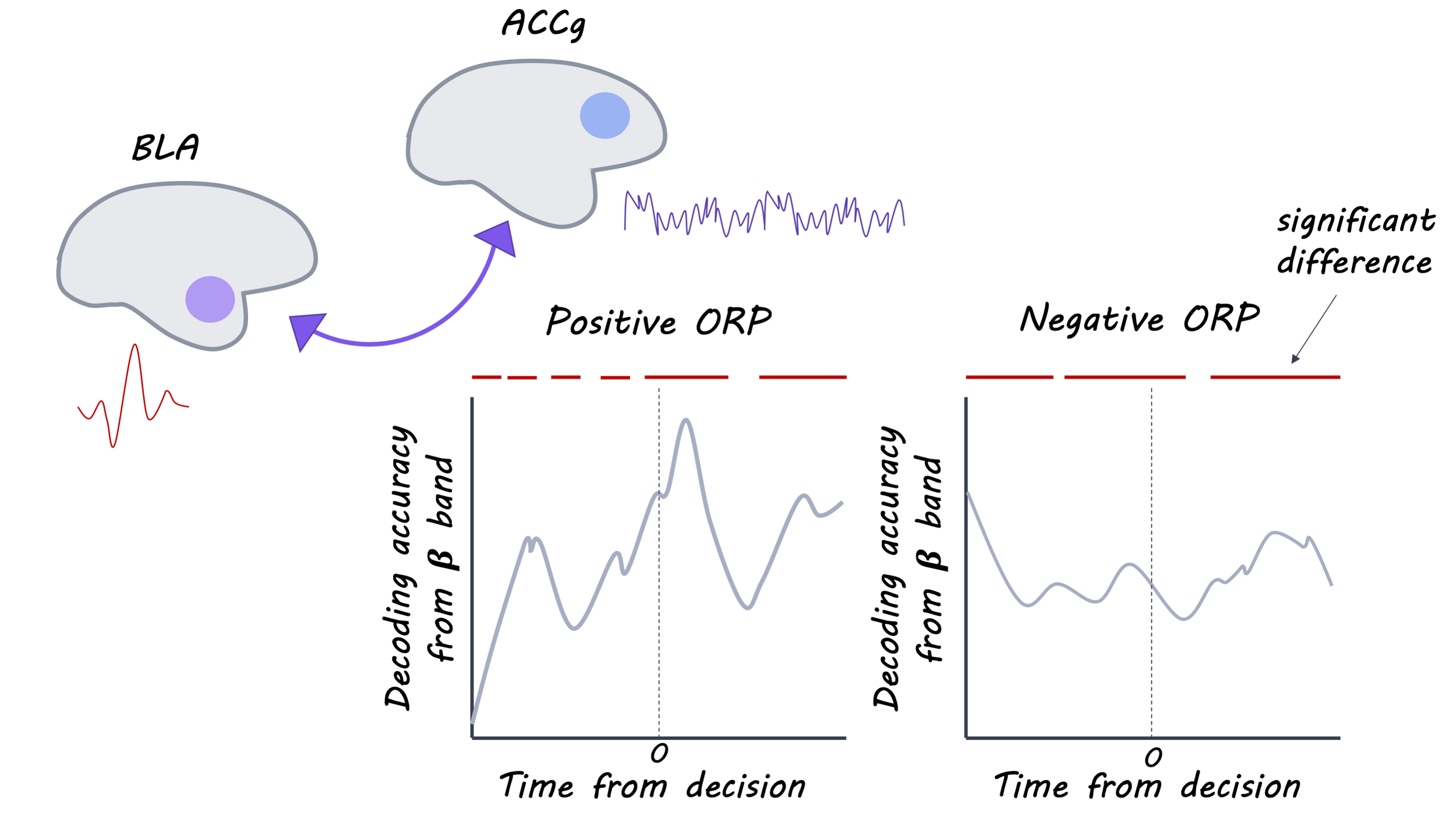
Two male “actor” monkeys and two female “recipient” monkeys participated in a social-interaction task while the authors recorded neural activity from the BLA and ACCg. The monkeys completed the task in pairs, with one actor and one recipient participating in each interaction. The task was to decide how to allocate a juice reward. On half of the trials, the actors could keep it for themselves or they could receive the reward as well as deliver it to the recipient (Self/Both condition). On the other half of the trials, the actor had to choose between delivering it to the recipient or to an empty bottle (Other/Bottle condition). Therefore, the actor always received juice in the Self/Both condition but never received juice in the Other/Bottle condition. In a control condition, the actors were delivered juice by a computer, and did not need to make a decision.. The authors computed a preference index for the actors that indicated how often they chose the recipient over the bottle (positive ORP) and themselves over the recipient (negative ORP). To examine neuronal communication, the authors computed spike-field coherence between the BLA and the ACCg. Spike-field coherence represents the relationship between spiking activity (action potentials) in one region and local field potentials (rhythmic neuronal activity) in another region. They first identified neurons in the ACCg and the BLA that were sensitive to the actor’s decisions during the task and then computed spike-field coherence in the beta (15-25 Hz) and gamma (45-75 Hz) frequency bands. They also calculated partial directed coherence, which is a statistical technique used to determine the direction of communication between two brain regions (i.e. which region drives activity in the other region). Finally, they performed linear discriminant analysis to determine whether neural activity could be used to decode the actor’s decision. To do this, they trained a linear classifier (a type of statistical model used for classification) on spike-field coherence from 75% of the trials and tested the classifier’s accuracy at identifying the actor’s decisions on the remaining trials.
What did they find?
In the Other/Bottle condition, when their own interests were not involved, the actors looked at and gave the reward to the recipient more than the bottle, reflecting a positive ORP. On the other hand, a negative ORP was observed in the Self/Both condition, with the actors choosing to receive the reward themselves rather than giving it to the recipient at the same time.
Spike-field coherence following decisions was enhanced for positive ORPs and suppressed for negative ORPs. Specifically, positive ORPs were associated with greater BLAspike–ACCgfield coherence in the beta band and greater ACCgspike–BLAfield coherence in the gamma band, whereas this was suppressed for negative ORPs. Importantly, this was not observed during the control condition, which means that spike-field coherence was specific to the decision rather than the reward outcome itself. Moreover, the direction of information flow in the beta and gamma bands differed for positive and negative ORPs. For positive ORPs, BLA activity led ACCg activity, whereas ACCg activity led BLA activity for negative ORPs. Finally, the classifier successfully distinguished between the actor’s decisions based on spike-field coherence values. For positive ORPs, classifier performance was greater for beta band BLAspike–ACCgfield coherence occurring around the decision point and gamma band ACCgspike–BLAfield coherence later in the post-decision period. Classifier accuracy for negative ORPs showed a similar pattern but was much lower overall and did not vary as much over the time course of the trial. Thus, spike-field coherence between the ACCg and BLA reliably distinguished between reward decisions related to the self and to others, particularly for positive ORPs.
What's the impact?
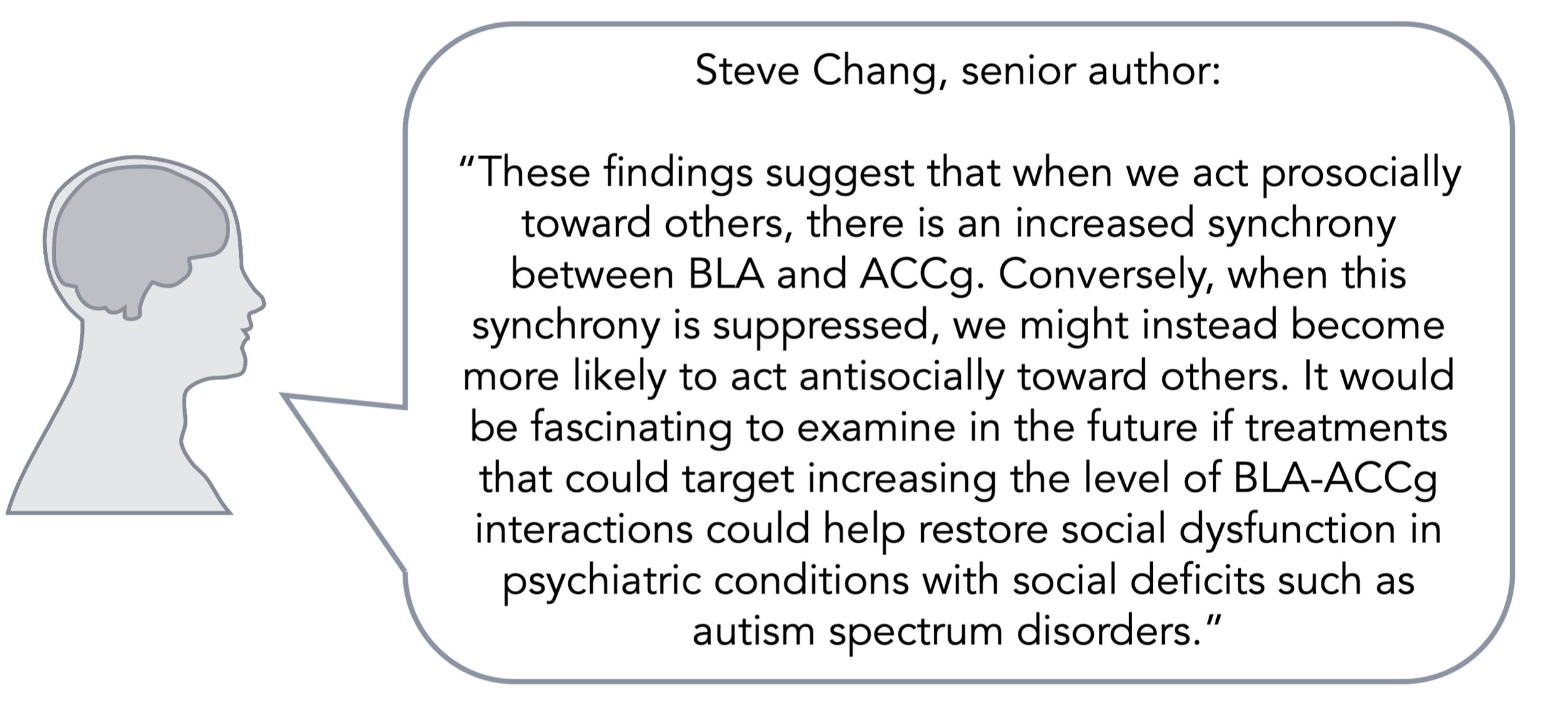
This study is the first to highlight differential patterns of inter-regional communication and transfer of information during social decision-making in primates, particularly between the BLA and the ACCg. These findings point to an important role of cortico-limbic connectivity in social decision-making processes that promote social cohesion.
Dal Monte et al. Specialized medial prefrontal-amygdala coordination in other-regarding decision preference. Nature Neuroscience. (2020). Access the original scientific publication here.