
Hypothetical Experiences Encoded by Fast, Regular Firing of Hippocampal Place Cells

Post by Amanda McFarlan

What's the science?

Whether for planning, imagination or decision-making, the ability to construct a hypothetical scenario is an important cognitive process that is fundamental to the brain. Recent studies have identified place cells in the hippocampus (a brain region known to be important for memory and spatial navigation) as a potential neural substrate for thinking about hypotheticals, as place cell firing has been observed to encode hypothetical spatial paths. However, the mechanisms underlying this activity remain unclear. This week in Cell, Kay, and colleagues investigated the role of hippocampal place cells in encoding hypothetical experiences.

How did they do it?

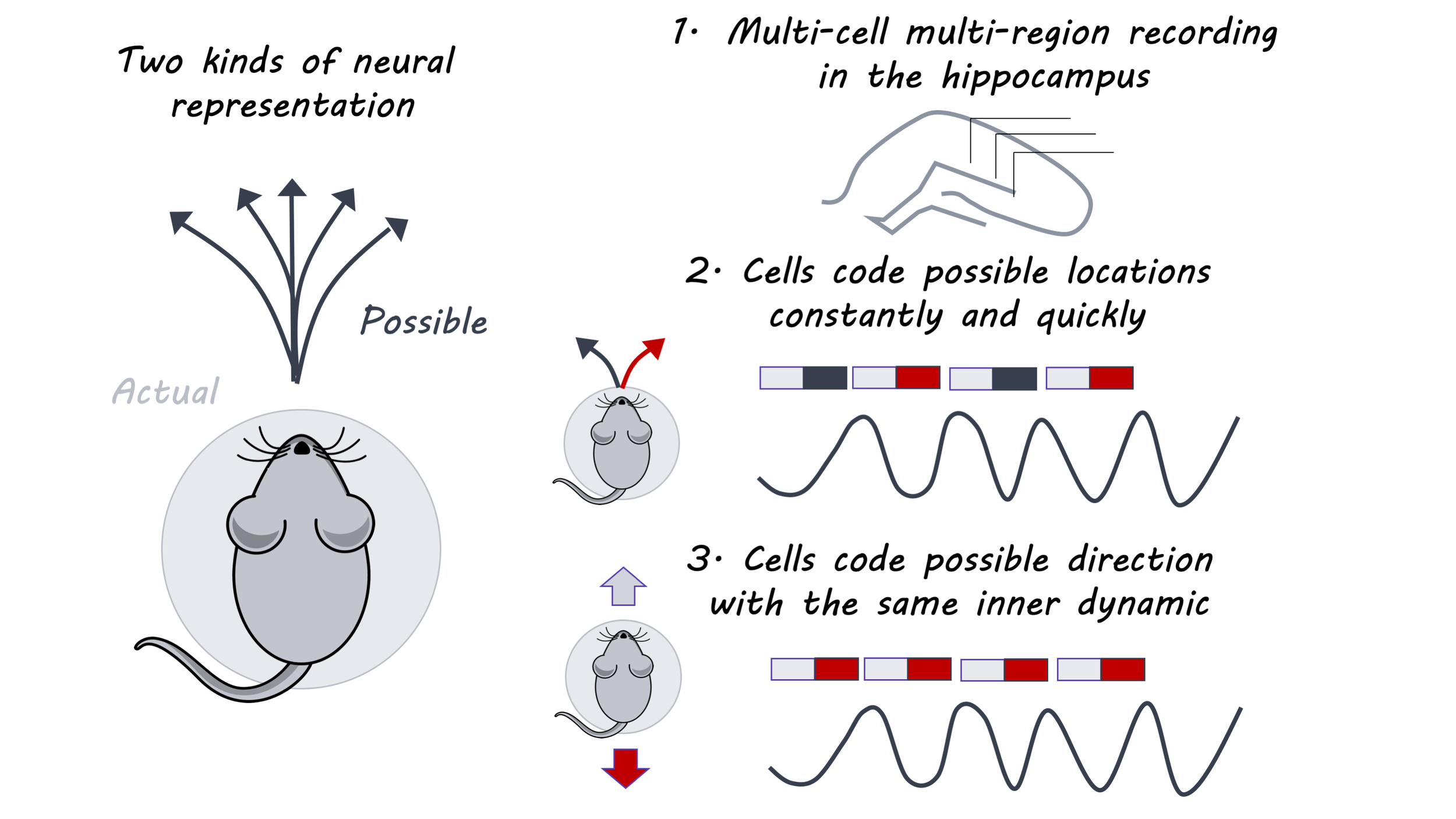
To study the activity of place cells, the authors trained rats to navigate a maze. By design, the maze was extremely simple: it had a single fork where rats had to choose between left or right. The rats were either placed in the centre arm of the maze where they had to move towards the fork (choice imminent group) or they were placed at the fork immediately (choice passed group). As rats ran in this maze, the authors recorded and analyzed the activity of place cells in the moments before the rats chose either the left or right arm of the maze. By doing so, they could determine whether place cells encoded the unchosen arm, and thus, encoded a hypothetical future scenario. The authors examined place cell activity at three levels: single cells, cell pairs, and at the population level. At the population-level, the authors used a decoding algorithm that summarizes the activity of all the cells (approximately dozens to hundreds of cells) recorded in the experiment.

What did they find?

The authors initially found that pairs of place cells encoding either the left or right arm of the maze fired in an alternating pattern at approximately 8 Hz, suggesting that future scenarios (choosing the left or right arm) could be encoded extremely quickly yet also extremely consistently. The authors further found that place cells were also more likely to fire in an alternating pattern when rats were approaching the maze fork (choice imminent group) compared to when they were moving away from the fork (choice passed group). Next, the authors showed that place cells at the population level encoded left and right arms in alternation at 8 Hz, similarly to what was observed in pairs of place cells. In the second stage of their study, they found that place cell activity encoding hypotheticals occurs systematically at specific phases of an 8 Hz neural rhythm called hippocampal theta, indicating that the hypothetical-encoding activity originates from a specific internal brain process. Overall, these findings indicate that hypothetical future scenarios can be neurally encoded both quickly and regularly (at 8 Hz) and that the underlying neural activity can be observed not only at the population level, but even down to the single-cell level.
place_cells_Feb4.png

What’s the impact?

This is the first study to show that neural firing can encode multiple hypothetical future scenarios both quickly and consistently (8 times a second). The authors also found that such neural firing could be seen at the single-cell, cell-pair, and population levels, and was influenced by both behavioral and anatomical factors. Together, these findings provide insight into the neural basis of how the brain can come up with hypothetical scenarios, an ability that is essential to complex cognition.
Frank_quote_Feb4.jpg

Kay et al. Constant Sub-second Cycling between Representations of Possible Futures in the Hippocampus. Cell (2020). Access the original scientific publication here.
Online Mindfulness-Based Cognitive Therapy in Patients with Depression

Post by Stephanie Williams

What's the science?

Many individuals with depression experience residual symptoms after receiving treatment. Some individuals may even experience a relapse after treatment. To combat relapse and to encourage full remission of symptoms, a mindfulness-based cognitive therapy program was designed to teach individuals to regulate their emotions by breaking out of harmful ruminating thought patterns. The program was designed with an online framework in order to bypass the usual barriers to in person-psychological interventions, including in-person travel times,  service costs, and long waiting list times, among others. This week in JAMA Psychiatry, Segal and colleagues assess whether the addition of an online mindfulness-based cognitive therapy program to regular treatment for depression can reduce residual symptoms, decrease relapse, and increase remission.

How did they do it?                             

To assess how well the online cognitive therapy program (“Mindful Mood Balance'') could help reduce depressive symptoms, the authors randomly assigned a large cohort (N=460) of participants with depression to one of two groups and assessed their progress over a 15 month period. The first 3 months of the study consisted of an active intervention phase, and the remaining 12 months were used as a follow-up phase. The treatment for the ‘usual depression care’ group included regular access to psychotropic medication and cognitive therapy sessions. The treatment for the mindfulness group was identical, except for the addition of the online mindfulness cognitive therapy program. To qualify for the study, participants must have experienced one depressive episode, have scored between 5 and 9 on PHQ-9, and have been older than 18. The mindfulness-based online cognitive therapy program was segmented into eight sessions. The core idea of the program was to teach participants how to break out of habitual, dysfunctional cognitive patterns (eg. depression-related rumination). To assess the effect of the program on participants’ moods, the authors administered a standard 9-item questionnaire, the PHQ-9, which is known to track depression severity. The authors assessed 3 primary outcomes of interest using the PHQ-9 results, including 1) the amount of reduction in residual symptom severity 2) the rate of remission (a score of 5 on the PHQ-9 was used as a threshold for remission) and 3) the rate of depressive relapse. The authors also administered a seven-item questionnaire related to generalized anxiety disorder, called GAD-7. They used this survey to assess the reduction in each participant’s anxiety symptoms. 

What did they find?

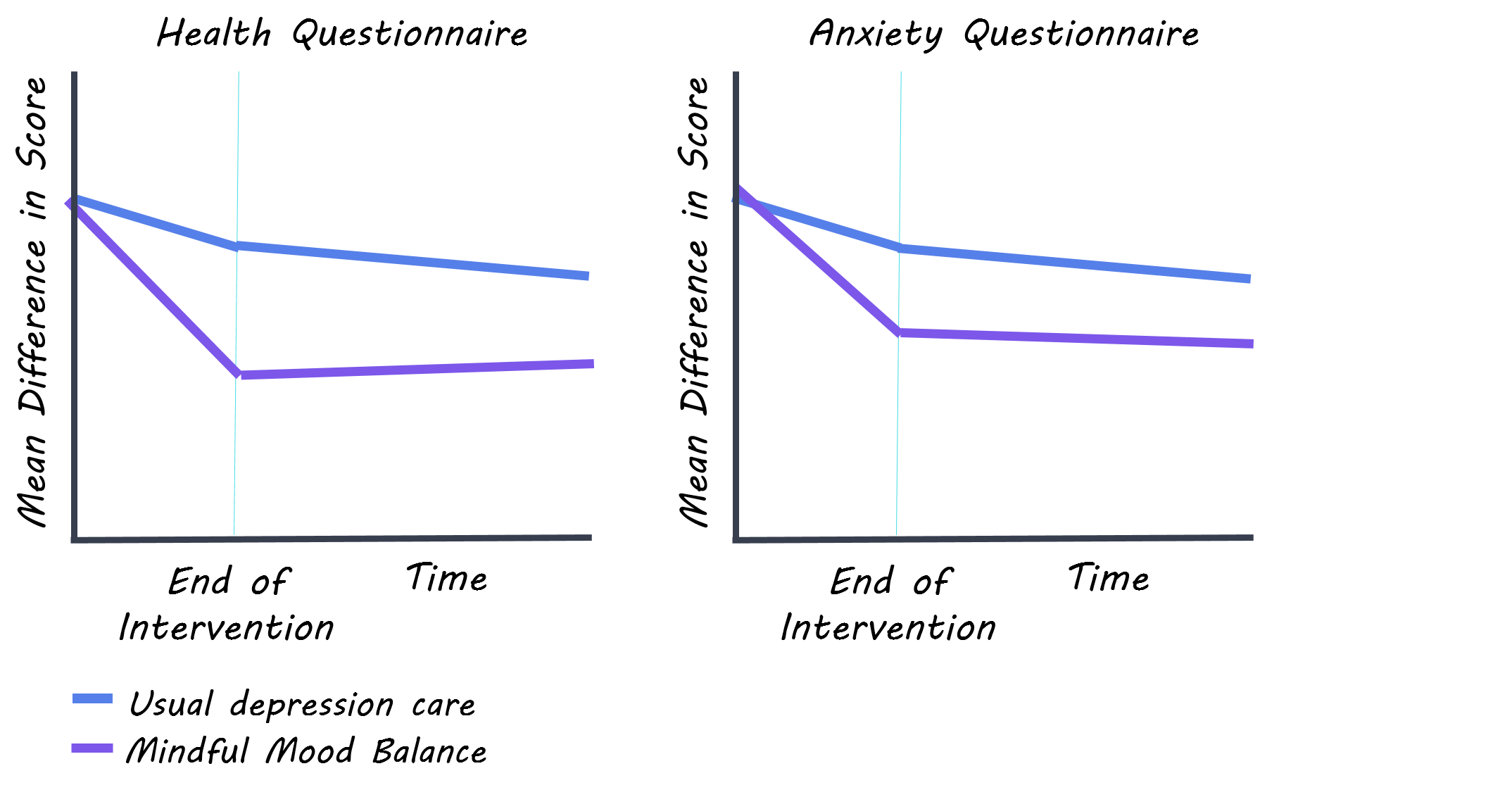
The authors found that the group that received the additional online mindfulness training showed a significantly greater reduction in symptoms across the entire study period compared to the usual depression care group. When the authors compared the reduction in residual symptoms for the two groups across the 12-month follow-up phase of the study, they found that patients who received the additional online training maintained their initial gains in symptom reduction. The authors also found residual symptoms of individuals who received usual depression care without the online program continued to decrease over the 12-month follow-up phase. When the authors assessed the rate of remission among subjects, they found that individuals in the group who received the additional online module achieved remission of their symptoms at a significantly higher rate (59.4%) compared to the group with standard treatment alone (47.0 %). The individuals in the online program treatment group continued to maintain their low rates of remission across the 12-month follow-up phase, while the standard treatment group showed increased rates of remission across the 12-month follow-up phase. When the authors assessed the relapse rate, they found a lower rate of relapse in the mindfulness program group (13.5%) compared to the group that received usual depression care (23%). Results from the generalized anxiety survey showed that the group receiving the additional online treatment showed a mean decrease in their anxiety scores.  

Stephanie_depression.png

What's the impact?

The authors show that the addition of a low-cost, accessible online program can significantly attenuate depressive symptoms better than usual depressive care alone. These results will inform the treatment of future patients with depression, and provide encouraging evidence that better symptom reduction and remission can be achieved using additional treatment strategies. 

Segal et al. Outcomes of Online Mindfulness-Based Cognitive Therapy for Patients with Residual Depressive Symptoms. Jama Psychiatry. (2020). Access the original scientific publication here.
 

A Method for Detecting Plasticity in the Brain

Post by Leigh Christopher

What's the science?

The brain is plastic, meaning that the strength between synapses (connections between neurons) is altered after learning something new or creating a memory. Long term potentiation is the biological process of the strengthening of synaptic connections. This process is mediated by the insertion of AMPA receptors containing a GluA1 subunit into the synapse, which is followed by a replacement of these receptors with GluA1 lacking AMPA receptors. Therefore, the presence of GluA1 acts as a signal of recent learning-induced plasticity in the brain. Current methods used to detect synaptic plasticity are either slow or lack resolution. This week in PNAS, Dore and colleagues present a new method called SYNPLA (synaptic proximity ligation assay) for detecting the insertion of GluA1 containing AMPA receptors, in order to identify recent synaptic plasticity. 

How did they do it?

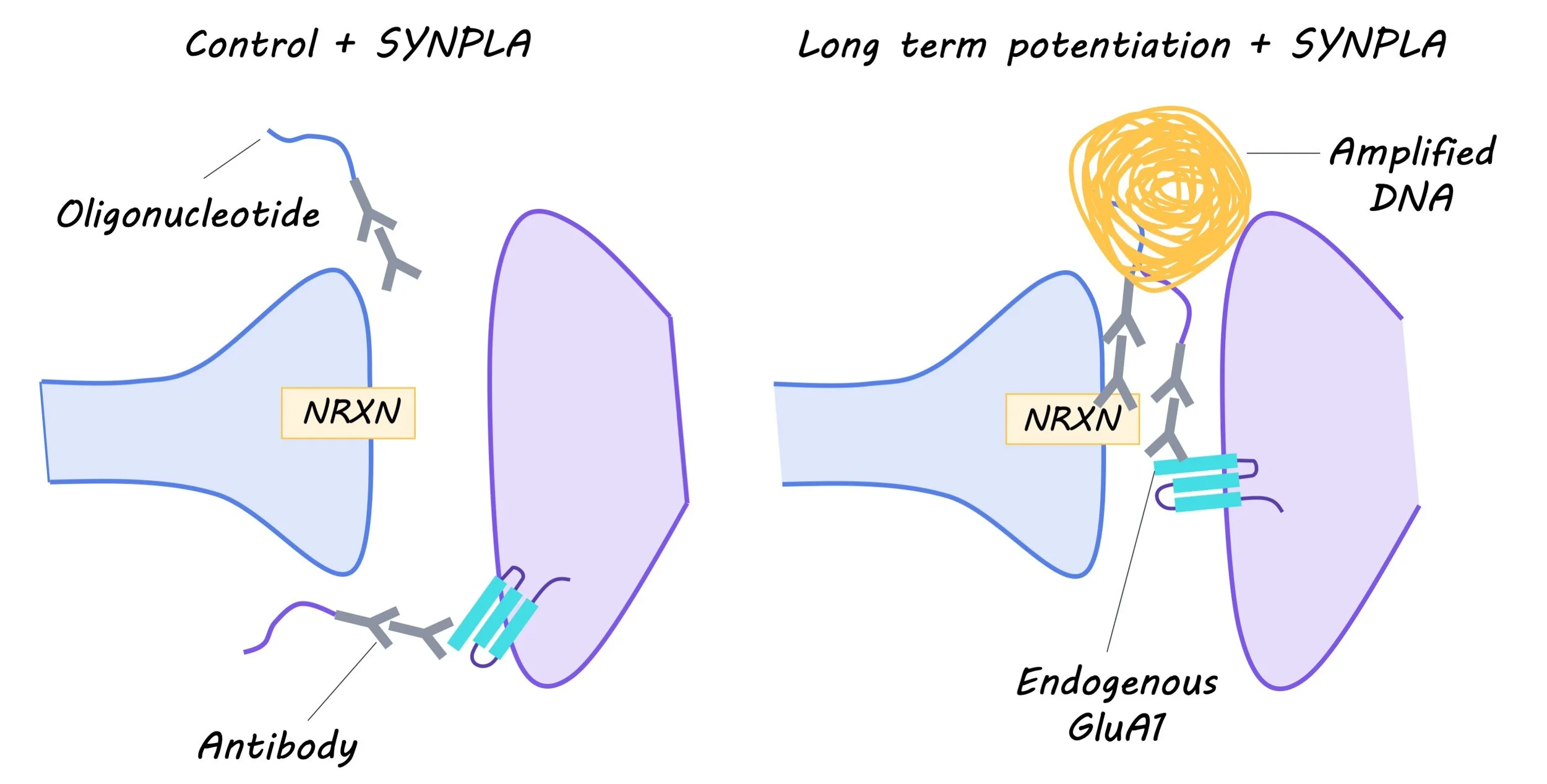
SYNPLA uses proximity ligation assay (PLA), a method that detects two proteins that are close together. This method relies on the use of antibodies to flag the proteins of interest. A second set of antibodies, each paired to oligonucleotides (short segments of DNA) are then used to detect the first set of antibodies. Lastly, a second complementary pair of oligonucleotides are added, and if they are close to one another, they will ligate and form a circle. This sequence can then by amplified (1000 times) to form a ball of DNA that is probed and observed with light microscopy as points where co-localized proteins exist (referred to here as PLA puncta). First, the authors expressed antibody detectable NRXN (a presynaptic protein), and antibody detectable NLGN (a postsynaptic protein) in neurons, and performed PLA in order to demonstrate that they were able to label synapse formation during development in cultured neurons. The authors then tested whether they could detect postsynaptic AMPA receptors containing GluA1 in cultured neurons and cultured hippocampal slices following chemically induced LTP (i.e. plasticity that is thought to occur during learning). Next, they went on to assess whether SYNPLA could detect learning-induced plasticity in rats in vivo. They injected either the auditory cortex or thalamus with a virus expressing antibody detectable NRXN (presynaptic protein) to detect the co-localization of this protein with postsynaptic AMPA containing GluA1. Rats underwent a defense conditioning paradigm where they heard an auditory tone, followed by a foot shock – this paradigm is known to induce fear learning and synaptic plasticity in the amygdala (fear center of the brain). They also performed SYNPLA on tissue sections of the amygdala as well as the lateral habenula which is known to process aversive stimuli.

SYNPLA_img_Jan28.jpg

What did they find?

SNYPLA was able to successfully detect and label synapse formation during development with a high specificity and signal-to-noise ratio. The authors were also able to detect the insertion of postsynaptic GluA1 containing AMPA receptors (a sign of potentiation) in neuron cultures and cultured hippocampal slices following chemically induced LTP, as demonstrated by a large increase in PLA puncta. Following the defense conditioning paradigm, the authors found that rats who underwent paired conditioning (paired tone and foot shock) showed increased levels of PLA puncta in the amygdala compared to control rats or rats who underwent unpaired conditioning, demonstrating that SNYPLA was able to detect synaptic plasticity in the amygdala in vivo following learning. They also observed increased PLA puncta in the lateral habenula (a region of the brain thought to be active during punishment or disappointment) for rats who underwent both the paired and unpaired conditioning paradigm compared to control rats, suggesting that plasticity occurs in this region whenever an aversive shock is administered (and not just for learning a fear response). 

What's the impact?

This is the first study to present a fast, high-resolution method for detecting learning-induced synaptic plasticity. Understanding which specific synapses have been modified by learning or memory is difficult. SYNPLA can quickly identify synaptic plasticity at specific synapses in defined pathways in the brain and can be used at the whole-brain level as a screening tool to detect recent learning and memory.

Malinow_quote_Jan28.jpg

Dore et al. SYNPLA, a method to identify synapses displaying plasticity after learning. PNAS (2020). Access the original scientific publication here.