
Dissecting Dynamic Inter-Network Relationships During Attention

Post by D. Chloe Chung

What's the science?

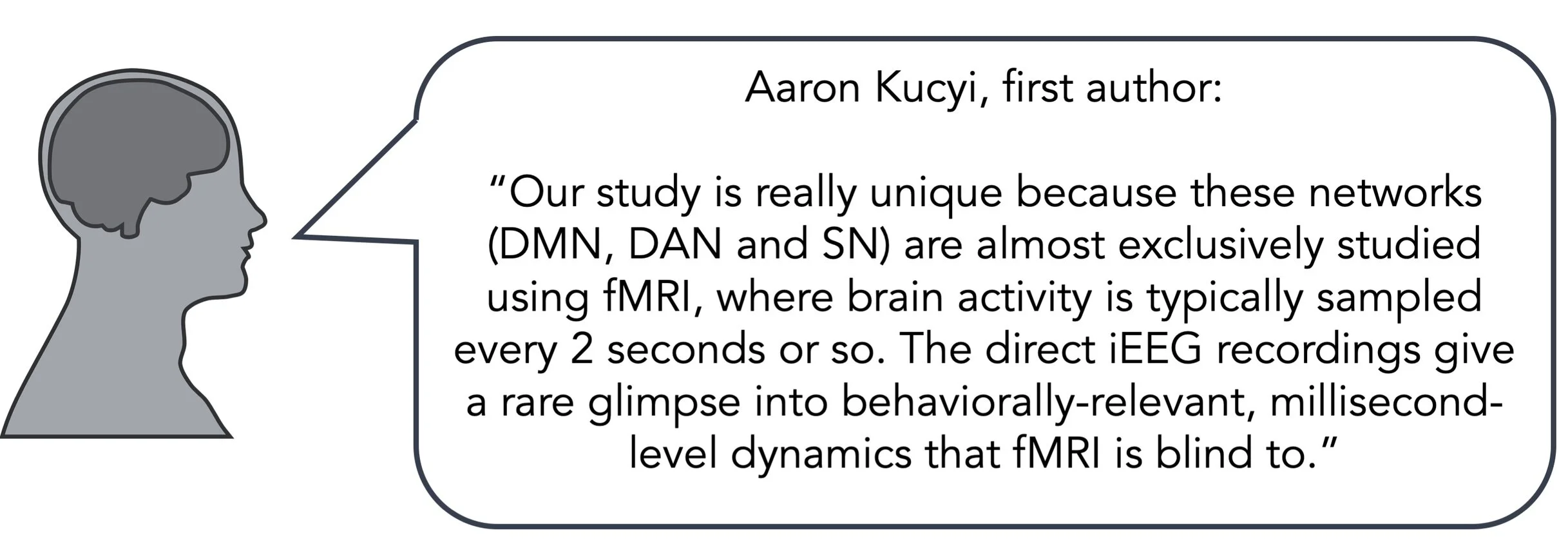
When we switch our minds from being restful to being attentive, different neural networks in our brain act in different ways. The dorsal attention network (DAN) and the salience network (SN) are known to be activated during attention-requiring tasks, while another network called the default mode network (DMN) behaves in the opposite direction - its activity is suppressed. Although previous studies using functional magnetic resonance imaging (fMRI) have reported this negative correlation between DMN and DAN/SN network activity, there is a lack of our knowledge on how this “anti-correlation” is relevant to human behaviors. This week in Nature Communications, Kucyi and colleagues present clear evidence that each network has a distinct response profile to attention-requiring tasks and dynamic relationships among these networks are closely related to the efficient switch between attention and rest.

How did they do it?

While fMRI offers important information on the activity of brain regions based on changes in the blood oxygen level, the authors chose to use intracranial electroencephalography (iEEG) that places electrodes directly on the surface of the brains of patients undergoing surgery. This way, the authors were able to record the electrical activity of the brain regions that constitute attention networks – DAN, SN, or DMN – with much higher temporal and anatomical resolution. The authors obtained iEEG data from more than 3500 sites across 31 human participants who were performing the attention-evaluating test, which shows images that gradually and continuously change every 800 milliseconds. In this test, participants were asked to specifically respond when images of city scenes presented to them changed to different city scenes, but not to respond when they changed to mountain scenes. When the participants successfully responded to image changes, their responses were categorized as “correct”, but otherwise, the responses were considered to be “incorrect”. During the iEEG recording, the authors measured the electrical activity within the high-frequency broadband that ranges from 70 to 170 Hz, as this activity range has been shown to well-represent the negative correlation between attention networks.

What did they find?

From the iEEG recording, the authors first detected an increase in high-frequency broadband activity from the brain regions that constitute the DAN/SN and a decrease in high-frequency broadband activity from the regions constituting the DMN. All of these changes occurred several hundred milliseconds after the image change during the attention-evaluating test and returned to baseline after 1 to 2 seconds. These changes in activity confirmed that the DAN/SN are activated while the DMN is deactivated when human participants paid attention to external stimuli. When they took a closer look at the precise timing of when the activity peaked in each network, the authors found that the DAN was the first to peak in its activity, followed by the SN, and then the DMN. This observation of a unique timing profile for each network suggests that there is a clear temporal lag in electrical activity across attention networks during attention-requiring tasks. By calculating the correlation between this temporal lag in the activity of attention networks and the accuracy of attention-task performance, the authors showed that the lagged anti-correlation between DAN and DMN was especially important for performance on the attention task. In addition to these findings, the authors found that when human subjects failed to correctly perform the attention-requiring tasks, activities of the DAN/ SN were noticeably elevated while the activity of DMN was not sufficiently suppressed. This interesting finding further supports the significance of anti-correlation among attention networks in accurate attentional performance.

Kucyi.png

What’s the impact?

This study is the first to show the significance of delays in the timing of activity among the DAN, SN and DMN networks in attention. Powered by a large group of human participants who had electrodes directly implanted within the brain areas that represent these different attention networks, this study provides findings that will be valuable in critically interpreting neuroimaging studies that investigate the brain states between rest and active tasks. What we learned from this study will also serve as a foundation for subsequent research on how these dynamic inter-network relationships can change as we age or develop neurological disorders.
Kucyi_quote_Jan28.jpg

Kucyi et al. Electrophysiological dynamics of antagonistic brain networks reflect attentional fluctuations. Nature Communications (2020). Access the original scientific publication here.
Gene-Environment Interactions, Major Depressive Disorder and Traumatic Experiences

Post by Lincoln Tracy 

What's the science?

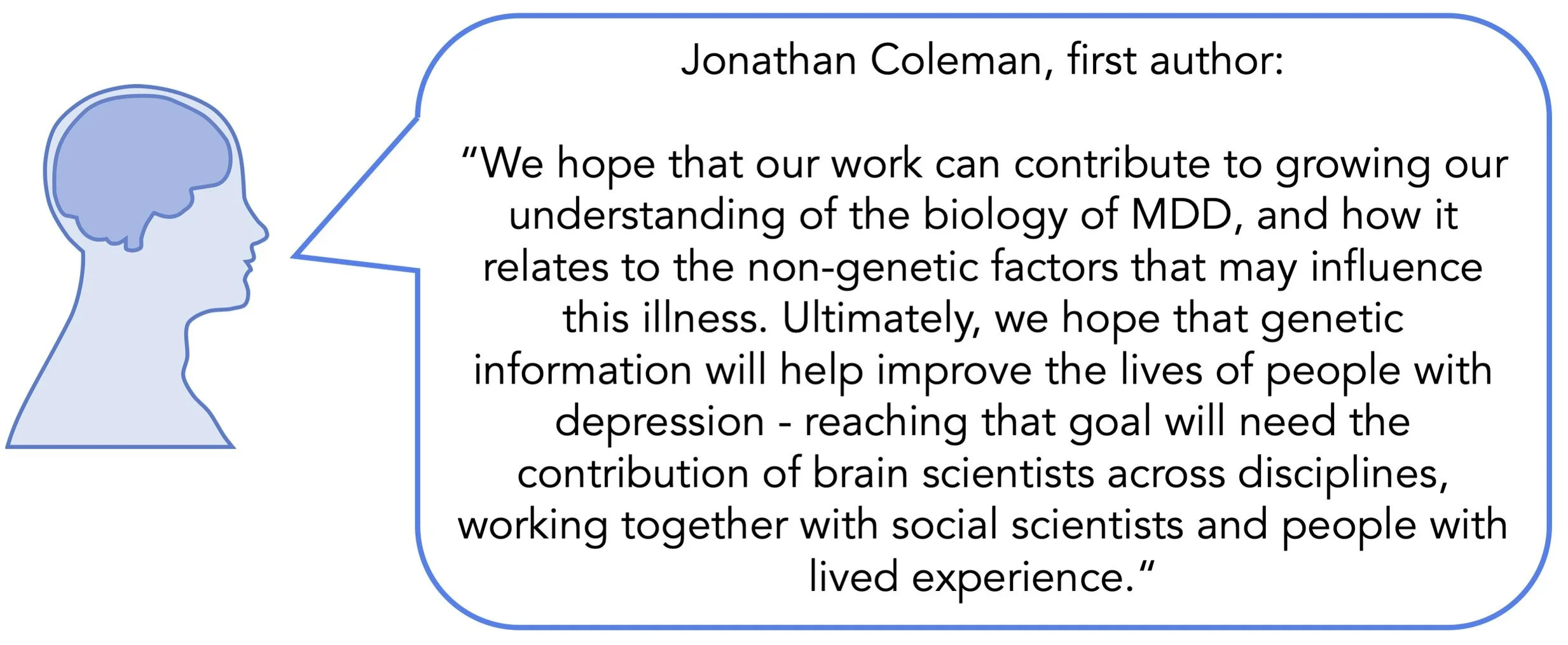
Depression is one of the most common mental illnesses in the world and Major Depressive Disorder, or MDD, is the most common clinically recognized form of depression. Previous research has identified that environmental factors influence the risk of developing MDD. For example, MDD is more commonly seen in people who report being exposed to stressful life events and trauma when they were younger. Twin studies have shown that there is also a heritable genetic component to MDD. Data from genome-wide association studies (GWAS) – a way of examining hundreds of thousands of genetic markers across a set of DNA – can be used to estimate how common genetic variants contribute to this genetic predisposition. Few studies have focused on the genetic components of trauma and how this might affect depression. Further, there is evidence to suggest that reported trauma is heritable. This week in Molecular Psychiatry, Coleman and colleagues sought to assess the relationship between genetic variance, the risk for MDD, and reported exposure to trauma in a single large cohort. To do so, the authors used data from the UK Biobank, an international health resource that follows the health and well-being of more than half a million volunteer participants.  

How did they do it?

The UK Biobank has assessed approximately half a million British individuals aged between 40 and 70 for a range of health-related phenotypes and biological measures, including GWAS data. A subset of these individuals has completed additional questionnaires assessing common mental health disorders – including MDD – and exposure to traumatic events. After excluding individuals who also self-reported other psychiatric conditions such as schizophrenia, the authors were left with a sample of 92,957 participants for whom they had both genetic and questionnaire data. Individuals were grouped based on their questionnaire responses; first on whether they reported having MDD or not, then on whether they reported previously experiencing a traumatic event or not. This allowed the authors to perform three sets of analyses comparing individuals with MDD to controls; comparing all individuals regardless of previous trauma exposure, comparing only individuals who reported previous trauma exposure, and comparing individuals with no history of trauma exposure. Individuals were first compared across demographic variables and common factors associated with MDD such as sex, age, and socioeconomic status. The GWAS data were used to identify individual genetic variants associated with MDD. The authors then combined the GWAS results to assess what proportion of the variability was associated with single nucleotide polymorphism (SNP) heritability. Finally, the authors calculated genetic correlations to determine the shared genetic influences between individuals with MDD and other groups. 

What did they find?

First, the authors found that 36% of individuals had been exposed to an MDD-related trauma. A greater proportion of individuals with MDD (45%) had been exposed to an MDD-related trauma compared to individuals without MDD (17%). Individuals with MDD were more commonly female, younger, came from a lower socioeconomic background, and had a higher BMI than individuals without MDD. These differences between individuals with and without MDD were also observed when the authors analyzed data only for individuals with a history of exposure to trauma, as well as when they analyzed the data for individuals without an exposure to trauma. Second, they found that the SNP-based heritability of MDD was greater in individuals who reported a history of traumatic exposure compared to without such a history. The heritability of MDD was 24% in individuals with a history of traumatic exposure, and only 12% in those without such a history. The authors also performed simulations with the genetic data to demonstrate that heritability was not confounded by the genetic correlations between MDD and previous traumatic exposure. This suggests that the combined effect of the genetic variations associated with MDD are greater in people reporting traumatic exposure. Finally, they found that waist circumference was significantly associated with MDD – but only in individuals who reported exposure to trauma, not individuals without a history of trauma. No significant associations with other factors (e.g., body mass index or years of education completed) were observed.

What's the impact?

This study used the largest single cohort to date to investigate the relationship between MDD and self-reported exposure to trauma. It displays that, within the UK Biobank, the genetic associations with MDD vary depending on the context. Specifically, it shows that the genetic heritability of MDD is larger in individuals with a history of traumatic exposure. This, together with the other findings, imply that the contribution of genetic variants to the observed variance in MDD is greater when additional risk factors are present. Further studies are required to examine whether similar associations are observed in non-European populations

Coleman_quote_Jan28.jpg

Coleman et al. Genome-wide gene-environment analyses of major depressive disorder and reported lifetime traumatic experiences in UK Biobank. Molecular Psychiatry (2020). Access the original scientific publication here.
Activity in Insular Cortex Reflects Current and Future Physiological States

Post by Stephanie Williams 

What's the science?

Information related to hunger and thirst is thought to be reflected in the ongoing activity of a region called the insular cortex. Interoception — the perception of internal bodily signals such as hunger or thirst — is critical for regulating physiological states, emotion and cognition. Models of interoceptive processing suggest that the insular cortex integrates external sensory information with internal bodily sensations (related to physiological changes like heart rate, thirst or hunger) and generates ‘interoceptive predictions’, however, the neural circuitry underlying this process remains unclear. This week in Neuron, Livneh, Lowell, Andermann and colleagues show that activity patterns in insular cortex represent current and future physiological need states. 

How did they do it?                             

The authors used two-photon calcium imaging, circuit mapping and manipulations in mice to investigate representations of physiological need and predictions in insular cortex. For the behavioral task, the authors trained water-restricted mice to perform a visual discrimination task for water rewards. While the mice performed this task, the authors imaged neurons in layer 2/3 of insular cortex using a method involving a reflective microprism that acts as a kind of periscope. To ensure that their results were not affected by arousal, the authors monitored the pupil diameter of the mice, along with a myriad of other factors (eg. motion), which they accounted for in their analysis. The authors compared activity recorded during the behavioral task (tens of minutes) with activity imaged during rapid thirst quenching (2-5 min of continuous consumption). The authors also performed two-photon imaging of axons (N=257) that extended from the basolateral amygdala into insular cortex to better understand the pathway of cue-related information into insular cortex.

To further investigate ongoing insular cortex activity, the authors analyzed the interval between trials to see if the pattern of activity tracked the hydration state of the animal. The authors then trained a Naïve Bayes classifier — a model trained to predict whether an animal was in a thirsty or a quenched state from the activity patterns in insular cortex. They performed the same classification procedure on temporaly shuffled data and also on identity-shuffled data. They also trained the classifier on data collected in primary visual cortex and postrhinal cortex for comparison. Next, the authors mapped the circuits connecting specific types of hypothalamic neurons (eg. “hunger” or “thirst” neurons) to insular cortex neurons. They used retrograde tracers to trace neurons and then recorded light-evoked current in the labeled neurons to understand the connections between the hypothalamus, thalamus, amygdala, and insular cortex. Then, they manipulated the hypothalamic neurons to induce artificial thirst or to suppress thirst and recorded the corresponding changes in insular cortex activity. Finally, they then performed a loss of function experiment, and inhibited glutamatergic neurons in order to suppress thirst. To confirm their results in a separate dataset, the authors analyzed similar data collected under hunger versus sated state conditions, this time stimulating other hypothalamic neurons to induce artificial hunger. The authors artificial manipulation techniques allowed them to analyze both 1) cue-evoked activity related to water seeking and  2) the ongoing activity patterns related to the animal’s physiological state to artificial induction or suppression of thirst. 

What did they find?

The authors found that individual insular neurons responded to 1) the visual water cue 2) the onset of licking or 3) water delivery during the behavioral task. Combined with their previous work, this result suggests that insular cortex neurons respond to learned water cues. The majority of neurons that the authors recorded from responded to the visual water cue (80%) and/or actual water consumption. They found that most cue-responsive neurons, which responded to the water cue in the thirsty state, were significantly attenuated in the quenched state. They observed this trend in data collected during both rapid thirst quenching, as well as during the behavioral task. When the authors imaged axons projecting from basolateral amygdala to insular cortex, they found that single axons responded to water cues, the onset of licking, and/or water delivery. Most of the axons they recorded from responded to the water cue or water reward, while others responded to visual cues.  When the authors compared thirst and quenched states, they found distinct patterns of activity in the insular cortical activity. They also showed that these patterns were consistent across days, and that they could train a classifier to predict whether an animal was in a quenched or thirsty state. The pattern of activity across the population specifically was essential to differentiating between the states, as classification accuracy was poor when single neurons or the average population time-course was used. These results suggest that ongoing activity patterns in insular cortex represent distinct physiological states that reflect hunger or thirst. 

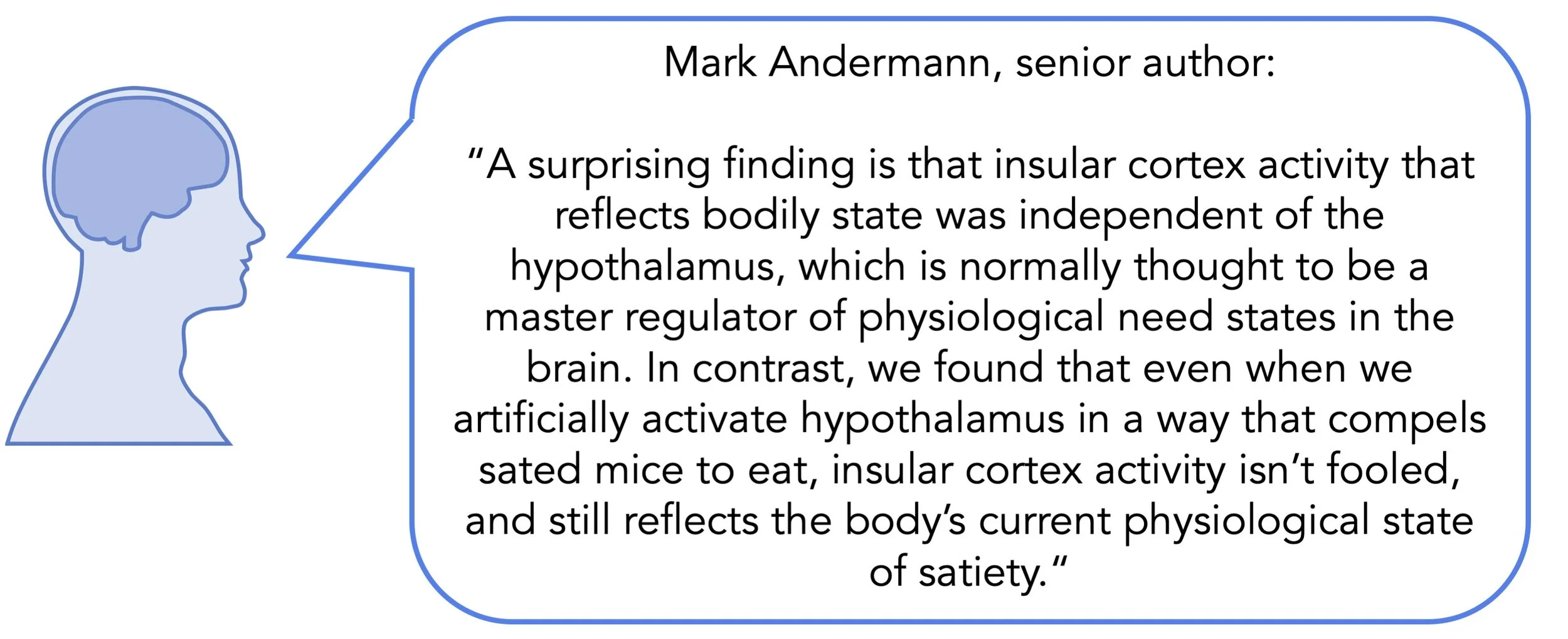
The authors also demonstrated that task events, arousal and motion could only be predicted in a small set of insular cortex neurons, suggesting that the activity of the majority of insular cortex neurons do not reflect these factors. To confirm their findings in an independent sample, the authors also classified hungry versus sated (as opposed to thirsty versus quenched) states in mice with good classification accuracy. However, they could not predict hungry versus sated states when they trained the classifier on thirsty versus quenched states from another day. They suggest that ongoing activity in insular cortex may be different for hunger vs. thirst states. The authors found that artificial activation of thirst neurons during a quenched state restored insular cortex responses to water-related cues. Similarly, artificial inhibition of hypothalamic thirst neurons reduced insular cortex response to water cues. Importantly, however, when the authors analyzed ongoing activity during artificial thirst stimulation following behavioral quenching and rehydration, they found that insular activity did not resemble the thirst-like pattern. Critically, water cues and consumption of a drop of water in the dehydrated state transiently shifted the pattern of activity towards the pattern of ongoing activity observed in the quenched state, suggesting cues led to prediction of a future quenched state

Stephanie_picture1.png

What's the impact?

The authors show that 1) ongoing activity patterns can discriminate between physiological states, and that 2) cues predicting availability of water/food may actually drive a prediction of a future satiety state in insular cortex. These findings deepen our understanding of interoceptive prediction, and will allow future studies to better understand interoceptive prediction errors.

hunger_thirst_quote_Jan21.jpg

Livneh et al. Estimation of Current and Future Physiological States in Insular Cortex. Neuron. (2020). Access the original scientific publication here.

In addition to Andermann and Livneh, authors included Arthur U. Sugden, Joseph C. Madera, Rachel A Essner, Vanessa I Flores, Jon M. Resch and Bradford B. Lowell, all of BIDMC; and Lauren A. Sugden of Duquesne University.

This work was supported by The Charles A. King Trust Postdoctoral Fellowship; Boston Nutrition Obesity Research Center P&F 2P30DK046200-26; grants from the National Institutes of Health (K99 HL144923; T32 5T32DK007516; DP2 DK105570; R01 DK109930; DP1 AT010971; R01 DK075632; R01 DK096010; R01 DK089044; R01 DK111401; P03 DK046200; and P03 DK057521); grants from the National Science Foundation (DGE1745303); Klarman Family Foundation; McKnight Foundations; Smith Family Foundation; and Pew Scholars Program.