
A Method for Detecting Plasticity in the Brain

Post by Leigh Christopher

What's the science?

The brain is plastic, meaning that the strength between synapses (connections between neurons) is altered after learning something new or creating a memory. Long term potentiation is the biological process of the strengthening of synaptic connections. This process is mediated by the insertion of AMPA receptors containing a GluA1 subunit into the synapse, which is followed by a replacement of these receptors with GluA1 lacking AMPA receptors. Therefore, the presence of GluA1 acts as a signal of recent learning-induced plasticity in the brain. Current methods used to detect synaptic plasticity are either slow or lack resolution. This week in PNAS, Dore and colleagues present a new method called SYNPLA (synaptic proximity ligation assay) for detecting the insertion of GluA1 containing AMPA receptors, in order to identify recent synaptic plasticity. 

How did they do it?

SYNPLA uses proximity ligation assay (PLA), a method that detects two proteins that are close together. This method relies on the use of antibodies to flag the proteins of interest. A second set of antibodies, each paired to oligonucleotides (short segments of DNA) are then used to detect the first set of antibodies. Lastly, a second complementary pair of oligonucleotides are added, and if they are close to one another, they will ligate and form a circle. This sequence can then by amplified (1000 times) to form a ball of DNA that is probed and observed with light microscopy as points where co-localized proteins exist (referred to here as PLA puncta). First, the authors expressed antibody detectable NRXN (a presynaptic protein), and antibody detectable NLGN (a postsynaptic protein) in neurons, and performed PLA in order to demonstrate that they were able to label synapse formation during development in cultured neurons. The authors then tested whether they could detect postsynaptic AMPA receptors containing GluA1 in cultured neurons and cultured hippocampal slices following chemically induced LTP (i.e. plasticity that is thought to occur during learning). Next, they went on to assess whether SYNPLA could detect learning-induced plasticity in rats in vivo. They injected either the auditory cortex or thalamus with a virus expressing antibody detectable NRXN (presynaptic protein) to detect the co-localization of this protein with postsynaptic AMPA containing GluA1. Rats underwent a defense conditioning paradigm where they heard an auditory tone, followed by a foot shock – this paradigm is known to induce fear learning and synaptic plasticity in the amygdala (fear center of the brain). They also performed SYNPLA on tissue sections of the amygdala as well as the lateral habenula which is known to process aversive stimuli.
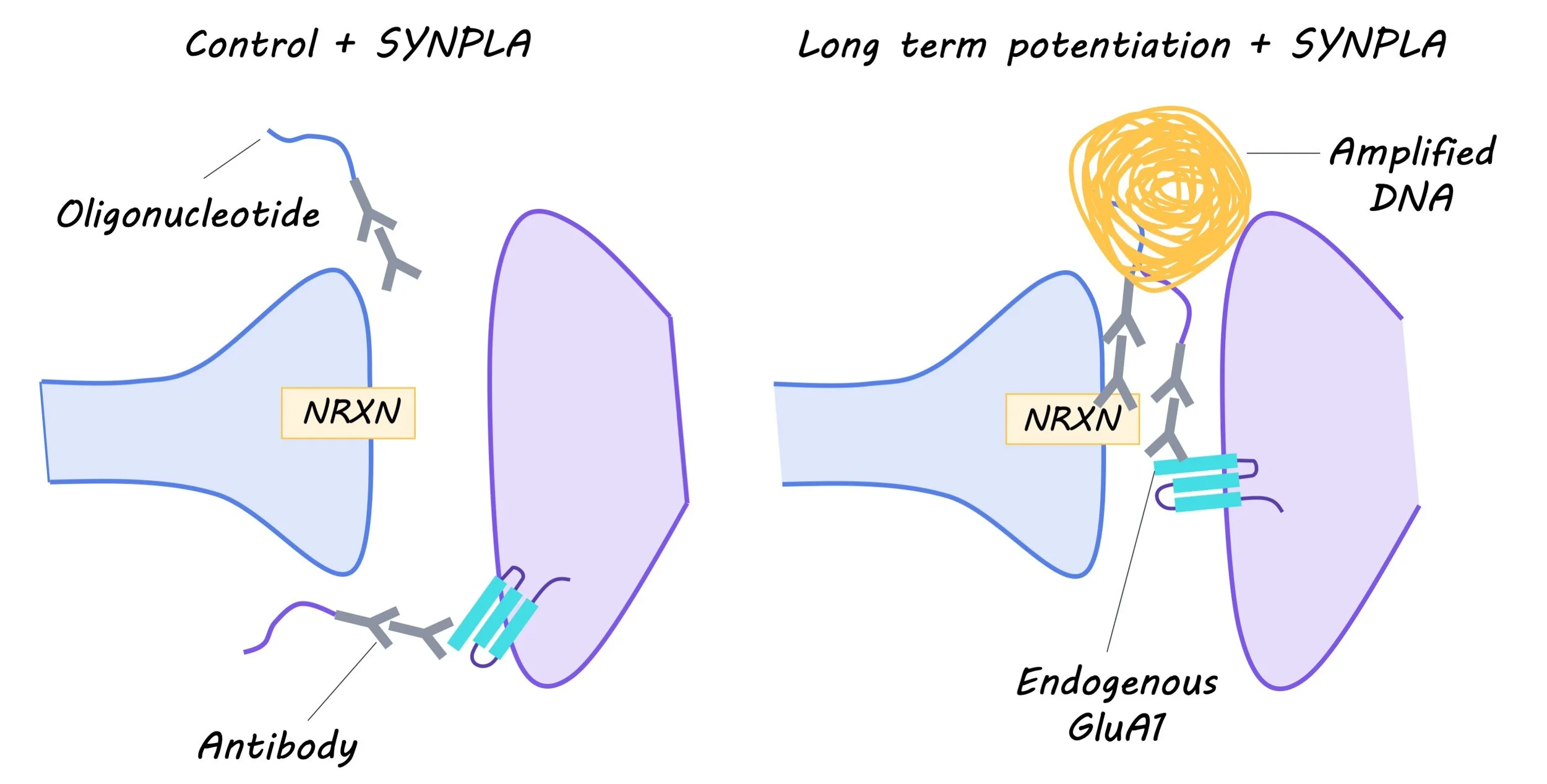
SYNPLA_img_Jan28.jpg

What did they find?

SNYPLA was able to successfully detect and label synapse formation during development with a high specificity and signal-to-noise ratio. The authors were also able to detect the insertion of postsynaptic GluA1 containing AMPA receptors (a sign of potentiation) in neuron cultures and cultured hippocampal slices following chemically induced LTP, as demonstrated by a large increase in PLA puncta. Following the defense conditioning paradigm, the authors found that rats who underwent paired conditioning (paired tone and foot shock) showed increased levels of PLA puncta in the amygdala compared to control rats or rats who underwent unpaired conditioning, demonstrating that SNYPLA was able to detect synaptic plasticity in the amygdala in vivo following learning. They also observed increased PLA puncta in the lateral habenula (a region of the brain thought to be active during punishment or disappointment) for rats who underwent both the paired and unpaired conditioning paradigm compared to control rats, suggesting that plasticity occurs in this region whenever an aversive shock is administered (and not just for learning a fear response). 

What's the impact?

This is the first study to present a fast, high-resolution method for detecting learning-induced synaptic plasticity. Understanding which specific synapses have been modified by learning or memory is difficult. SYNPLA can quickly identify synaptic plasticity at specific synapses in defined pathways in the brain and can be used at the whole-brain level as a screening tool to detect recent learning and memory.

Malinow_quote_Jan28.jpg

Dore et al. SYNPLA, a method to identify synapses displaying plasticity after learning. PNAS (2020). Access the original scientific publication here.

Dissecting Dynamic Inter-Network Relationships During Attention

Post by D. Chloe Chung

What's the science?

When we switch our minds from being restful to being attentive, different neural networks in our brain act in different ways. The dorsal attention network (DAN) and the salience network (SN) are known to be activated during attention-requiring tasks, while another network called the default mode network (DMN) behaves in the opposite direction - its activity is suppressed. Although previous studies using functional magnetic resonance imaging (fMRI) have reported this negative correlation between DMN and DAN/SN network activity, there is a lack of our knowledge on how this “anti-correlation” is relevant to human behaviors. This week in Nature Communications, Kucyi and colleagues present clear evidence that each network has a distinct response profile to attention-requiring tasks and dynamic relationships among these networks are closely related to the efficient switch between attention and rest.

How did they do it?

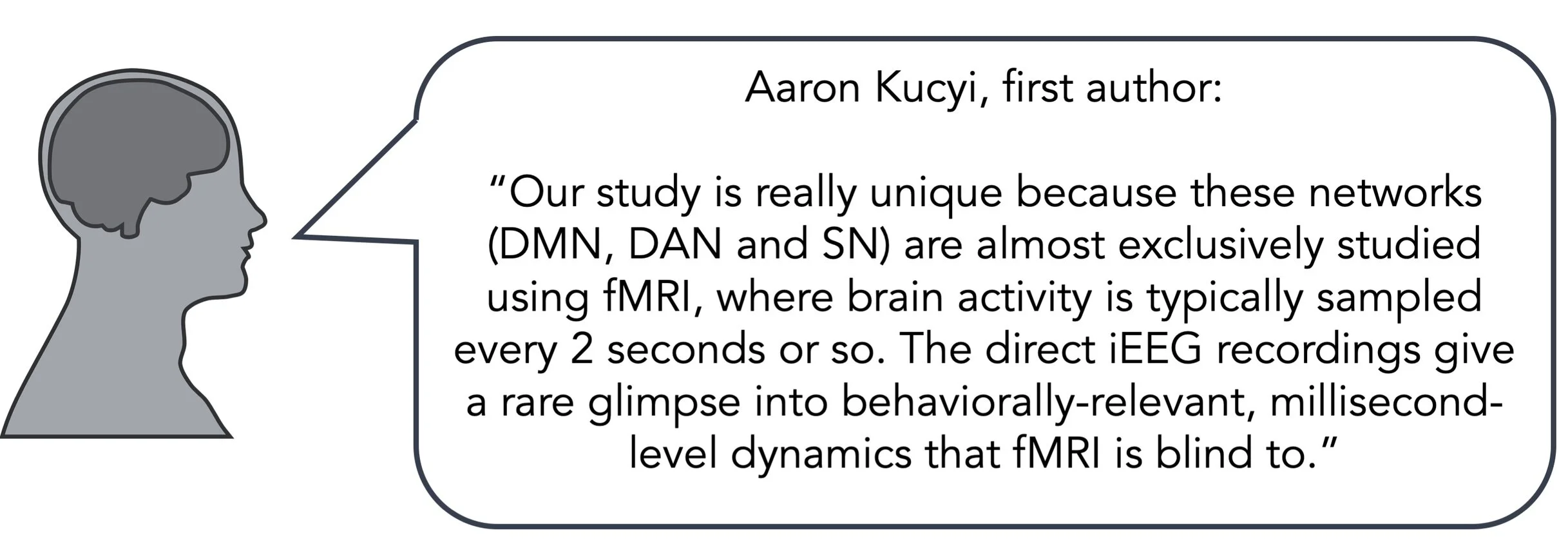
While fMRI offers important information on the activity of brain regions based on changes in the blood oxygen level, the authors chose to use intracranial electroencephalography (iEEG) that places electrodes directly on the surface of the brains of patients undergoing surgery. This way, the authors were able to record the electrical activity of the brain regions that constitute attention networks – DAN, SN, or DMN – with much higher temporal and anatomical resolution. The authors obtained iEEG data from more than 3500 sites across 31 human participants who were performing the attention-evaluating test, which shows images that gradually and continuously change every 800 milliseconds. In this test, participants were asked to specifically respond when images of city scenes presented to them changed to different city scenes, but not to respond when they changed to mountain scenes. When the participants successfully responded to image changes, their responses were categorized as “correct”, but otherwise, the responses were considered to be “incorrect”. During the iEEG recording, the authors measured the electrical activity within the high-frequency broadband that ranges from 70 to 170 Hz, as this activity range has been shown to well-represent the negative correlation between attention networks.

What did they find?

From the iEEG recording, the authors first detected an increase in high-frequency broadband activity from the brain regions that constitute the DAN/SN and a decrease in high-frequency broadband activity from the regions constituting the DMN. All of these changes occurred several hundred milliseconds after the image change during the attention-evaluating test and returned to baseline after 1 to 2 seconds. These changes in activity confirmed that the DAN/SN are activated while the DMN is deactivated when human participants paid attention to external stimuli. When they took a closer look at the precise timing of when the activity peaked in each network, the authors found that the DAN was the first to peak in its activity, followed by the SN, and then the DMN. This observation of a unique timing profile for each network suggests that there is a clear temporal lag in electrical activity across attention networks during attention-requiring tasks. By calculating the correlation between this temporal lag in the activity of attention networks and the accuracy of attention-task performance, the authors showed that the lagged anti-correlation between DAN and DMN was especially important for performance on the attention task. In addition to these findings, the authors found that when human subjects failed to correctly perform the attention-requiring tasks, activities of the DAN/ SN were noticeably elevated while the activity of DMN was not sufficiently suppressed. This interesting finding further supports the significance of anti-correlation among attention networks in accurate attentional performance.

Kucyi.png

What’s the impact?

This study is the first to show the significance of delays in the timing of activity among the DAN, SN and DMN networks in attention. Powered by a large group of human participants who had electrodes directly implanted within the brain areas that represent these different attention networks, this study provides findings that will be valuable in critically interpreting neuroimaging studies that investigate the brain states between rest and active tasks. What we learned from this study will also serve as a foundation for subsequent research on how these dynamic inter-network relationships can change as we age or develop neurological disorders.

Kucyi_quote_Jan28.jpg

Kucyi et al. Electrophysiological dynamics of antagonistic brain networks reflect attentional fluctuations. Nature Communications (2020). Access the original scientific publication here.
Gene-Environment Interactions, Major Depressive Disorder and Traumatic Experiences

Post by Lincoln Tracy 

What's the science?

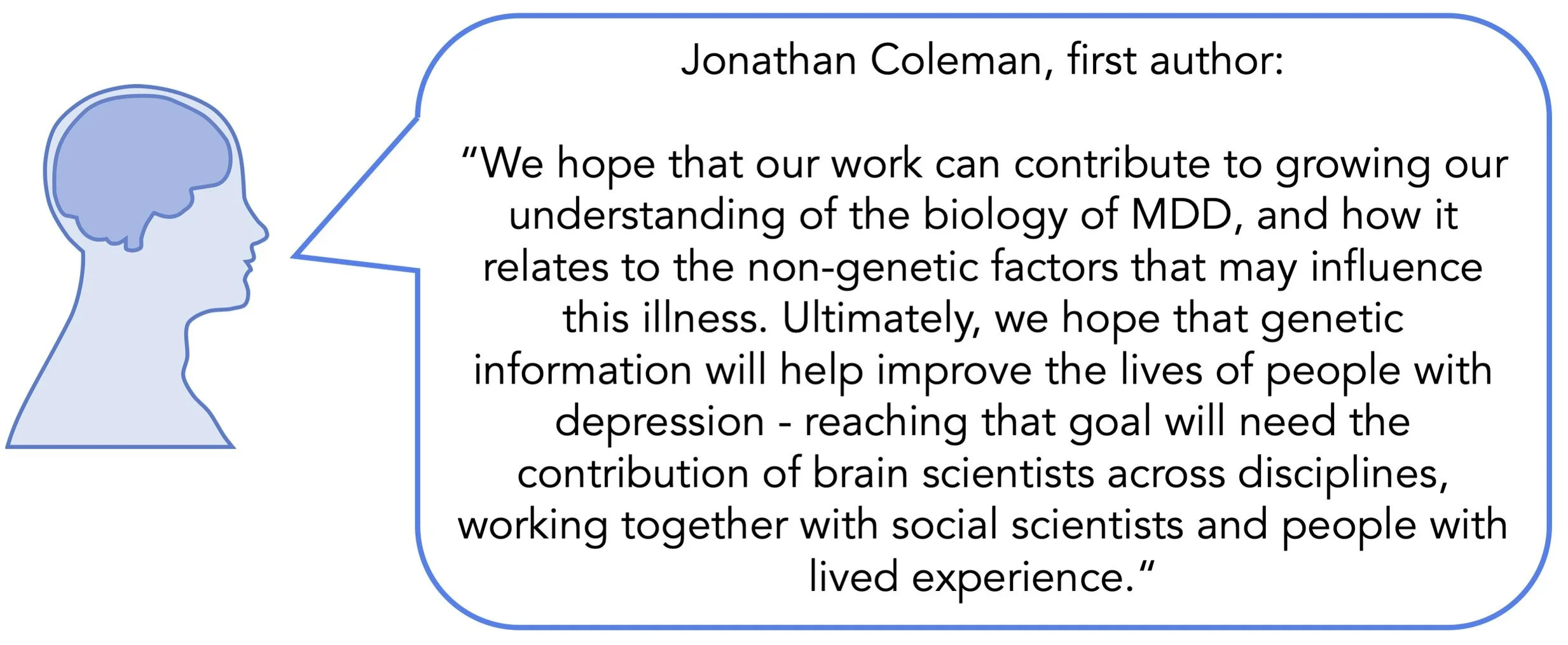
Depression is one of the most common mental illnesses in the world and Major Depressive Disorder, or MDD, is the most common clinically recognized form of depression. Previous research has identified that environmental factors influence the risk of developing MDD. For example, MDD is more commonly seen in people who report being exposed to stressful life events and trauma when they were younger. Twin studies have shown that there is also a heritable genetic component to MDD. Data from genome-wide association studies (GWAS) – a way of examining hundreds of thousands of genetic markers across a set of DNA – can be used to estimate how common genetic variants contribute to this genetic predisposition. Few studies have focused on the genetic components of trauma and how this might affect depression. Further, there is evidence to suggest that reported trauma is heritable. This week in Molecular Psychiatry, Coleman and colleagues sought to assess the relationship between genetic variance, the risk for MDD, and reported exposure to trauma in a single large cohort. To do so, the authors used data from the UK Biobank, an international health resource that follows the health and well-being of more than half a million volunteer participants.  

How did they do it?

The UK Biobank has assessed approximately half a million British individuals aged between 40 and 70 for a range of health-related phenotypes and biological measures, including GWAS data. A subset of these individuals has completed additional questionnaires assessing common mental health disorders – including MDD – and exposure to traumatic events. After excluding individuals who also self-reported other psychiatric conditions such as schizophrenia, the authors were left with a sample of 92,957 participants for whom they had both genetic and questionnaire data. Individuals were grouped based on their questionnaire responses; first on whether they reported having MDD or not, then on whether they reported previously experiencing a traumatic event or not. This allowed the authors to perform three sets of analyses comparing individuals with MDD to controls; comparing all individuals regardless of previous trauma exposure, comparing only individuals who reported previous trauma exposure, and comparing individuals with no history of trauma exposure. Individuals were first compared across demographic variables and common factors associated with MDD such as sex, age, and socioeconomic status. The GWAS data were used to identify individual genetic variants associated with MDD. The authors then combined the GWAS results to assess what proportion of the variability was associated with single nucleotide polymorphism (SNP) heritability. Finally, the authors calculated genetic correlations to determine the shared genetic influences between individuals with MDD and other groups. 

What did they find?

First, the authors found that 36% of individuals had been exposed to an MDD-related trauma. A greater proportion of individuals with MDD (45%) had been exposed to an MDD-related trauma compared to individuals without MDD (17%). Individuals with MDD were more commonly female, younger, came from a lower socioeconomic background, and had a higher BMI than individuals without MDD. These differences between individuals with and without MDD were also observed when the authors analyzed data only for individuals with a history of exposure to trauma, as well as when they analyzed the data for individuals without an exposure to trauma. Second, they found that the SNP-based heritability of MDD was greater in individuals who reported a history of traumatic exposure compared to without such a history. The heritability of MDD was 24% in individuals with a history of traumatic exposure, and only 12% in those without such a history. The authors also performed simulations with the genetic data to demonstrate that heritability was not confounded by the genetic correlations between MDD and previous traumatic exposure. This suggests that the combined effect of the genetic variations associated with MDD are greater in people reporting traumatic exposure. Finally, they found that waist circumference was significantly associated with MDD – but only in individuals who reported exposure to trauma, not individuals without a history of trauma. No significant associations with other factors (e.g., body mass index or years of education completed) were observed.

What's the impact?

This study used the largest single cohort to date to investigate the relationship between MDD and self-reported exposure to trauma. It displays that, within the UK Biobank, the genetic associations with MDD vary depending on the context. Specifically, it shows that the genetic heritability of MDD is larger in individuals with a history of traumatic exposure. This, together with the other findings, imply that the contribution of genetic variants to the observed variance in MDD is greater when additional risk factors are present. Further studies are required to examine whether similar associations are observed in non-European populations

Coleman_quote_Jan28.jpg

Coleman et al. Genome-wide gene-environment analyses of major depressive disorder and reported lifetime traumatic experiences in UK Biobank. Molecular Psychiatry (2020). Access the original scientific publication here.