Ongoing Antidepressant Medication Treatment Prevents Recurrence of Major Depression

Post by Lincoln Tracy

What's the science?

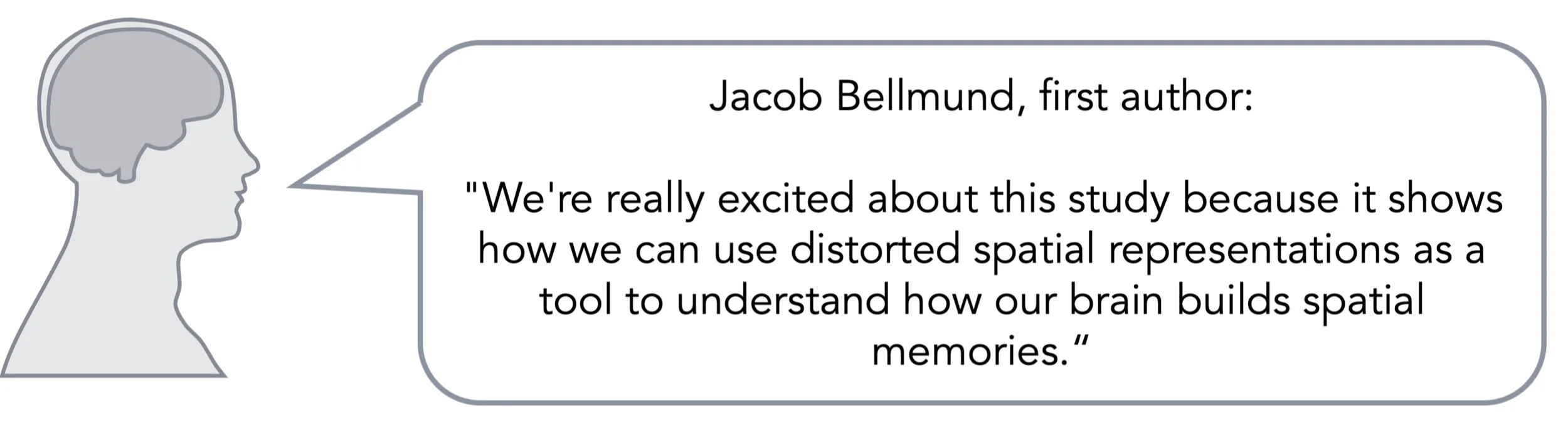
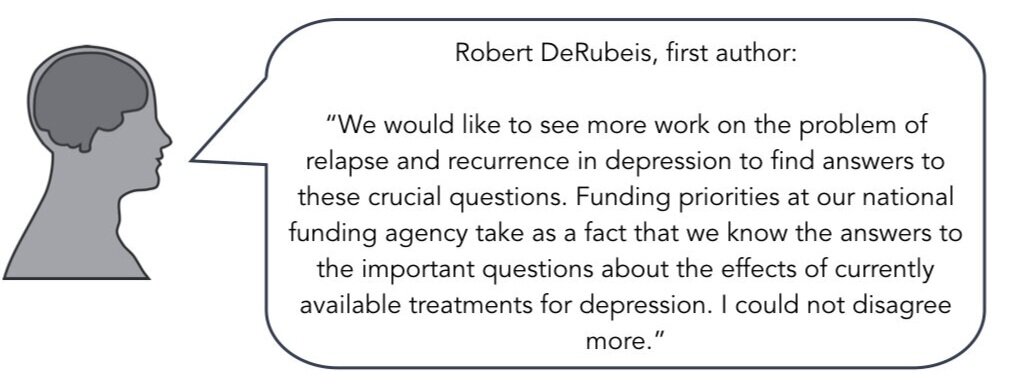
Evidence suggests that antidepressant medications and cognitive behavioral therapy (CBT) are equally effective in the acute treatment of major depressive disorder (MDD). Furthermore, the combination of these two treatment approaches has been proven to be more effective than either treatment alone in the short term. The ongoing use of antidepressant medication has also been proven to be effective in preventing future depressive episodes. However, it is not known whether CBT has the same long-term preventative effects. This week in JAMA Psychiatry, DeRubeis and colleagues investigated the effects of combining CBT and antidepressant medications when they were continued or withdrawn on preventing recurrent episodes of depression in patients with MDD. 

How did they do it?

In phase one of the study, the authors recruited 452 patients (266 women, mean age of 43.2 years) with MDD from three outpatient clinics across the United States. The patients were randomly allocated to one of two treatment groups: antidepressant medication monotherapy or a combination therapy of antidepressant medication and CBT. Patients received treatment for up to three and a half years until recovery from MDD was achieved. The patients who achieved recovery in phase one continued into phase two of the study. In phase two, the authors randomly allocated the 292 patients who recovered from MDD (171 women, mean age of 45.1 years) into one of two groups: one group continued to take antidepressant medication while the second group stopped taking antidepressant medication. Patients who received combination therapy were discontinued from CBT for phase two. This allowed the authors to look at four different groups of patients across the two study phases: (1) patients who received only medication in both phase one and two, (2) patients who received only medication in phase one and received no treatment in phase two, (3) patients who received combination therapy in phase one and medication only in phase two, and (4) patients who received combination therapy in phase one and were discontinued from both treatments for phase two. Patients underwent regular assessments for three years, or until a recurrence of depression occurred.

What did they find?

In phase one, the combined treatment of antidepressant medication and CBT was associated with higher rates of recovery from MDD compared to the medication alone. In phase two, the authors first found that ongoing antidepressant medication therapy was associated with a decreased risk of recurrent depression. A greater proportion of patients who stopped taking antidepressant medication in phase two experienced a recurrent episode of depression regardless of whether they received monotherapy or combination therapy in phase one. That is, the proportion of patients who experienced a recurrent episode of depression was similar for both phase one treatment groups. Second, they found that the likelihood of sustained recovery (i.e. achieving recovery in phase one and then not having a recurrent episode in phase two) was higher for those who remained on medications in phase two, but was not affected by one treatment condition. In other words, receiving CBT in phase one did not appear to affect the odds of sustained recovery.

lincoln (4).png

What's the impact?

The findings of this study show that continued antidepressant treatment in patients with MDD is associated with lower rates of recurrent depression and increased odds of a sustained recovery. These findings highlight the benefits of ongoing antidepressant treatment in this population. Further research is required to determine whether CBT has a similar protective effect, or whether combining antidepressant therapy with CBT interferes with any potential benefits.
DeRubeis_Dec24.001.jpg

DeRubeis et al. Prevention of Recurrence After Recovery From a Major Depressive Episode With Antidepressant Medication Alone or in Combination With Cognitive Behavioral Therapy: A Phase 2 Randomized Clinical Trial. JAMA Psychiatry (2019). Access the original scientific publication here.

Sleep Disturbance and Migraine Onset

Post by Sarah Hill 

What's the science?

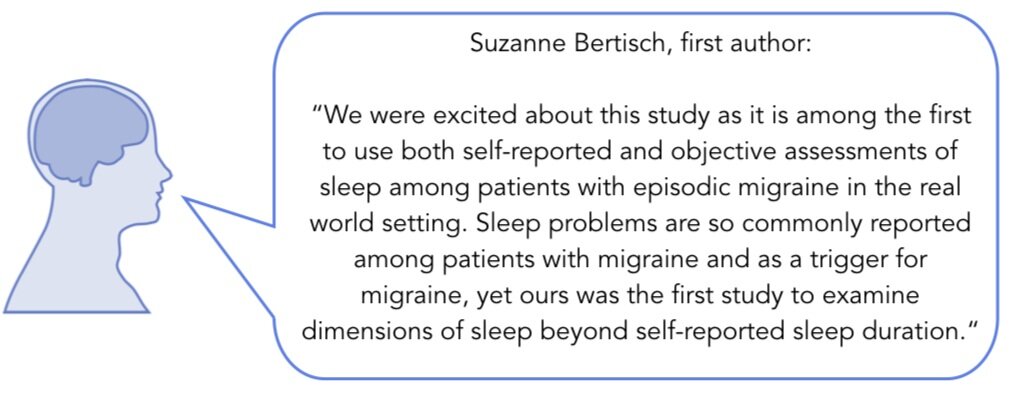
Getting a good night's sleep goes a long way towards helping a person stay healthy, and for those that suffer from migraine, maybe even more so. According to previous research, the same neurotransmitter system responsible for mediating sleep and wake states may also initiate the onset of a migraine, characterized by severe headache with adverse sensory, autonomic, and cognitive effects. Thus, sleep disturbance may directly trigger migraine in some patients. Despite this mechanistic evidence, the link between sleep disturbance and migraine has been poorly investigated in a real-world setting. This week in Neurology, Bertisch and colleagues show that disturbances in sleep efficiency and fragmentation, but not duration or quality, temporally precede a migraine.   

How did they do it?

The authors conducted a prospective cohort study to test the hypothesis that sleep disturbance is temporally associated with migraine onset. For this study, they recruited 98 adult participants with episodic migraine. Participants were asked to wear wrist actigraphs continuously for 6 weeks to monitor sleep activity, as well as record sleep measures each morning in a sleep diary. Subjects also reported the presence of migraine each morning and evening, including the time of onset, duration, symptom intensity, and medications used, as well as other factors, such as daily caffeine and alcohol use and stress levels. In addition to sleep duration, the following sleep parameters were assessed: 1) WASO - minutes awake after sleep onset 2) sleep efficiency - the proportion of total sleep duration/duration of rest period 3) sleep quality (self-reported rating). After the 6-week study period, the relationship between sleep disturbance and migraine onset was examined throughout the day immediately following each sleep period (day 0) and the subsequent day (day 1).      

What did they find?

Unexpectedly, the authors found no association between sleep duration or quality and migraine occurrence on either day. Instead, diary-assessed low sleep efficiency (defined as ≤90%) was associated with a 39% increase in the odds of migraine occurrence on day 1. Paradoxically, high sleep fragmentation (defined as actigraphy-based WASO ≥53 minutes and efficiency ≤88%) was associated with a 36% reduction in the odds of headache during the day immediately following the sleep period (day 0). Taken together, these results suggest that low sleep fragmentation precedes migraine on day 0, while low sleep efficiency precedes migraine on day 1.   

sarah (3).png

What's the impact?

The findings presented here indicate that changes in sleep efficiency and fragmentation, but not duration or quality, precede migraine onset. This is one of the few studies to investigate a link between sleep quality and migraine using a prospective cohort study design, and the largest to collect objective sleep data in adults with episodic migraine.

Bertisch_dec24.001.jpg

Bertisch et al. Nightly sleep duration, fragmentation, and quality and daily risk of migraine. Neurology (2019). Access the original scientific publication here.
Distorting Mental Maps Using Virtual Reality

Post by Anastasia Sares

What's the science?

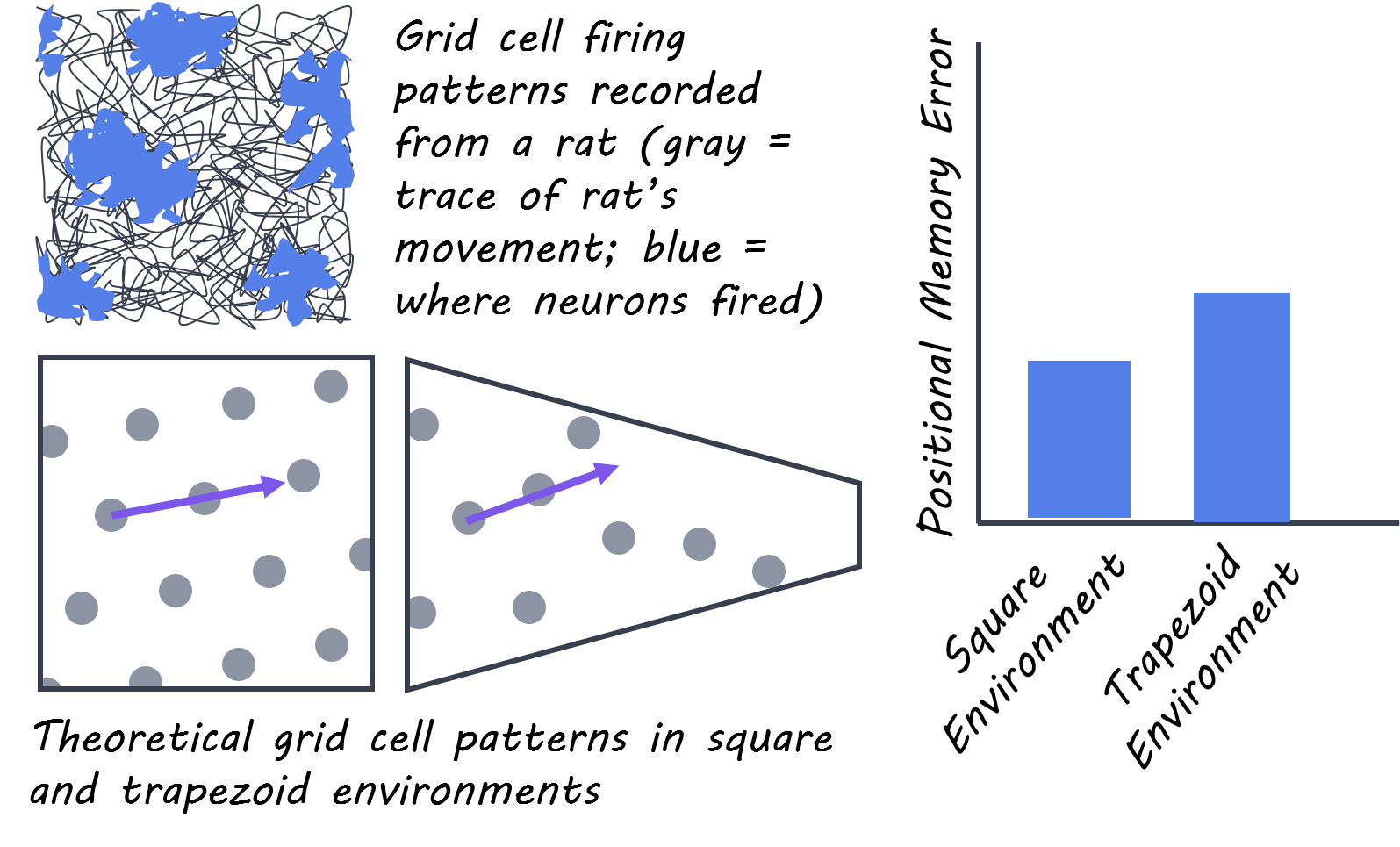
If you’ve ever played Settlers of Catan, you are familiar with a hexagonal grid. Players place settlements at the intersection of hexagon-shaped terrains, and roads along the edges of the hexagons to connect them. Did you know that this is exactly how our brain represents the spaces we navigate through? In rats, we can measure this by putting electrodes in the entorhinal cortex to record neuronal activity as the animal moves around. Neurons in this region of the brain will fire at evenly spaced positions as the rat moves through the environment, creating a sort of grid. Previous research has shown that these grid cells also exist in humans, and they function the same way when we explore real and virtual environments. Many previous experiments on grid cells have taken place in environments with circular or square boundaries, but research in rodents suggests that in environments with different geometries, such as a trapezoid, the grid pattern can be distorted. This week in Nature Human Behavior, Bellmund and colleagues wanted to see how a distorted environment, like a trapezoid, would affect people’s navigation and spatial memory.

How did they do it?

The authors measured positional memory (i.e. the memory of where things are located in space) using a virtual reality (VR) game. Participants wearing VR goggles walked around on a motion platform that translated their steps into virtual movement. The participants had to find objects and learn their positions in the environment. Later, they were asked to put the objects back where they had been before. Participants did the task in both square and trapezoid-shaped environments. Later, they were presented with pairs of objects and asked how far apart they were.

What did they find?

During the VR game, participants in the trapezoidal environment replaced objects further away from their original location—in other words, they had more spatial errors. The increase in error was especially evident for the narrow part of the trapezoid, where studies in rodents have shown the most distortion of grid cells. In the distance rating part of the experiment, participants judged distances in the two parts of the trapezoid as different when they were, in fact, identical, showing that the distortions in the spatial map persisted outside of the VR simulation. The authors were able to use the participants’ distance ratings to reconstruct the remembered spatial maps of each person and see how accurate they were (using multidimensional scaling followed by a Procrustes analysis). These reconstructed locations lined up with the spatial error scores from the VR.

grid_cells.png

What's the impact?

This study connects distorted grid cell maps observed in rodents with spatial memory in humans, showing the same mechanisms at work. It reinforces the fact that the overall shape of our environment affects us; which could be informative for architects and designers, among other applications (Imagine what spatial maps look like in the Denver Art Museum!).

Bellmund_Dec17.jpg

Bellmund et al. Deforming the metric of cognitive maps distorts memory. Nature Human Behavior (2019). Access the original scientific publication here.