
Cognitive Deficits in Temporal Lobe Epilepsy and Alzheimer-like Pathologies

Post by Amanda McFarlan

What's the science?

Temporal lobe epilepsy (TLE) is a chronic, debilitating disorder characterized by spontaneous, recurring focal seizures originating in the temporal lobe. TLE is commonly treated with antiepileptic drugs, however, approximately one-third of individuals with TLE are resistant to drug-related treatments. Importantly, recent studies in brain imaging have shown that drug-resistant individuals with TLE exhibit signs of advanced brain aging, similar to what is observed in patients with Alzheimer’s disease. This week in Brain, Gourmand and colleagues investigated the link between cognitive dysfunction, amyloid and tau pathologies, and epileptogenesis in individuals with drug-resistant TLE.

How did they do it?

The authors acquired brain tissue from three groups: individuals with TLE, individuals with Alzheimer’s disease (positive control group), and a control group. For the TLE group, they obtained brain tissue that was collected during an anterior temporal lobe resection in 19 patients with drug-resistant TLE. All the TLE patients were given a neuropsychological exam to assess their memory, language, and executive function before undergoing their surgical procedure. Additionally, the authors obtained post-mortem temporal lobe tissue collected from 22 individuals (control group) and 9 individuals (Alzheimer’s group) with no prior history of seizures. They used western blot analysis and immunohistochemistry to identify and compare the expression of proteins involved in amyloid and tau pathologies in the tissue samples from all three groups.

What did they find?

The authors found a significant increase in phosphorylated amyloid precursor protein (this protein yields amyloid beta peptide when cut by cleaving enzymes) in both the hippocampus and temporal cortex of the TLE group and Alzheimer’s group compared to controls. They also found increased expression of amyloid-Beta42 (a product of amyloidogenic processing) in the hippocampus of the TLE group and Alzheimer’s group compared to controls. Next, they showed that the temporal cortex had increased expression of BACE1 (cleaving enzyme involved in amyloidogenic processing), but no change in the expression of ADAM10 (cleaving enzyme involved in non-amyloidogenic processing) in the TLE group and Alzheimer’s group compared to controls. Together, these findings suggest that individuals with drug-resistant TLE exhibit amyloid pathologies similar to those observed in individuals with Alzheimer’s disease. Next, the authors showed that the expression of hyperphosphorylated tau was upregulated in the hippocampus and temporal cortex of the TLE and Alzheimer’s groups compared to controls, however, the increase was much higher in the Alzheimer’s group. Notably, the authors determined that the TLE group did not show any evidence of aggregated tau (i.e. neurofibrillary tangles) that are present in Alzheimer’s disease, suggesting that tau pathology in individuals with TLE is not as prominent as that observed in Alzheimer’s disease. Finally, the authors showed that hippocampal phosphorylated amyloid precursor protein and hyperphosphorylated tau were negatively correlated with executive function in individuals with drug-resistant TLE, suggesting that upregulation of these proteins may be involved in impaired cognitive function in individuals with TLE. 
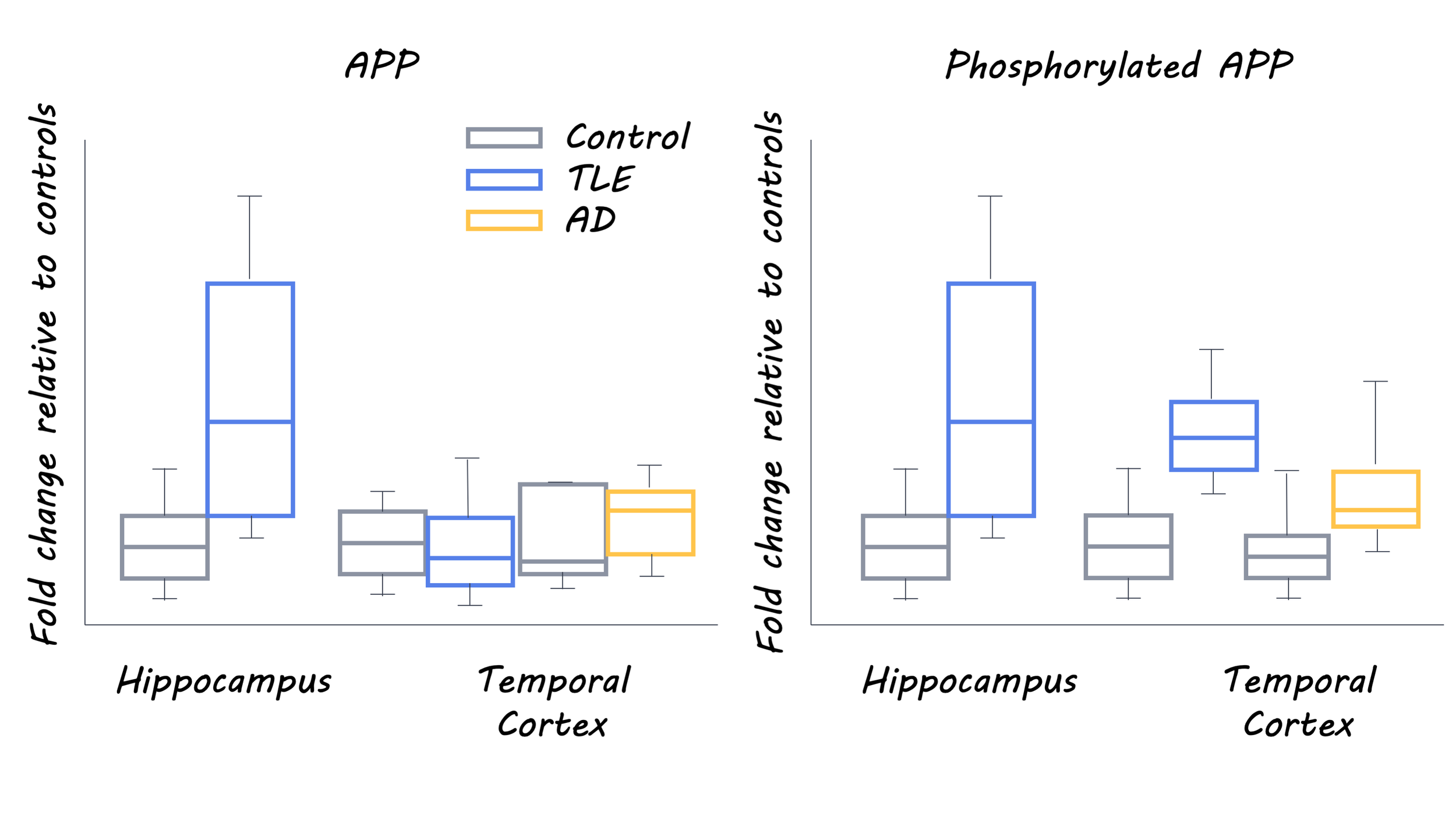
TLE_dec17.png

What’s the impact?

This is the first study to show that brain tissue from individuals with drug-resistant TLE exhibits similar amyloid and tau pathologies as observed in Alzheimer’s disease. The authors also showed that increased expression of molecular markers associated with amyloid and tau production was correlated with impairment in executive function in individuals with TLE. Together, these findings suggest that amyloid and tau pathologies may underlie the cognitive dysfunction observed in drug-resistant TLE. Therefore, targeting these pathways for therapeutic intervention may help to treat or stop cognitive decline in individuals with TLE.

Gourmand et al. Alzheimer-like amyloid and tau alterations associated with cognitive deficit in temporal lobe epilepsy. Brain (2019). Access the original scientific publication here.

Overlapping Emotion Gradients in the Human Temporo-Parietal Cortex

Post by Deborah Joye

What's the science?

Understanding our own emotions and the emotions of others is an important aspect of our social experience. While we know that our emotional experience is reflective of changes in our brain, precisely how our brains encode emotional states remains unclear. Some research has reported that individual brain regions process specific emotional features, while other research reports that multiple brain networks must converge to create our emotional experience. It is also unclear whether emotional processing involves discrete basic emotions like happiness, sadness, and fear, or whether emotions are processed on gradient scales such as positive vs. negative or intense vs. weak emotions. One interesting possibility is that emotional processing is spatially organized in the brain similar to other sensory systems, such as vision. For example, the visual cortex is retinotopically mapped so that areas that are next to each other on the retina are next to one another in the cortex. Similarly, it is possible that one region of the brain contains cells that are specifically tuned to respond to intense feelings whereas other cells in that region only respond to weak feelings. This type of gradient organization is biologically efficient because it means that several gradients can be spatially overlapping, allowing one region of the brain to process multiple features of an emotional state. This week in Nature Communications, Lettieri, Handjaras, and colleagues present evidence that one patch of the human right temporal-parietal cortex contains spatially overlapping gradients that encode features of subjective emotions including polarity (pleasant vs. unpleasant), intensity (strong vs. weak), and complexity (automatic bodily responses like fear vs. mentalized emotions such as a mixture of happiness and sadness).

How did they do it?

The authors recruited 12 native Italian participants to watch an edited version of the movie Forrest Gump while continuously indicating the intensity of their moment-to-moment perceived, subjective emotions. Participants were able to select from 6 basic emotions including happy, sad, afraid, angry, surprised, or disgusted and could also select more than one subjective emotion at a time to indicate more complex emotional states. The authors analyzed these moment-to-moment data and examined how well emotion ratings agreed between subjects. The authors also determined the complexity of emotional responses made possible by the option to respond with multiple perceived emotions. The authors performed a principal component analysis to isolate and dissect variables that explained the most variability in emotional responses.

The authors then compared their emotion time series data with data from an independent, publicly available dataset in which 15 different German-native participants viewed the same segments of Forrest Gump while undergoing fMRI. The authors then used their collected data to determine the extent to which subjective emotional responses correlated with changes in brain blood flow. The authors also took advantage of publicly available emotion-tagging of characters in Forrest Gump to investigate whether the emotions reported by participants reflected their own subjective internal state, or rather, emotions portrayed by characters in the movie.

What did they find?

First, emotional responses from participants were categorized into 15 distinct emotional states, suggesting that 6 basic emotions do not capture the range of human emotional experiences even when considering something as simple as responses to a movie narrative. Interestingly, the authors also found that participant emotion ratings were able to explain brain activity changes from independent participants who watched the same movie, even though they were from a different country and spoke a different language. The association between the emotion ratings and brain activity was localized to the right temporo-parietal junction, which is known to be important for social cognition. Specifically, the authors found that this region contained spatially overlapping emotion gradients that encode the polarity, complexity, and intensity of emotional states. These emotion gradients have specific directionality and were only found in the right (not left) temporo-parietal junction. Since the temporo-parietal junction is known to be involved in social cognition, the authors investigated whether emotional responses from the participants could be explained by emotions portrayed by movie characters; they found that the TPJ topography was better explained by subjective emotion reports than by emotions portrayed by movie characters. Finally, the authors demonstrate that populations of brain cells in the TPJ may be specifically tuned to encode specific gradient features, such as neurons that maximally respond to highly positive or negative events or neurons that selectively respond depending on the intensity of the emotional experience.

deb (8).png

What's the impact?

This is the first study to demonstrate the existence of spatially overlapping gradients within the temporo-parietal junction that can encode the polarity, complexity, and intensity of subjective emotional responses. Spatially overlapping gradients allow for a relatively small region of the brain to process many different aspects of an emotional state in parallel. Overall, this emotionotopic mapping of the cortex presents an intriguing model for how our brain may process various features of a complex emotional state and resembles how other sensory regions represent stimuli from the environment.

Cecchetti_dec10.jpg

Lettieri & Handjaras et al., Emotionotopy in the human right temporo-parietal cortex, Nature Communications (2019). Access the original scientific publication here.

The Role of Alpha Synchrony in Spatial Attention During Neurofeedback Training

Post by Shireen Parimoo

What's the science?

Neural oscillations in the alpha frequency range (8-12Hz) are associated with cortical inhibition and visuospatial attention. Higher alpha power (i.e. synchronization) is related to decreased neuronal firing and thought to suppress sensory processing, whereas reduced alpha power (i.e. desynchronization) is thought to facilitate sensory processing. Although brain stimulation studies provide support for a causal role of alpha oscillations in visuospatial attention, the widespread and non-specific spatiotemporal effects of stimulation make it difficult to infer causality. Neurofeedback training is a technique that is used to alter brain activity endogenously by monitoring neural activity and using real-time feedback to allow the participant to achieve the desired brain state. This week in Neuron, Bagherzadeh and colleagues used magnetoencephalography (MEG) and neurofeedback training to modulate parietal alpha activity and investigate its causal role in visuospatial attention.

How did they do it?

Twenty participants completed neurofeedback training with a match-to-sample task during MEG scanning. Half of them were trained to increase alpha power in the left hemisphere (LNT group) and the rest were trained to do the same in the right hemisphere (RNT group). During the task, participants were shown grated stimuli (see picture) and trained to modulate their alpha power. Stimulus visibility changed with alpha power, providing real-time feedback to participants. The MEG recordings were used to compute an alpha asymmetry index, which was the difference in alpha activity between the hemispheres ipsilateral and contralateral to the training direction. The authors used dynamic statistical parametric mapping – a statistical method used to map neural activity to brain regions – to determine whether participants successfully modulated alpha power in the parietal cortex. To examine whether alpha modulation changed over the course of training, they compared alpha asymmetry in the first block to the last block of the training task.

shireen (6).png

A subset of the participants also completed a Posner cueing task (n=14) and a free-viewing task (n=6) before and after neurofeedback training, which allowed the authors to compare the effects of training on alpha modulation and behavioral performance. The Posner cueing task is a target detection task in which valid, invalid, or neutral spatial cues indicate which side of the screen to attend. To evaluate preparatory spatial attention in response to the cues, the authors computed an attentional modulation index (AMI) for cortical activity in each hemisphere as the difference in alpha power between left-cued trials and right-cued trials. They also calculated the difference in AMI before and after neurofeedback training to assess the effect of training on alpha modulation. Finally, participants completed a free-viewing task in which they freely explored images of scenes and fractals while their eye movements were recorded. Eye movements during visual exploration were examined to determine whether neurofeedback training led to a spatial bias in the absence of explicit spatial instructions.

What did they find?

Participants in both groups successfully modulated parietal alpha synchrony in the relevant hemisphere during neurofeedback training by increasing ipsilateral alpha, reducing contralateral alpha power, or a mix of the two strategies. Alpha modulation improved with training, as alpha asymmetry was higher at the end of the training session than at the beginning. The LNT group, who trained to increase alpha power in their left hemisphere, had higher alpha power in the left parietal cortex but not the right parietal cortex. Interestingly, the RNT group decreased left parietal alpha over the course of training rather than increasing alpha power in the right parietal cortex. Thus, the effects of training were specific to the left parietal cortex in both groups. In the Posner cueing task, the AMI reflected visual attention in response to each cue. Specifically, the AMI was positive in the left parietal cortex, indicating greater alpha activity in response to the left cue than the right cue, and negative in the right parietal cortex, indicating greater alpha activity in response to the right cue. After training, the LNT group exhibited larger left parietal AMI, whereas the RNT group had lower AMI in the right parietal cortex. This means that the effects of neurofeedback training on alpha power in the trained hemisphere persisted into a subsequent spatial attention task.

Neurofeedback training was not related to performance on the spatial trials of the Posner cueing task. However, specifically on neutral trials, participants were faster at detecting targets ipsilateral to the trained hemisphere than to contralateral targets. For example, participants in the LNT group responded faster to targets presented in the left visual hemifield than in the right visual hemifield. Additionally, there was a positive relationship between alpha modulation and reaction time, since those who showed the largest change in alpha modulation over the course of neurofeedback training also had the largest difference in reaction times between ipsilateral and contralateral targets. Finally, neurofeedback training also modulated eye movement behavior on a non-spatial task. After training, participants in the LNT group showed a bias toward exploring the left visual hemifield whereas the RNT group was biased toward the right visual hemifield. Thus, neurofeedback training of parietal alpha activity modulated alpha oscillations across multiple tasks and was related to visuospatial behavior.  

What's the impact?

This study is the first to use neurofeedback techniques to demonstrate the causal role of endogenous parietal alpha oscillations in visuospatial attention, even in non-spatial tasks. The results provide further insight into the effect of alpha synchrony on top-down and bottom-up attention and pave the way for future research on the applications of neurofeedback training for psychiatric disorders.

Bagherzadeh et al. Alpha synchrony and the neurofeedback control of spatial attention. Neuron (2019). Access the original scientific publication here.