
The Role of Alpha Synchrony in Spatial Attention During Neurofeedback Training

Post by Shireen Parimoo

What's the science?

Neural oscillations in the alpha frequency range (8-12Hz) are associated with cortical inhibition and visuospatial attention. Higher alpha power (i.e. synchronization) is related to decreased neuronal firing and thought to suppress sensory processing, whereas reduced alpha power (i.e. desynchronization) is thought to facilitate sensory processing. Although brain stimulation studies provide support for a causal role of alpha oscillations in visuospatial attention, the widespread and non-specific spatiotemporal effects of stimulation make it difficult to infer causality. Neurofeedback training is a technique that is used to alter brain activity endogenously by monitoring neural activity and using real-time feedback to allow the participant to achieve the desired brain state. This week in Neuron, Bagherzadeh and colleagues used magnetoencephalography (MEG) and neurofeedback training to modulate parietal alpha activity and investigate its causal role in visuospatial attention.

How did they do it?

Twenty participants completed neurofeedback training with a match-to-sample task during MEG scanning. Half of them were trained to increase alpha power in the left hemisphere (LNT group) and the rest were trained to do the same in the right hemisphere (RNT group). During the task, participants were shown grated stimuli (see picture) and trained to modulate their alpha power. Stimulus visibility changed with alpha power, providing real-time feedback to participants. The MEG recordings were used to compute an alpha asymmetry index, which was the difference in alpha activity between the hemispheres ipsilateral and contralateral to the training direction. The authors used dynamic statistical parametric mapping – a statistical method used to map neural activity to brain regions – to determine whether participants successfully modulated alpha power in the parietal cortex. To examine whether alpha modulation changed over the course of training, they compared alpha asymmetry in the first block to the last block of the training task.

shireen (6).png

A subset of the participants also completed a Posner cueing task (n=14) and a free-viewing task (n=6) before and after neurofeedback training, which allowed the authors to compare the effects of training on alpha modulation and behavioral performance. The Posner cueing task is a target detection task in which valid, invalid, or neutral spatial cues indicate which side of the screen to attend. To evaluate preparatory spatial attention in response to the cues, the authors computed an attentional modulation index (AMI) for cortical activity in each hemisphere as the difference in alpha power between left-cued trials and right-cued trials. They also calculated the difference in AMI before and after neurofeedback training to assess the effect of training on alpha modulation. Finally, participants completed a free-viewing task in which they freely explored images of scenes and fractals while their eye movements were recorded. Eye movements during visual exploration were examined to determine whether neurofeedback training led to a spatial bias in the absence of explicit spatial instructions.

What did they find?

Participants in both groups successfully modulated parietal alpha synchrony in the relevant hemisphere during neurofeedback training by increasing ipsilateral alpha, reducing contralateral alpha power, or a mix of the two strategies. Alpha modulation improved with training, as alpha asymmetry was higher at the end of the training session than at the beginning. The LNT group, who trained to increase alpha power in their left hemisphere, had higher alpha power in the left parietal cortex but not the right parietal cortex. Interestingly, the RNT group decreased left parietal alpha over the course of training rather than increasing alpha power in the right parietal cortex. Thus, the effects of training were specific to the left parietal cortex in both groups. In the Posner cueing task, the AMI reflected visual attention in response to each cue. Specifically, the AMI was positive in the left parietal cortex, indicating greater alpha activity in response to the left cue than the right cue, and negative in the right parietal cortex, indicating greater alpha activity in response to the right cue. After training, the LNT group exhibited larger left parietal AMI, whereas the RNT group had lower AMI in the right parietal cortex. This means that the effects of neurofeedback training on alpha power in the trained hemisphere persisted into a subsequent spatial attention task.

Neurofeedback training was not related to performance on the spatial trials of the Posner cueing task. However, specifically on neutral trials, participants were faster at detecting targets ipsilateral to the trained hemisphere than to contralateral targets. For example, participants in the LNT group responded faster to targets presented in the left visual hemifield than in the right visual hemifield. Additionally, there was a positive relationship between alpha modulation and reaction time, since those who showed the largest change in alpha modulation over the course of neurofeedback training also had the largest difference in reaction times between ipsilateral and contralateral targets. Finally, neurofeedback training also modulated eye movement behavior on a non-spatial task. After training, participants in the LNT group showed a bias toward exploring the left visual hemifield whereas the RNT group was biased toward the right visual hemifield. Thus, neurofeedback training of parietal alpha activity modulated alpha oscillations across multiple tasks and was related to visuospatial behavior.  

What's the impact?

This study is the first to use neurofeedback techniques to demonstrate the causal role of endogenous parietal alpha oscillations in visuospatial attention, even in non-spatial tasks. The results provide further insight into the effect of alpha synchrony on top-down and bottom-up attention and pave the way for future research on the applications of neurofeedback training for psychiatric disorders.

Bagherzadeh et al. Alpha synchrony and the neurofeedback control of spatial attention. Neuron (2019). Access the original scientific publication here.
Brain Cell-Type Specific Enhancer-Promoter Interactions and Disease Risk

Post by Stephanie Williams

What's the science?

The relationship between common genetic variation, regulatory elements in different types of brain cells, and disease risk is poorly characterized. Regulatory elements, such as promoters and enhancers, which control the expression of genes, vary across cell types. It is possible that particular common genetic variants (i.e. single nucleotide polymorphisms) that confer disease risk, may also interact with cell-type-specific regulatory elements to affect the risk of psychiatric and neurological diseases. This week in Science, Nott, and colleagues analyzed the regulatory elements of four major cell types in the brain to establish cell-type specific enhancer-promoter maps and to understand the relationship between regulatory elements and disease risk across different cells. 

How did they do it?                             

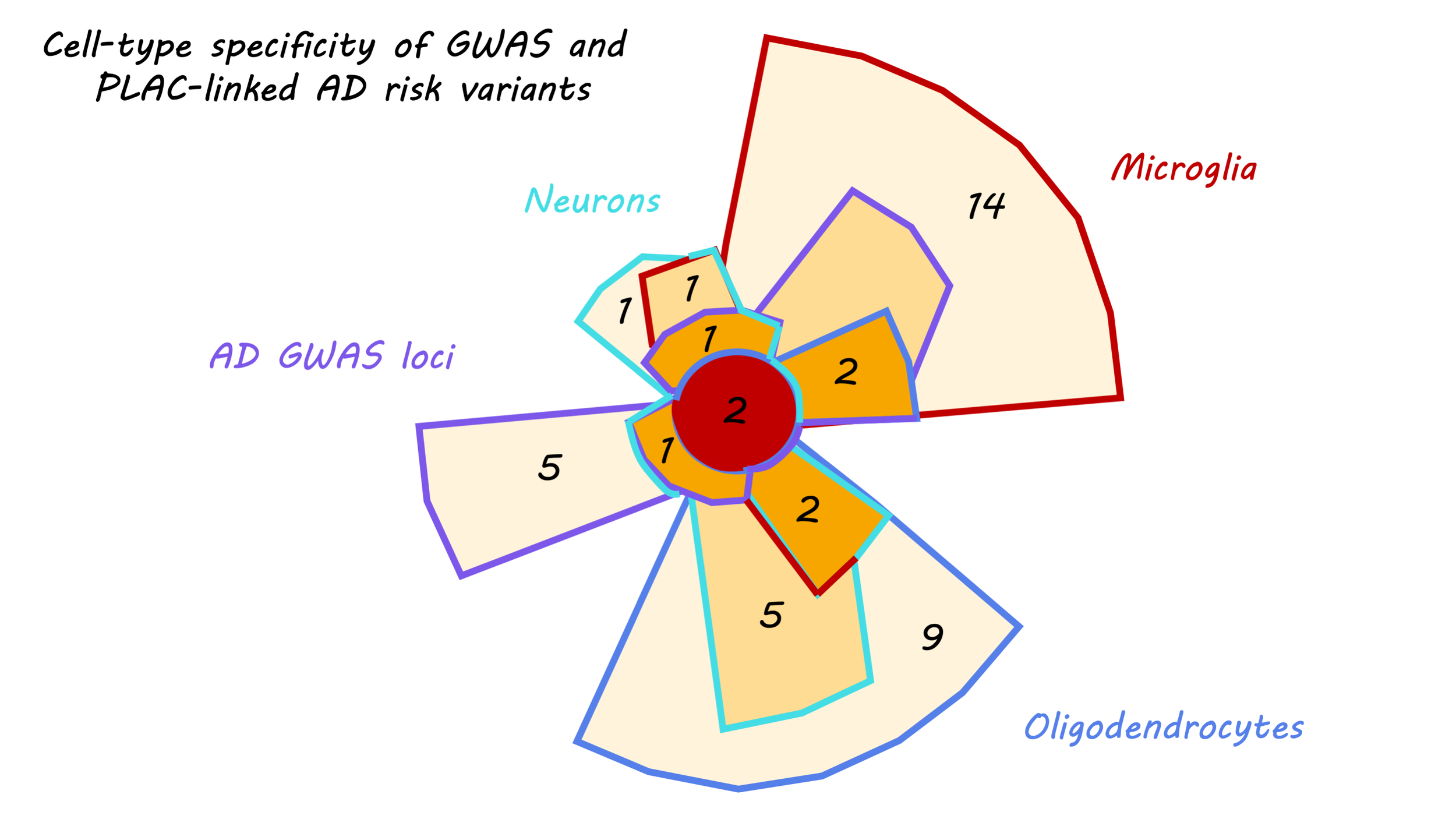
First, the authors performed a series of analyses to characterize the regulatory regions for four major cell types in the human brain. They extracted their samples from post-mortem cortical tissue from six individuals. They group cells into four major types, including neuronal cells and three types of non-neuronal cells, including microglia, oligodendrocytes, and astrocytes. The authors identified active promoters and enhancers in each cell type in order to establish enhancer-promoter maps. The authors then used statistics from previous genome-wide association studies (GWAS) that characterized different risk alleles (common genetic variants conferring risk) for neurological disorders, psychiatric disorders, and neurobehavioral traits to investigate how risk variants were related to the identified regulatory elements. They used the results from these analyses to further probe the relationship between particular disease risk variants (eg. Alzheimer’s risk variants) and regulatory elements within specific sets of cells (eg. microglia). The authors selected a subset of previously-defined Alzheimer’s risk variants and analyzed whether those variants overlapped with cell-type-specific regulatory elements that they had identified. They performed a series of steps to confirm that those genomic regions containing the risk variants interacted with active promoters. These steps resulted in 41 genes that spanned all 4 cell types, which were linked to the variants. Of the 41 genes, 25 were identified in microglia, and the remaining were not identified in the other types of cells that the authors looked at. They then repeated this analysis with other Alzheimer’s disease genome-wide association studies and found a greater number of risk genes. They focus on one particular enhancer that contains an Alzheimer’s Disease risk variant with the second highest Alzheimer’s Disease risk score. They performed analyses to verify the functionality of the enhancer and to investigate the cell-type specificity of the enhancer.

What did they find?

When the authors analyzed which regulatory elements were active in the nuclei of their different cell types, they found that their data clustered according to cell type and showed cell-type-specific patterns. They found that the promoters associated with cell-type-specific signatures exhibited specific H3K27ac (a type of histone modification) profiles. From their analysis on the relationship between promoters and enhancers, the authors found that there was a large amount of overlap in the active promoters across different cell types, while there was very little overlap in the active enhancers across cell types. They suggest that the cell-type specificity is therefore captured by the group of active enhancers. From their analysis on the relationship between the regulatory regions of their four classes of cells and complex traits and diseases, the authors found that 1) psychiatric disorders and behavioral trait heritability was most highly enriched for enhancers and promoters in neuronal cells, and 2) Alzheimer’s heritability was most highly enriched in microglia-specific regulatory regions. In particular, the authors showed that Alzheimer’s heritability was enhanced in microglial enhancers. Methodologically, results from their analysis on promotors and distal regulatory regions with a technique called proximity ligation-assisted ChIP seq (PLAC), showed that PLAC could be used to identify cell-type-specific promoter-enhancer interactions.

science_dec10.png

They identified several thousand clusters of multiple enhancers, called super-enhancers, which are thought to be important in driving the expression of cell identity genes. Of the super-enhancers that they identified, many contained GWAS disease-risk variants and were related to cell-type-specific genes. These results suggest that some GWAS variants may act on these clusters of enhancers to affect gene expression. From their series of analyses on Alzheimer’s Disease-risk variants, the authors identified several interesting characteristics of Alzheimer’s Disease variants. They found that the risk variants were usually linked to active promoters that were far away, and not to the closest gene promoter. They also found that although some Alzheimer’s Disease risk variants were expressed in different cell types, there were microglia-specific enhancers that contained the risk variants. The authors focused on the BIN1 (a gene involved in Alzheimer’s risk) enhancer, which contained a risk variant with the second highest AD-risk score after APOE, and confirmed that the risk allele associated with BIN1 was contained in the microglia-specific enhancers.

What's the impact?

The authors collected evidence that advances our understanding of promoter-enhancer interactions in specific cell types and characterized associations between cell-type-specific regulatory elements and particular disease risk variants. They show that risk variants for psychiatric disorders are associated with regulatory elements within neurons, while a particular risk variant for sporadic Alzheimer’s disease is regulated by a microglia-specific enhancer. 

Glass_dec10.jpg

Nott et al. Brain cell type-specific enhancer-promoter interactome maps and disease-risk association. Science. (2019). Access the original scientific publication here.
Exercise Improves Brain Tissue Oxygenation in a Mouse Model of Alzheimer’s Disease

Post by Elisa Guma

What's the science?

Alzheimer’s disease (AD) is a progressive neurodegenerative disease associated with loss of memory, as well as neuronal cell death due to the aggregation of tangles (formed by misfolded tau protein in neurons), and plaques (formed by a protein amyloid-beta). Further, the vascular system has been shown to be compromised in AD, but it is unclear what role it plays in disease progression and whether it could be a potential treatment target. Voluntary exercise has been identified as an effective means for preserving brain function and preventing cognitive decline in both rodent and human research. However, the oxygenation mechanism through which voluntary exercise affects AD remains unknown. This week in the Neurobiology of Aging, Lu, and colleagues use a novel approach to image brain oxygenation and blood flow in awake mice to investigate whether brain oxygenation is compromised in a mouse model of AD and if voluntary exercise can reverse impairments. 

How did they do it?

The authors used a transgenic AD mouse model, which expresses Amyloid Precursor Protein Presenilin-1 gene mutations that have been identified in humans with AD, and develops cognitive impairments and memory loss at 4.5 months. Tissue oxygenation was measured in AD and wild-type (normal) mice at 3 and 6 months of age, as well as in a group of AD mice who were given a running wheel at 3 months and assessed at 6 months.

The authors used a novel two-photon microscopy system with a phosphorescent lifetime arm, which measures the lifetime of a fluorescent signal as opposed to just identifying its presence, in order to measure tissue oxygenation and cerebral blood flow at a sub-capillary resolution around cortical arterioles, capillaries, and venules in awake mice. Tissue oxygenation was measured using oxygen partial pressure in brain tissue which is affected by variations in blood flow and metabolic demand in different regions. To be able to view the blood vessels in the brain, the authors drilled a hole in the mouse skull (under anesthesia) above the barrel cortex, while keeping the dura mater (a layer of tissue surrounding the brain and spinal cord) intact, and mounted a glass cover over it, keeping a small silicone-covered hole on the side to act as a biocompatible port. 

An oxygen-sensitive dye was injected into the brain tissue via the biocompatible port, and tissue oxygenation was measured using the two-photon phosphorescence lifetime microscopy. This allowed the authors to see how quickly the oxygen-sensitive dye was decaying (an advantage of the phosphorescence lifetime microscopy), to assess how oxygenated the tissue was at a given time. The authors used another kind of imaging technique, Doppler Optical Coherence Tomography, to acquire cerebral blood flow estimates in the blood vessels. During the experiment, the animals could move on a treadmill wheel which allowed free movement of the limbs. Following the awake imaging, the authors collected the brains of their mice and stained them for amyloid plaques, neuronal cell density, and the LRP1 receptor in the cortex, which has been associated with improving amyloid clearance, to determine if exercise was able to reverse AD pathology.

What did they find?

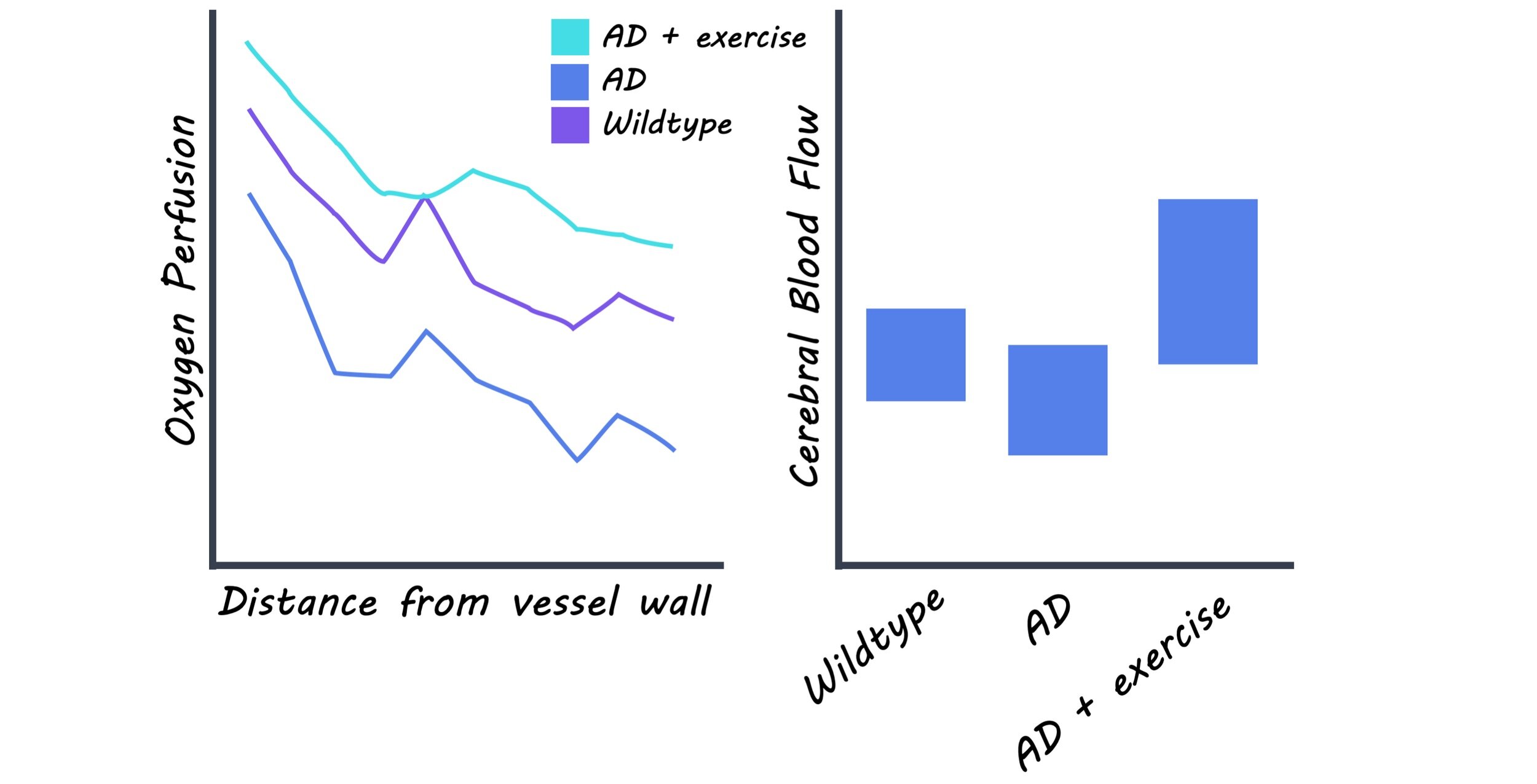
The authors found a decrease in tissue oxygenation over time in the AD mice. Further, there was more heterogeneity of tissue oxygenation indicative of vascular dysfunction both with increased age and due to AD. They also observed more regions of hypoxia or near-hypoxia (low oxygenation) and decreased cerebral blood flow in the AD mice. An increase in amyloid-beta and a decrease in neuronal cell density in the AD mice were also found.

ad_Dec3.jpg

Voluntary exercise for 3 months seemed to reverse all of the observed impairments in vascular function in the AD mice. First, the authors found increased tissue oxygenation and decreased heterogeneity of oxygenation in the AD mice. Exercise also decreased the number of near-hypoxic areas in AD mice and improved cerebral blood flow. At a cellular level, the authors found that exercise decreased the amount of amyloid-beta plaque and reversed the decrease in neuronal cell density. Interestingly, exercise increased the levels of a receptor called LRP1 in the cortex, suggesting that perhaps it may have improved amyloid clearance. Not all mice ran the same amount over the 3 months, so the authors were able to investigate whether the distance ran correlated with the improvement in oxygenation and blood flow; in fact, they found that it correlated with the amount of brain oxygenation and blood flow observed, suggesting that there is a dose-response between the two. 

What's the impact?

This study is the first to measure brain tissue oxygenation and cerebral blood flow in a live awake mouse using a cutting-edge microscopy technique. They show that blood oxygenation and cerebral blood flow are compromised in a mouse model of AD and that voluntary exercise is able to reverse many of these impairments. This suggests that exercise may be an interesting treatment intervention for individuals with dementia. Unfortunately, this work was only performed in male mice; future work should extend this work to female mice as well, as AD is more prevalent in females. 

Xuecogn Lu et al. Voluntary exercise increases brain tissue oxygenation and spatially homogenized oxygen delivery in a mouse model of Alzheimer’s Disease. Neurobiology of Aging (2019). Access the original scientific publication here.