
Auditory Cortex Contributes to Threat Memory

Post by Sarah Hill

What's the science?

The same learning principle made famous by Pavlov and his dogs - classical conditioning - is exercised when an animal associates a neutral stimulus with a threat. For example, a mouse that has learned to associate an auditory cue with an impending aversive stimulus (e.g. a foot shock), will exhibit freezing behavior upon hearing the cue even if the cue is no longer followed by a shock. This type of aversive learning results in a threat memory, a form of memory important for future avoidance of aversive stimuli. Whether the auditory cortex, a brain region located in the temporal lobe, is involved in threat memory is unclear, as lesions to this brain region have had mixed effects on memory. This week in Neuron, Dalmay and colleagues show that the auditory cortex and other subregions of the temporal cortex contribute to threat memory acquisition and retrieval.

How did they do it?

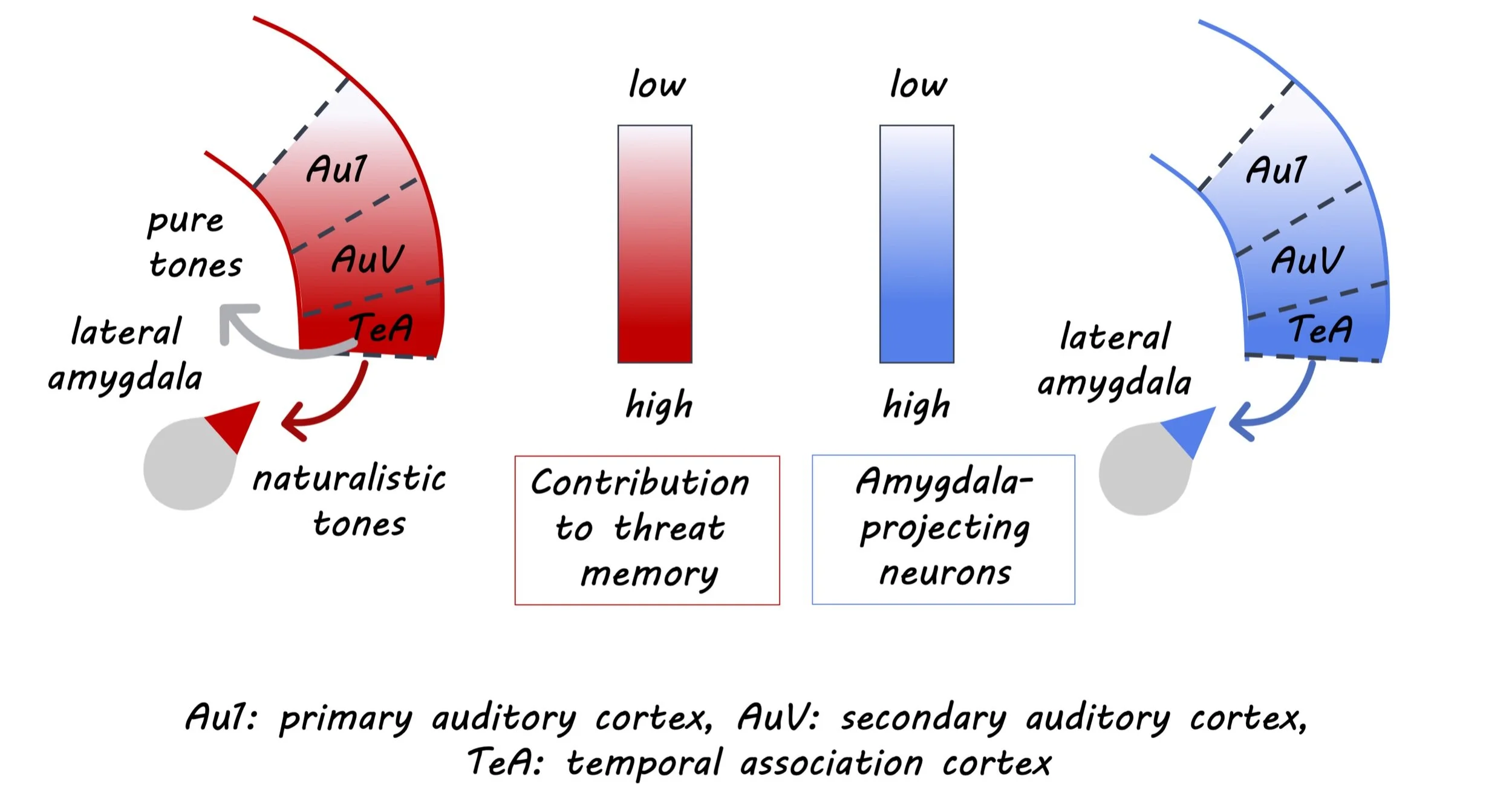
The authors used optogenetic methods to inhibit the auditory cortex, and conditioned mice to associate an auditory cue with a foot shock. They carried out both discriminative (i.e. using a conditioned stimulus [CS+] and a neutral stimulus [CS-]) and non-discriminative conditioning (i.e. using only a CS+), presenting one set of animals with complex naturalistic auditory cues (akin to sounds heard in nature) and another with pure tones. To test threat memory, they presented mice the next day with acoustic stimuli, this time without the associated foot shock, and recorded freezing behavior as a measure of the fear response. An analogous series of experiments were then carried out to determine the contribution of neighboring brain areas to threat memory. Optogenetics techniques were similarly used to inhibit adjacent regions of the temporal neocortex, including the ventral region of the secondary auditory cortex, the temporal association cortex, and neuronal axons projecting to the amygdala, the brain region that mediates the fear response. Fear conditioning was again carried out followed by threat memory testing.     

What did they find?

Mice with auditory cortex inhibition exhibited reduced freezing behavior following presentation with complex naturalistic auditory cues, but not after presentation with pure tone cues, suggesting that the role of the auditory cortex in threat memory is dependent on stimulus complexity. This effect was observed whether the auditory cortex was inhibited during fear conditioning or during memory retrieval, as well as in the context of both discriminative and non-discriminative conditioning. Thus, the auditory cortex was shown to contribute in a stimulus-dependent manner to discriminative and non-discriminative threat memory expression. In contrast, mice with inhibition of adjacent temporal cortex regions displayed significant memory impairments regardless of stimulus complexity. Some neocortical subregions were shown to contribute more to threat memory than others — particularly the ventral region of the secondary auditory cortex and the temporal association cortex. Finally, inhibition of amygdala-projecting neurons resulted in reduced freezing behavior when paired with complex, but not pure tone, auditory cues. In other words, complex acoustic stimuli selectively activate direct information transfer between the neocortex and amygdala to elicit auditory threat memory expression.            
threat_memory_Nov19.jpg

What's the impact?

This study conclusively demonstrates a role for the temporal cortex, including the auditory cortex, in auditory threat memory. These findings are particularly important for understanding the extent to which the neocortex participates in learning and memory and the circumstances in which this form of neocortical processing occurs. 

Letzkus_Nov19.jpg

Dalmay et al. A Critical Role for Neocortical Processing of Threat Memory. Neuron (2019). Access the original scientific publication here.
Driving Brain Plasticity with Gamma Oscillations

Post by Anastasia Sares

What's the science?

The visual cortex is a classical area for studying neuron tuning, specialization, and brain plasticity. Located in the very back of the brain, the visual cortex was studied as early as the 1960s, and it was discovered that different clusters of neurons responded to moving stripes oriented at different angles. Changing the preferred orientation of some neurons is a small-scale example of brain plasticity, but it doesn’t happen all by itself. Something has to happen in the brain to change the status quo. This week in Proceedings of the National Academy of Sciences, Galuske and colleagues induced brain plasticity by pairing visual conditioning with stimulation of a brainstem area (midbrain reticular formation).

How did they do it?

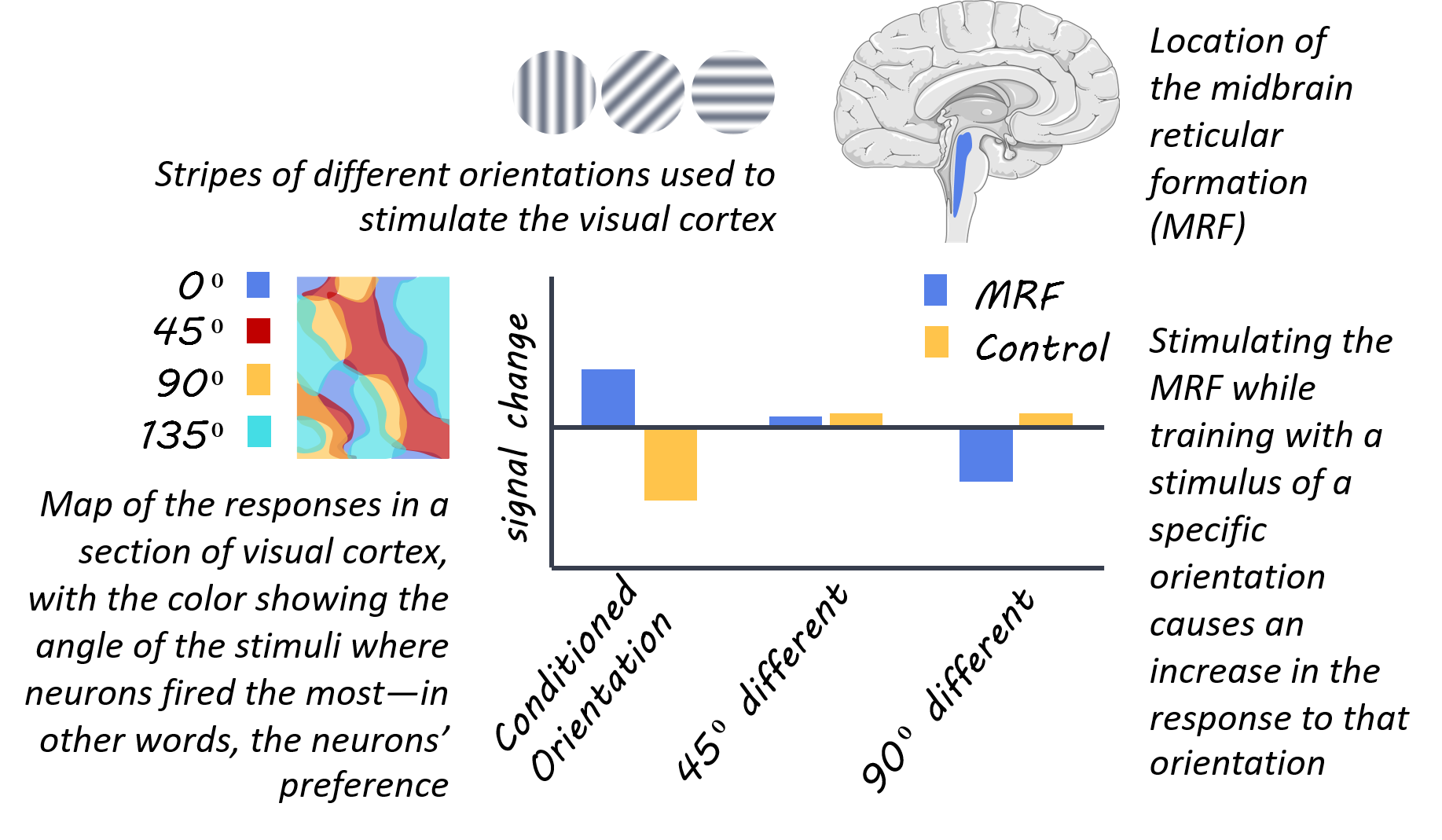
The authors studied the visual cortex of cats, implanting electrodes in order to record neural activity (more specifically: electrocorticograms, multiunit activity, and local field potentials), and also performed optical imaging. They recorded neural responses to different orientations of stripes to create an “orientation map” of the cortex. Recordings took place before and after a long conditioning session, where the cats were exposed to moving stripes (also called ‘gratings’) in a single orientation. Repeatedly exposing neurons to the same stimulus (stripes at a certain orientation) usually just causes them to habituate, firing less as they get used to the stimulus. It does not typically change their preferred orientation. However, during some of the conditioning sessions, the authors additionally stimulated the midbrain reticular formation (MRF) in the brainstem. Activity in this brainstem area can enhance gamma oscillations in the visual cortex, which the authors believed would drive plasticity. This plasticity would cause greater responsiveness and attunement to the orientation presented in the conditioning session.

What did they find?

The authors succeeded in causing a plastic change in the visual neurons. After the conditioning session with the MRF being stimulated, more neurons responded to the grating that had been presented. The cells that changed the most were the ones that had originally responded to orientations 10-30 degrees away. These cells were “re-tuned” so that they preferred the orientation presented in the session. The effect lasted at least 6 hours, at which point the researchers stopped measuring it. It wasn’t just stimulation of the MRF that caused this plasticity. Only when MRF stimulation led to an increase in gamma oscillations did this effect show up.

visual_cortex.png

What's the impact?

This study shows that gamma oscillations put the brain’s cortex in a unique state that facilitates plasticity, changing how it represents the outside world. More research is needed to connect gamma oscillations to learning, but some evidence suggests that they may be related to context and prediction, providing a way for the brain to turn plasticity on or off when the need arises.

Galuske et al. Relation between gamma oscillations and neuronal plasticity in the visual cortex. Proceedings of the National Academy of Sciences (2019). Access the original scientific publication here.
The Role of the Brain’s Reward System in Expectation of Pain

Post by Kasey Hemington

What's the science?

Pain is a subjective experience that can be modulated by many factors, including its anticipation. The brain’s reward system works by detecting the difference between events that we experience and their prior anticipation and is known to be involved in how we perceive pain. The ventral tegmental area (VTA) projects to the rostral anterior cingulate cortex and nucleus accumbens via the mesocorticolimbic pathways and is a key part of the brain’s reward system. How these pathways might play a role in encoding our expectations of pain is not clear. This week in The Journal of Neuroscience, Tu and colleagues studied the structure and function of the mesocorticolimbic pathways using magnetic resonance imaging (MRI) during a task in which humans anticipated a painful experience.

How did they do it?

Twenty-nine young adults (14 females) participated in the experiment, which involved a calibration phase, a conditioning phase, and a test phase. During the calibration phase, electrical stimulation was delivered to the forearm to identify the level at which each individual reported low pain (2/10), moderate pain (4/10) and high pain (6/10). In the conditioning phase, participants saw a + sign or – sign on a screen, which they were told was ‘associated with a painful stimulus’. Fifteen seconds after seeing the + sign or – sign, the high pain or low pain level of electrical stimulation respectively was delivered. In other words, the participants were conditioned to associate the + with more pain and the – with less pain. During the test phase, participants again viewed the + or – sign prior to experiencing the painful stimuli, however, unbeknownst to participants, the same moderately painful stimuli were delivered after every image shown, in order to test conditioning effects. Participants were also shown an ‘o’ symbol on some trials during the test phase that they did not see during the conditioning phase, which could be assumed to be ‘neutral’. After receiving the painful stimulus, participants rated the pain.

Kasey (2).png

During the test phase, functional MRI (fMRI) scanning was performed and the connectivity of the VTA with other brain regions was analyzed while participants viewed the images and anticipated the painful stimuli. The authors studied a ‘positive expectancy effect’, the difference between pain perception in response to the – sign versus the o sign, and a ‘negative expectancy effect’, the difference between pain perception in response to the + sign versus the o sign. Structural MRI data (assessing the brain’s grey matter volume) was also collected.

What did they find?

On average, pain following the -, o and + cues was rated as 2.69/10, 3.32/10 and 4.10/10 respectively during the test phase, indicating that the conditioning phase was effective. The VTA was more tightly functionally connected with the rostral anterior cingulate cortex and the nucleus accumbens during – cues compared to o cues, and less tightly connected during + cues compared to o cues. There was also a negative relationship across trials between perceived pain intensity and VTA connectivity with the aforementioned brain regions. In statistical mediation analyses, VTA – nucleus accumbens functional connectivity and VTA – rostral anterior cingulate cortex functional connectivity were found to mediate the effect of expectancy (due to a cue) on pain perception. For example, if someone had an expectation of high pain and low VTA – nucleus accumbens functional connectivity, this might result in them reporting higher pain perception than they otherwise might have.

When the authors compared VTA functional connectivity across subjects, they found that it did not predict pain responses. However, when they analyzed the structural MRI data, they found that grey matter volumes of the VTA, rostral anterior cingulate cortex, and nucleus accumbens predicted the positive expectancy effect - individuals with larger volumes in these areas were likely to experience a larger effect. Grey matter volume of the rostral anterior cingulate cortex predicted a larger negative expectancy effect.

What's the impact?

This study demonstrates that the function and structure of the VTA and mesocorticolimbic pathways are related to one’s anticipation of a painful experience. These results emphasize the role of the brain’s reward system in shaping how expectancy of pain can alter the way we feel pain.

Hu_quote_Nov12.jpg

Tu et al. Mesocorticolimbic pathways encode cue-based expectancy effects on pain. Journal of Neuroscience (2019). Access the original scientific publication here.