
Identity Domains: A Computational Framework for Personality Analysis

Post by Deborah Joye

What's the science?

Personality is the collection of individual behaviors or traits that differ from one human to the next. The ability to organize individual differences in behavior into distinct categories is important for understanding the biological underpinnings of both healthy and pathological behaviors. In humans, many individual differences have been categorized by psychologists into varying personality traits, resulting in the widespread use of personality tests to determine the trait make-up of individuals. However, personality tests tend to rely on self-report questionnaires and do not track actual behaviors as they occur. Like humans, mice also exhibit individual differences in their behaviors. Some mice prefer to stay close to the nest, whereas others leave the nest to explore the environment. Some mice will readily approach a stranger, while others are more reserved. Organizing individual differences amongst other species has been challenging since there are few conceptual frameworks with which to comprehensively categorize behaviors into consistent traits. This week in Nature Neuroscience, Forkosh, Karamihalev, and colleagues present a computational framework that organizes individual behaviors into trait-like dimensions that are stable across development, consistent across social settings, and correlated with gene expression differences within the brain.

How did they do it?

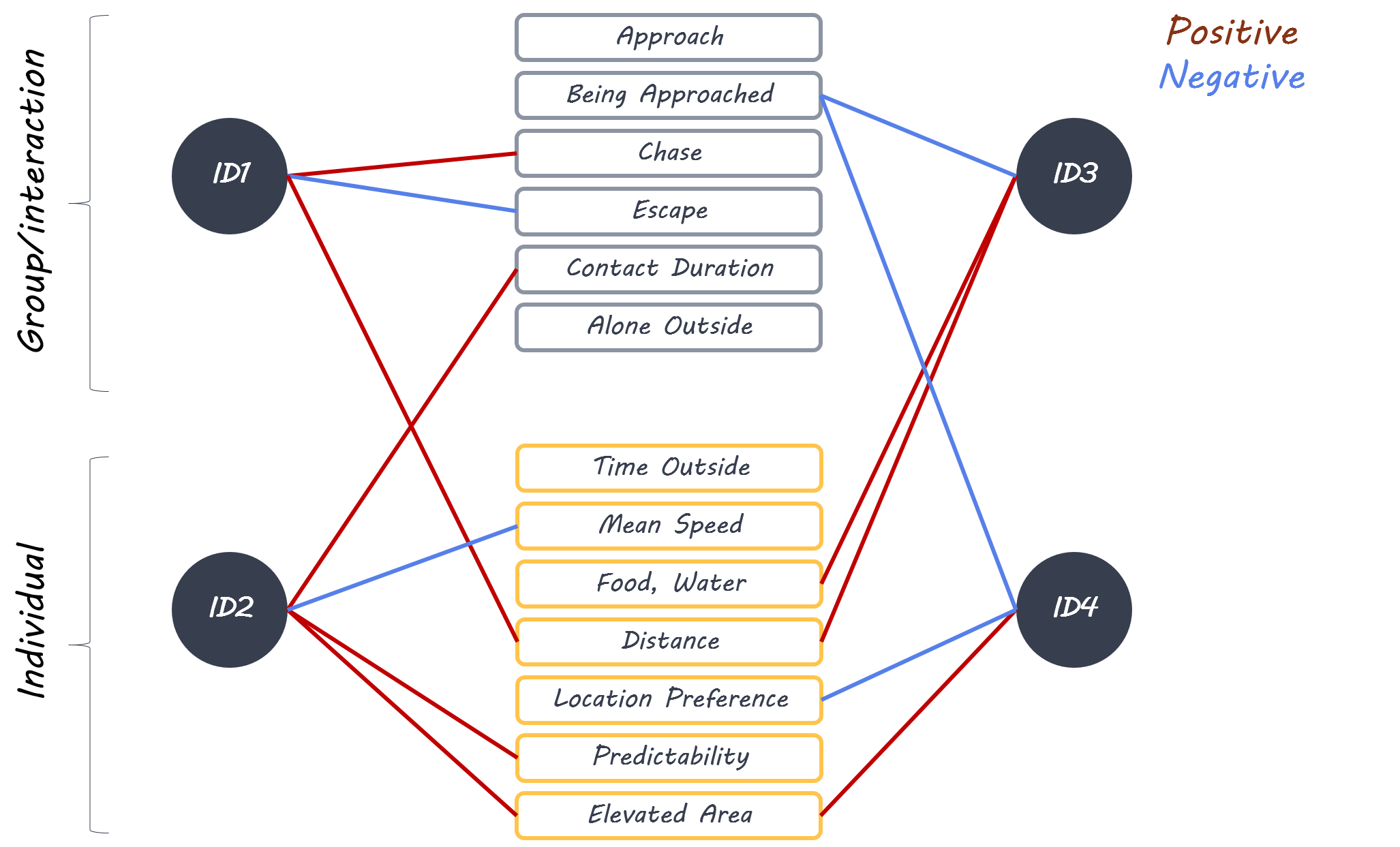
The authors built a semi-naturalistic arena and filled it with different features for mice to interact with such as ramps, feeders, dividing walls, and hiding places. The authors then tracked the behavior of individual mice as they interacted with their cage-mates and environment over several days. They classified both individual behaviors, like movement and foraging and interactions between the mice, like dominance behaviors and other social contacts. The authors then trained their linear discriminant analysis algorithm to look for 60 unique behaviors within the behavioral dataset. Their algorithm was specifically designed to isolate dimensions of the dataset that are the best at discriminating one mouse from another, which they called identity domains. The algorithm does this by maximizing trait variability between each mouse, while also maximizing trait consistency within one mouse. To ensure that their algorithm functioned as planned, the authors validated the analysis on two separate groups of mice and found consistent results. To determine if identity domains were consistent within mice across development, the authors profiled identity domains of juvenile mice, then profiled the same mice as adults. To test whether identity domains remained consistent in different social settings, the authors profiled groups of mice, then mixed the mice up into different groups and profiled them again. Finally, to determine whether identity domains correlated with changing gene expression in the brain, the authors performed RNA sequencing three brain regions (basolateral amygdala, insular cortex, and medial prefrontal cortex) of profiled mice.

What did they find?

The authors’ algorithm captured four identity domains – consistent dimensions of the data that described the stable behavior of individual mice over time. Interestingly, the authors found that when mice were profiled as both juveniles and adults, three of the four assigned identity domains remained stable, suggesting that identity domains capture traits that are consistent across development. The authors then mixed up groups after they had been profiled and found that while mice changed some behaviors in new social settings, their assigned identity domains remained stable. Using RNA sequencing, the authors demonstrated that gene expression variability in 3 different regions could be predicted using identity domain scores, suggesting that behavioral differences captured by identity domains and gene expression in the brain are associated. Finally, the authors investigated the identity domains of mice with known behavioral phenotypes, such as mice that are known to exhibit high anxiety behavior. The authors found that their assigned identity domain scores were highly associated with expected personality traits, suggesting real-world relevance of the identity domain scores.
Deb (6).png

What's the impact?

Individual differences in behavior are quite difficult to study. This work presents a novel framework that offers a more objective study of personality by tracking real behavioral output and categorizing it into trait-like identity domains in mice. Interestingly, identity domains capture differences that are stable over time and in different social contexts. Moreover, the correlation between identity domain scores and gene expression differences in several brain areas suggests that this tool can capture stable behavioral differences that are reflective of fundamental differences in brain function.

Forkosh et al., Identity domains capture individual differences from across the behavioral repertoire, Nature Neuroscience (2019). Access the original scientific publication here.

Ghrelin Increases Food Intake via Descending Hippocampus to Hindbrain Signalling Pathway

Post by Amanda McFarlan

What's the science?

Ghrelin is a gut-derived hormone that plays a critical role in feeding behavior by stimulating the appetite. The ghrelin receptor can be found in regions of the hippocampus and recently, it has been shown that activating the ghrelin receptor in the ventral hippocampus results in an increase in food intake. However, the underlying mechanisms that mediate feeding behavior are still unknown. This week in Biological Psychiatry, Suarez and colleagues investigated the role of ghrelin signalling in the ventral hippocampus in mediating food intake.

How did they do it?

To investigate the role of hippocampal ghrelin signalling, the authors implanted cannulas bilaterally in the ventral hippocampus in adult male rats. After food-restricting the rats for 24 hours, they delivered an injection of artificial cerebrospinal fluid (as a control) or a subthreshold dose of ghrelin (no effect on feeding behaviours alone) through the cannulas. Approximately 45 minutes after the injection, they performed either an intraperitoneal injection of a satiation-promoting drug or a nonnutritive oral gavage of fiber to physically expand the stomach. The rats were given access to food following the intraperitoneal injection or gavage and their food intake was recorded for up to 4 hours. Then, the authors used a deprivation intensity discrimination task to train two groups of rats to use internal cues about their hunger and satiety levels as a discriminative stimulus for a sugar reward. The first group of rats was trained to anticipate a reward after 24 hours of food restriction, while the second group was trained to anticipate a reward with no food restriction. After the training, both groups of rats underwent two test days following a period of no food restriction. On the test days, the rats received a delivery of artificial cerebrospinal fluid (control) or ghrelin in the ventral hippocampus via the cannulas (with the order counterbalanced) 1 hour prior to being placed in an operant chamber to record their appetitive behavior. Next, to identify the downstream targets of the ventral hippocampal → lateral hypothalamic area projections, the authors targeted the expression of Cre-recombinase to neurons in the ventral hippocampus and their first-order targets and targeted the expression of an anterograde tracer (traces neurons from their source to their target) tagged with tdTomato in the lateral hypothalamic area. They performed immunohistochemistry and fluorescence in situ hybridization to map the axons from lateral hypothalamic area projections and determine their neuronal targets.

What did they find?

The authors determined that administering a subthreshold dose of ghrelin to the ventral hippocampus in 24-hour food-restricted rats significantly attenuated the reduction in food intake following the administration of satiation-promoting drugs or oral fiber gavage compared to controls. Since the satiation-promoting drugs targeted either the paracrine (vagal) or non-vagal endocrine pathways, these findings indicate that ghrelin signalling within the ventral hippocampus may act on both paracrine and endocrine pathways to mediate food intake. Next, the authors revealed that, following the administration of ghrelin in the ventral hippocampus, the group of rats that were trained to anticipate a reward after 24 hours of food restriction had an increase in appetitive behaviors compared to controls. In contrast, the group of rats that were trained to anticipate a reward with no food restriction had a decrease in appetitive behaviors compared to controls. These findings suggest that ghrelin signalling in the ventral hippocampus may override satiety-inducing mechanisms by producing internal cues that signal a low energy state similar to being food-restricted for 24 hours. The authors also found that the ghrelin receptor is most commonly expressed in glutamatergic neurons in the pyramidal layer of the ventral hippocampus. Further, they showed that a subset of tdTomato-positive projection neurons in the lateral hypothalamic area was co-localized with the expression of orexin (a neuropeptide that promotes food intake) and had axon terminals that targeted the laterodorsal tegmental nucleus. They used fluorescent in situ hybridization to determine that a large population of neurons in the laterodorsal tegmental nucleus in the hindbrain have a co-localized expression of the orexin-1 receptor and the glucagon-like peptide-1 receptor (previously shown to be important for reducing food intake). Together, these findings suggest that glutamatergic neurons in the ventral hippocampus that express the ghrelin receptor project to orexin neurons in the lateral hypothalamic area, which in turn target neurons in the laterodorsal tegmental nucleus in the hindbrain to regulate food intake.

ghrelin_img.jpg

What's the impact?

This is the first study to show that ghrelin signalling in the ventral hippocampus decreases the efficacy of satiation and satiety-promoting signals that target endocrine pathways in the periphery. The authors also identified orexin neurons in the lateral hypothalamic area as the downstream targets of ghrelin receptor-expressing neurons in the ventral hippocampus. Together, these findings provide insight into the neural pathways and mechanisms involved in hippocampal-mediated control of feeding behavior via ghrelin signalling.

Kanoski_nov12_quote.jpg

Suarez et al. Ghrelin and orexin interact to increase meal size through a descending hippocampus to hindbrain signalling pathway (2019). Access the original scientific publication here.
The Night's Watch: How Microglia Protect and Shape Our Brain as We Sleep

Post by Flora Moujaes 

What's the science? 

The brain is not just comprised of neurons: it contains many other types of cells, such as microglia and astrocytes, which play a fundamental role in the brain. Microglia are best known for their role in the immune response, yet they are also involved in a number of other key brain functions including plasticity: the process through which the brain changes and adapts to new experiences. Microglia interact closely with neurons at the synapse: the junction between two neurons. To date, research on microglia has focused on anesthetized animals, leaving open the possibility that microglial dynamics may be different during awake-states. It also remains unknown how neurotransmitters regulate microglial functioning. However, microglia have a higher expression of a specific type of receptor for the neurotransmitter norepinephrine compared to any other type of brain cell, suggesting norepinephrine may be a key modulator. This week in Nature Neuroscience, Stowell et al. use advanced imaging technology to show that microglial dynamics (1) differ between awake and anesthetized mice and (2) are modulated by norepinephrine.

How did they do it? 

To determine whether microglial behavior is affected by anesthesia, the researchers first imaged microglial dynamics in healthy adult mice while they were awake and after having been anesthetized with a fentanyl cocktail. Given the role of microglia in the immune response, they also imaged microglial dynamics in awake and anesthetized mice that had suffered an acute brain injury.

In order to uncover the underlying mechanisms responsible for the differences in microglia in awake and anesthetized mice, the researchers explored the role of norepinephrine in microglial functioning. Norepinephrine was of particular interest as (1) it is known to be a powerful mediator of wakefulness, and (2) microglia have a very high number of beta2 adrenergic receptors (which norepinephrine bind to). The researchers modulated the level of noradrenergic signalling in microglia, either by stimulating the microglia’s beta2 adrenergic receptors using the agonist clenbuterol to increase norepinephrine levels or by inhibiting the microglia’s beta2 adrenergic receptors using the antagonist ICI-118,551 to decrease norepinephrine levels. They examined whether this (1) affected microglial functioning in both anesthetized and awake mice, (2) affected microglial response to injury, or (3) impaired synaptic plasticity. 

What did they find?

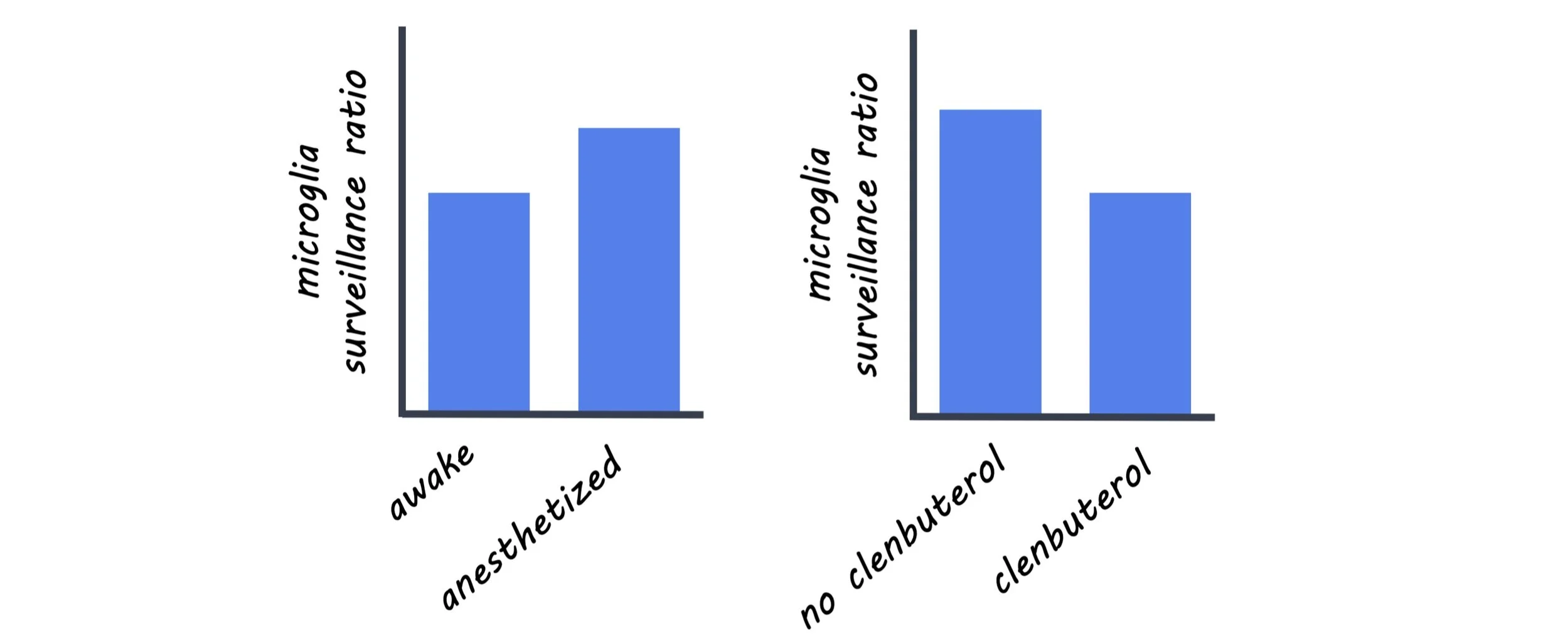
Wakefulness vs. Anaesthesia: The researchers found that microglia in the awake brain differ from those in the anesthetized brain with regards to (1) surveillance monitoring and (2) their injury response. They showed that anesthesia rapidly increased microglial surveillance and increased the microglial response to injury compared to the awake condition. This suggests that wakefulness exerts a primary inhibitory effect on microglial dynamics.

flora_nov5.jpg

Norepinephrine Modulation: The researchers then replicated the findings from awake vs. anesthetized mice by pharmacologically modulating microglial noradrenergic signalling. They found high levels of norepinephrine in awake mice led to reduced microglial functioning, while low levels of norepinephrine in anesthetized mice led to increased microglial functioning. Increased norepinephrine levels also led to a significant reduction in microglial response to injury. Finally, they found that a chronic increase in microglial noradrenergic signalling impairs experience-dependent plasticity in the developing visual system of mice. 

What's the impact?

Overall this study suggests that wakefulness exerts a primarily inhibitory effect on microglial dynamics. It also shows that microglial roles in surveillance and synaptic plasticity in the healthy brain are modulated by norepinephrine. This suggests that the enhanced remodeling of the neural circuits that occurs during sleep may be mediated by the increase in the ability of microglia to dynamically interact with the brain. This is an especially interesting finding as it demonstrates that simply by modulating immune cells, it’s possible to alter synaptic plasticity

majewska_nov5.jpg

Stowell et al. Noradrenergic signaling in the wakeful state inhibits microglial surveillance and synaptic plasticity in the mouse visual cortex. Nature Neuroscience (2019). Access the original scientific publication here.