
Cancer Cells Form Pseudo-Synapses with Neurons To Promote Brain Metastasis

Post by Stephanie Williams 

What's the science?

Cancer cells in solid breast tumors commonly seed cells in the brain and acquire the ability to metastasize (grow in an organ distant from the original tumor). Breast-to-brain metastasis is well characterized, but it is not known why this particular form of metastasis is common. Previous research has identified a signaling pathway that may be involved - a type of glutamate receptor called N-methyl-D-aspartate (NMDA), that is activated by the excitatory neurotransmitter glutamate. Glutamatergic signaling via NMDA receptors is known to support neuroendocrine and ductal pancreatic cancer tumor growth. It has not yet been investigated whether similar glutamatergic signaling is responsible for breast-to-brain metastatic growth. This week in Nature, Zeng and colleagues identify a mechanism that explains how breast cancer cells can position themselves in existing synapses (spaces between neurons in the brain) to facilitate metastatic growth in the brain

How did they do it?

The authors performed a series of experiments in human and mouse cell lines to assess the role of glutamate-mediated signaling in human breast to brain metastasis. 1) First, they examined the expression of different glutamate receptor subunit genes across human cancer types, and ultimately focused on breast cancer. To understand the relationship between breast-to-brain metastasis and the NMDA receptor, the authors investigated whether a particular subunit of the receptor, a protein called ‘GluN2B’, was phosphorylated at particular sites in brain metastasis tissue versus in primary breast tissue (no metastasis). Phosphorylation at particular sites can allow the NMDA receptor to reach the surface of cells, where it can participate in signaling with glutamate. The authors compared the ratio of phosphorylated to total GluN2B protein in primary breast cancer tissue with that from breast-to-brain metastatic cell tissue. The results of these analyses led the authors to focus on the GluN2B subunit of the NMDA receptor for further analyses. 2) They confirmed NMDA GluN2B-mediated signaling was functional in the breast-to-brain metastatic cells by applying L-glutamate (known to activate the receptor) and analyzing whether phosphorylation of the GluN2B subunit had occurred. They also imaged the breast-to-brain metastatic cells while applying either NMDA or glutamate exogenously and looking for responses typical of active cells (elevated intracellular calcium & single-channel currents), to confirm the signaling was mediated by NMDA. 3) To understand where the activating molecule, L-glutamate (that activated the NMDA receptor subunit), was originating, the authors performed analyses in different cell lines: they stained sections of both tissue around the lesions containing the metastatic cells and normal tissue to investigate whether the cells were absorbing glutamate from glutamatergic synapses. They used stimulated emission depleted super-resolution microscopy to image the synapses. The authors also used electron microscopy to further examine the structure of the interactions between the cells and existing synapses. 4) Finally, the authors identified the stage at which the GluN2B-mediated signaling contributed to brain metastasis. To confirm that NMDA receptor signaling was important for the proliferation of the cells, the authors disrupted signaling at different stages of tumor development in cells in which NMDA receptor signaling could be disrupted (DOX-inducible knockdown).

What did they find?

The authors found that GluN2B-mediated signaling in cancer cells in the brain is activated by interactions between metastatic cells and neurons in the brain. From their analyses of different receptor subunit genes in humans, the authors found that tumors cells in humans exhibited higher NMDA receptor expression scores versus other glutamate receptors, and that gene expression encoding GluN2B was high in a type of breast cancer with a poor prognosis. When the authors compared several human breast cancer cell lines in mice, they found that GluN2 was upregulated in the breast-to-brain metastatic line. When mice were inoculated with cells from this line at different locations in the body, brain metastases were highly stained for phosphorylated GluN2B compared to the breast and lung. 
Stephanie (2).png

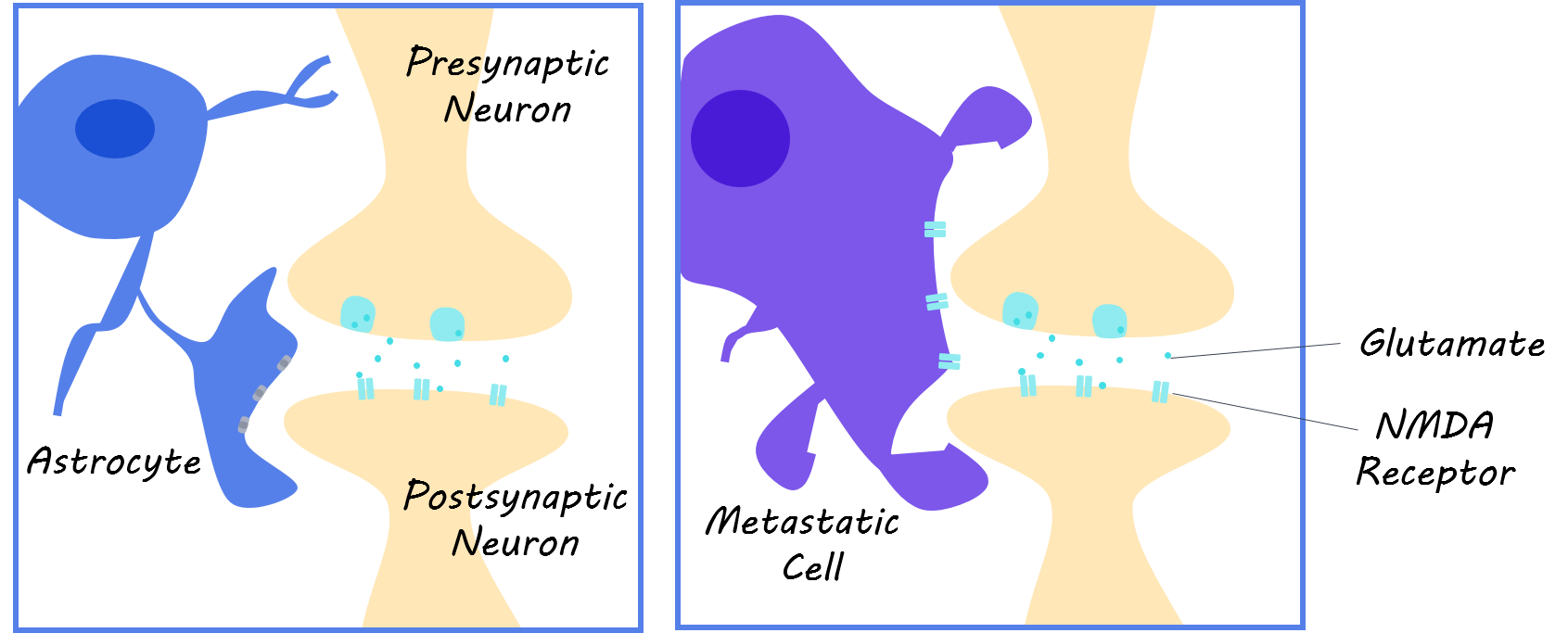
Super-resolution microscopy revealed that metastatic cell puncta (processes; stained with luciferase) were in close proximity to presynaptic neurons (stained with vGlut2) and NMDA receptors (stained with pGluN2B). The authors also observed that the metastatic tissue exhibited increased expression of a key postsynaptic signal-transducing protein as well as other markers including neuroligin, which facilitates adhesion and psuedo-synapse formation between cells. These findings suggest that metastatic human breast cancer cells access glutamate the same way that neuronal cells do (by forming synapses with neurons), and that upregulated NMDA receptors may play a role in the brain-metastatic proficiency of the breast-to-brain metastatic cells. The electron microscopy images of the metastatic tissue revealed “finger-like processes” that extended from the breast-to-brain metastatic cells toward excitatory synapses. The authors note that extended process from the breast-to-brain metastatic cells did not disrupt the pre-post neuronal synapse, but was similar to the position usually occupied by astrocytes. The results from the 3D electron microscopy suggest that breast-to-brain metastatic cells are positioned in the pseudo-tripartite synapse (i.e. cells were associated with both pre and postsynaptic membrane) and access the glutamate secreted by presynaptic neurons. When the authors disrupted NMDA receptor signaling, they found that the proliferation of the metastatic cells was disrupted, and that restoring NMDA signaling increased the proliferation of the breast-to-brain metastatic cells again. These findings suggest that GluN2B-NMDA receptor signaling was not essential for metastatic seeding, but rather promoted colonization and tumor growth in the brain.  

What's the impact?

The study identified a signaling pathway that mechanistically explains metastatic tumor growth in the brain. The findings show that cancerous cells position themselves next to glutamatergic synapses in the brain, allowing them to access glutamate which ultimately promotes metastasis via NMDA receptor signaling. This finding will enable future research to identify specific vulnerabilities in the NMDA-related metastatic pathway that could be targeted to block brain metastasis without harming nearby neurons.

cancer_quote.jpg

Zeng et al. Synaptic Proximity Enables NMDAR Signaling To Promote Brain Metastasis. Nature (2019). Access the original scientific publication here.

Social Media Use is Linked to Internalizing Problems in Adolescents

Post by Shireen Parimoo

What's the science?

The growing prevalence of social media has sparked an interest in the effects of social media use on mental health. Studies have shown that more frequent use of social media is related to lower self-esteem and self-evaluation. Adolescents use social media at high rates and therefore may be particularly at risk for experiencing its negative effects. Childhood psychopathology can be broadly divided into internalizing and externalizing sub-types, which means that the symptoms are either experienced internally (e.g. sadness) or directed externally (e.g. aggressive behavior), respectively. Little research is available on the long-term effects of social media use, particularly on the development of internalizing and externalizing symptoms. This week in JAMA Psychiatry, Riehm and colleagues conducted a longitudinal study to investigate the relationship between time spent on social media and mental health outcomes in adolescents.

How did they do it?

Publicly available longitudinal data for 6595 adolescents were obtained from the Population Assessment of Tobacco and Health Study. In the study, nationally representative data were collected at three time points, each one year apart. The adolescents were aged 12 – 15 years old at the first time point, and 14 – 17 years old at the final time point. At the first time point, participants provided demographic data and at the second time point, they provided information on daily exposure to social media based on frequency and duration of use. Time spent on social media per day was divided into four groups: up to 30 minutes, 30 minutes to three hours, three to six hours, and more than six hours. Participants also completed the Global Appraisal of Individual Needs – Short Screener at the first (baseline) and third time points, which measures self-reports of mental health-related problems and severity categorized as either internalizing or externalizing problems. The authors examined the link between social media use and internalizing and externalizing problems in adolescents. They further estimated the population attributable fraction (PAF) to determine how reducing the amount of social media use might mitigate mental health problems. They did this by creating counterfactual population data for various scenarios in which adolescents from each social media use category would use it less frequently, and then examining the association between social media use and mental health problems.

What did they find?

Most adolescents reported no or low internalizing and externalizing problems (59.3%), whereas 9.1% reported internalizing problems only, 14% reported externalizing problems only, and 17.7% reported experiencing both internalizing and externalizing problems (i.e. comorbid). For social media exposure, most adolescents reported using social media for up to three hours (62.5%), with 12.3% using social media for 3-6 hours and 8.4% reporting more than six hours of daily use. Greater use of social media was associated with a higher risk of experiencing internalizing problems as well as comorbid (internal & external) mental health problems. This association persisted even after baseline mental health was taken into account. The association between social media use and externalizing problems was not as clear; using social media for 30 minutes to 3 hours or for more than 6 hours was associated with more externalizing problems, but not after controlling for the baseline measure of externalizing problems. Finally, according to the PAF estimates, lowering daily social media use to 30 minutes or less per day would result in up to a 9.4% reduction in internalizing problems and up to 7.3% reduction in externalizing problems. 

shireen (2).png

What's the impact?

This study demonstrates the extent to which internalizing and externalizing mental health problems in adolescents can be attributed to social media use. The finding that using social media less often might reduce mental health problems in adolescents has implications for developing general guidelines on frequency of social media use, and further highlights the importance of understanding the link between social media use and mental health in other populations (e.g. young adults).

riehm_quote.jpg

Riehm et al. Associations between time spent using social media and internalizing and externalizing problems among US youth. JAMA Psychiatry (2019). Access the original scientific publication here.
How Do Pathogens Invade the Brain?

Post by Anastasia Sares

What's the science?

Infections of the central nervous system can be life-threatening. Their dynamics are changing, influenced by globalization, climate change, and other factors. Meningitis alone affects 1.2 million people, and certain subtypes can be extremely deadly. This week in Neuron, Cain and colleagues reviewed the multiple ways that pathogens (bacteria, fungi, viruses, toxins, and parasites) can make their way into the brain.

What have we learned?

Our body has many lines of defense against would-be invaders, and the brain is one of the most protected parts of the body. First, there are the skin and the skull, which provide formidable physical barriers to entry. Below the skull is a leathery layer called the dura mater. Below this is the spongy arachnoid mater, housing a number of blood vessels. Finally, there is the pia mater, a thin and delicate layer that is almost like shrink-wrap around the brain. Unlike in the rest of the body, blood nutrients do not migrate freely into brain tissue. Blood vessels are tightly sealed, forming what we call the “blood-brain-barrier.” The cells surrounding the blood vessels get to pick and choose what nutrients they want and transport them selectively across their membranes. Even some of our own immune cells are not allowed past this barrier. Instead, the brain and spinal cord have a separate, dedicated system for pumping nutrients around, the cerebrospinal fluid (CSF), and in-house immune cells. At this point, you might think the brain is extremely well protected, however, there are surprisingly still ways for invaders to penetrate these defenses.

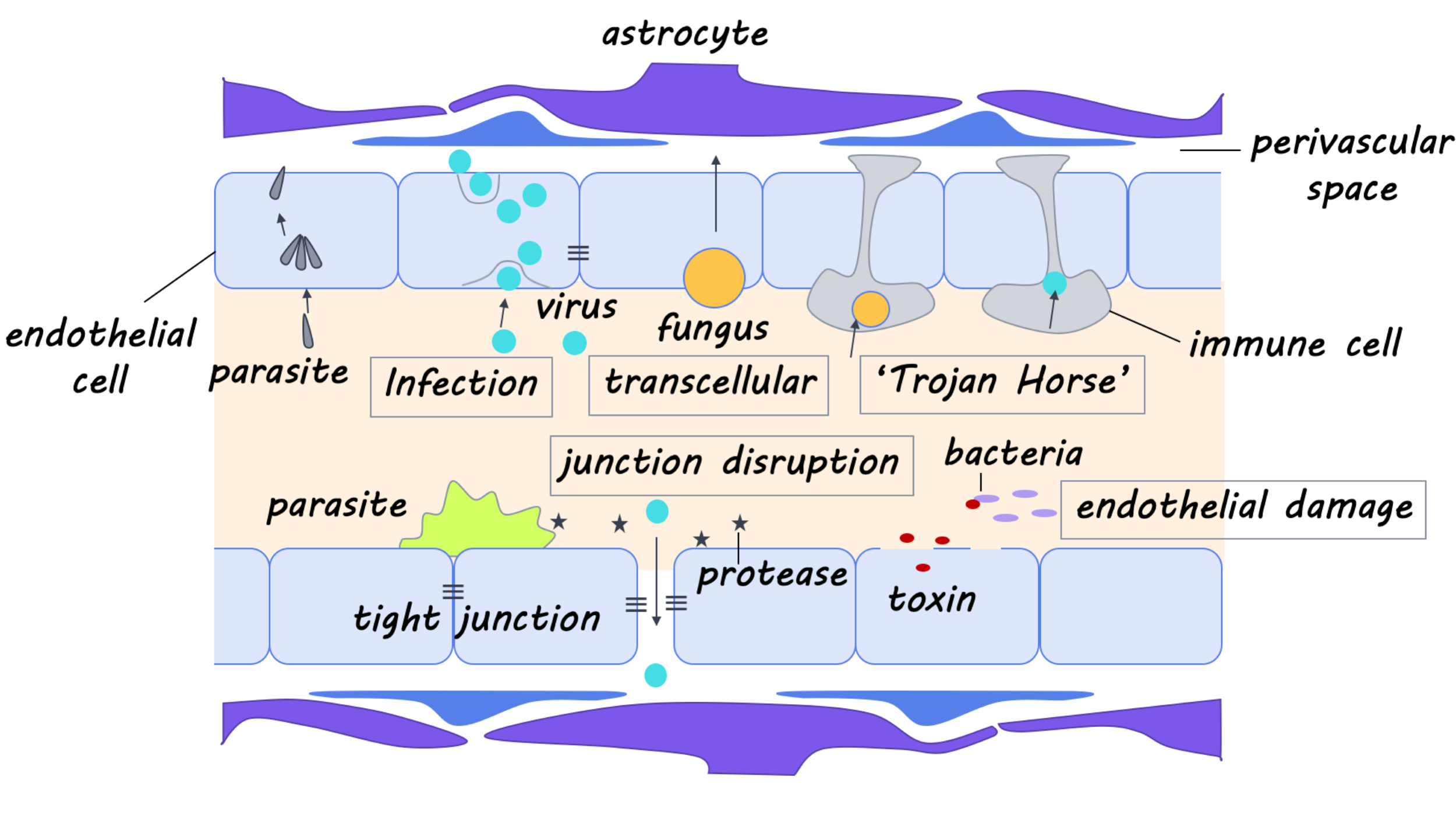
So, how do some pathogens still manage to get inside the brain? Some only need to get through one or two layers of the brain’s protection to be dangerous. Meningitis is a swelling of the membranes that protect the brain: it typically happens when a pathogen gets in between those layers and multiplies there. Even bacteria that commonly exist in some people’s noses and throats can be life-threatening if they make their way into these spaces. Another point of entry is through the peripheral nerves. If a pathogen manages to get inside neurons somewhere else in the body, it can make its way back along the nerves up to the spinal cord and brain. This is called retrograde transport and allows the virus to bypass the blood-brain barrier completely (used by rabies, poliovirus, and herpes viruses including chickenpox).

pathogens_image.png

Other pathogens confront the blood-brain barrier head-on. This means dealing with the endothelial cells surrounding blood vessels, which can be thought of as “gatekeeper cells,” tightly restricting access to brain tissue. One way to overcome this is to hijack the mechanisms usually involved in nutrient transport (one of the many strategies of West Nile Virus). Then, there is the “Trojan Horse” method: hitch a ride inside the few immune cells that are allowed to squeeze through the blood-brain barrier (another strategy for West Nile and many other viruses). Still, other pathogens specifically infect the gatekeeper cells themselves (Toxoplasma gondii in mice). If an infected cell ruptures, the pathogens can then cross into the brain itself. Finally, invaders can also disrupt the function of gatekeepers or other cells that help maintain the blood-brain barrier so that it gradually degrades. Or, they can cause an inflammatory response in the brain, which has a similar effect (used by S. pneuomniae).

What else is new?

New technologies have allowed us to better understand the different ways that pathogens enter the central nervous system. For example, we are able to grow and compartmentalize individual neurons in different chambers and see their networks more clearly; we can also image live, fluorescent viruses as they move. The ability to sequence and modify genomes has allowed us to determine which genes and proteins are used by these pathogens and what happens when we turn them on or off. All of these advances have allowed us to understand things like how viruses can move up nerves, co-opting cellular transport machinery along the way.

What’s the bottom line?

The more we know about how pathogens overcome our body’s natural defenses, the better we can combat them with medicine. With some work, we might also be able to repurpose the mechanisms used by neuro-invasive pathogens to deliver life-saving treatments past the blood-brain barrier. 

Cain et al. Mechanisms of Pathogen Invasion into the Central Nervous System. Neuron (2019).Access the original scientific publication here.