How Amyloid, Vascular and Resilience Factors Interact to Associate with Cognitive Aging

Post by Deborah Joye

What's the science?

In general, our cognitive abilities decline as we get older. Sometimes cognitive decline is related to a disease state, such as Alzheimer’s Disease or other dementias, but many non-disease factors likely contribute as well. To better prevent or treat age-related cognitive decline, we must first understand the many intersecting processes that contribute to it and how they interact. For example, systemic vascular issues such as rapid increases in blood pressure in mid-life can negatively impact brain health later in life. Declining vascular health also contributes to small vessel disease and white matter hyperintensities which can decrease the structural integrity of brain fibres. However, some loss of brain tissue integrity is also a normal part of aging, so consideration of normal age-related brain changes is also warranted. There may also be factors that increase the brain’s resilience to aging, such as intellectual enrichment. This week in Annals of Neurology, Vemuri and colleagues model the complex process of cognitive aging and examine several possible causal mechanisms including systemic vascular health, cognitive abilities, brain health indicators such as amyloid build-up (amyloidosis), cortical thickness, integrity of fibers in the corpus callosum, and resilience effects of education and occupation. 

How did they do it?

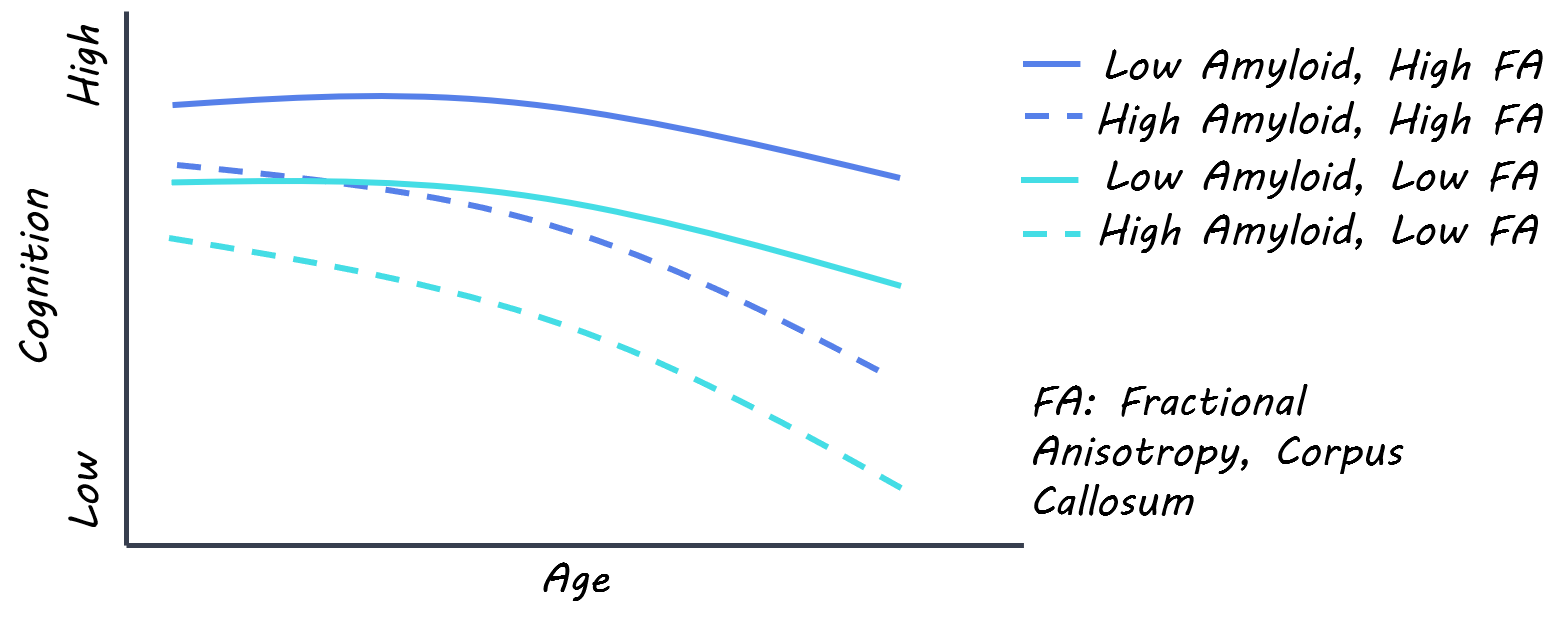
The authors selected 1230 participants enrolled in the Mayo Clinic Study of Aging, aged 50 years or older who had undergone brain scans and had at least two clinical follow-ups. The authors also calculated a composite cardiovascular health score for each participant that considered cardiovascular and metabolic conditions such as hypertension, diabetes, and stroke prior to the brain scans. The authors analyzed brain scans of participants to quantify average cortical thickness in brain regions known to be affected by Alzheimer’s Disease pathology and created a single measure as a proxy for aging- and Alzheimer’s-related neurodegeneration. They also computed a measure of amyloid levels in each participant’s brain (high levels can indicate pre-clinical stages of Alzheimer’s disease). To quantify brain tissue integrity, the authors measured the fractional anisotropy of a region of the corpus callosum. Fractional anisotropy quantifies the directionality of a diffusion process on a scale from 0 to 1, where a value of 0 means particles can diffuse in equally in all directions such as in a liquid (or cerebrospinal fluid), whereas a value of 1 means that particles can diffuse in only one direction, usually indicating the presence of dense fibre bundles. Finally, the authors estimated a cognitive score for each participant based on their performance on tests of executive function, language, memory, and visuospatial performance.

What did they find?

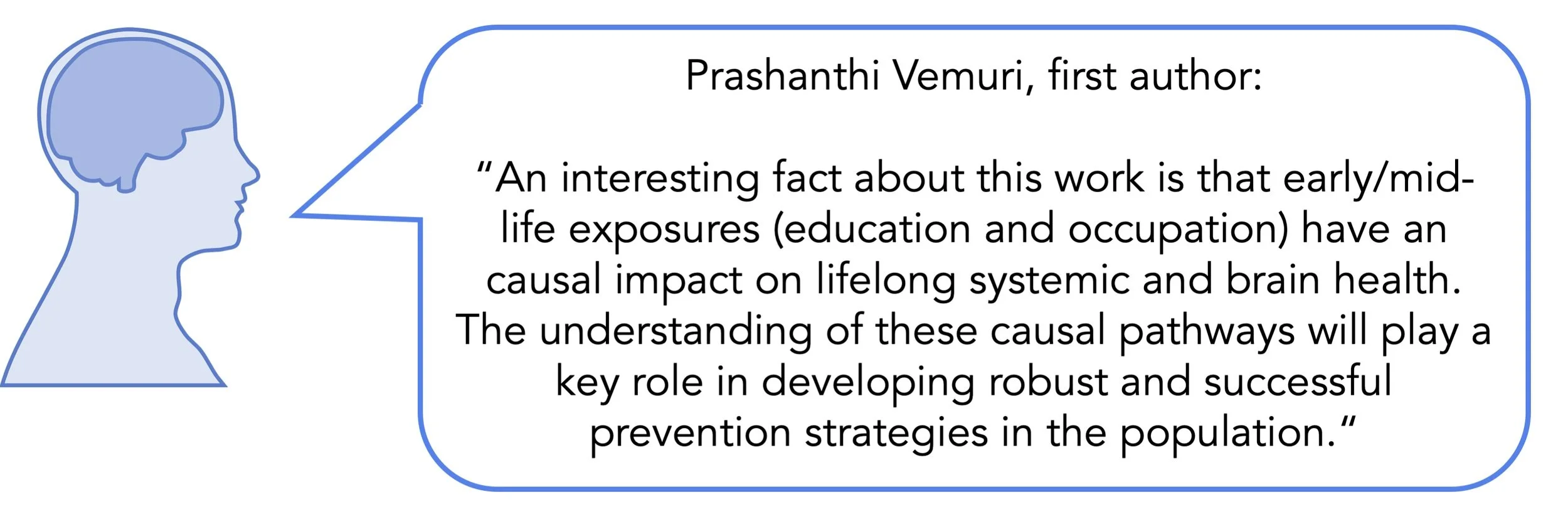
The authors found that cognition generally worsened with age, and that reduced brain tissue integrity predicted later decreases in cortical thickness. The authors also found that older age was associated with lower education (younger generations tend to be more educated), worse cardiovascular and metabolic condition, and reduced brain tissue integrity. Older women had the most risk of amyloid deposition, though older men had the most risk for cortical thinning. The authors also found that the strongest predictors of lower cognitive performance were old age, male sex, high amyloid, and decreased brain tissue integrity and cortical thickness. Factors that increased resilience of the brain included higher levels of education and occupation. Interestingly, higher education was associated with better systemic vascular health, which contributed to better brain tissue integrity, increased cortical thickness, and ultimately better cognition and reduced risk of dementia, suggesting that early-life exposures had an impact on life-long health. Finally, the authors found that increased amyloid levels predicted accelerated cognitive decline and increased risk of dementia. Notably, the authors describe that cerebrovascular, amyloid/Alzheimer’s, and resilience factors have converging effects on cortical thickness and cognitive decline. Amyloid/Alzheimer’s factors generally result in neuronal loss and a decrease in grey matter integrity, but cerebrovascular and resilience factors affect white matter integrity which can subsequently impact grey matter changes.
deb (5).png

What's the impact?

This is the first study to demonstrate that resilience and vascular factors contribute to the degradation of white matter, which then contributes to shrinkage of grey matter regions as seen in Alzheimer’s and aging. This suggests an important effect of vascular health on cognitive decline in the aging brain. This study expands our knowledge of the complex and dynamic processes of age-related cognitive decline and has broad implications for improving therapies and preventative treatments for cognitive impairment.
vemuri_quote.jpg

Vemuri et al., Amyloid, vascular, and resilience pathways associated with cognitive aging, Annals of Neurology (2019). Access the original scientific publication here.


How Does the Brain Understand Language From Letters?

Post by Flora Moujaes

What's the science?

For skilled readers, the process of reading comes so naturally that its complexities are often overlooked. In order to read at a reasonable level, the brain is required to recognise arbitrary visual symbols irrespective of their case, font, size, position in a word, or other irregularities caused by variations in handwriting. The brain must then instantaneously link the visual form of the letters with the stored meaning they represent. Neuroimaging research has suggested that the brain’s ability to abstract from letters to meaning is achieved by the ventral occipito-temporal (vOT) cortex. When a visual stimulus is encountered by the brain, the first signals reach the primary visual cortex — part of the occipital cortex. The information is then relayed through the occipital lobe towards the temporal lobe to recognize objects or symbols. However, the literature is still unclear about exactly how the vOT supports the ability to abstract from letters to meaning. This week in PNAS, Taylor and colleagues combined artificial language learning and neuroimaging to reveal how the brain represents written words.

How did they do it?

Researchers first trained twenty-four adults to read two sets of 24 novel words, written using two different alphabets of specially created symbols. They used pseudo words as this allowed the researchers to manipulate word form, sound, and meaning in a manner that would be hard to achieve in natural languages. Each pseudo word had a distinct meaning and was comprised of four symbols, three that contributed to the sound of the word and a final silent symbol. The words were similar to each other in one of three ways: (1) they contained some of the same symbols (they were from the same alphabet), (2) they sounded similar, or (3) they had a similar meaning but were written in different alphabets. This enabled researchers to examine how the brain encodes the visual stimuli itself as well as its associated sound and meaning. After two weeks of training, participants read the trained words while neural activity was measured using functional MRI.  The researchers then used representational similarity analysis to analyze the response similarity between evoked fMRI responses to similar words in selected regions-of-interest.

Flora (1).png

What did they find?

Representational similarity analysis of words from the same alphabet revealed that: right vOT and posterior left vOT represented written words in terms of their low-level visual form, and are thus sensitive to basic visual similarity. Posterior to mid -left vOT represented written words in terms of their letters. In mid-vOT these letters had similar representations even when they occurred in different positions within a word. Representational similarity analysis on words from different alphabets revealed that: The anterior left vOT had similar neural patterns for words with similar sounds or meanings, even though they were written differently with no letters in common.

Overall these results show that as you move from the posterior to the anterior vOT, representations of letters become transformed from visual inputs to meaningful linguistic information. There is thus a hierarchical gradient in the vOT where letters are transformed from merely containing visual information to having more abstract meanings in order to convey spoken language information.

What's the impact?

These findings advance our understanding of how the brain comprehends language from arbitrary visual symbols. By examining the relationship between how visual form, sound, and meaning are encoded in the occipito-temporal cortex, this study provides strong empirical support for a hierarchical, posterior-to-anterior gradient in vOT that represents increasingly abstract information about written words. Given that learning to read is the most important milestone in a child’s education, it will be important for future studies to specify how linguistic influences on vOT change over time; both in the short term while reading a word and during reading development.

rastle_quote.jpg

Taylor et al. Mapping visual symbols onto spoken language along the ventral visual stream. PNAS (2019). Access the original scientific publication here.
Intervention During Adolescence Leads to Long-Lasting Rescue of Network Dysfunction in a Model of Schizophrenia

Post by Amanda McFarlan

What's the science?

Prefrontal cortex (PFC) maturation in late adolescence is known to be disrupted in individuals with schizophrenia. A key feature of this maturation process involves the synchronization of the PFC to other cortical and limbic brain regions through high-frequency oscillatory neuronal activity. This synchronization process is mediated by inhibitory neuron signaling from parvalbumin (PV)-expressing interneurons. The ventral hippocampus also plays a role in the maturation process of the PFC, by promoting inhibitory neuron signaling. Mouse models with chromosome 16 deletions, including the LgDel mouse model, have been useful in studying the pathological changes associated with the onset of schizophrenia. This week in Cell, Mukherjee and colleagues investigated whether cognitive and network dysfunction could be rescued in the LgDel mouse model of schizophrenia if treatments were administered during adolescence.

How did they do it?

To validate the LgDel mouse model as a model of schizophrenia, the authors investigated whether LgDel mice displayed similar phenotypes to those observed in humans with schizophrenia, namely, deficits in network synchronization and cognition. They used two behavioural approaches to test for impairments in cognition commonly associated with schizophrenia: goal-directed learning (associated with deficits in the PFC) and social recognition (associated with deficits in the hippocampus). To determine whether network synchronization was disrupted in LgDel mice, they recorded local field potentials in the medial PFC in awake, behaving animals and assessed the oscillatory activity of neurons in this region. Next, the authors used the PSAM/PSEM chemogenetic approach (allows for select activation of PV interneurons) to investigate whether PV interneuron signaling was disrupted in LgDel mice. Recording electrodes were implanted in the PFC of both LgDel mice and control mice to measure neural activity while selectively activating PV interneurons. Then, the authors tested whether the systemic administration of a dopamine receptor-2 antagonist (commonly used to treat the symptoms of schizophrenia) would rescue deficits in network function, cognition and PV interneuron signaling in LgDel mice. Next, they targeted the administration of dopamine receptor-2 antagonists to either two regions of the hippocampus (dorsal and ventral) or two regions of the PFC (medial PFC and the lateral orbital cortex) during several different time windows to determine the specific conditions that would allow for long-lasting effects from antipsychotic treatment. Finally, the authors investigated the role of PV interneurons in rescuing the LgDel mouse phenotype in late-adolescence by applying repeated chemogenetic activation of PV interneurons in either the medial PFC or ventral hippocampus between postnatal day 60 and 70 (late-adolescence).

What did they find?

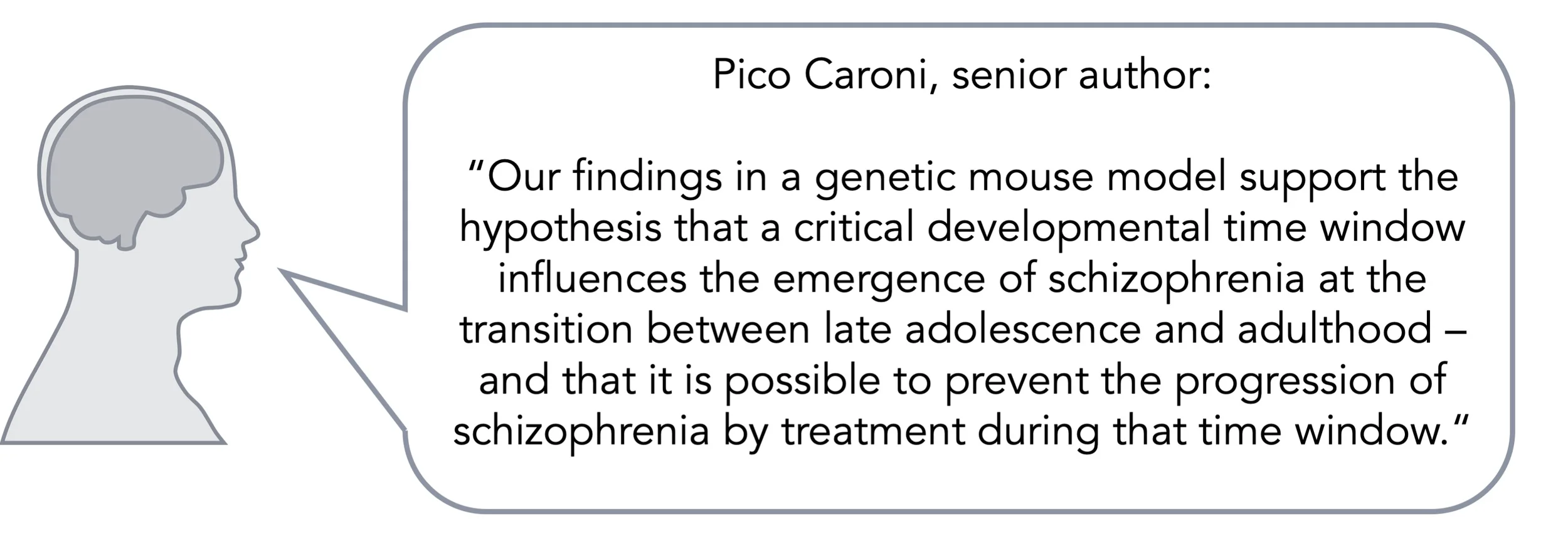
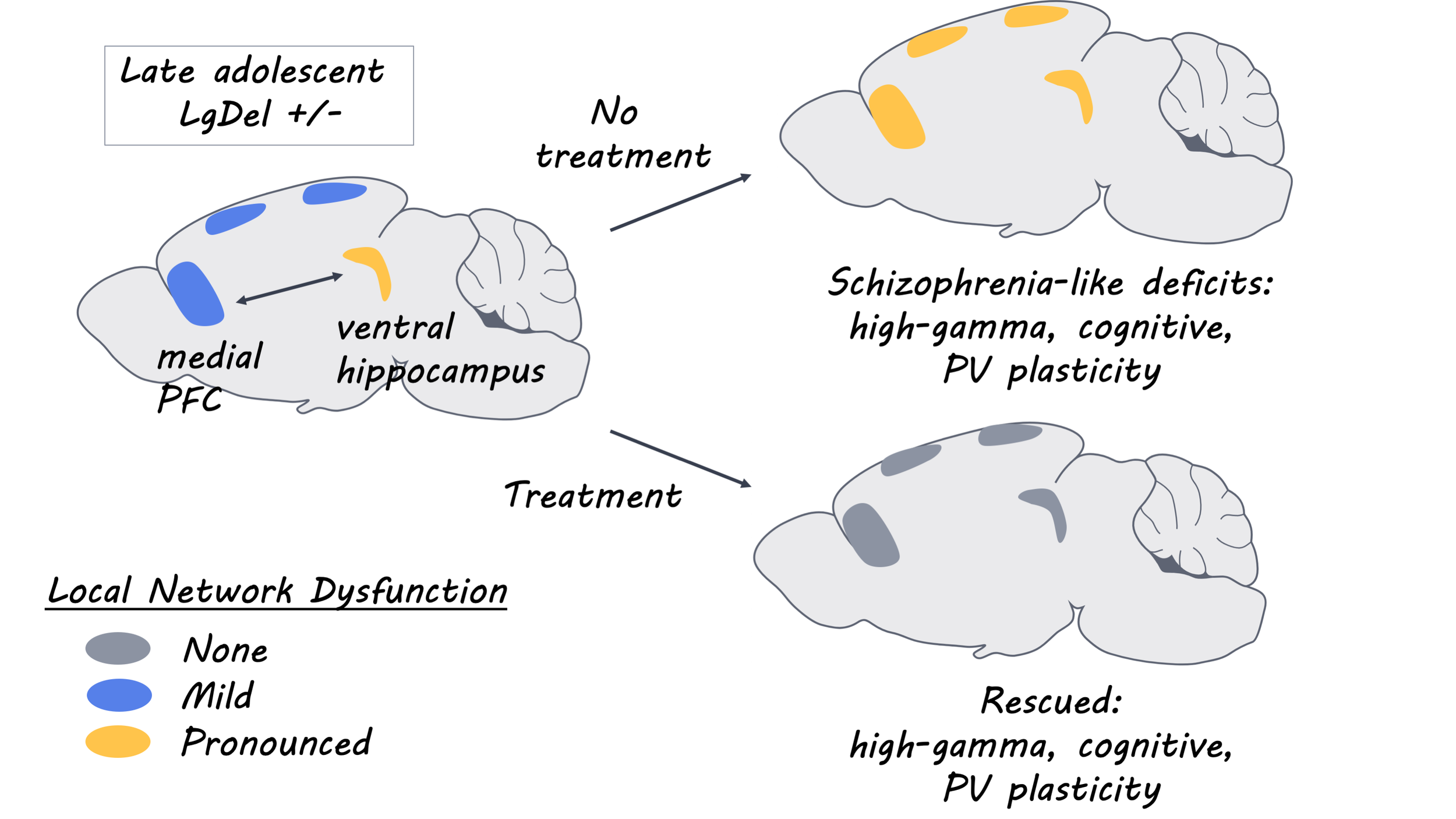
The authors determined that LgDel mice exhibit similar deficits in cognition as individuals with schizophrenia. They also found that, compared to controls, adult LgDel mice had a power deficit in the oscillatory activity of medial PFC neurons in the high gamma range, which may be indicative of a reduction in the activity of fast-spiking PV interneurons. In support of this, they revealed that interneurons had lower firing rates in LgDel mice compared to controls. Next, the authors showed that chemogenetic activation of PV interneurons in the medial PFC led to a robust increase in inhibitory neuron firing rates in control mice, but not LgDel mice, suggesting that PV interneuron signaling is disrupted in LgDel mice. Then, the authors determined that a single systemic dose of a dopamine receptor-2 antagonist in LgDel mice was able to transiently rescue the observed deficit in oscillatory activity in the gamma range and significantly improve performance during a social recognition task. Next, they found that targeted administration of a dopamine receptor-2 antagonist the ventral hippocampus or the medial PFC, but not the dorsal hippocampus or the lateral orbital cortex, led to long-lasting improvements in PV expression levels, PV interneuron activity and cognition. They showed that these long-lasting improvements only occurred if the dopamine receptor-2 antagonist was delivered in late-adolescence, suggesting that this period may be critical for treatment intervention. Finally, the authors revealed that repeated chemogenetic activation of PV interneurons targeted to the ventral hippocampus or medial PFC in late-adolescence resulted in similar long-lasting improvements in network activity and cognition as observed with dopamine receptor-2 antagonist administration. Together, these findings suggest that increasing the activity of PV interneurons within the medial PFC-ventral hippocampus axis during late adolescence may be critical to prevent progression to schizophrenia-like network and cognitive deficits in LgDel mice.

schizophrenia_rescue_img.png

What's the impact?

This is the first study to show that network deficits and cognitive impairments in LgDel mice can be prevented by targeted activation of PV interneurons in the ventral hippocampus and medial PFC during late adolescence. The authors showed that these improvements are long-lasting and can be achieved by chemogenetic activation of PV interneurons as well as administration of dopamine receptor-2 antagonists. Together, these findings provide insight into the mechanisms that may underly the pathological changes during late adolescence that lead to the onset of schizophrenia as well as potential treatments that may be useful to prevent progression to pathological changes in predisposed individuals.

caroni_quote.jpg

Mukherjee et al. Long-Lasting Rescue of Network and Cognitive Dysfunction in a Genetic Schizophrenia Model (2019). Access the original scientific publication here.