
The Right Frontal Eye Fields are Causally Involved in Distractor Suppression

Post by Shireen Parimoo

What's the science?

Selective attention involves attending to the appropriate, target information and ignoring distracting, irrelevant information. The dorsal attention network, which consists of the frontal eye fields (FEF) and the intraparietal sulcus (IPS), is active during tasks that require selective attention. Specifically, these regions are thought to be involved in the control of visual attention, as they bias posterior visual areas to enhance target processing and/or inhibit distractor processing. However, it is not clear whether the FEF provides unique regulatory input or whether both regions are independently involved in attentional control of distraction. This week in the Journal of Neuroscience, Lega and colleagues used transcranial magnetic stimulation (TMS) to identify the dorsal attention network regions causally involved in distractor suppression during a visual search task.

How did they do it?

Thirty right-handed young adults completed a visual search task in two separate sessions. In the task, participants saw four pairs of triangles in each quadrant of the screen and were instructed to identify the orientation of the target pair. The target was the pair of triangles with the same orientation (i.e. both pointing up or both down). On half of the trials, a pair of differently colored triangles served as the distractor, whereas on the other half of the trials, the distractor was absent and the non-target triangles were the same color as the target. In each session, participants completed six blocks of the task while TMS was applied to the IPS, FEF, and a sham stimulation region in each hemisphere. During TMS, a coil is used to non-invasively stimulate cortical brain regions by applying pulses of magnetic stimulation. The authors stimulated both hemispheres independently to determine whether the contribution of the dorsal attention network regions comes from one side of the brain more than the other. In the sham (control) condition, the TMS coil was placed between the FEF and the IPS to prevent cortical stimulation. In the task, the search array was presented for 50ms and the authors applied three 10 Hz TMS pulses 100ms after the onset of the search array, with a 100ms gap in between each pulse. After the search array disappeared, participants had two seconds to make a response for the target orientation.
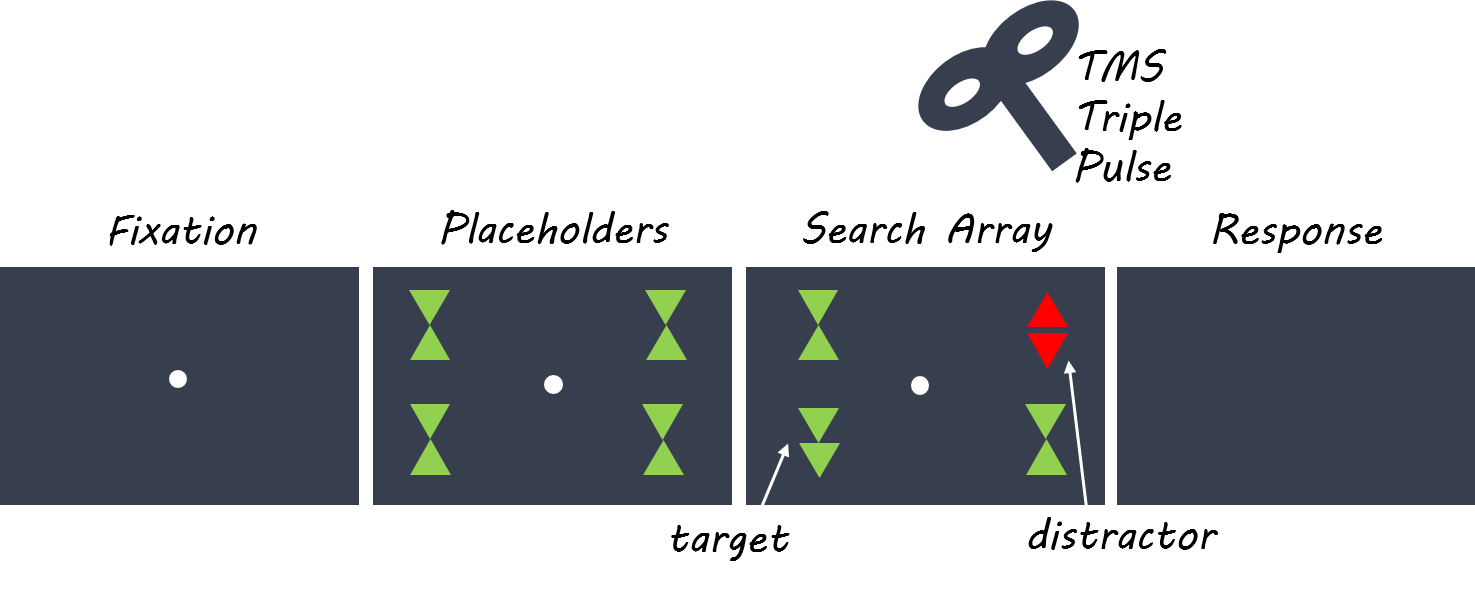
TMS.png

The authors analyzed participants’ reaction times on correct trials using linear mixed effects models, a statistical technique that accounts for variation in the data that is not explained by the TMS conditions (e.g. each participant could respond to stimulation differently). They compared differences in reaction times following TMS to the IPS and the FEF in each hemisphere and to the sham condition. The authors also computed distractor cost as the difference in reaction times between the distractor-present and distractor-absent conditions. Finally, to examine the effect of distractors on the preceding trial, they calculated distractor cost for trials that were preceded by a distractor-absent compared to a distractor-present trial. They hypothesized that in the sham condition, distractor cost would be smaller if the previous trial contained a distractor, as participants would be relatively more prepared to suppress subsequent distraction.

What did they find?

In general, participants were slower and less accurate when a distractor was present than when it was absent. In the sham condition, participants were faster on distractor trials if the distractor was also present on the preceding trial, versus when it was absent. Reaction times did not differ when TMS was applied to the FEF, IPS, or the sham region in the left hemisphere. However, distractor costs were smaller after right FEF stimulation than after left FEF stimulation, but there was no difference in distractor costs following left and right IPS or sham stimulation, suggesting that the FEF is functionally lateralized during visual attention, at least in relation to distractor inhibition. Moreover, the reduction in distractor costs following right FEF stimulation was driven by faster reaction times on distractor-present trials, particularly when the preceding trial did not contain a distractor. When a distractor was present on the previous trial, there was no difference in distractor cost in the right FEF and sham stimulation conditions, likely reflecting the attentional preparation carried over from the previous trial. These findings indicate that the dorsal attention network – particularly the FEF but not the IPS – is right-lateralized in tasks requiring top-down control of distractor suppression.

What's the impact?

This study highlights a causal role of the right frontal eye fields, but not the intraparietal sulcus, in exerting top-down control over visual attention and distractor suppression. These findings also suggest that in addition to single-trial effects, stimulation of prefrontal regions like the FEF prolong attentional control across multiple trials, providing further insight into their role in modulating visual attention in a sustained manner.

Chelazzi_quote.jpg

Lega et al. Probing the neural mechanisms for distractor filtering and their history-contingent modulation by means of TMS. Journal of Neuroscience (2019). Access the original scientific publication here.

Altered Expectations in Depression: A Predictive Processing Model

Post by Stephanie Williams

What's the science?

The cognitive model of depression suggests that individuals with depression experience the world in a more negative way -- likely as a result of abnormal information processing and cognitive function. Although this model has been valuable in understanding depression, some researchers have argued that altered expectations, specifically, might underlie Major Depressive Disorder (MDD). Mismatches between predictions and expectation (also known as ‘prediction errors’) are used to update current belief models. Individuals with depression are known to generate predictions and process mismatches between predictions and expectations differently than people who are considered mentally healthy. This week in Biological Psychiatry, Kube and colleagues propose a new model that incorporates aspects of predictive processing to explain how learning from predictions can be affected in MDD. 

How did they do it?

The authors review a collection of recent findings on cognitive processing in depression to propose a new model of depression focusing on expectations and predictive processing. They summarize key findings related to the neurobiology of prediction, behavioral studies and neurophysiological studies that support their framework for altered expectation and prediction error processing in MDD.

What did they find?

The authors propose that individuals with MDD predict negative experiences, discard positive information, and then find confirmation of those negative predictions. This process of discarding positive feedback is referred to as “cognitive immunization.” This framework suggests a biased learning process in individuals with depression, resulting in sustained negative predictions about their environment (i.e. a “negative feedback loop”). Interestingly, the authors point out that healthy individuals employ the same cognitive immunization strategy --- when faced with disconfirming negative information, healthy individuals discard the negative information and subsequently sustain positive expectations, which is related to optimism bias. Individuals with MDD rarely predict positive experiences, and consequently, miss the opportunity to perceive them. Specifically, the authors propose that individuals with MDD attend to negative experiences with greater precision, reducing the weight of positive experiences. The authors use their model to draw conclusions about learning rates in healthy and depressed individuals, which is dependent on the valence of the experience. They show that individuals with depression tend to maintain negative predictions longer than healthy people before updating them. The authors also suggest several brain regions involved in the maintenance of MDD, including the prefrontal cortex and the ventral striatal regions. The cognitive immunization strategy that individuals with MDD employ in the face of positive information may be supported by the suppression of prediction error processing in the ventral striatum by the prefrontal cortex. 

Stephanie (1).png

What's the impact?

The authors proposed a novel model focused on expectation that helps advance our knowledge of distorted cognition in depression. Their proposed framework could inform treatment strategies, such as attempts to reduce individual use of cognitive immunization against positive information. The authors also propose future research involving prediction errors to better understand which types of prediction errors are critical in perpetuating depressive symptoms.

Kube et al. Distorted Cognitive Processes in Major Depression- A Predictive Processing Perspective. Biological Psychiatry (2019). Access the original scientific publication here.

Brain Connectivity and the Spread of α-Synuclein Pathology

Post by Shireen Parimoo

What's the science?

Misfolding of α-synuclein protein is thought to underlie neurological disorders like dementia with Lewy bodies and Parkinson’s disease. As Parkinson’s disease progresses, Lewy bodies composed of misfolded α-synuclein are found in an increasing number of brain regions. However, little is known about how α-synuclein pathology spreads through the brain over time. Research in rodents has found that injecting misfolded α-synuclein directly into the brain can induce the aggregation of the rodent's own α-synuclein into Lewy body-like aggregates, eventually leading to neuronal loss. Additionally, people with a G2019S mutation in the LRRK2 gene have an increased risk of getting Parkinson’s disease, but not everyone with this mutation goes on to develop Parkinson’s disease. Thus, it is unclear how this genetic risk factor interacts with α-synuclein pathology in the development of disease. This week in Nature Neuroscience, Henderson and colleagues quantified the spatiotemporal spread of α-synuclein pathology in non-transgenic mice and examined the effect of the G2019S LRRK2 mutation in transgenic “at-risk” mice. 

How did they do it?

The authors injected pre-formed α-synuclein fibrils into the dorsal striatum of non-transgenic mice and mice with the G2019S LRRK2 mutation. α-Synuclein pathology was then quantified using immunohistochemistry one, three, or six months after the injection in 172 regions throughout the brain. A separate quantitative algorithm allowed the authors to develop a measure of neuron loss based on Lewy body loss over time, which was validated by counting the number of dopamine neurons lost in mice (detected by tyrosine hydroxylase antibodies). This experiment generated the first quantitative map of α-synuclein pathology in mice.

To further understand factors which impact the spread of α-synuclein pathology, the authors generated a network diffusion model that makes predictions about how pathology would spread along the axonal connections between regions. As a means of validation, they also tested several other models which predict spread based on 1) how close regions are to each other, 2) only anterograde (forward from neuron cell bodies to presynaptic terminals) connections, 3) a mixed-up connection map or 4) simulated injections from other regions. Finally, they measured relative vulnerability of brain regions to pathology by comparing the data to the model’s predictions. The reasoning behind this approach is that if there is more pathology in a given region than the model predicts, then that region is more vulnerable. Conversely, if there is less pathology than predicted by the model, then those regions are more resilient to α-synuclein pathology.

What did they find?

In non-transgenic mice, α-synuclein fibril injection induced reproducible spatiotemporal patterns of α-synuclein pathology in many regions of the brain, including the vulnerable substantia nigra. Neuronal death was observed primarily in the ipsilateral substantia nigra, which contains the dopamine neurons most affected in Parkinson’s disease. The network model based on retrograde connectivity (backwards from the synapse to neuron cell bodies) showed the best fit to actual pathology data, suggesting that these connections form the major pathway for pathology spread. Using this model, the authors found that thalamic nuclei were among the most resilient to pathology, and the amygdala and the piriform cortex were among the most vulnerable. These vulnerability measures correlated with α-synuclein gene expression, meaning that both the anatomical connectivity of brain areas and their gene expression profiles are important determinants of α-synuclein pathology. Interestingly, a different pattern was observed in G2019S LRRK2 transgenic mice, and pathology increased selectively in regions that were resilient in non-transgenic mice, indicating that the spread of α-synuclein pathology varies in the presence of genetic risk factors. 

synuclein_image.jpg

What's the impact?

This study is the first to quantify the spread of misfolded α-synuclein throughout the brains of non-transgenic and transgenic mouse models of Parkinson’s disease, and to generate a network model that can predict how α-synuclein pathology spreads. The final model, which predicts how pathology will spread through the brain based on anatomical connectivity and α-synuclein gene expression, provides a valuable tool for investigating the impact of genetic risk factors, understanding regional vulnerability and estimating the efficacy of therapeutic interventions.

synuclein_quote.jpg

Henderson et al. Spread of α-synuclein pathology throughout the brain connectome is modulated by selective vulnerability and predicted by network analysis. Nature Neuroscience (2019). Access the original scientific publication here.