
Visual Attention is Associated with Spatially Specific Neural Activity

Post by Elisa Guma

What's the science?

The visual system is organized retinotopically, such that mapping of visual inputs from retina to neurons within the visual cortex is spatially organized. In humans, these maps are commonly identified using functional magnetic resonance imaging. However, the relationship of these between these maps and those identified in humans and animals electrophysiologically  requires further investigation. It is thought that visual attention is related to the strength of alpha band activity (which is measured electrophysiologically) in the cortex. This week in Human Brain Mapping Popov and colleagues investigated whether alpha-band activity changes are retinotopically distributed using magnetoencephalography (MEG), a technique used to measure magnetic fields produced by electric currents in the brain.

How did they do it?

Thirty healthy participants (15 males/15 females) underwent MEG scanning while performing a visual response inhibition task (similar to the Eriksen flanker task). Briefly, participants were asked to fixate their gaze on a central white square. Next, a spatial cue, either a barrel or bowtie, was presented to them at one of 16 locations. Following a short interval (2.5 seconds) in which participants had to maintain their fixation on the cue, a target shape appeared at the same location in which the spatial cue was presented. The targets were flanked by either the same shape (bowtie-bowtie), or the opposite shape (bowtie-barrel). The goal of the task was for participants to identify whether the target was a bowtie or a barrel. The authors used spatial location tuning functions to associate spatial location of alpha frequency brain activity to the spatial location of the visual cues. Finally, they mapped the activation patterns onto a probabilistic atlas of the human brain.

meg.png

What did they find?

The authors found that maintenance of the cue position when the cue was in a location in the left half of the visual field was associated with a decrease in alpha band power on the opposite (right) side, and an increase in alpha power on the same side (left side). Next, they observed an increase in response time and a decrease in accuracy when the targets were flanked by the opposite shape. This was reflected in patterns of alpha activity such that when participants were not distracted by flankers of the opposite shape, but rather saw the same object for target and flank, they were better able to maintain alpha activity in the spatial location of the target. Further, the slower the reaction time of the participants, the less focal the alpha-band activation. Finally, using a brain atlas the authors show that their maps of alpha activity map onto areas of the visual cortex in the brain in a retinotopic fashion: Changes in the location of the target stimuli in the visual field were reflected by spatial differences in the activation pattern in the visual cortex..

What's the impact?

This study found that alpha-band activity in a spatial attention task had spatial specificity and was affected by participants’ distractibility and response time. These findings demonstrate that the alpha-band activity is critical in allocation of the brain’s resources in directing spatial attention. A deeper understanding of the way in which neural activity underlies visual attention may help us understand the mechanisms underlying visual perception and attention.

Popov et al. Spatial specificity of alpha oscillations in the human visual field. Human Brain Mapping (2019). Access the original scientific publication here.
Food and Drug Rewards are Processed by Unique Pathways in Mice

Post by Lincoln Tracy

What's the science?

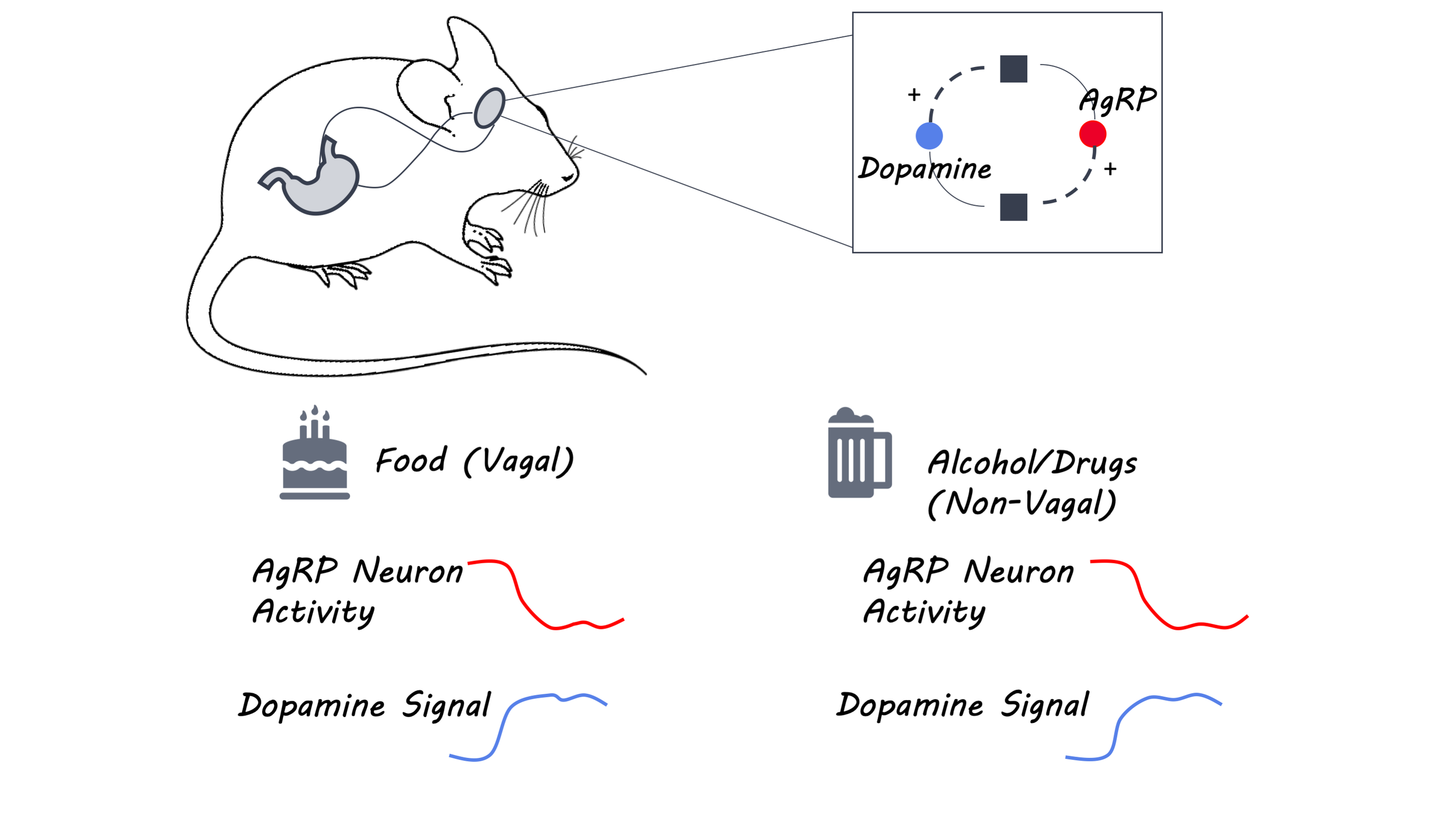
The motivation for natural rewards is mediated by both classic homeostatic circuits as well as mesolimbic dopaminergic circuits in the brain. It is not known how external rewards influence homeostatic circuits in the hypothalamus to alter behavior. Within the hypothalamus, agouti-related protein (AgRP-) and pro-opiomelanocortin (POMC)-expressing neurons play a key role in the control of food intake. The former subset of neurons is inhibited by food intake, while the latter subset of neurons is activated by food intake. Therefore, stimulating these subsets of neurons increases or decreases food intake, respectively. But does alcohol—a calorie-containing drug—use similar mechanisms to influence the activity of these hypothalamic neurons and food intake? This week in Neuron, Alhadeff and colleagues describe the different pathways utilized by drugs and nutrients as part of the coordinated regulation of hypothalamic feeding and midbrain reward circuits in mice.

How did they do it?

First, the authors engineered mice to express a calcium indicator in AgRP and POMC neurons in the hypothalamus. This allowed them to measure calcium fluorescence from these neurons as a proxy measure of neural activity using fiber photometry. Second, they examined AgRP and POMC neuronal activity in response to forced alcohol consumption by injecting alcohol through a catheter into the upper part of the stomach of the mice. Third, they tested how unrestricted alcohol drinking affected AgRP and POMC activity as alcohol is normally consumed on a voluntary basis. Fourth, they used optogenetics to test whether stimulating AgRP neurons led to increased alcohol consumption. Fifth, they investigated the role of the vagus nerve in how the AgRP neurons in the brain communicate with the gut. They severed the vagus nerve and examined whether the neuropeptides cholecystokinin (CCK) and peptide YY (PYY) modulated AgRP activity. Sixth, they looked at the effects of short- (hours) and long-term (two weeks) alcohol consumption on food intake in food-deprived and non-food-deprived mice. Finally, they injected several recreational drugs that suppress appetite—cocaine, amphetamine, and nicotine—into the abdomen of the mice to determine their effects on AgRP, POMC, and dopaminergic neuronal activity.

What did they find?

First, the authors found that injecting alcohol into the stomach of the mice reduced AgRP neuron activity in a dose-dependent fashion—meaning that the more alcohol that was injected, the less the AgRP were active. The injected alcohol had no effect on the POMC neurons. Second, they found that drinking alcohol reduced AgRP activity—but had no effect on POMC neuronal activity. These results imply that alcohol consumption sends different signals to the brain, compared to other nutrients. Third, they found that using light to stimulate the AgRP neurons did not influence the amount of alcohol that was consumed—but it did increase glucose intake. This finding suggests that the brain—at the level of AgRP neurons—does not associate alcohol with calories. Fourth, they found that severing the vagus nerve eliminated the effects of CCK and PYY on AgRP neuronal activity, implying that vagal neurotransmission—not central action—mediates the suppression of AgRP neurons. Fifth, they observed that only the food-deprived mice—and not the non-food-deprived mice—showed reduced food consumption after alcohol consumption. Sixth, they found that cocaine, amphetamine, and nicotine all reduced activity of the AgRP and POMC neurons and increased dopaminergic signaling in the nucleus accumbens.

Hunger_image_Jul9.png

What's the impact?

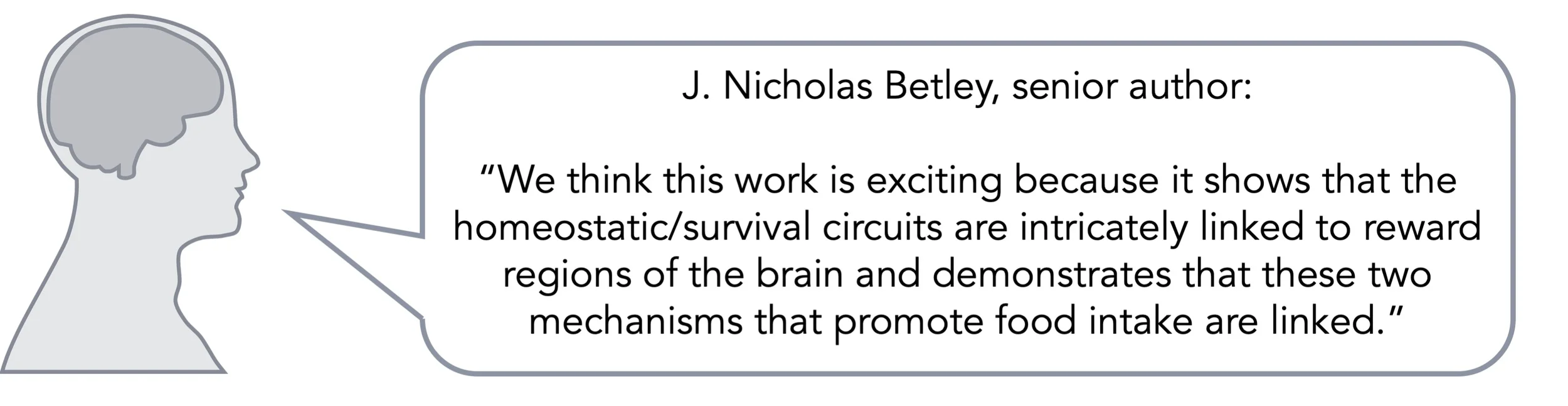
These findings show that there are both vagal-dependent and vagal-independent methods for reward signaling in the brain, and reveal the presence of bidirectional, modulatory network effects across brain circuits involving the hypothalamus and midbrain. This research also shows that drugs of abuse can robustly inhibit AgRP neurons independent of calories, which opens the door for the potential use of pharmacotherapeutics to modulate AgRP activity. Future research will be required to determine if and how drugs of abuse affect neural activity in other brain regions that control food intake and reward behavior. By improving our understanding of how nutrient-rich and nutrient-poor substances alter brain reward circuit activity, this research provides new targets for the development of weight loss and addiction therapies.

Betley_quote_Jul9.jpg

Alhadeff et al. Natural and Drug Rewards Engage Distinct Pathways that Converge on Coordinated Hypothalamic and Reward Circuits. Neuron (2019). Access the original scientific publication here.
Age- and Sex-Related Expression of Epigenetic Enzymes in the Human Brain

Post by Amanda McFarlan

What's the science?

Histone deacetylases are a family of epigenetic enzymes often termed epigenetic regulators, as some members of the family can modify gene expression in response to environmental and genetic cues. Preclinical and post-mortem studies in humans have shown that dysregulation of these enzymes may be associated with neurodegenerative diseases. Additionally, it has been suggested that sex-related differences in histone deacetylase expression may account for the discrepancy in the prevalence of neurodegenerative disorders between males and females. This week in Nature Communications, Gilbert, Zurcher and colleagues used neuroimaging techniques to investigate the role of sex and aging on the expression of histone deacetylase in the human brain.

How did they do it?

The authors used simultaneous magnetic resonance imaging (MRI) and positron emission tomography (PET) to map the expression of histone deacetylases in the brains of 41 healthy male and female participants aged 18 to 79 years old. They used 11C Martinostat (selective for class-I histone deacetylases) as the radiotracer for the PET scan and used the standard uptake value normalized to the whole brain mean as the measure of radiotracer uptake in the brain. They used a voxel-wise analysis (an analysis that examines each voxel or pixel in the brain) to investigate the correlational relationship between radiotracer uptake (indicative of histone deacetylase expression) and age or sex. Additionally, they calculated the generalized fractional anisotropy (a measure of the structural organization of the brain’s white matter) to determine whether age-related changes in histone deacetylase levels may be linked with white matter microstructure. Then, they used a voxel-wise analysis to look at the relationship between changes in histone deacetylase levels and white matter microstructure across the lifespan. Next, the authors used post mortem human brain tissue from 9 older individuals (average age of 85 years) and 9 younger individuals (average age of 18 years) of both sexes to investigate age-related changes in histone deacetylase expression at the molecular level. They assessed the relative protein expression levels of histone deacetylases 1, 2, 3, and 6 in the white matter using western blots.

The authors also explored how changes in histone deacetylase expression across the lifespan affect human behaviour. To do this, they assessed 23 participants (both male and female, aged 23-79 years old) on the Mayer-Salovey-Caruso Emotional Intelligence Test and then performed voxel-wise analyses to determine the relationship between radiotracer uptake levels and emotional intelligence.

What did they find?

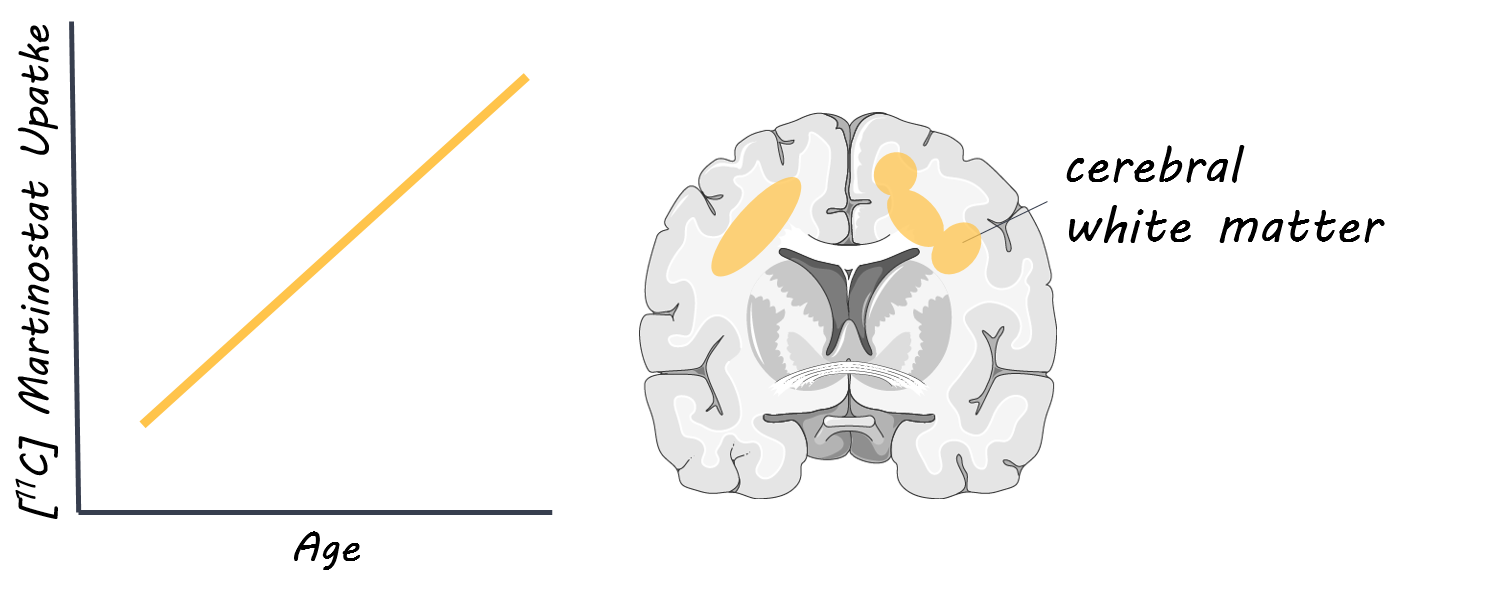
The authors found that the expression of histone deacetylase (measured by radiotracer uptake) increased with age in the cerebral white matter, but not in the corpus callosum or the hippocampus. Notably, they determined that the onset of this age-related increase in histone deacetylase occurred in mid-adulthood, around the age of 35 years old. The authors also showed that levels of histone deacetylase expression were higher in males compared to females in the cerebellar white matter and lower in males compared to females in the frontal medial cortex, amygdala, hippocampus, parahippocampal gyrus and thalamus. Together, these findings suggest that histone deacetylase exhibits both sex-related and age-related patterns of expression in the brain. Additionally, the authors determined that age-related increases in histone deacetylase expression levels were associated with decreases in white matter microstructure, suggesting that increased histone deacetylase expression may be linked to degeneration of white matter. Next, the authors found that expression levels of histone deacetylases 1 and 2 (important for myelination and oligodendrocyte differentiation) were significantly higher in tissue from older individuals compared to younger individuals. Conversely, there were no observable age-related differences in the expression levels of histone deacetylases 3 and 6. Together, these findings suggest that increased expression of histone deacetylases 1 and 2, but not 3 and 6, are likely responsible for the observed increase in histone deacetylase across the lifespan.

amanda33.png

Finally, the authors revealed that histone deacetylase expression levels in the hippocampus, as well as the inferior fronto-occipital fasciculus and the inferior longitudinal fasciculus tracts (important for social cognition and theory of mind),  were negatively correlated with emotional intelligence scores, suggesting that age-related increases in epigenetic changes in these brain regions may have a negative impact on emotional cognitive performance. 

What's the impact?

This is the first study to show that the expression of histone deacetylase in the human brain differs between sexes and increases across the lifespan. Additionally, the authors revealed that increased histone deacetylase expression in the hippocampus and white matter may negatively affect behaviour. Since histone deacetylase expression is known to be implicated in disease risk, these findings provide insight into how they may be used as an ideal target for the development of treatments to prevent or interrupt disease progression.

Gilbert et al. Neuroepigenetic signatures of age and sex in the living human brain. Nature Communications (2019). Access the original scientific publication here.