Non-Spatial Replay Is Informed by Previous Experience

Post by Sarah Hill

What's the science?

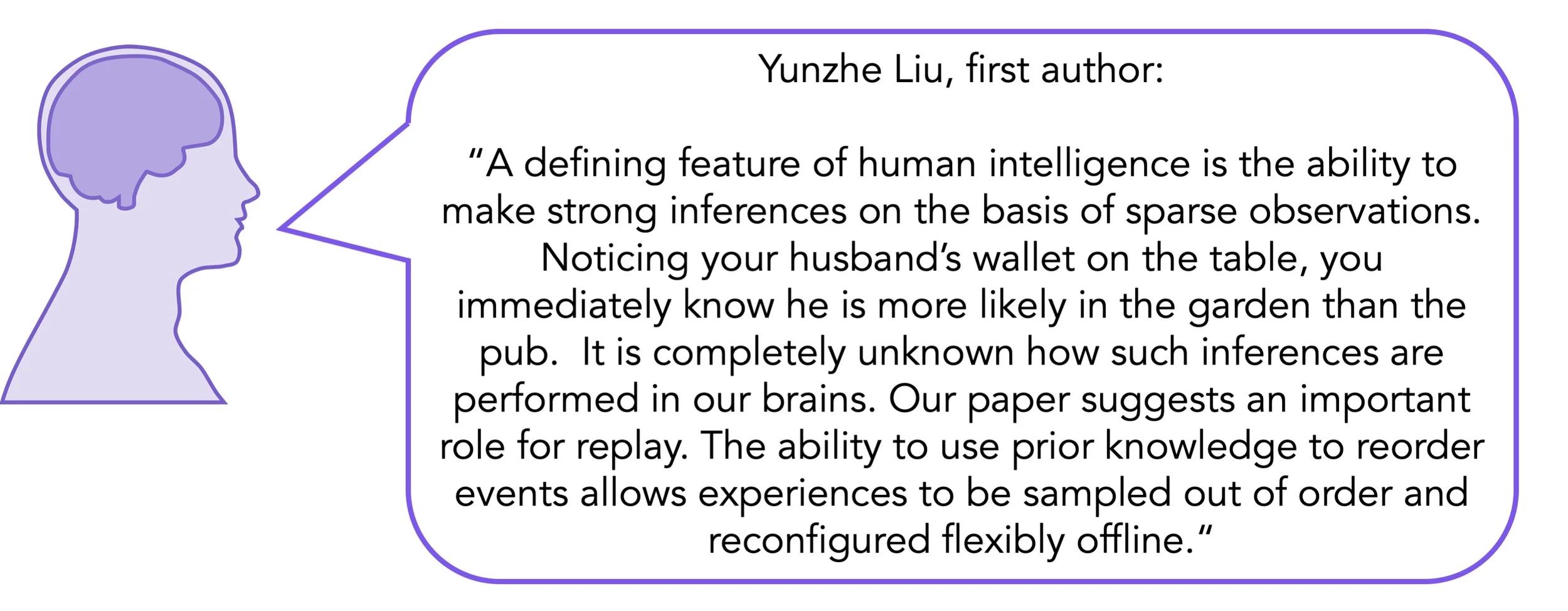
During rest, real and imagined stimuli are sequentially replayed in the brain as spontaneous rapid-fire sequences independent of sensory input. This phenomenon, termed 'replay', has been widely studied in rodent hippocampal place cells following a spatial navigation task. Replay has also been observed in non-spatial scenarios, such as when making inferences about how objects relate to one another. For example, after observing a broken vase next to a guilty-looking dog, one might mentally replay a scenario in which the dog knocks over the vase, despite not having witnessed said scenario. Relational knowledge abstracted from previous experience is theorized to guide future inference of relational information, though how this occurs and how it might be used in replay is poorly understood. This week in Cell, Liu and colleagues demonstrate that non-spatial scenarios are replayed in sequences inferred from existing knowledge of relationships between objects.

How did they do it?

To investigate how replay facilitates rapid inference of relational information, the authors carried out two studies using magnetoencephalography (MEG) to record spontaneous neural activity in human subjects. The first study was designed to test whether replay is derived in part from knowledge obtained from past experience. On day 1 of this experiment, participants were shown eight pictures from two different sequences, having been told the order the pictures were presented in was a scrambled version of the 'true' order. For example, pictures that were shown in the order [YZ, Y'Z'], [XY, X'Y'], and [WX, W'X'] implied two sequences WXYZ and W'X'Y'Z. On day 2, participants underwent MEG scanning while being presented with eight new pictures from another two sequences (termed the 'applied learning' phase): [CD, C'D'], [AB, A'B'], and [BC, B'C'] from the sequences ABCD and A'B'C'D'. After a 5 minute rest period, the subjects were shown that one of the terminal stimuli - either D or D' - was associated with a reward. This served to characterize one sequence as rewarding and the other as neutral (termed the 'value learning' phase). After another 5 minute period of rest, participants were randomly presented with pictures from the two sequences and asked to indicate the sequence to which the stimulus belonged. During the first 5 minute rest period, neural representations of each picture were decoded from the MEG recordings to decipher the sequence in which they were replayed. The decoding of these stimuli was based on a functional localizer task performed prior to the main task, in which participants simply viewed the images they would see later.

sarah.png

The second study was designed to rule out the possibility that sequential replay is a consequence of a simple Hebbian-like associative mechanism (based on the strength of association between the neurons encoding the stimuli). This would occur if participants encoded individual transitions (e.g. AB) rather than applying abstract knowledge (true replay). In this experiment, subjects took part in a 2-day task similar to that of the first experiment, except the pictures were no longer presented in pairs. Instead, they were explicitly told that the order in which pictures were presented mapped to the sequence of pictures in the 'true' order, and the same mapping pattern would be used for pictures shown on day 2. On day 1, subjects were presented with pictures individually in the order [Z' X Y' Y] and [Z W' W X'] corresponding to the sequences [WXYZ] and [W'X'Y'Z'], and told the sequence position of the stimuli (e.g. “the first stimuli to be presented (Z’) is last in the second sequence”). On day 2, they were first permitted to rest for 5 minutes while in the MEG scanner and then presented with eight new pictures that mapped to the 'true' order in the same way as day 1: [D' B C' C] and [D A' A B'] mapped to the sequences [ABCD] and [A'B'C'D']. After another 5 minute rest period, participants were shown the pictures in a randomized order and asked to indicate either the position of the stimulus in its respective sequence or the sequence to which the picture belonged. Finally, neural representations of each stimulus, as well as the position and sequence identity for each stimulus, were again decoded from the MEG recordings during the first rest period. 

What did they find?

In the first study, the authors observed that participants mentally replayed the novel pictures (ABCD and A'B'C'D) in the 'true' inferred order rather than the order visually experienced. During the 5 minute rest period following the applied learning phase, spontaneous neural activity encoding the new stimuli replayed the picture sequences predominantly in the forward direction. However, following the value learning phase, a spontaneous replay of the rewarding sequence occurred in the reverse direction (while the neutral sequence continued to replay in the forward direction). This is consistent with a previous study that found reward increases the relative frequency of reverse replay in rodents.

Neural replay during the 5 minute rest period was also observed in the second study following the applied learning phase. However, because the pictures were no longer shown in pairs, the order in which they were neurally represented could not have resulted from an associative mechanism. This suggests instead that relational information acquired from day 1 was used to inform the sequential replay of stimuli on day 2. Intriguingly, relational and sensory information about each stimulus were represented in distinct spatial and temporal domains. While each stimulus was neurally represented in occipital regions, corresponding position and sequence information were represented in posterior temporal regions. Furthermore, during sequential replay, spontaneous neural activity encoding the position and sequence of each stimulus occurred 40-60 ms before representation of the stimulus itself, demonstrating that relational information about an object is represented prior to representation of the object during rest.           

What's the impact?

This study provides further evidence that replay is not restricted solely to spatial processes and can be recorded non-invasively in humans. These findings suggest that spontaneous replay of stimulus sequences serves to aid the construction of internal relational models that are used for making future inferences about how objects relate to one another. More broadly, it seems possible that replay may be a brain-wide mechanism present in spatial and non-spatial learning and inference processes.
Liu_quote_Jul9.jpg

Liu et al. Human Replay Spontaneously Reorganizes Experience. Cell (2019). Access the original scientific publication here.

Crowded Organelles and Lipid Membranes: Key Features in Parkinson’s Disease Pathology

Post by Lincoln Tracy

What's the science?

Parkinson’s disease (PD) is a chronic progressive neurological disorder and the most common age-related movement disorder characterised by a wide spectrum of motor and non-motor features. Classic motor symptoms include shaking, rigidity, and difficulty with walking. Moreover, sleep disturbances, anxiety, depression, cognitive decline, and dementia are also common among PD patients. The motor symptoms arise through the death of dopamine neurons in an area of the brain called the substantia nigra. The key neuropathological feature of PD are Lewy bodies and Lewy neurites, which contain a protein called alpha-synuclein (αSyn). Lewy bodies accumulate in various regions of the brain in PD, including the substantia nigra. However, the process by which the Lewy bodies accumulate, and the details of their structure is unknown. This week in Nature Neuroscience, Shahmoradian and colleagues present a 3D view of the internal structure of Lewy body pathologies through the use of various advanced light and electron microscopy techniques.

How did they do it?

First, the authors collected postmortem brain tissue samples from five donors who had a clinical diagnosis of PD from the Netherlands Brain Bank. Second, they used correlative light and electron microscopy —a combination of light microscopy and electron microscopy—to identify the Lewy body pathology in the brain tissue samples and examine their ultrastructure. They also used serial block-face scanning electron microscopy (SBFSEM) and transmission electron microscopy (TEM) to visualize the shape and structure of the Lewy bodies on a nanometer scale. Finally, they used stimulated emission depletion (STED) microscopy in a second set of brain tissue samples from 14 donors with PD who had coherent anti-Stokes Raman spectroscopy (CARS), and lipidomics to corroborate the light and electron microscopy, SBFSEM, and TEM findings.

What did they find?

Using the correlative light and electron microscopy approach, the authors captured a 3D structure of 17 Lewy bodies and Lewy neurites (LNs) that contained αSyn. The majority of the αSyn inclusions consist mainly of membrane fragments, intact-looking and distorted mitochondria and other organelles, but have in most cases none or negligible quantities of protein fibrils. The findings confirm that the protein αSyn is a major constituent of Lewy bodies, but that they have a high degree of compositional heterogeneity and complexity.

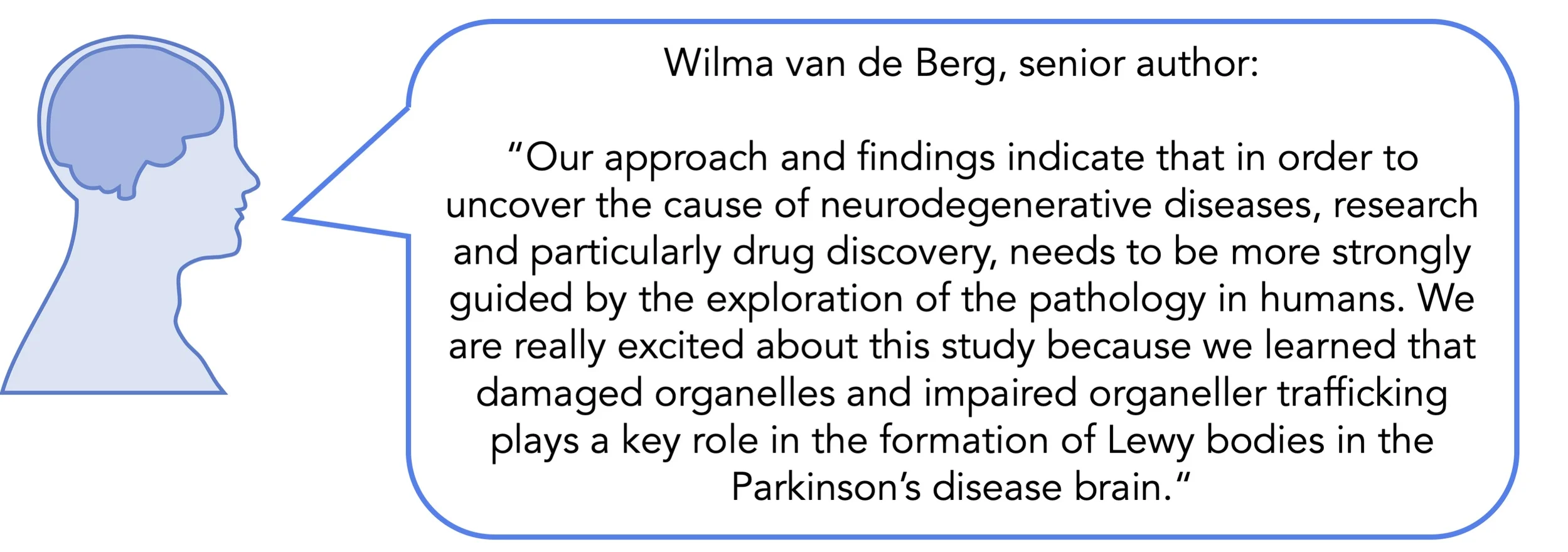
Further, these findings support the hypothesis that potentially damaged organelles and  impaired organeller trafficking play a key role in the formation of Lewy bodies. Next, the SBFSEM data showed the Lewy body pathology contained aggregated intracellular material, including crowded mitochondria, lysosomes and other organelles, and a shell of mitochondria surrounding some of the inclusions. The TEM images displayed the ultrastructure of the Lewy body pathology more clearly and revealed the pathologies contained membrane fragments and lipids. The independent techniques of STED microscopy, compositional mapping methods (CARS), and mass spectrometry confirmed the microscopy findings that Lewy bodies and Lewy neurites contain αSyn, lipids, lysosomes, and mitochondria.

lincoln (1).png

What's the impact?

These findings further our understanding of Lewy body pathology within the human brain while providing support for the hypothesis that impaired organelle trafficking is a key driver of disease progression in PD. Further studies are needed to examine the structure of Lewy body pathology across different stages of PD. Improving the understanding of how PD develops could trigger further studies on Lewy pathology, including mechanistic ones, that will assist in identifying better biomarkers and urgently needed new treatments for the disease.

vandeBerg_quote_Jul2.jpg

Shahmoradian et al. Lewy pathology in Parkinson’s disease consists of crowded organelles and lipid membranes. Nature Neuroscience (2019). Access the original scientific publication here.

Improved Brain Blood Vessel and Functional Repair after Stroke via Nogo-A Therapy

Post by Kasey Hemington

What's the science?

Ischemia (lack of oxygen) after stroke can cause severe disability, in part because there is limited blood vessel regeneration (angiogenesis) and repair in damaged brain tissue around the stroke (periinfarct zone). An axonal guidance molecule called Nogo-A is an angiogenesis inhibitor, so blocking this pathway after stroke could result in improved recovery via increased vascular restoration. This week in PNAS, Rust and colleagues assessed the effect of a genetic deletion or antibody-mediated neutralization of Nogo-A on mice after cerebral (brain) ischemia.

How did they do it?

The authors included 13 control mice, nine mice deficient for Nogo-A, and five mice deficient for S1PR2, (Nogo-A’s receptor) in the study. They also applied an anti-Nogo-A antibody to control mice, as an alternative to genetic deletion of Nogo-A. The mice’s motor skills were assessed at several time points between three and 21 days after ischemic brain injury. The authors also characterized gene expression using mRNA extracted from the periinfarct zone, in order to understand what genes were upregulated after stroke. Three weeks post-stroke, histological analysis was performed on the mice’s brains, and vascular function and regeneration, synapse and neurotransmitter function, and cell survival were evaluated. The authors also evaluated the relationship between any functional improvement in mice deficient of Nogo-A and angiogenesis, by applying an anti-VEGF antibody, in order to directly link vascular repair with functional improvement. VEGF is a growth factor critical for angiogenesis.

What did they find?

The authors found that several genes were upregulated post-stroke, including increased expression of Nogo-A and S1PR2 and other inhibitory vascular and neural factors, indicating these genes may be involved in post-stroke brain tissue damage or poor recovery. In control mice three weeks post-stroke, the authors observed low vascular branching and low overall vascular area in the periinfarct region, compared to the uninjured hemisphere of the brain. In Nogo-A and S1PR2 deficient mice, the vascular area was 179% and 53% improved and vascular branching was 179% improved and 85% improved respectively. In the uninjured hemisphere of the brain, vasculature and blood perfusion were not altered in Noga-A or S1PR2 mice compared to control mice. Similar results were found when the vasculature of mice was treated with an anti-Nogo-A antibody. The results suggest inhibiting Nogo-A improved the re-vascularization post-stroke, but didn’t alter vascularization in healthy brain tissue. In functional tests, three weeks post-stroke, Nogo-A and S1PR2 deficient mice experienced less paw dragging, and less error touches in a horizontal ladder test. Paw dragging was negatively correlated with vascular branching, indicating the functional improvement was related to the degree of vascular repair. When VEGF-mediated angiogenesis was blocked using an anti-VEGF antibody in Nogo-A deficient mice, vascular branching and other metrics were decreased compared to Nogo-A deficient mice (that received a control-antibody). These results suggest that the anti-VEGF antibody counteracts the beneficial effects of Nogo-A deletion.

Kasey (1).png

What's the impact?

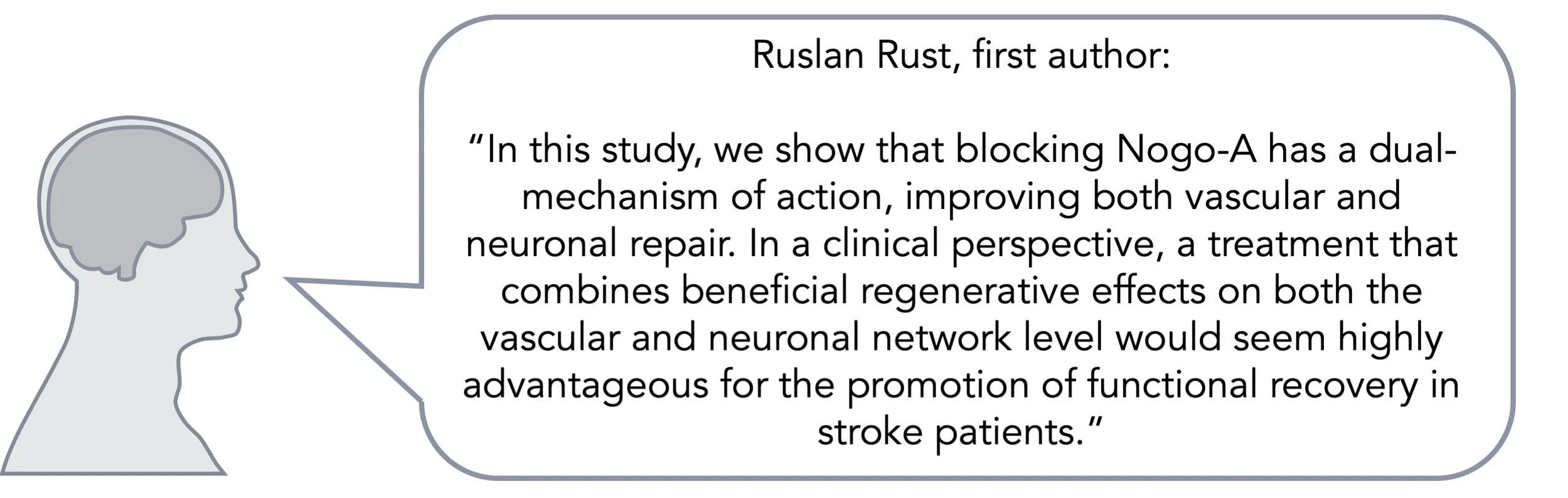
This study demonstrated that blocking Nogo-A, which can inhibit angiogenesis, results in improved both vascular and functional (behavioural) recovery post-stroke. This study, performed in mice, points to Nogo-A and other neurite outgrowth inhibitors as promising areas for future research, with the potential to improve vascular repair and functional recovery for stroke patients.

Rust_quote_Jul2.jpg

Rust et al. Nogo-A targeted therapy promotes vascular repair and functional recovery following stroke. PNAS (2019). Access the original scientific publication here.