Why We Make Decisions Together

Post by Anastasia Sares

What’s the science?

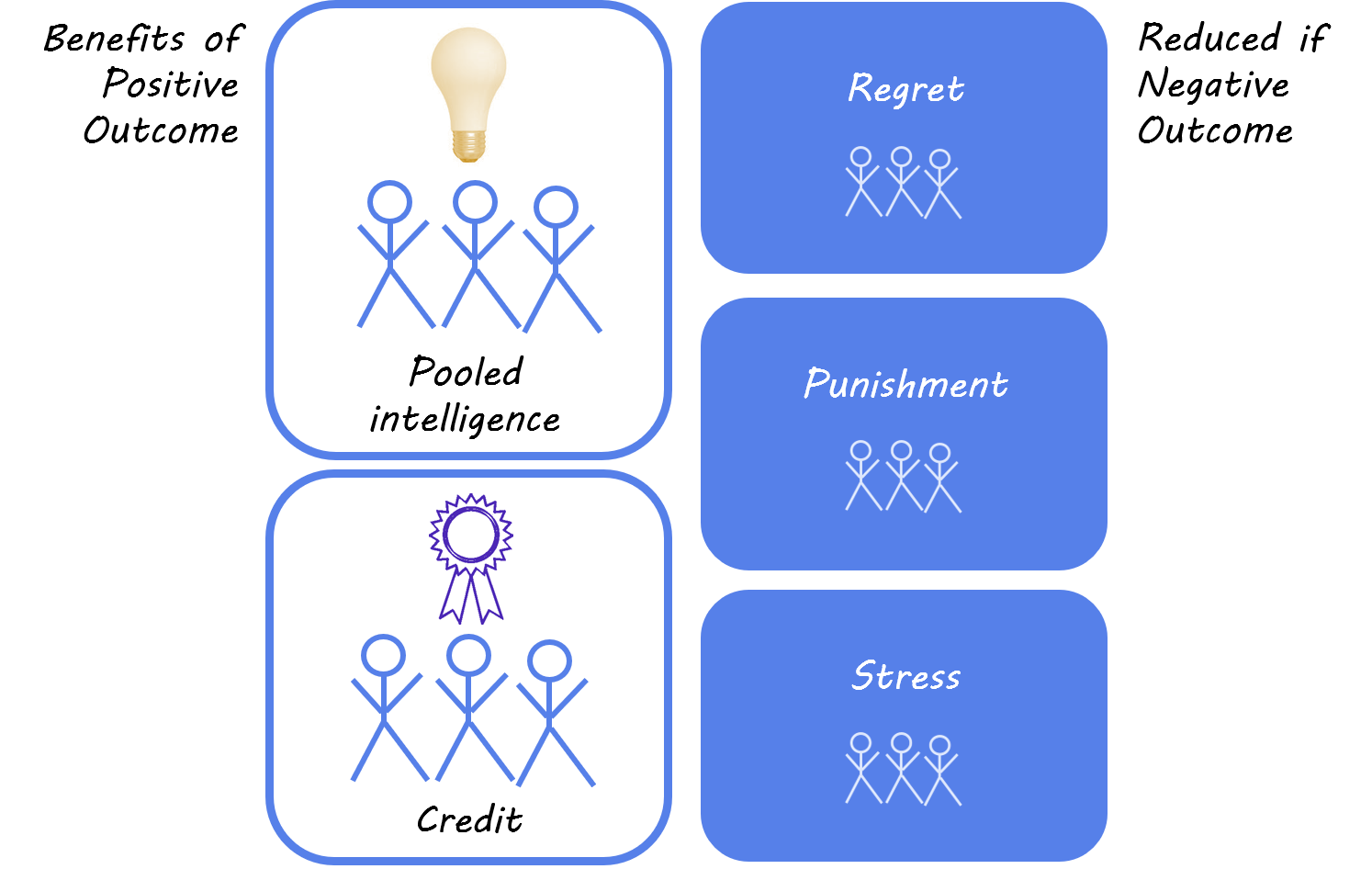
Collective decision-making behaviors have been demonstrated in social animals like bees, ants, and fish. Humans are also social creatures, and like these other species, we often make decisions together, even though we strongly value autonomy. What benefit is there in giving up some of our autonomy and making a decision as a part of a group? This week in Nature Human Behavior, El Zein and colleagues suggested that we decide together in order to dilute risks and negative outcomes.

What do we already know?

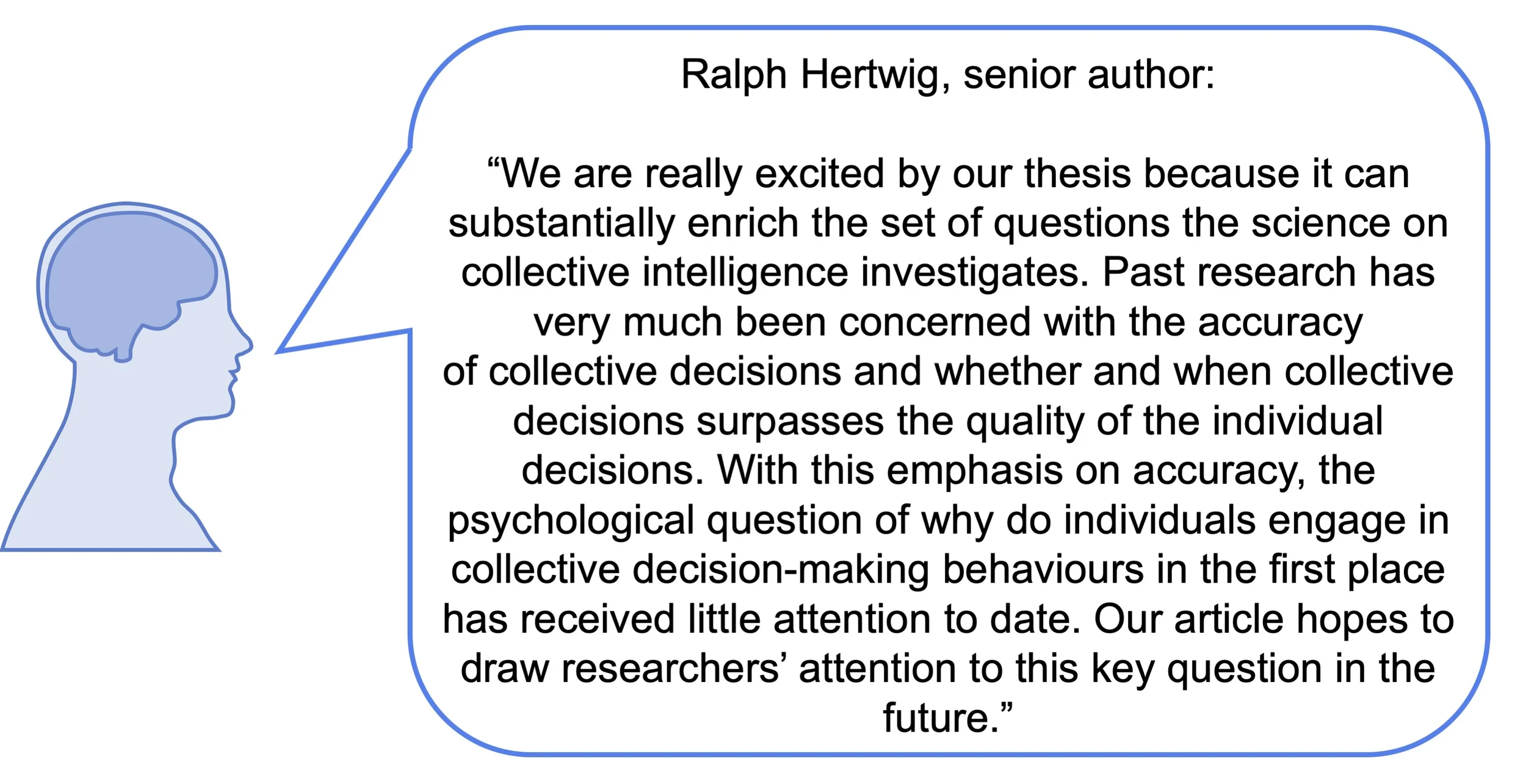
Previous research in this area has focused on whether collective decision-making results in a better decision overall. In some circumstances this process is helpful, but other times a group can get derailed and make a non-optimal decision. Since group decisions aren’t necessarily better in terms of accuracy, it is important to understand why we bother with them at all. After all, we like to have a choice when deciding what kind of product to buy, or what career to pursue. Some decisions are made together out of social obligation or a sense of fairness, but this may not account for all of the collective decision-making situations we observe.

What’s new?

The authors propose that one of the main reasons that individuals make decisions collectively is because it minimizes the risk taken by any one member. It’s what animals do when they herd or flock together, making it less likely that any one member is attacked (known as the dilution effect). Humans, even when they are not in physical danger, are very averse to certain emotional risks, especially regret or responsibility for a negative outcome. Making a decision as part of a group reduces the feeling of personal responsibility and can help us to cope with the stress of difficult decisions (like parents deciding whether or not to keep an injured child on life support). It may also protect us from social backlash (like when “whistleblowers” call out bad behavior of very powerful individuals). However, when taking the group perspective and not the individual perspective, the decrease of personal responsibility comes with its own problems: at worst, no one assumes responsibility for negative outcomes, and they are not addressed at all. Think of the bystander effect, where witnesses to an emergency situation are less likely to step in and help if others are present, or the tragedy of the commons, where individuals tend to over-use common resources.
anastasia.png

What's the bottom line?

There are a number of factors that push us toward collective decision-making: social inclusion and fairness, the idea that we are smarter together, and, as El Zein and colleagues emphasize, protection from negative consequences. In the future, it will be important to evaluate the relative contribution of these different factors in the drive to collective decision-making. This will help us better understand the behavior of the different social groups and governing bodies that permeate human society. Perhaps then we’ll know when to say, “many hands make light work” and when to say, “too many cooks spoil the broth.”
Hertwig_quote_May7th.jpg

El Zein et al. Shared responsibility in collective decisions. Nature Human Behavior (2019).Access the original scientific publication here.

Maternal Genetics, Early Life Exposures and Risk for Neurodevelopmental Disorders

Post by Stephanie Williams

What's the science?

Factors that occur before and during pregnancy, including maternal alcohol intake, poor nutrition, and stressful life events, have previously been linked with a higher risk for neurodevelopmental disorders in offspring. Most studies that assess the link between lifestyle factors and neurodevelopmental disorder risk do not properly account for maternal genotype, and could therefore be confounded by the genetics of the mother. This week in Jama JAMA Psychiatry, Leppert and colleagues assess the relationship between maternal lifestyle factors and maternal polygenic risk scores for neurodevelopmental conditions.

How did they do it?                                            

The authors analyzed data collected in an ongoing longitudinal study “Children of the 90s” of a large number (N=7921) of mothers in the United Kingdom. The dataset included genetic data and information on the health and lifestyles of the children and their mothers. Mothers were asked to report their drinking and smoking habits, use of antidepressants, and nutritional supplements. They were assigned a ‘stressful life score’ based on a self-report of whether they had experienced 18 different stressful life events.  Analysis of the mother’s blood was used to determine nutritional status and toxin exposure. Obstetric records were used to assess adverse birth events like low birth weight. The authors used previously identified risk alleles to calculate a polygenic risk score, which is a score calculated from the number of variants (single nucleotide polymorphisms) for a gene that indicates a certain amount of genetic risk for a disorder or disease. The authors were interested in investigating whether the polygenic risk scores for 3 different disorders, Attention Deficit Disorder (ADHD), Autism Spectrum Disorder, and Schizophrenia were associated with the lifestyle factors mentioned above. The authors calculated an association score for each of the lifestyle-related variables and the polygenic risk score for the 3 diseases.

What did they find?

The authors identified several associations between lifestyle factors and maternal risk alleles. Specifically, the authors identified associations between genetic risk for ADHD and SCZ and higher risk of smoking, and pregnancy BMI (higher BMI for ADHD, lower BMI for schizophrenia). Genetic risk for ADHD was associated with several additional factors, including infections, use of acetaminophen during late pregnancy, lower blood levels of mercury and higher blood levels of cadmium. The only factors found to be associated with polygenic risk score for all three disorders were maternal stressful life events during pregnancy and a higher risk for experiencing severe depression. Importantly, the authors point out that they found little evidence for associations between genetic risk for autism and schizophrenia and lifestyle factors (except for BMI with schizophrenia).

What's the impact?

This work emphasizes the importance of accounting for maternal genetics when drawing conclusions about lifestyle factors that affect risk for neurodevelopmental disorders. The authors identified for the first time associations between genetic risk for ADHD and several factors, including infections, acetaminophen, and blood levels of toxins. The results of the study could inform the care and treatment of pregnant women carrying risk alleles for neurodevelopmental disorders.

Leppert, B et al. (2019) Association of maternal neurodevelopmental risk alleles with early-life exposures. JAMA Psychiatry. Access the original scientific publication here

Thirst Controls Motivated Behavior by Modulating Neural Activity in Mice

Post by Lincoln Tracy

What's the science?

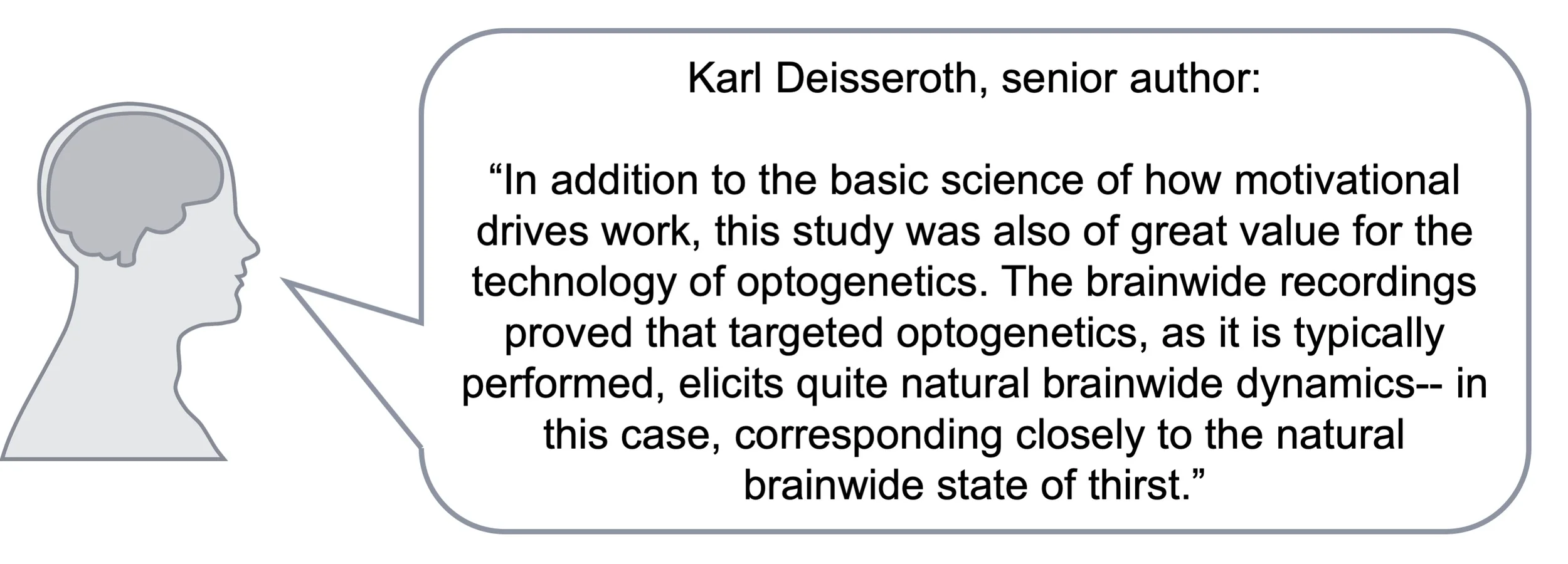
Motivation refers to an internal psychological state that explains how we can respond to the same stimulus or event in different ways depending on the context and our needs. For example, if you see a glass of water on a table, you are more likely to want to drink it after you have been exercising and are thirsty compared to when you had a glass of water ten minutes earlier. Traditionally, scientists have thought that motivational states control our behavior by altering the salience of a stimulus—that is, how noticeable or important we perceive something in our environment to be—depending on how much reward or pleasure we would get from the stimulus. Keeping in line with our example, we are more likely to notice the water when we are thirsty as drinking it then would be more rewarding. This week in Science, Allen and colleagues set out to uncover the neural mechanisms and activity that control these motivational states in the context of thirst.

How did they do it?

The authors first performed surgery on mice, so they could later use electrodes to record their brain activity. After the mice had recovered from the surgery they were deprived of water and trained in a modified version of a Go/No-Go task. In each trial of this task, mice were presented with one of two odors—ethyl acetate (the Go cue; a sweet-smelling liquid used in nail polish removers) or 2-pentatone (the No-Go cue; a colorless liquid found in apples). When ethyl acetate was presented in the trial, mice could lick a water spout and receive water as a reward. There was no reward associated with the 2-pentatone cue, meaning that the mice had no motivation to lick the water spout in these trials. The mice went through hundreds of trials of the task, learning to lick the water spout when they smelled ethyl acetate until eventually they had had enough to drink and stopped responding to the cue. Once the mice stopped drinking, another several dozen trials were undertaken where the mouse was presented with the same cues but did not drink because they were sated (i.e. satisfied). The authors used electrodes implanted throughout the brain to record brain activity while the mice completed the task to examine how neural activity changed throughout the brain at different stages of each trial, and throughout the whole task. Finally, the authors used optogenetics, a technique in which neural activity can be controlled by shining light on neurons that have been genetically modified to respond to light, to activate thirst neurons in the hypothalamus.

What did they find?

The authors found that neurons in different brain regions were active at different times during individual trials and throughout the task overall. Neurons could be grouped into one of three different clusters: state-related clusters that were active depending on whether the mouse was thirsty or not; cue-related clusters that were active or suppressed during the presentation of the odors; and behavior-related clusters that were only active in thirsty mice during Go trials when they drank the water. Each brain region where activity was recorded contained neurons belonging to each cluster, but specific regions had more of one type of neuron compared to other regions. In thirsty mice the presentation of the Go cue produced a rapid increase in neural activity, yet the same Go cue and the No-Go cue did not elicit the same activity increase in sated mice. These results suggest that the motivation to drink prior to the onset of drinking behavior is not driven by a broad change to all cue-responsive neurons, but rather a specific subset of neurons. When the authors optogenetically activated thirst neurons in the hypothalamus after mice were sated, they found that brain activity was temporarily restored to that of the ‘thirsty state’.

sciencepaper.png

What's the impact?

This study found that being thirsty places the brain in a particular motivational state. When we realize that water is available nearby—such as seeing a glass of water—there is a surge of activity in our brain that changes our motivation, resulting in us picking up the glass and drinking the water. Once we drink the water and are no longer thirsty, our brain state changes to prevent the same stimulus (a glass of water) from eliciting the same reaction (drinking the water). Further research is needed to determine whether these findings represent a more general form of arousal and motivational behavior in different states beyond thirst.

Deisseroth_quote_April30.jpg

Allen et al. Thirst regulates motivated behavior through modulation of brainwide neural population dynamics. Science (2019). Access the original scientific publication here.