
Impaired Decision Making Associated with Delusion Severity in Individuals with Schizophrenia

Post by Elisa Guma

What's the science?

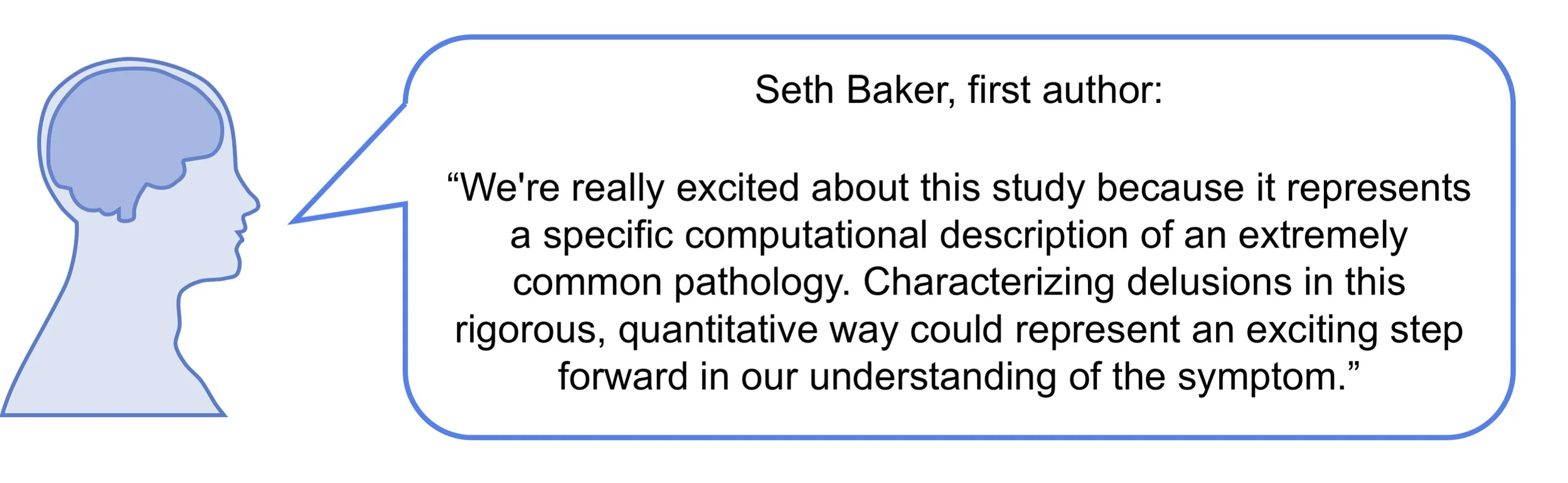
Delusions, a core symptom of schizophrenia, are defined as a belief that is firmly maintained despite being met with contradictory evidence. They can be very distressing and interfere with the social functioning of individuals. The cognitive mechanisms underlying the formation and maintenance of delusions is not well understood. This week in Brain, Baker and colleagues aimed to understand how individuals with severe delusions update beliefs based on new information using computational analyses of an inference-based decision-making task.

How did they do it?

Healthy controls and individuals with schizophrenia (half of whom were unmedicated) with varying severity of delusions completed a novel variant of a task commonly referred to as the ‘beads task’ to assess the relationship between delusion severity and evidence-based decision-making. During each trial of the novel ‘bead-task’, participants had to decide whether to draw beads from a hidden jar, at a small cost, or, if they felt confident enough, to guess the color most represented in that hidden jar, at a larger penalty in the case that their guess was wrong.
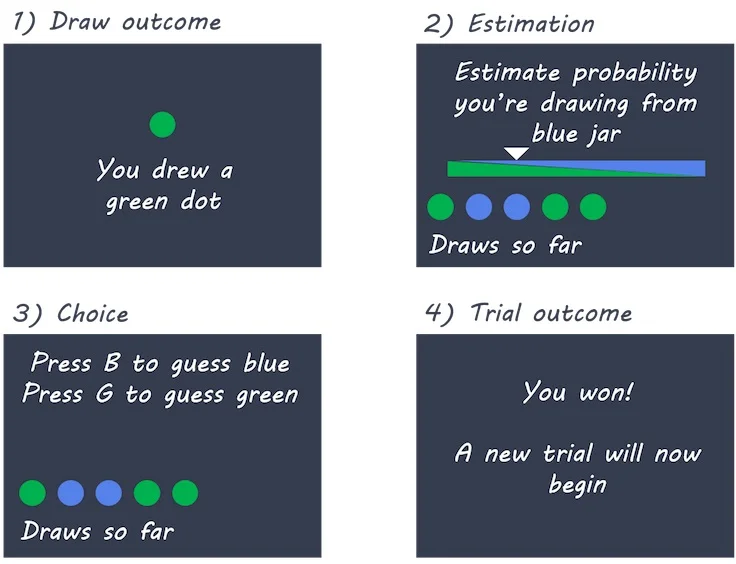
Elisa_new.jpg

The authors made great efforts to remove certain confounds from this test. Firstly, participants were given very detailed instructions, practice trials, a comprehension quiz, and post-task debriefing; participants who did not understand the task were excluded from analyses. To remove effects of general cognitive deficits and stress of time pressures, choice screens displayed the sequence of beads participants had drawn from the start of the trial to that point, and trial times were self-paced. To model their beads task data, the authors used a computational model (partially observable Markov decision process) in order to balance three components: (Bayesian) belief updating, value comparison, and choice. In short, the model estimates the expected value of guessing the beard color of the hidden jar (considering the cost of a potential incorrect guess), the expected cost of future guesses after drawing a bead (considering the cost of drawing a bead), and of potential incorrect guesses in the future. They tested whether individuals with higher delusion severity were more conservative or liberal with their guesses, and further investigated the effects of medication, other symptomatology, socio-economic status, and other aspects of working memory (based on two other tests).

What did they find?

The authors found that individuals with schizophrenia that had higher delusion severity were more conservative in their ‘draws-to-decision’ (i.e. the number of beads drawn before making a guess on the colour of the beads). In line with previous findings, individuals with schizophrenia, with low-delusion severity were found to be more liberal than both controls and high-delusion patients. Further, they found that the relationship between delusion severity and draws-to-decision was unaffected when accounting for hallucination severity, medication status, working-memory, income, and socio-economic status. Based on their modelling, the authors propose that the increased draws-to-decision in delusional patients was associated with an inability to update beliefs based on new, incoming information. Patients who acquired a biased either at baseline or sequentially throughout the task had abnormal belief updating, as modelled by Bayesian methods, which altered their value-based decision-making abilities. This is fitting in light of the fact that delusions are, by definition, rigid beliefs (i.e. resistant to updating).

What's the impact?

This study found that a failure to update beliefs in the face of new evidence by relying too heavily on prior beliefs, underlies delusions in schizophrenia. Conversely, individuals with schizophrenia and low delusion severity may seek less information in their decision-making process. The specific association between delusion and impaired decision making may aid in our understanding of the mechanisms underlying delusions, and schizophrenia more broadly. Future work could investigate whether this relationship holds true in high-risk phases.
Baker_quote_March26.jpg

Baker et al. A distinct inferential mechanisms for delusions in schizophrenia. Brain (2019). Access the original scientific publication here.
Kappa Opioid Receptors Drive the Emotional Component of Chronic Pain

Post by Elisa Guma

What's the science?

Chronic pain is a multidimensional experience. It is one of the leading causes of suicide, and often co-occurs with mood disorders such as depression and anxiety. Activation of the kappa opioid system is implicated in mood disorders like depression and has been shown to produce negative emotions, however its role in emotion associated with chronic pain remains unclear. This week in the Journal of Neuroscience, Liu and colleagues used a mouse model of chronic pain to investigate the function of the kappa opioid receptor (KOR) system in the mesolimbic circuitry (including the nucleus accumbens and ventral tegmental area) in modulating the aversive (i.e. emotional) component of chronic pain.

How did they do it?

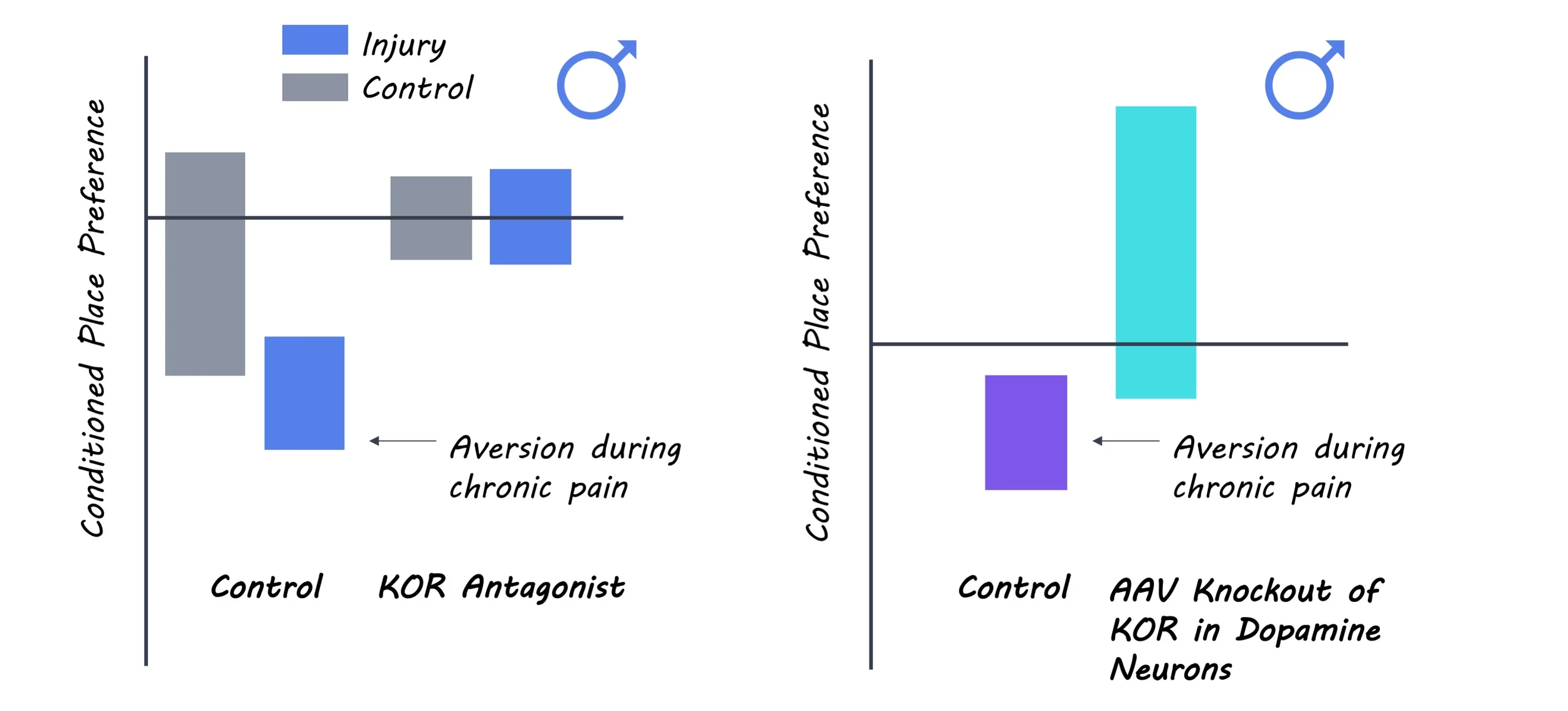
The authors first examined the behavioural relationship between KOR activation and chronic pain; they used the conditioned-place-preference/aversion paradigm to test for preference (more time spent in drug-paired environment) or aversion (more time spent in control environment) to a KOR agonist (a receptor activator) and a long-lasting KOR antagonist (an inhibitor), in mice with peripheral nerve injury to their hind leg (a model of chronic neuropathic pain).

Next, the authors tested the extent to which chronic pain alters expression and function of KORs, and expression of the endogenous ligand dynorphin, which binds to KOR in the mesolimbic circuitry of the brain. They did this by measuring ex vivo expression of messenger RNA (using in situ hybridization) and binding potential of KORs (autoradiography). Dopamine circuitry is thought to be dysfunctional in chronic pain. Therefore, using in vivo microdialysis, the authors measured dopamine release in real-time following morphine administration in the mesolimbic circuitry, to test the relationship between KORs and the mesolimbic dopamine system. To further characterize this relationship, the authors stained for KOR messenger RNA levels in dopamine cells projecting from the ventral tegmental area to the nucleus accumbens.  

The authors investigated the effects of an opioid antagonist (naloxone) with or without a KOR antagonist pretreatment, on preference and aversion. Because naloxone is non-selective (i.e. binds to receptors other than KORs), they used mice whose pro-enkephalin gene (another endogenous opioid) was knocked out to isolate the role of KORs. They also used the conditioned place preference/ aversion model to assess ongoing pain aversion to determine if KORs contribute to this aversive state. They performed some of these experiments in a model of chronic inflammatory pain to confirm that their findings were applicable to chronic pain more generally. Lastly, to investigate the specific role of KORs in the mesolimbic system, they selectively knocked out KORs in dopamine neurons projecting from the VTA (using adeno-associated virus technology) and measured conditioned place preference and aversion.

What did they find?

Opioid agonist administration produced a dose-dependent place aversion in male but not female mice who had chronic pain. Male (but not female) mice also had a profound increase in KOR messenger RNA expression, KOR activation (based on autoradiography), and phosphorylated KOR protein levels in the nucleus accumbens contralateral to the peripheral nerve injury. Pro-dynorphin (an opioid polypeptide found in the body) levels were increased in both male and female pain mice. These findings suggest that chronic pain associated with peripheral nerve injury increases expression and activation of the KORs in the nucleus accumbens of male but not female mice.

Micro-dialysis experiments demonstrated that systemic morphine administration failed to induce an increase in dopamine release in mice experiencing chronic pain. However, when KORs were blocked, dopamine release was normalized, suggesting that KORs act to downregulate dopamine release and the pain-reducing effects of morphine. Similarly, injection of mu-opioid agonist directly into the ventral tegmental area (in this experiment in rats) did not induce the expected conditioned place preference in rats with chronic pain. The conditioned place preference was restored in rats with chronic pain when KORs were blocked by an antagonist, suggesting that KORs antagonists restore blunted reward-related processing in chronic pain. Further, elevated KOR messenger RNA levels were observed in reward circuitry dopamine neurons (which send signals from the ventral tegmental area to the nucleus accumbens) of male mice, suggesting that chronic neuropathic pain causes a sex-dependent increase in KOR expression and function.

Pain_image_March19.jpg

Administration of the opioid antagonist naloxone produced aversion in both pain naïve wild-type mice and in wild-type mice experiencing chronic pain. Interestingly, it produced place preference in chronic pain pro-enkephalin knockout mice, and this was prevented by a long-acting opioid antagonist. These experiments suggest that naloxone-induced conditioned place preference in chronic pain pro-enkephalin knockout mice, is specifically associated with KOR blockade by naloxone. The authors found similar effects using an inflammatory pain model. Finally, they showed that place aversion was absent in mice whose KOR had been conditionally knocked out in dopamine neurons of the ventral tegmental area. This suggests that KORs in dopamine mesolimbic circuits contribute to aversive component of pain.

What's the impact?

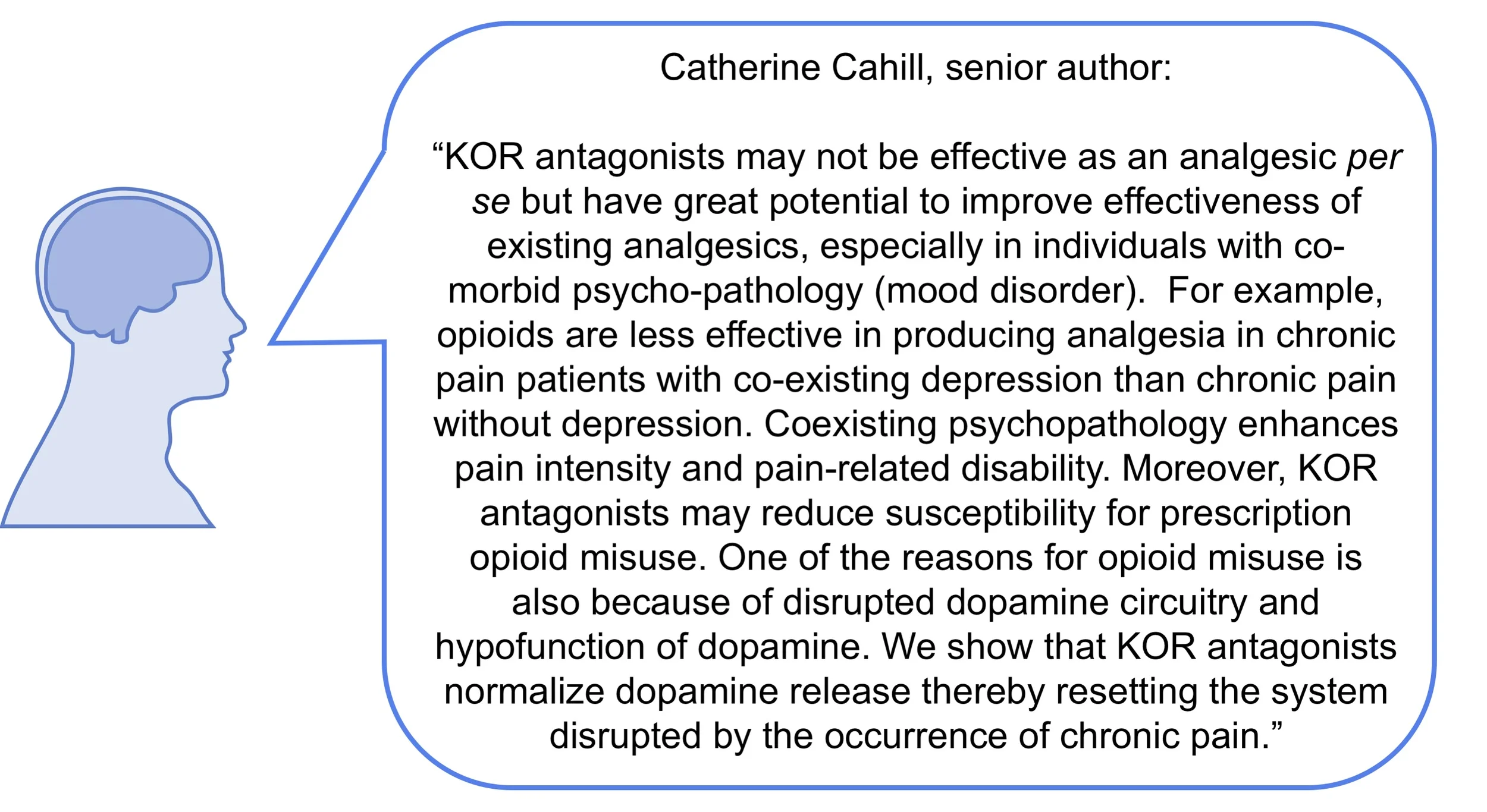
This study shows that activation of the kappa opioid receptor system in the reward circuitry of the brain is responsible for driving the negative emotional (tonic-aversive) component of pain in a sex-dependent manner. Further, the mechanisms investigated here are relevant to affective disorders associated with a disruption in reward circuitry, such as anxiety and depression as well as substance abuse. Kappa opioid antagonists may be a promising treatment avenue for these individuals, possibly reducing prescription opioid misuse in patient populations.

Cahill_quote_March19.jpg

Liu et al. Kappa Opioid Receptors Drive a Tonic Aversive Component of Chronic Pain. The Journal of Neuroscience (2019). Access the original scientific publication here.

The Timing of Synapse Formation During Development Drives Social Behavior in Rats

Post by Shireen Parimoo

What's the science?

In the first week after birth, hippocampal neurons first exhibit GABA-mediated (inhibitory neurotransmitter) signaling followed by glutamatergic (excitatory neurotransmitter) signaling. Cortical neuronal populations exhibit glutamatergic activity in the first postnatal week, followed later by GABAergic activity. These developmental sequences of neurotransmitter activity correspond to the maturation of neurons in the brain. Network-level (groups of neurons)patterns of activity are important for complex behaviors like social interaction. However, it is not known whether a particular developmental sequence initiates a shift toward network-level activity that enables the development of more complex behaviors. This week in Nature Communications, Naskar and colleagues used electrophysiology and chemogenetics to investigate the relationship between the development of functional synapses and complex social behavior in newborn rats.

How did they do it?

The authors first recorded synaptic activity from pyramidal cells (neurons) in layers II/III and V of somatosensory cortex slices from rat pups between 2 and 15 days old (i.e. ‘postnatal days’ 2 and 15). They used whole-cell patch clamp electrophysiology to record postsynaptic currents to determine the relative timing of glutamate and GABA synaptogenesis (i.e. the creation of synapses). They also examined whether synaptogenesis was related to structural changes in these somatosensory cortex layers by staining the slices and counting the number of dendritic spines while mice were between 7 and 15 days old. They assessed the development of 1) complex sensory and motor behavior in pups by observing huddling behavior, and 2) more basic sensory and motor behavior by measuring performance on the modified SHIRPA test.development. Behavioral results from the SHIRPA test can be clustered in revealed three main categories of behaviors: (i) primitive behaviors like reflexes, and (ii) motor and (iii) sensory behaviors. Huddling behavior (more complex) included the time that pups spent together, the number of different clusters they formed, and the number of times they switched from one cluster to another.

To investigate the relationship between synaptogenesis and huddling behavior, the authors transfected somatosensory layer II/III precursor cells with inhibitory Designer Receptors Exclusively Activated by a Designer Drug (iDREADDs; synthetic receptors) or a control green fluorescent protein (GFP). The authors then recorded huddling behavior in pups before and after CNO application; clozapine N-oxide (CNO) is a synthetic drug that inhibits activity in cells expressing iDREADDs but has no effect on GFP-expressing cells. Finally, they investigated whether serotonergic transmission affects the relationship between cortical activity and huddling behavior. This was done by measuring serotonin transporter (SERT) levels in cortical slices of projections to the somatosensory cortex and assessing huddling behavior after increasing serotonergic activity with citalopram (inhibits serotonin reuptake) in the pups.

What did they find?

In layer II/III neurons of the somatosensory cortex, glutamatergic currents were observed at postnatal day 5, before GABAergic currents at postnatal day 7, and the frequency of both currents increased between postnatal days 8 and 9. This increase in the frequency of currents was associated with an increase in the number of dendritic spines on somatosensory neurons. By contrast, glutamatergic and GABAergic synapse formation occurred at the same time in layer V somatosensory neurons, whereas GABAergic currents preceded glutamatergic currents in hippocampal neurons. This indicates that developmental sequences are not the same across different cortical layers within a brain region or across different brain regions entirely.

The motor and sensory behaviors assessed in the SHIRPA were observed before the development of functional cortical synapses, suggesting that these basic behaviors are not dependent on the somatosensory cortex. On the other hand, the emergence of the more complex huddling behavior was aligned with the timeline of cortical synaptogenesis. Specifically, pups exhibited greater huddling behavior between postnatal days 8 and 9, consistent with the increase in synaptic current frequency in the somatosensory cortex. In fact, inhibiting somatosensory neurons by CNO in iDREADD-expressing pups reduced huddling behavior compared to control pups. This relationship between somatosensory cortical activity and huddling behavior was modulated by serotonergic transmission. Serotonin neurons project to layers I-IV of the somatosensory cortex, and there was a larger concentration of SERT on axons projecting to the somatosensory cortex on postnatal day 9 compared to postnatal day 7. Moreover, enhancing serotonergic activity with citalopram had no effect on basic behaviors as measured by the SHIRPA, but led to earlier emergence of huddling behavior compared to control pups.

shireeen_pic.png

What's the impact?

This study demonstrates that functional synapses follow a non-uniform pattern of development both within and across different regions of the brain. It further shows that early social behaviors occur concurrently with the development of glutamatergic and GABAergic synapses in the rodent somatosensory cortex, and that this is modulated by serotonergic transmission. Overall, this research provides deeper insight into the relationship between the precise timing of cellular processes during development and the emergence of complex, social behaviors.

Naskar et al. The development of synaptic transmission is time-locked to early social behaviors in rats. Nature Communications (2019). Access the original scientific publication here.