
A New Neuron Population in the Hypothalamus Regulates Satiety and Prevents Obesity

Post by: Amanda McFarlan

What's the science?

The paraventricular nucleus of the hypothalamus contains a population of neurons expressing the SIM1 protein that have been shown to be critical in regulating feeding behaviour and satiety (feeling full). Neurons expressing the melanocortin-4 receptor (MC4R) were the first subset of SIM1-expressing neurons to be identified for their role in mediating satiety. However, previous studies have shown that inhibition of MC4R-expressing neurons causes increased appetite that only accounts for approximately half of that observed with inhibition of all SIM1-expressing neurons. Thus, there may be an unidentified population of SIM1-expressing cells, anatomically distinct from MC4R-expressing neurons, that also play a role in mediating satiety. This week in the Neuron, Li and colleagues investigated the role of prodynorphin (PYDN)-expressing neurons in the paraventricular hypothalamus in regulating satiety and bodyweight.

How did they do it?

The authors performed histological analysis in transgenic mice to investigate whether PDYN-expressing neurons and MC4R-expressing neurons were distinct cell populations within the paraventricular hypothalamus, and to determine whether PDYN-expressing neurons also expressed SIM1. Next, they explored how PDYN-expressing neurons affect satiety compared to MC4R-expressing neurons and SIM1-expressing neurons. To do this, they targeted the expression of an inhibitory DREADD (Designer Receptors Exclusively Activated by Designer Drugs) to PDYN-expressing neurons, MC4R-expressing neurons or SIM1-expressing neurons in the paraventricular hypothalamus and then observed the effect of inhibiting these neuronal populations on food consumption during a time of low caloric intake (the light cycle for mice).  

Next, the authors investigated the impact of long-term inhibition of PDYN-expressing neurons, MC4R-expressing neurons and both neuronal populations together on food consumption and bodyweight. They targeted either a tetanus toxin (to inhibit synaptic release) or a control virus (non-toxic) to each of the neuronal populations and measured changes in food intake and bodyweight over a one-month period. Next, they identified the brain areas that were innervated by PDYN-expressing neurons by injecting a Cre-dependent anterograde tracer into the paraventricular hypothalamus of a PDYN-Cre transgenic mouse. They used whole-cell recordings and Channelrhodopsin-2-assisted circuit mapping (CRACM) to assess glutamatergic transmission between PDYN-expressing neurons and their downstream connections. Finally, they used optogenetics to either increase or suppress the activity of PDYN-expressing neuronal terminals in the parabrachial complex to investigate the role of this circuit (PDYN-expressing neurons >> parabrachial complex) on food intake and satiety.

What did they find?

The authors determined that nearly all PDYN-expressing neurons also expressed SIM1, but not MC4R, suggesting that PDNY-expressing neurons are an anatomically distinct subset of SIM1-expressing cells. Then, they showed that chemogenetic inhibition of PDNY, MC4R and SIM1-expressing neurons caused an increase in food consumption compared to controls, and the effect of inhibiting PDYN or MC4R-expressing neurons was ~half as great as inhibiting SIM1-expressing neurons. Simultaneous chemogenetic inhibition of both PDNY and MC4R-expressing neurons, increased food intake to a level that was comparable to that observed with inhibition of SIM1-expressing neurons. These findings suggest that PDNY and MC4R-expressing neurons are two functionally independent subpopulations of SIM1-expressing neurons, that together, account for the majority of SIM1-mediated satiety. In addition, the authors found that long-term inhibition of PDYN- expressing neurons caused an increased appetite and a progressive increase in body weight compared to controls.

amanda (1).png

Next, the authors determined that PDYN-expressing neurons innervated and formed strong glutamatergic connections with neurons in a subregion of the parabrachial complex; this subregion was different than the subregion preferred by MC4R neurons. The results suggest that the pathway from PDNY-expressing neurons to parabrachial complex might be implicated in regulating satiety. Finally, they determined that optogenetic activation of PDNY-expressing neuronal terminals in the parabrachial complex decreased food intake, suggesting that the parabrachial complex is involved in regulating food intake. Conversely, they revealed that optogenetic inhibition of these neuronal terminals increased food intake, suggesting that the parabrachial complex is also necessary for satiety.

What's the impact?

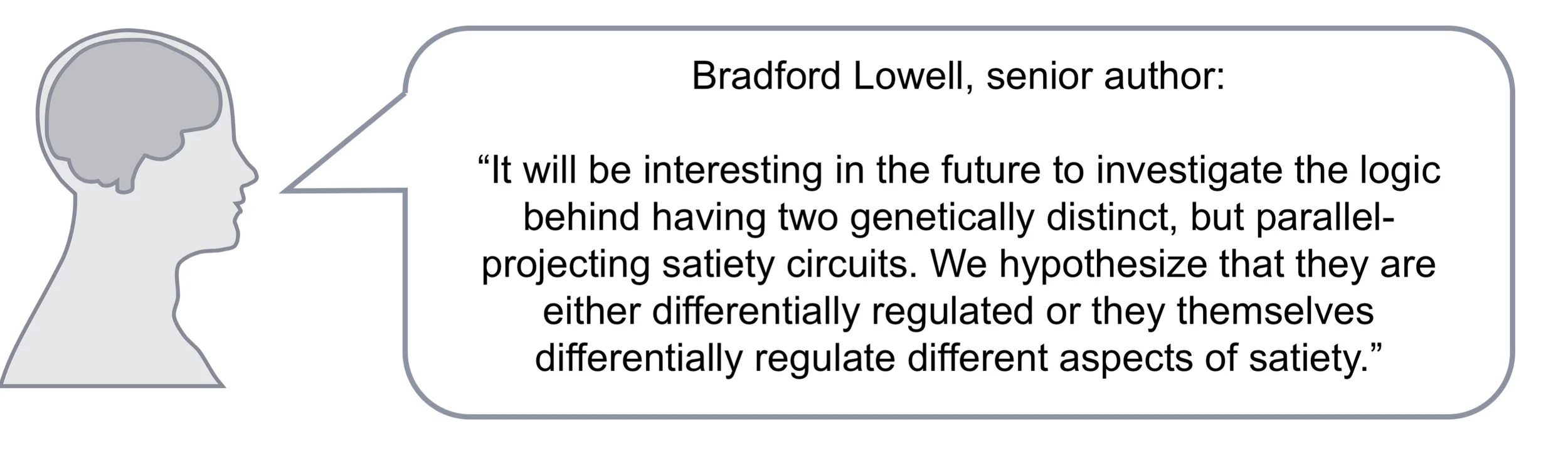
This is the first study to identify a novel subpopulation of SIM1-positive neurons in the paraventricular hypothalamus, expressing PDYN, that are anatomically and functionally independent from MC4R-expressing neurons. These PDYN-expressing neurons were shown to play a key role in regulating feeding behaviour and satiety. Notably, PDYN and MC4R-expressing neurons were shown to have an additive effect that accounted for the totality of SIM1-expressing neuron-mediated satiety. This study has provided insight into the circuitry underlying feeding behaviour and satiety and may be critical in understanding how to better treat conditions such as obesity.  
Lowell_quote_March19.jpg

Li et al. The Paraventricular Hypothalamus Regulates Satiety and Prevents Obesity via Two Genetically Distinct Circuits. Neuron (2019).Access the original scientific publication here.

Can We Alter the Progression of Huntington’s Disease?

Post by Anastasia Sares

What's the science?

The Huntingtin (HTT) gene has a number of roles in our brain, including neural development and transport of neuronal cell components, and we still don’t understand everything about it. We do know that the gene has an area where the base pairs “CAG” repeat a number of times. Sometimes, during DNA replication, the “CAG” gets stuck on repeat: if there are over 35 repeats, this leads to Huntington’s disease. The more repeats, the earlier the onset of symptoms, which include chorea (dance-like movements), muscle rigidity, lack of coordination, dementia, and depression. Statistically, 50% of the children of a person with Huntington’s will also have the disease.

In the mere 25 years since the discovery of the gene causing Huntington’s disease in 1993, there are now a myriad of possible approaches to treat this devastating genetic disease. This week in Neuron, Tabrizi and colleagues inventoried different treatment options for Huntington’s disease at the DNA, RNA, and protein level, showing how far in clinical trials each one has progressed, and evaluating their pros and cons.

What do we know?

In our body’s cells, genetic material (DNA) lives in the nucleus. In order to make functional proteins that do work in the rest of the cell, the DNA must first be transcribed into RNA, a messenger that takes the instructions outside of the nucleus, and then translated into proteins. The many repeats of “CAG” base pairs in the mutant HTT gene get translated into a long chain of abnormal material in the resulting protein. Because of HTT’s integral role in cell, these bad proteins have a variety of different effects, not least of which is that they can fragment off and cause neurofibrillary tangles. The tangles may lead to cell death in important brain regions like the striatum, which is responsible for movement selection and initiation.

When it comes to treating the disease, there are many different plans of attack. It might be possible to directly modify the mutant Huntingtin gene itself, chopping it out of the DNA. We could also target RNA, the messenger. Finally, we could intervene at the level of the Huntingtin protein, breaking down the mutants before they have a chance to affect other parts of the cell. However, silencing HTT, especially early in life, can cause a host of problems. A successful therapy must either silence ONLY the mutant HTT, or find a balance between reducing mutant HTT and leaving enough normal HTT for successful neural development. There’s another problem, too. Because of the mutations in the HTT gene, the cell doesn’t always follow the normal rules about where it should start and stop in the process of creating RNA or proteins. This can result in a number of non-standard proteins which are also toxic. An optimal therapy would be able to remove or reduce these non-standard proteins.

What’s new?

To make a treatment acceptable for use in humans, the method must first be demonstrated to be effective in cell cultures, other mammals, and non-human primates. It then proceeds to rigorous multi-phase clinical testing. Recent advances in DNA technologies like the CRISPR/Cas9 system allow for precision manipulation of DNA, and go directly to the source of the problem for a one-time treatment (this means the non-standard proteins will be taken care of as well). However, these technologies are very new and are still in the preclinical stage. Most DNA treatments, including CRISPR/Cas9, and also some RNA treatments, are currently very invasive, requiring insertion of foreign viral proteins directly into the brain. This is irreversible and might provoke inflammation or other immune responses, not to mention the high risks of brain surgery in general.

anastasia_image.png

The most clinically advanced treatments for Huntington’s disease are RNA-targeting methods, especially antisense oligonucleotides (ASOs). Unlike the highly-invasive DNA treatments, ASOs can be administered via lumbar puncture. However, ASOs might have to be administered repeatedly, which isn’t ideal, and they can’t target all of the abnormal proteins generated by the mutant HTT gene. At the protein level, one therapeutic method would be to stimulate the cell’s native machinery to degrade mutant Huntingtin proteins faster (through PROTACS). However, this is also preclinical and needs to be developed further, as we don’t yet know the best way to deliver them to the central nervous system or what side effects they might have. No matter which method is chosen, silencing both normal and mutant HTT seems more promising since it won’t have to be as personalized for patients with different numbers of CAG repeats. However, if we are to decrease HTT on a system-wide level, the timing of the intervention is critical. It would be important to delay start time of the therapy  to avoid the period of neural development but also start treatment early enough for it to be effective. Having better detection methods for Huntington’s disease progression will be crucial to this endeavor.

What’s the bottom line?

The principles behind Huntington gene therapies also extend to many other genetic diseases. The main problem is how to successfully deliver these therapies. The most powerful and specific therapies are also the most invasive and dangerous, and editing DNA comes along with ethical concerns. There is still much work to be done in bringing these therapies to the clinic, and future research will need to focus on providing a safe delivery of therapies while mitigating harmful side effects.

Tabrizi et al. Huntingtin lowering strategies for disease modification in Huntington’s disease. Neuron (2019). Access the original scientific publication here.

The Effect of Knowledge and Communication Style on Teaching Effectiveness

Post by Stephanie Williams

What's the science?

Human learning typically emerges from interactions with others. As online learning and e-lectures become more prevalent, it is important to understand how different social communication styles (eg. computer-mediated) can influence teaching effectiveness. Previous evidence has suggested that both communication style and prior knowledge states can affect how well students learn from their teachers. It is still unclear how the two factors interact, and how neural mechanisms contribute to differences in learning. This week in NeuroImage, Liu and colleagues used fNIRS-scanning to analyze how communication style and knowledge state affect how students learn.

How did they do it?                          

The authors measured the brain activity of 42 pairs of participants simultaneously, using a method called hyperscanning. The brain activity recordings were done using function near infrared spectroscopy (fNIRS), which employs lasers to noninvasively measure changes in deoxygenated and oxygenated hemoglobin in the brain. During the experiment, one participant of the pair acted as the ‘student’ and the other as the ‘teacher’. Teachers were asked to present material for approximately six minutes in two different communication modes: Face-to-face and via computer-mediated communication. In the face-to-face group, the teacher and student could see each other and could interact with nonverbal cues. In the computer-mediated communication mode, the participants sat with their backs to each other, and could only communicate via the computers.

Teachers presented two different types of material. One was a topic that the student already had prior knowledge about (“with prior knowledge” group), and one was a completely new topic (“without prior knowledge” group). In the prior knowledge group, teachers taught a Probability Theory formula (P(A|B) = P(A∩B)/P(B)) to students who had taken a formal course on Probability Theory. Material in the no prior knowledge group covered Option Theory (teachers taught the formula FV=Ae^nxr to calculate the price of a call option). Before they were allowed to interact with the students, the teachers underwent training and demonstrated that they could teach both types of materials.

The authors analyzed a) the participants’ responses to questionnaires (to understand how subjects the perceived teacher-student interaction), and b) the students’ scores on tests covering the material taught. The authors used these two types of behavioral measures to analyze the effect of interpersonal neural synchronization. They were interested in whether interpersonal neural synchronization mediated the relationship between the ratings of the teacher-student interaction, and the student subjects’ test scores. They were also interested in identifying the earliest time point in the experiment at which there was a correlation between the interpersonal neural synchronization and the teaching outcome. Finally, they assessed whether interpersonal neural synchronization in specific regions of the brain contributed to the relationship between the teacher-student interaction and the students’ test scores.

What did they find?

The authors found that the mode of communication had a significant effect on the perceived quality of the teacher-student interaction. Subjects tended to rate the perceived student-teacher interaction higher after face-to-face communication versus after computer-mediated  communication. The prior knowledge state of the student did not affect the ratings of the student-teacher relationship. The authors found that both prior knowledge and communication mode had an effect on the students’ test scores: Students taught in the face-to-face mode scored higher on tests than students in computer-mediated  communication mode, but only when they had already been exposed to the material and not when they had to learn new material. Students who rated their teacher-student interaction higher also tended to have higher test scores.

Neuroimage_March12.png

The authors found significant interpersonal neural synchronization in the left prefrontal cortex during the face-to-face teaching condition when students had prior knowledge. Early (within the first 25-35 seconds of teaching) prefrontal task-related interpersonal neural synchronization was correlated with teaching effectiveness. Differences between the fNIRS data collected during the two communication modes showed that task-related interpersonal neural synchronization was higher overall during face-to-face teaching than for the computer-mediated teaching. The authors concluded that interpersonal neural synchronization mediated the relationship between the perceived interaction and the students’ test scores. The authors did not see any signs of synchronization in the rTPJ, which had been previously found by other researchers during social interactions.

What's the impact?

The author’s findings suggest that fNIRS can be used to better understand dynamics between teachers and students, and to analyze teaching effectiveness. Further, teaching effectiveness is affected by the mode of communication (face-to-face vs. computer mediated) and this could be mediated in part by neural synchronization between student and teacher. This work advances our understanding of the interplay between knowledge state and communication mode in teacher-student interactions.

Liu et al. Interplay between prior knowledge and communication mode on teaching effectiveness: Interpersonal  neural synchronization as a neural marker. Neuron (2019).Access the original scientific publication here.