The Effect of Knowledge and Communication Style on Teaching Effectiveness

Post by Stephanie Williams

What's the science?

Human learning typically emerges from interactions with others. As online learning and e-lectures become more prevalent, it is important to understand how different social communication styles (eg. computer-mediated) can influence teaching effectiveness. Previous evidence has suggested that both communication style and prior knowledge states can affect how well students learn from their teachers. It is still unclear how the two factors interact, and how neural mechanisms contribute to differences in learning. This week in NeuroImage, Liu and colleagues used fNIRS-scanning to analyze how communication style and knowledge state affect how students learn.

How did they do it?                          

The authors measured the brain activity of 42 pairs of participants simultaneously, using a method called hyperscanning. The brain activity recordings were done using function near infrared spectroscopy (fNIRS), which employs lasers to noninvasively measure changes in deoxygenated and oxygenated hemoglobin in the brain. During the experiment, one participant of the pair acted as the ‘student’ and the other as the ‘teacher’. Teachers were asked to present material for approximately six minutes in two different communication modes: Face-to-face and via computer-mediated communication. In the face-to-face group, the teacher and student could see each other and could interact with nonverbal cues. In the computer-mediated communication mode, the participants sat with their backs to each other, and could only communicate via the computers.

Teachers presented two different types of material. One was a topic that the student already had prior knowledge about (“with prior knowledge” group), and one was a completely new topic (“without prior knowledge” group). In the prior knowledge group, teachers taught a Probability Theory formula (P(A|B) = P(A∩B)/P(B)) to students who had taken a formal course on Probability Theory. Material in the no prior knowledge group covered Option Theory (teachers taught the formula FV=Ae^nxr to calculate the price of a call option). Before they were allowed to interact with the students, the teachers underwent training and demonstrated that they could teach both types of materials.

The authors analyzed a) the participants’ responses to questionnaires (to understand how subjects the perceived teacher-student interaction), and b) the students’ scores on tests covering the material taught. The authors used these two types of behavioral measures to analyze the effect of interpersonal neural synchronization. They were interested in whether interpersonal neural synchronization mediated the relationship between the ratings of the teacher-student interaction, and the student subjects’ test scores. They were also interested in identifying the earliest time point in the experiment at which there was a correlation between the interpersonal neural synchronization and the teaching outcome. Finally, they assessed whether interpersonal neural synchronization in specific regions of the brain contributed to the relationship between the teacher-student interaction and the students’ test scores.

What did they find?

The authors found that the mode of communication had a significant effect on the perceived quality of the teacher-student interaction. Subjects tended to rate the perceived student-teacher interaction higher after face-to-face communication versus after computer-mediated  communication. The prior knowledge state of the student did not affect the ratings of the student-teacher relationship. The authors found that both prior knowledge and communication mode had an effect on the students’ test scores: Students taught in the face-to-face mode scored higher on tests than students in computer-mediated  communication mode, but only when they had already been exposed to the material and not when they had to learn new material. Students who rated their teacher-student interaction higher also tended to have higher test scores.

Neuroimage_March12.png

The authors found significant interpersonal neural synchronization in the left prefrontal cortex during the face-to-face teaching condition when students had prior knowledge. Early (within the first 25-35 seconds of teaching) prefrontal task-related interpersonal neural synchronization was correlated with teaching effectiveness. Differences between the fNIRS data collected during the two communication modes showed that task-related interpersonal neural synchronization was higher overall during face-to-face teaching than for the computer-mediated teaching. The authors concluded that interpersonal neural synchronization mediated the relationship between the perceived interaction and the students’ test scores. The authors did not see any signs of synchronization in the rTPJ, which had been previously found by other researchers during social interactions.

What's the impact?

The author’s findings suggest that fNIRS can be used to better understand dynamics between teachers and students, and to analyze teaching effectiveness. Further, teaching effectiveness is affected by the mode of communication (face-to-face vs. computer mediated) and this could be mediated in part by neural synchronization between student and teacher. This work advances our understanding of the interplay between knowledge state and communication mode in teacher-student interactions.

Liu et al. Interplay between prior knowledge and communication mode on teaching effectiveness: Interpersonal  neural synchronization as a neural marker. Neuron (2019).Access the original scientific publication here.

Spatial Encoding Differences Between Horizontal and Vertical Planes

Post by Deborah Joye

What's the science?

The brain helps us navigate the world by creating a spatial map of our surroundings, combining sensory information about how our body is moving with inputs from our external environment. The brain has specialized cells, called hippocampal place cells, that track where we are in the environment by only firing when we are in the cell’s ‘preferred’ location, or ‘firing field’. Place cells work together with grid cells of the entorhinal cortex, which track distance travelled by creating a grid-like array of firing fields across the entire environment. When we move, place and grid cells use external landmarks to estimate location, and self-motion cues, like where the body is in relation to the surface and movement speed, to constantly update those estimations. However, the function of these cells has mostly been studied as animals move horizontally. Do these cells integrate sensory information the same way when we move vertically? This week in PNAS, Casali and colleagues record grid cells and place cells in freely behaving rats to demonstrate that the brain differently encodes movement in the vertical and horizontal planes.

How did they do it?

The authors recorded electrical activity from 148 grid cells in the medial entorhinal cortex of 11 rats and 72 place cells from the hippocampus of 3 rats as they explored an open field arena (horizontal surface only) or over a floor with an adjoining climbing wall (horizontal and vertical surfaces). To ensure that recorded brain activity was not due to the novelty of a new climbing environment, the authors recorded from rats that had extensive climbing experience. Since self-motion cues, such as running speed, and local field potentials are also important for grid cell and place cell function, the authors also recorded from separate cells that encode speed and measured local field potentials. If the grid plane is defined by gravity, then walking on a vertical surface instead of a horizontal plane should produce “stripes” (firing fields would be aligned in vertical stripes) in the recording of grid cell activity. Alternatively, if the grid plane is defined by the body plane, then firing fields should be grid-like (circular and evenly spaced) on the wall, just as they are on the floor. This is because even though the rat is moving vertically, the body is still parallel to the movement surface, as it would be if the rat was moving horizontally across the floor.

What did they find?

The authors found that grid cell firing patterns were different when rats climbed on the wall versus walking across the floor. During climbing, grid cells showed an overall reduction in firing activity with fewer, larger firing fields than those seen during horizontal movement. Grid cells also produced discrete firing fields during climbing, rather than the vertical “stripes,” that might be expected if grid cell firing while climbing on a vertical wall were due to gravity, suggesting that grid cell firing is adjusted by considering the rat’s body plane in relation to their movement surface. In contrast to grid cells, fewer hippocampal place cells were active during climbing but firing characteristics were otherwise not different between the horizontal and vertical planes. Lastly, recordings of firing rates and local field potentials from speed cells revealed that the brain’s encoding of movement speed was consistently underestimated during vertical climbing, which may contribute to the enlarged grid cell firing fields observed when rats were climbing.

firingcells.png

What's the impact?

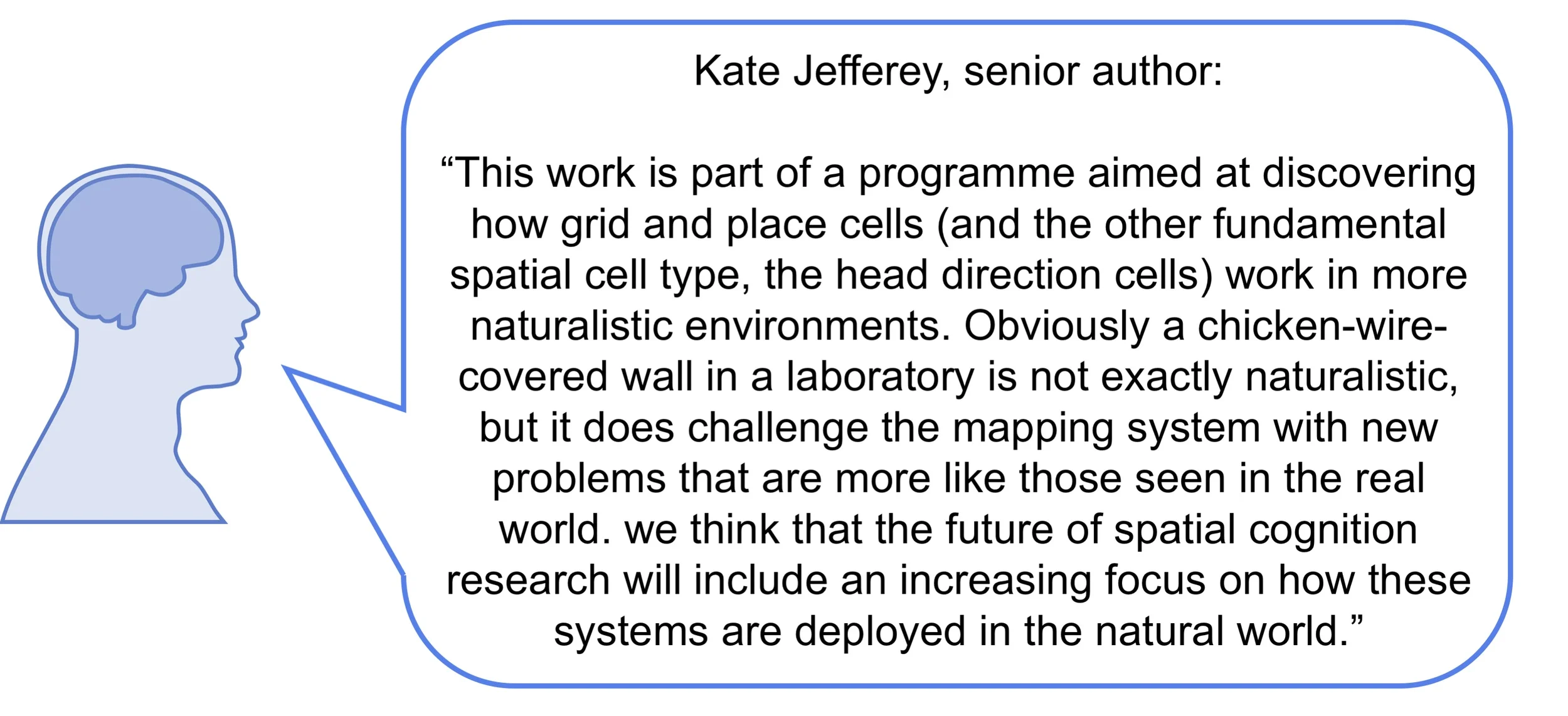
This study is the first to demonstrate that spatial representation in the brain is determined by an interaction between the body-plane alignment and the gravity axis; grid cells track distance differently when movement is over a vertical surface rather than a horizontal one. The speed-coding analysis suggests that this difference may result from underestimation of movement speed on the wall - the grid cells behave as though the animal is moving more slowly than it really is, thus producing larger, more widely spaced firing fields. Overall, this study suggests that the neural encoding of space is can distinguish horizontal from vertical movement, which may have adaptive consequences for animals that move over surface terrain.

Kate_Jefferey_Quote_March12.jpg

Casali et al., Altered neural odometry in the vertical dimension, PNAS (2019). Access the original scientific publication here.
The Sleep-Wake Cycle Regulates Extracellular Tau

Post by: Amanda McFarlan

What's the science?

The aggregation of hyperphosphorylated tau protein is one of the primary markers of Alzheimer’s disease and is known to be highly correlated with neuronal and synaptic degeneration. Previous studies have shown that neurons release tau protein into the extracellular space–where it can spread from one synapse to another—and that this release is increased with elevated neuronal activity. Since the state of wakefulness, compared to sleep, is associated with increased activity, the authors hypothesized that tau may be regulated by the sleep-wake cycle. This week in Science, Holth and colleagues investigated the effect of the sleep-wake cycle on tau in rodents and humans.

How did they do it?

The authors used in vivo microdialysis to examine the effect of the sleep-wake cycle on tau and lactate (regulated by neuronal activity) levels in the brain interstitial fluid in freely behaving mice. To do this, they surgically implanted a guide cannula into the left hippocampus of wild-type mice, and after recovery, inserted a microdialysis probe to collect brain interstitial fluid samples. The levels of tau and lactate in the brain interstitial fluid were then measured in mice that underwent one of three conditions: undisturbed sleep-wake cycle (control), manual sleep deprivation, and sleep deprivation with the infusion of tetrodotoxin (reduces neuronal activity). They further tested the effect of elevated wakefulness (sleep deprivation) on interstitial fluid tau and amyloid-β levels using chemogenetic activation (DREADDs) of the brain wake circuitry. Next, the authors investigated the effect of a longer period of sleep deprivation on the ability of injected tau fibrils to seed tau pathology as well as the ability of seeded tau pathology to proliferate in the brain and promote the misfolding of other tau proteins (tau spreading). They used a transgenic mouse model of tauopathy (P301S mice) and injected recombinant human tau fibrils into the hippocampus of young male mice (not yet expressing a tau pathology). Mice underwent either 28 days of sleep deprivation using the modified multiple platform technique or a control condition. Immunohistochemistry analyses were performed to determine whether tau aggregates had spread throughout the brain. Based on their results in mice, the authors also examined the effect of the sleep deprivation on tau levels in the cerebrospinal fluid of humans. A lumbar catheter was used to collect cerebrospinal fluid in adult participants as they underwent one night of normal rest and one night of sleep deprivation. The authors also measured levels of α-synuclein (a protein associated with increased neuronal activity) as well as other neuronal and glial proteins in the cerebrospinal fluid.

What did they find?

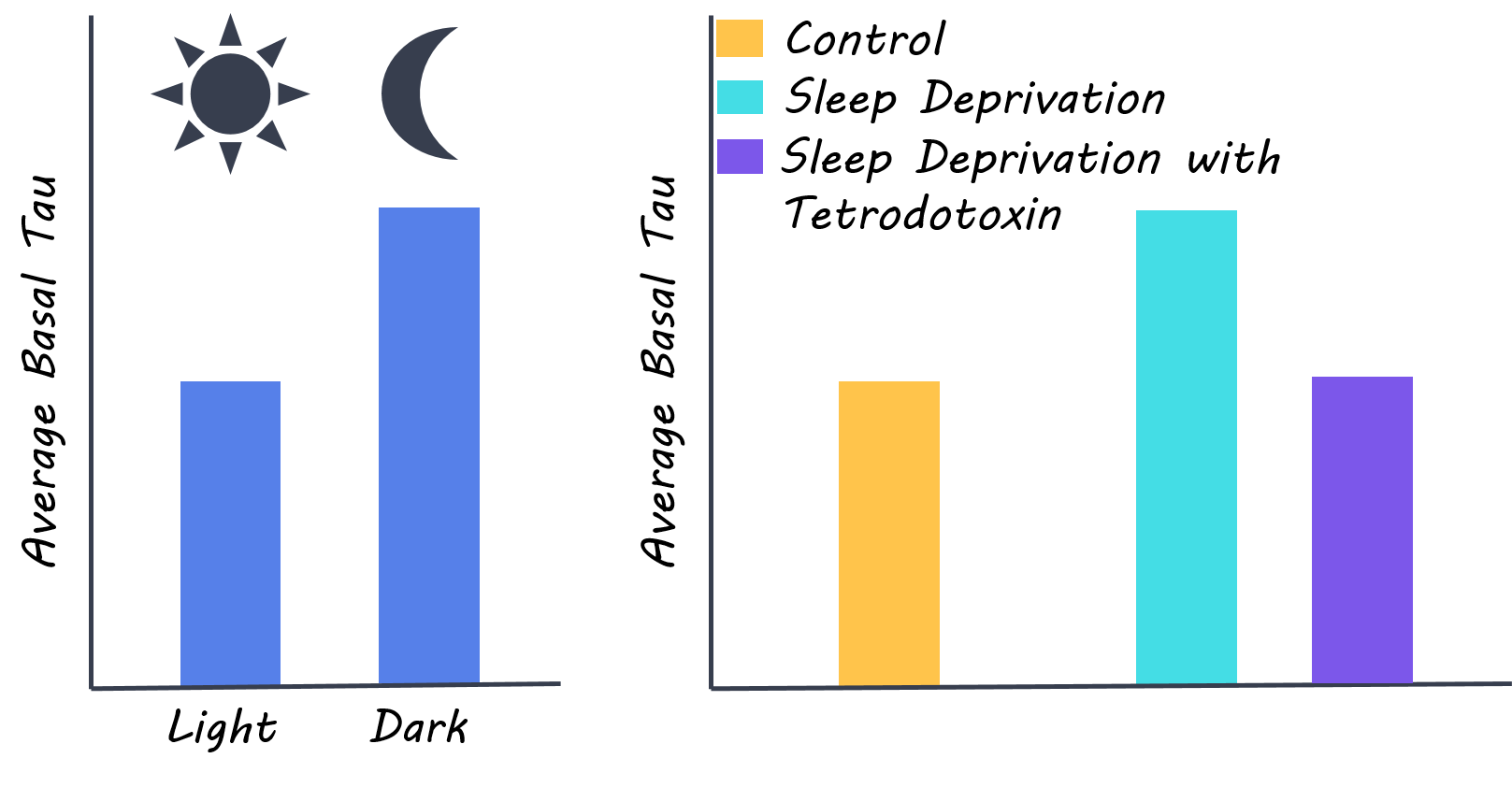
The authors determined that tau and lactate levels in the brain interstitial fluid were higher in control mice during the period of wakefulness compared to the period of sleep. They found that sleep deprivation caused an even greater increase in tau and lactate levels in the brain interstitial fluid. In mice that were both sleep deprived and infused with tetrodotoxin (reducing neuronal activity), there were no detectable changes in tau or lactate levels in the brain interstitial fluid. They also showed that increasing wakefulness using DREADDs significantly increased tau and amyloid-β in the interstitial fluid. Together, these findings suggest that higher tau levels during wakefulness and sleep deprivation might be a result of tau secretion due to increases in neuronal metabolism and synaptic strength. Next, the authors revealed that longer periods of sleep deprivation did not alter the ability of tau fibrils to seed the misfolding of other tau proteins at the injection site, but did increase the spreading of tau pathology throughout the brain compared to control conditions. They determined that in sleep deprived animals, tau spread from the hippocampus to the locus coeruleus, a brain region involved in wakefulness, was increased. In human studies, the authors found that levels of tau and synuclein in the cerebrospinal fluid were significantly increased with a night of sleep deprivation compared to a normal night of sleep. These findings suggests that tauopathies in humans might be sensitive to the sleep-wake cycle and in particular, sleep deprivation.

science_amanda_pic.png

What's the impact?

This is the first study to show that levels of tau in the brain interstitial fluid are modulated by the sleep-wake cycle and increased with sleep deprivation in rodents. Furthermore, the authors showed that prolonged sleep deprivation in mice significantly increases tau spreading in the brain. Similarly, sleep deprivation was shown to increase tau levels in cerebrospinal fluid in humans. Altogether, this study provides evidence for a role of sleep and wake in regulating tau and tau pathology.

amanda_quote.png

Holth et al. The sleep-wake cycle regulates brain interstitial fluid tau in mice and CSF tau in humans. Science (2019). Access the original scientific publication here.