
Cholinergic Interneurons in the Nucleus Accumbens Inhibit Reward-Seeking Behavior

Post by Shireen Parimoo

What's the science?

The nucleus accumbens (NAc), located in the midbrain, regulates motivational or reward-seeking behavior primarily through dopaminergic signaling. For example, dopaminergic activity increases in response to cues that signal an upcoming reward, such as a tone signaling that food will be arriving soon. Conversely, activation of cholinergic interneurons in the NAc is associated with the inhibition of reward-seeking behavior when this behavior might not be beneficial, like seeking food when already full. However, the causal role of these interneurons in regulating cue-motivated behavior is not well-understood. This week in Biological Psychiatry, Collins and colleagues used behavioral conditioning and a combination of optogenetic and chemogenetic techniques to investigate the causal role of cholinergic NAc interneurons in cue-motivated behavior.

How did they do it?

Adult transgenic rats were were injected with adeno-associated virus carrying channelrhodopsin (ChR2) or a control yellow fluorescent protein, and the human M4 muscarinic receptor (hM4D(Gi)) or the control mCherry, which were selectively expressed in the NAc interneurons. Optical stimulation of ChR2 increases interneuron activity, whereas clozapine N-oxide (CNO) injection inactivates interneurons by binding to hM4D(Gi). Cue-motivated behavior was measured using the Pavlovian-to-instrumental transfer (PIT) test, which consisted of a training and a test phase. In the training phase, the rats underwent 8 days each of Pavlovian and instrumental conditioning. For Pavlovian conditioning, a predictive tone cue was repeatedly paired with a chocolate pellet reward; for instrumental conditioning, pressing a lever resulted in a chocolate pellet reward, but no tone was present. Rats were also exposed to a neutral tone in the absence of any rewards during a single session.

In the PIT test phase, the rats were presented with the neutral and reward-predictive cues. They had access to a lever but pressing it did not result in a reward. The authors tested the effect of cholinergic interneuron inactivation on cue-motivated behavior (i.e. lever-pressing) by injecting the rats with CNO or a vehicle and examining behavior before (baseline) and after cue presentation. They optically stimulated the interneurons at cue presentation to test the effect of interneuron activation on behavior. Finally, they injected DhbE into the NAc, which is an acetylcholine antagonist that binds to b2-containing nicotinic receptors. They then optogenetically stimulated the interneurons and recorded cue-motivated behavior to determine whether acetylcholine released from the interneurons acts on nicotinic receptors to regulate cue-motivated behavior.

What did they find?

When the reward predictive cue was presented, both the hM4D(Gi) and control rats had more lever presses compared to baseline or when the neutral cue was presented. However, the hM4D(Gi) rats showed much greater lever-pressing behavior compared to controls when CNO was administered (i.e. when interneuron activity was reduced). Optogenetic activation of cholinergic interneurons led to greater acetylcholine release in ChR2-expressing rats, which was accompanied by a reduction in reward-seeking behavior in ChR2-expressing rats but not in control rats. This means that inhibiting cholinergic interneurons increases cue-motivated behavior, whereas activating the interneurons reduces cue-motivated behavior. Lastly, in the absence of any stimulation, rats infused with an acetylcholine antagonist or a vehicle (control condition) showed greater lever-pressing behavior in response to the predictive cue, but not at baseline or in response to the neutral cue. However, when the cholinergic interneurons were optically activated, there was a reduction in cue-motivated behavior among rats infused with the vehicle, but no change in response to the cue among rats infused with the acetylcholine antagonist. Thus, even though the activation of interneurons normally decreases cue-motivated behavior, an acetylcholine antagonist disrupts the downstream effects of these interneurons by blocking the interaction between acetylcholine and b2-containing nicotinic receptors.

shireen_pic.png

What's the impact?

This study demonstrates that nucleus accumbens cholinergic interneurons have an inhibitory effect on cue-motivated behavior and regulate this behavior by acting on downstream nicotinic receptors. These findings provide further insight into our current understanding of psychiatric conditions with dysfunctional motivational behavior, such as eating disorders and addiction, and have important implications for developing treatments for such disorders.

shireen_quote.png

Collins et al. Nucleus accumbens cholinergic interneurons oppose cue-motivated behavior. Biological Psychiatry (2019). Access the original scientific publication here.

Dopamine Modulates the Reward Experiences Elicited by Music

Post by Flora Moujaes

What's the science?

Humans experience pleasure from abstract rewards, such as music, that do not confer any direct advantage for survival. Understanding how the brain translates music, a sequence of sounds, into a pleasant rewarding experience remains a challenge. Reward can be divided into three neurobiologically distinct components: hedonic pleasure (in-the-moment liking), motivation (or wanting), and learning. The role of dopamine in motivation and learning has been widely established in the animal literature, but dopamine’s function in hedonic pleasure is more controversial. Animal literature has tended to focus on primary rewards such as food and sex, rather than abstract rewards such as music. This week in PNAS, Ferreri and colleagues used a pharmacological intervention to explore for the first time whether dopamine function is causally related to the pleasure we experience from music, and how it influences both hedonic pleasure and motivation.

How did they do it?

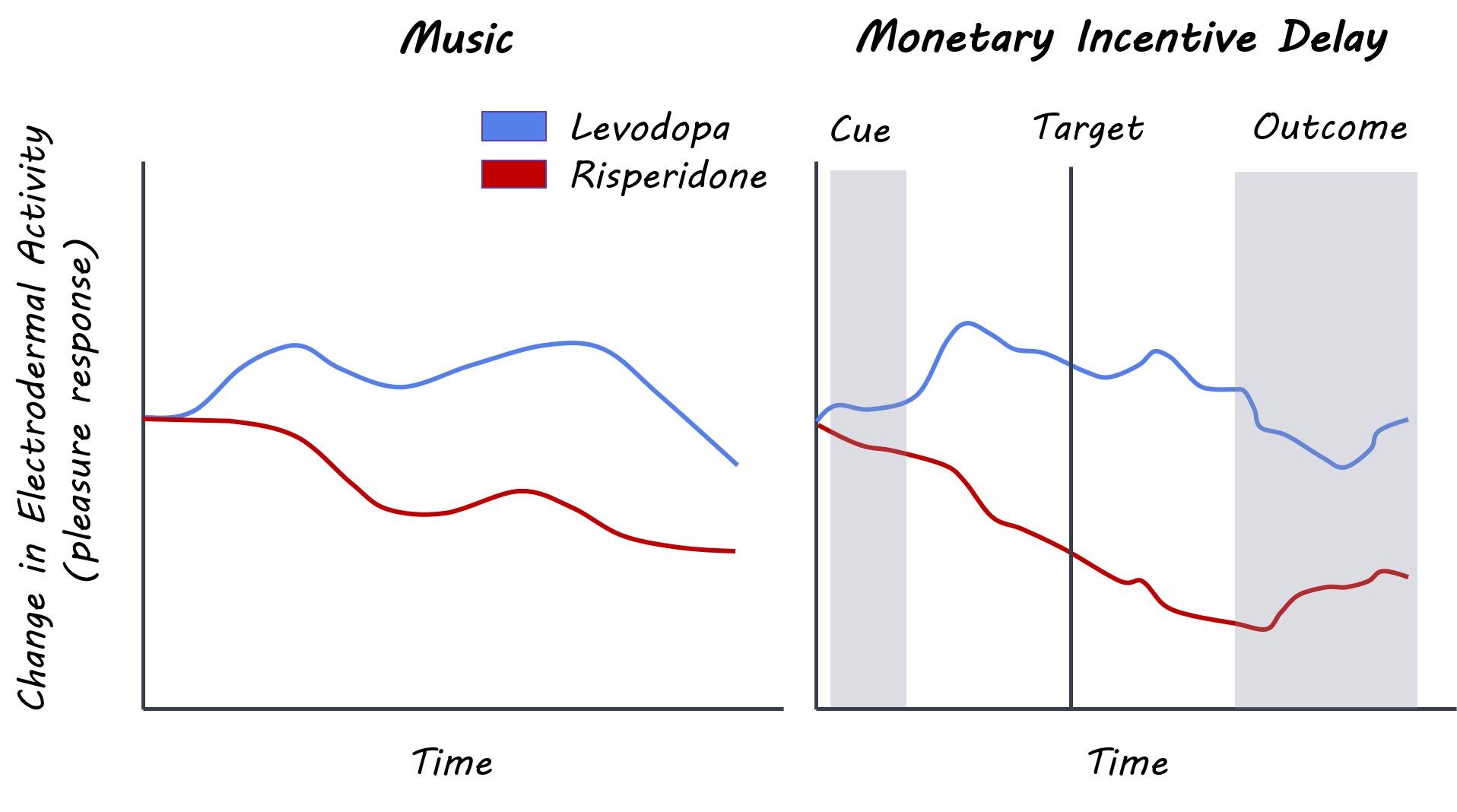
Researchers manipulated dopamine transmission in 27 human participants while they listened to music in three different sessions, each at least a week apart. The authors began by orally administering either levodopa (a dopamine enhancer), risperidone (a dopamine blocker), or lactose (a placebo). Participants then listened to five of their favourite musical excerpts and 10 pop songs selected by the experimenters, which included a range of artists from Antonio Orozco to Taylor Swift. Pleasure responses were measured continuously 1) by participants indicating in real-time the degree of pleasure they were experiencing and 2) by measuring electrodermal activity: changes in the electrical properties of the skin that are related to emotional arousal. Motivational responses were measured using an auction paradigm, where participants indicated how much money they were willing to part with to buy the song. Finally, participants also completed a well-validated reward control task (the Monetary Incentive Delay Task) in order to verify that any changes caused by dopamine were related to the reward system, and not more general processes.

What did they find?

Researchers predicted that if dopamine plays a causal role in music-evoked reward, enhancing dopamine through levodopa and reducing dopamine through risperidone should lead to opposite effects regarding musical pleasure and motivation. In line with their prediction, they found that administration of levodopa and risperidone led to opposite effects: levodopa led to an increase in the experience of ‘chills’ or goose bumps, a common indicator of musical pleasure, while risperidone resulted in a decrease in chills. Electrodermal activity and participants’ ratings also indicated that they experienced an increase in pleasure when listening to music following dopamine enhancement and a decrease in pleasure following dopamine impairment. In contrast to much of the animal literature, this suggests that dopamine causally influences the hedonic pleasure experienced while listening to music. Participants bid significantly more money for songs under levodopa than risperidone, indicating that dopamine is also causally involved in motivational reward responses. The dopamine-induced changes in reward responses were paralleled by those observed in the control Monetary Incentive Delay task, suggesting that the effects seen while listening to music were a result of dopamine’s modulation of the reward system rather than of more general processes.

flora_pic.png

What's the impact?

This study is the first to show that dopamine function is causally related to the pleasure we experience from music, influencing both hedonic pleasure and motivation. More broadly, these findings begin to shed light on the more complex role the human dopaminergic system plays in abstract rewards. Musical pleasure also depends on additional affective and abstract cognitive processes (e.g. episodic memory). Given these additional processes also rely on dopaminergic transmission, further research is needed to determine whether dopamine generates the hedonic and motivational responses to music or whether it interacts with other neurotransmitter systems (e.g. the opioid system) to generate such responses.

flora_quote.png

Ferreri et al. Dopamine modulates the reward experiences elicited by music. PNAS (2019). Access the original scientific publication here.
Hippocampal-Accumbens Pathway Drives Memories of Reward-Seeking Behavior

Post by Lincoln Tracy

What's the science?

Being able to recall specific memories of where to find food – a reward-seeking behavior – is a fundamental part of survival. In mammals, pyramidal cells in the dorsal hippocampus store memories of the environment around us. The nucleus accumbens (part of the ventral striatum) plays an important role in connecting memory and the motor system to process reward-driven behaviors such as eating. Research suggests suggesting a functional connection between the dorsal hippocampus and the nucleus accumbens, however, little is known about whether hippocampal pyramidal cells and nucleus accumbens neurons are connected to one another and how they interact. This week in Cell, Trouche and colleagues used in vivo electrophysiological recordings, viral vector-mediated tracing, and intersectional trans-synaptic optogenetics to understand how hippocampal pyramidal cells interact with nucleus accumbens neurons to use memories of the surrounding environment in reward-seeking behavior.

How did they do it?

The authors first used electron microscopy to investigate whether hippocampal pyramidal cells connect and interact with nucleus accumbens neurons by labelling pyramidal cells in mice with green fluorescent protein. Next, the authors investigated whether pyramidal cell activity was required for using memories of the surrounding environment in reward-seeking behavior. They used a conditioned place preference task in which mice formed memories between entering one of two different chambers and a reward (sucrose). The conditioned place preference task involved three stages: (1) a pre-test session to determine which chamber the mice preferred without any stimulus or reward present; (2) a conditioning session in which the mice explored their non-preferred chamber (using sucrose as bait) and then their preferred chamber (using water as bait); and (3) a test session where conditioned place preference memory was assessed –whether the mice spent more time in the chamber that contained sucrose or the one that contained water. The authors implanted electrodes in the CA1 region of the dorsal hippocampus to record pyramidal cell activity while the mouse completed the conditioned place preference task. They also implanted optic fibers in the dorsal hippocampus and nucleus accumbens so they could use light to turn off different cells in these brain regions (i.e., pyramidal cells and parvalbumin-expressing interneurons).

What did they find?

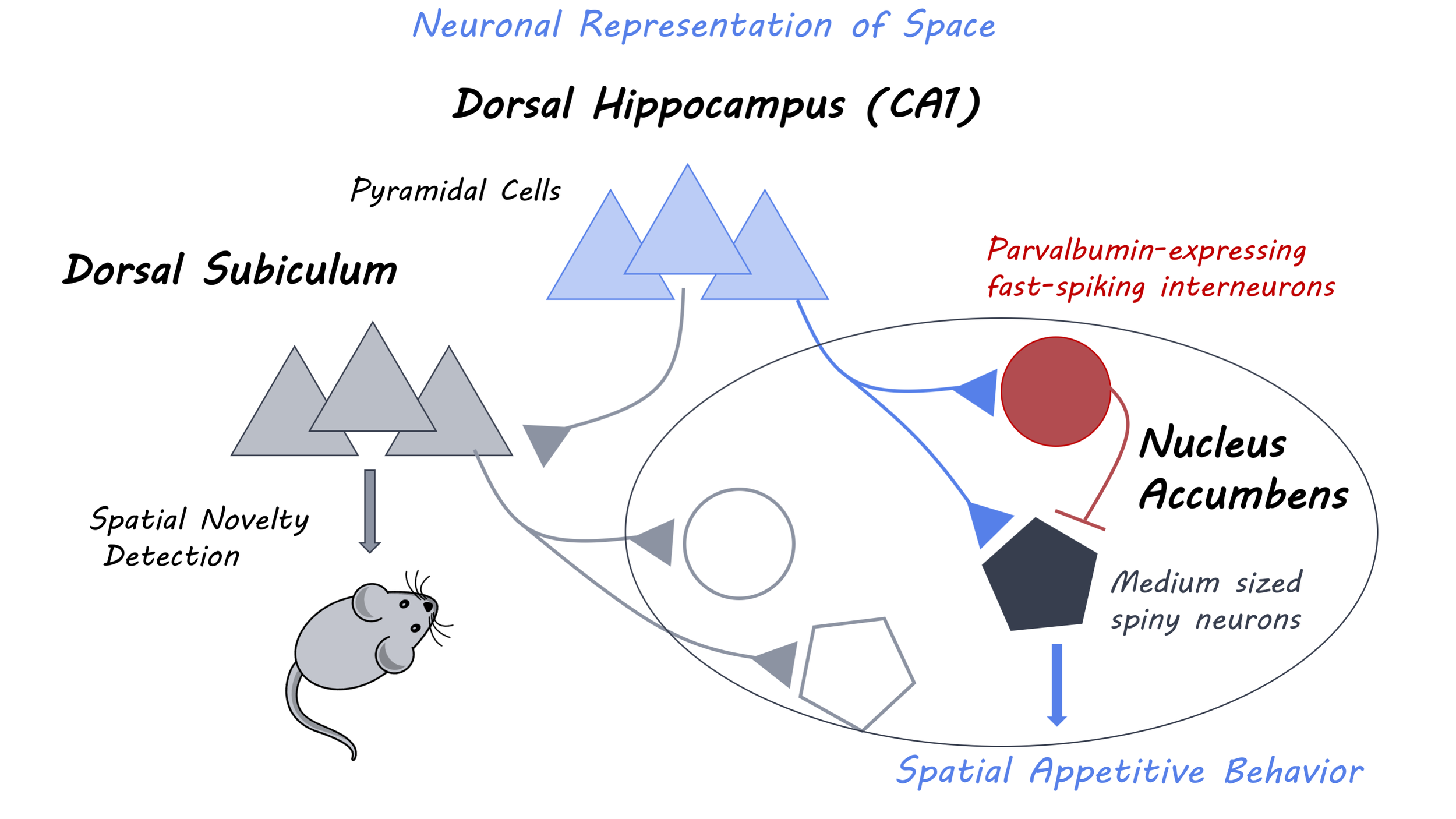
The authors found a direct pathway connecting hippocampal pyramidal cells to nucleus accumbens medium spiny neurons, providing the first evidence for a link between dorsal hippocampal pyramidal cells and nucleus accumbens neurons. Electrode recordings revealed patterns of dorsal hippocampal pyramidal cell activity during the pre-test component of the conditioned place preference task, representative of the mice forming memories about the different chambers. These firing patterns returned during the test phase of the conditioned place preference task, coinciding with the amount of time spent in the sucrose-containing chamber. When the dorsal hippocampal pyramidal cells were silenced via the optic fibers, the mice spent less time in the sucrose-containing chamber – and the dorsal hippocampal firing patterns decreased during the test phase of the task.

Spatial_Memory_image_Feb26.png

Therefore, remembering the location of sucrose – and subsequently seeking the sucrose out depended on dorsal hippocampal pyramidal cell firing. When the axon terminals of the pyramidal cells in the nucleus accumbens were silenced during the conditioned place preference test phase the mice still explored the two chambers – but they spent less time in the sucrose-containing chamber. When the authors silenced parvalbumin-expressing interneurons in the nucleus accumbens they saw the same result – the mice explored the conditioned place preference apparatus but spent less time in the sucrose-containing chamber during the test phase. These results suggest that interrupting the hippocampal-nucleus accumbens pathway prevented the ability to form and use memories of the surrounding environment in reward seeking behavior.

What's the impact?

This study provides evidence that the dorsal hippocampal – nucleus accubmens pathway represents an interaction point between memory and motor processes when recalling information about reward-seeking behavior.  Pyramidal cells from the hippocampus connect to medium spiny neurons and parvalbumin-expressing interneurons in the nucleus accumbens – and all three cell types are required in using spatial memory to drive reward seeking behavior. This study suggests that this pathway could be important in several aspects of linking memory and motor behavior.

Trouche et al. A hippocampus-accumbens tripartite neuronal motif guides appetitive memory in space. Cell (2019).Access the original scientific publication here.