
Conscious Awareness is a Key Feature of MTL-Dependent Memory

Post by Shireen Parimoo

What's the science?

Memories guide our eye movements and how we explore visual information. For example, people look at altered regions of familiar scenes more than they look at these same regions in familiar but unaltered scenes – a phenomenon known as the manipulation effect. This effect is observed only when people can also identify the change, suggesting that the eye-movement behavior might reflect awareness of the change, rather than an automatic and unconscious response. Regions of the medial temporal lobe (MTL) – particularly the hippocampus – play a key role in creating and retrieving recent declarative memories, which are memories about facts and events that we can consciously recollect. However, the role of the MTL in the manipulation effect as well as the relationship between the MTL and knowledge about the manipulation is not understood. This week in PNAS, Drs. Smith and Squire investigated the role of the MTL and declarative memory in the manipulation effect by comparing healthy participants and patients with MTL lesions.

How did they do it?

Participants included four patients with hippocampal lesions, one patient with broader MTL damage, and six healthy adults who served as controls. They viewed a series of scene images across three blocks while their eye movements were recorded. The same scenes were presented in the first two blocks and participants simply viewed the scenes. In the third block, half of the scenes were altered, and half were unaltered (repeated). After viewing each scene, participants were asked if the scenes were the same as before or if they had changed. They were then shown the altered scenes and asked to describe how those scenes had changed and where the change had occurred (i.e. the critical region). The authors divided the participants into three groups based on their knowledge of the altered scenes: those who correctly answered all three questions (whether the scene was altered and what and where the changes were) had robust knowledge (awareness) of the change, those who answered some of the questions correctly had partial knowledge about the change, and those who didn’t answer any question correctly were unaware. Eye movement data were analyzed to examine how often participants looked at the critical region of the altered scenes in the third block and how much time they spent viewing this region.

What did they find?

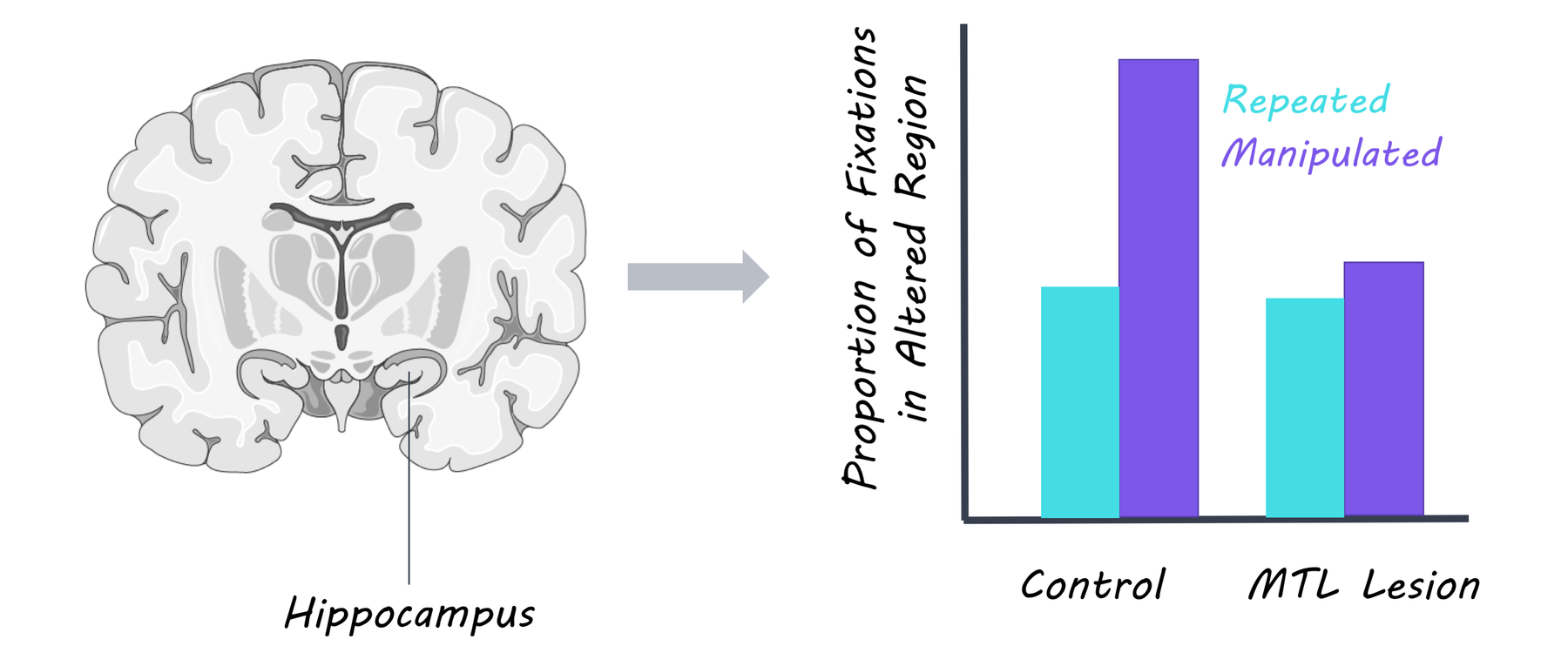
Compared to control participants, patients were unable to discriminate between the repeated and the altered scenes. Moreover, control participants had robust awareness of the changes in 60% of the scenes and were unaware of changes in 18% of the scenes. The reverse pattern was observed in patients, who showed awareness for only 11% of the scenes and were unaware of changes in 56% of the scenes. Thus, patients with MTL lesions had poorer declarative memory than the healthy controls.
MTL_image.png

Overall, the manipulation effect was observed only in control participants, who viewed the critical region of the scenes more when it was altered than unaltered. However, when participants had robust awareness of the changes in altered scenes, both patients and controls showed the manipulation effect. In other words, when they could identify that a scene had changed, what the change was, and where the change occurred, both controls and patients viewed the critical region more in the altered scenes than in the unaltered scenes. When participants had only partial awareness or were unaware of the changes, they spent a similar amount of time viewing the altered and repeated scenes, indicating that the manipulation effect is linked to conscious awareness for what has been learned.

What's the impact?

This study found that viewing behavior is related to the conscious recollection of memories, and that the manipulation effect could be driven by regions in the MTL, such as the hippocampus. Although previous studies have also linked viewing behavior to different memory-related eye movements, these findings help us better understand the role of awareness in declarative memory retrieval. Further research is needed to determine the conditions under which declarative or non-declarative memory supports different types of viewing behavior.

MTL_quote.png

Smith & Squire. Awareness of what is learned as a characteristic of hippocampus-dependent memory. Proceedings of the National Academy of Sciences of the United States of America (2018). Access the original scientific publication here.

Changes in Cerebral Blood Flow During the Sleep-Wake Cycle

Post by: Amanda McFarlan

What's the science?

The synaptic homeostasis theory of sleep suggests that being awake is associated with strengthening of the brain’s synapses (connections between neurons), which has a high metabolic cost, while sleep is associated with synaptic downscaling. Given that cerebral blood flow in the brain increases with greater metabolic demand, it is hypothesized that cerebral blood flow should increase during the day and decrease during sleep. Previous studies investigating cerebral blood flow have reported mixed results, so it remains unknown how sleep and wake affect cerebral blood flow. This week in NeuroImage, Elvsåshagen and colleagues investigated the effect of a day of wake, sleep and sleep deprivation on resting cerebral blood flow in the brain using neuroimaging.

How did they do it?

The authors examined resting cerebral blood flow in thirty-eight healthy adult males using arterial spin labeling (ASL) perfusion magnetic resonance imaging (MRI) to determine the effect of wake, sleep and sleep deprivation. On the first day of testing, the participants underwent ASL scanning at two time points: in the morning (after a night of sleep at home) and in the evening (approximately 14 hours after waking). The participants were then separated into two groups: the sleep group and the sleep deprivation group. The participants in the sleep group were sent home for another night of sleep, while the participants in the sleep deprivation group stayed awake all night. Both groups received a third ASL scan the following morning. Additionally, the authors interviewed participants on various aspects of their sleep habits the night, the week and the month prior to the first day of testing. The Horne-Östberg Morningness-Eveningness questionnaire and the Epworth Sleepiness Scale were used to measure participants’ chronotype and daytime sleepiness, respectively. Sleep quality was measured using the Pittsburgh Sleep Quality Index and subjective sleepiness was assessed using the Karolinska Sleepiness Scale. Participants were also asked to perform a task that measured attention by examining each individual’s variability in reaction time immediately after each ASL scan.

What did they find?

The authors compared whole-brain ASL scans taken in the morning to those taken in the evening of the first testing day and determined that resting cerebral blood flow increased bilaterally in the hippocampus, amygdala, thalamus, and sensorimotor cortices over the course of the day. However, they found no differences in resting cerebral blood flow when comparing the first morning versus the second morning in the sleep group, suggesting that resting cerebral blood flow resets after a night of sleep.

CBF_image.png

Next, the authors examined the effect of sleep deprivation on resting cerebral blood flow. In an interaction analysis, they determined that cerebral blood flow was further increased after a night of sleep deprivation in bilateral lateral and medial occipital cortices, anterior cingulate gyrus and insula, while cerebral blood flow in these areas decreased after a night of sleep. They hypothesized that the changes in resting cerebral blood flow after sleep deprivation may be explained by homeostatic mechanisms. The authors also found  a positive correlation between reaction time and resting cerebral blood flow in the left and right somatosensory and motor cortices and a negative correlation between subjective sleepiness changes between the first and second mornings and cerebral blood flow in the bilateral insula. However, none of the findings related to sleep habits remained significant after being adjusted to account for multiple analyses.

What's the impact?

This is the first study to show that resting cerebral blood flow increases throughout the day in the hippocampus, amygdala, thalamus, and sensorimotor cortices, but resets after a night of sleep. Moreover, this study shows that sleep deprivation is correlated with further increases in resting cerebral blood flow in occipital and temporal cortices as well as the insula. This study provides a foundation for understanding the effect of wake and sleep on cerebral blood flow. In future studies it will be necessary to elucidate the neural mechanisms underlying these changes.

Elvsåshagen et al. Cerebral blood flow changes after a day of wake, sleep, and sleep deprivation. NeuroImage (2018). Access to the original scientific publication here.
Identifying a Brain Network Associated with Variation in Human Mood

Post by Elisa Guma

What's the science?

Human emotions arise in part from interactions between brain areas within the limbic system, which includes the amygdala, hippocampus, insula, and cingulate cortex. Most research on brain networks encoding emotion involves non-invasive imaging such as functional magnetic resonance imaging or positron emission tomography. These techniques, however, are not sensitive to rapid changes in brain activity, and measure it indirectly. Little is known about the way in which human brain networks contribute to real-time changes in mood. This week in Cell, Kirkby and colleagues aimed to identify brain networks associated with rapid variations in human mood, using intracranial brain recordings from limbic regions and self-reported mood.

How did they do it?

The authors made use of uniquely rich multi-site data, whose original purpose was to aid in seizure localization and treatment for 21 patients with epilepsy. This data included intracranial electroencephalography recordings over multiple days from regions of the human limbic system, as well as self-reported mood. Since the amygdala is highly implicated in mood and emotion, the authors only included subjects who had an electrode in the amygdala, and at least three other limbic regions known to connect to the amygdala (ventral hippocampus, cingulate cortex, insular cortex, orbitofrontal cortex, or subtemporal cortex). A custom-made questionnaire was used to measure subjective mood several times per day; a higher score indicated a more positive mood. To identify limbic subnetworks, authors first looked for correlations between all pairs of recording sites in four different frequency bands associated with brain function: theta, alpha, beta, and gamma. To do so, they used an independent component analysis and confirmed that the network patterns they observed occur more often than expected by chance. These patterns corresponded to limbic subnetworks. To identify the most mood-predictive network, they used a regression analysis to measure the strength of association between mood scores and the networks they identified in a subset of subjects with a sufficient number of mood scores (>10). The authors used a cross-validation analysis, in which they tested whether this mood-predictive network identified using the first subset of subjects could predict mood in in the remaining subset of subjects (who had <10 mood scores). Lastly, they investigated how psychological traits may have influenced the presence or absence of the identified mood-predictive network, focusing on anxiety-like, and depressive-like traits.

What did they find?

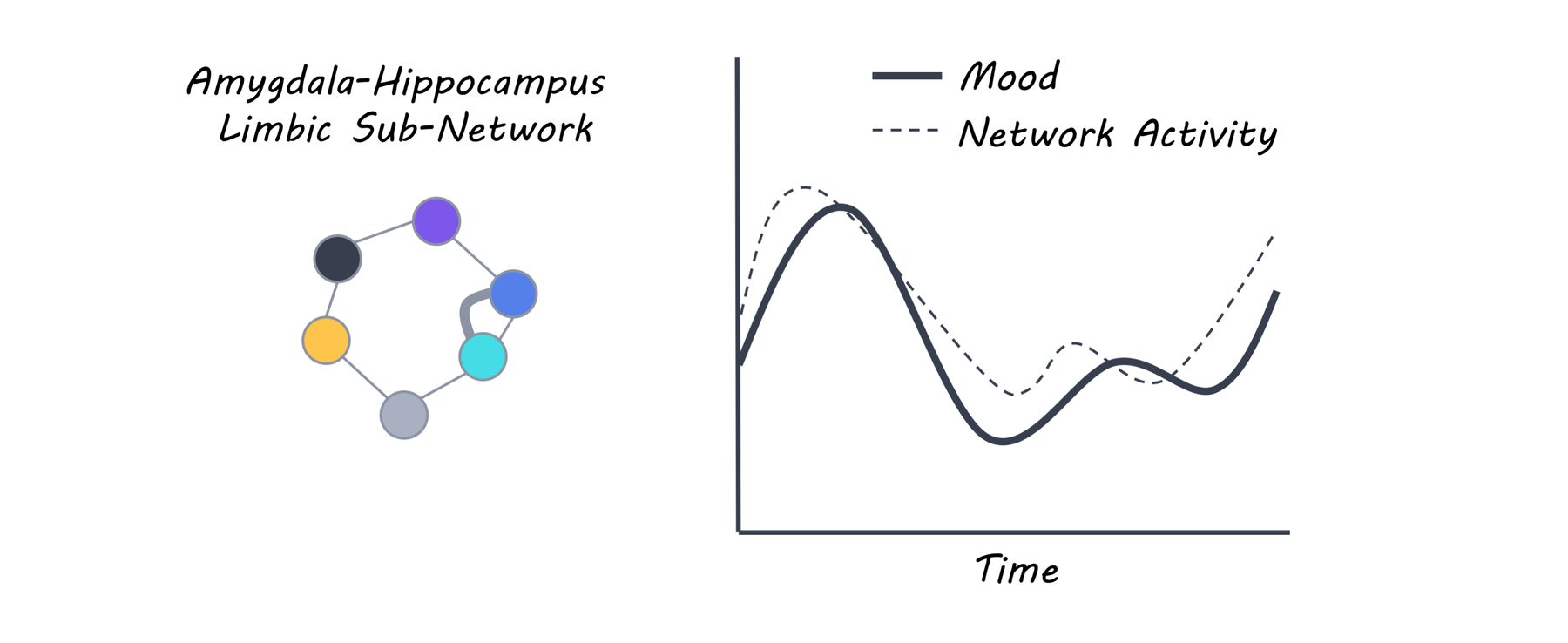
First, the authors identified 9 distinct networks based on pairwise correlations between brain regions. The most common network they identified was between electrodes in the amygdala and ventral hippocampus, oscillating at the beta frequency. This was present in 62% (13 out of 21) of their subjects. Further, the authors showed that their identified networks exceeded chance levels of covariation, confirming the robustness of their findings. Interestingly, they found that this network was also most predictive of changes in mood over time, with higher variation in the activity correlating with worsening mood. Moreover, the authors show that network activity was always present in individuals with high levels of trait anxiety, and often absent (only present in half) of individuals with low trait anxiety. Finally, the authors also confirmed that epileptiform activity in both the hippocampus and amygdala did not correlate with mood and did not confound the significance of the relationship between the mood-predictive network and mood.

What's the impact?

This study was the first to identify a specific subnetwork (beta frequency amygdala-hippocampus subnetwork) associated with rapid changes in mood in humans. Further, the authors identified that stronger activity in this network may be linked with higher trait anxiety. Previous studies have used imaging methods that do not have the temporal resolution to detect real-time changes in both brain activity and mood. This work provides a deeper understanding of how mood and anxiety are encoded by the brain and may aid in revealing potential biomarkers for diagnosis and treatment of mood and anxiety disorders.

Kirkby et al., An Amygdala-Hippocampus Subnetwork that Encodes Variation in Human Mood. Cell (2018). Access the original scientific publication here