
Sensory Cues Can Promote Riskier Choices

Post by Stephanie Williams

What's the science?

We know from animal studies that reward-related cues like noises (chimes) or visual signals (flashing lights) can influence animals to make risky decisions. It is still unknown if reward-related cues can influence humans in a similar way. It is also unclear how the cues would exert their effects on decision making. This week in the Journal of Neuroscience, Cherkasova and colleagues assessed the effects of reward-associated sensory cues on the promotion of risky decisions in humans.

How did they do it?

The authors randomized 131 human subjects to play two computerized games, either with or without visual (i.e. stacks of bills or coins) and auditory (casino chiming noises) cues, to test whether these cues affected decision making. The first game, the Iowa Gambling Task (IGT), consisted of four decks of cards, and the participant’s goal was to win as much money as possible by selecting cards from the decks. Some decks were more advantageous than others, and each time the participant selected a card, they either won or lost money. To win the maximum amount of money, participants should have chosen cards from the two of the four decks that had low risk/low reward cards (no big wins, but no big losses either). In the second game, the Vancouver Gambling Task (VGT), participants had to choose between a low chance of winning a larger amount of money, and a higher chance of winning a smaller amount of money. Participants were repeatedly presented with various pairs of potential winnings. The researchers used the participant’s choices in this task to create a model of a participants' willingness to take risks.

The authors tracked several physiological measurements including eye movements and pupil dilation, which is related to arousal. Eye tracking data was analyzed to measure time spent looking at probability information (participants were shown pie charts representing probabilities of winning during the VGT task). Pupil size was analyzed from the VGT to see whether the auditory and visual effects were related to pupil dilation, and whether dilation was related with riskier choices.     

stephanie (1).png

What did they find?

To understand the effect of the sensory cues on decision making, the authors applied various models that took into account different variables related to their data. They found that the presence of sensory cues did not cause subjects to make a greater number of disadvantageous choices in the IGT task. In contrast, during the VGT task, they found that subjects made riskier choices and spent less time paying attention to probability information when playing the cued task than when playing the uncued VGT task. The authors were able to relate the risk enhancement to subject’s decreased consideration of reward probability when making choices, rather than changes in the subject’s perceived expected value. It is still unclear what mechanism swayed participant's attention away from the probability information.

Several findings emerged from the authors analysis of pupil dilation during the VGT. In both the cued and uncued tasks, subjects showed increased pupil dilation during risky decisions. This was a significant finding, as it provides novel confirmation of a strong association between pupil dilation and risky choice. In the cued task, the authors found that pupil dilation associated with decision-making and anticipation was increased. This finding highlights the effect of the sensory cue in increasing arousal. The authors also found that the risk-promoting and arousal-promoting effects of cues were separate and independent effects.

What's the impact?

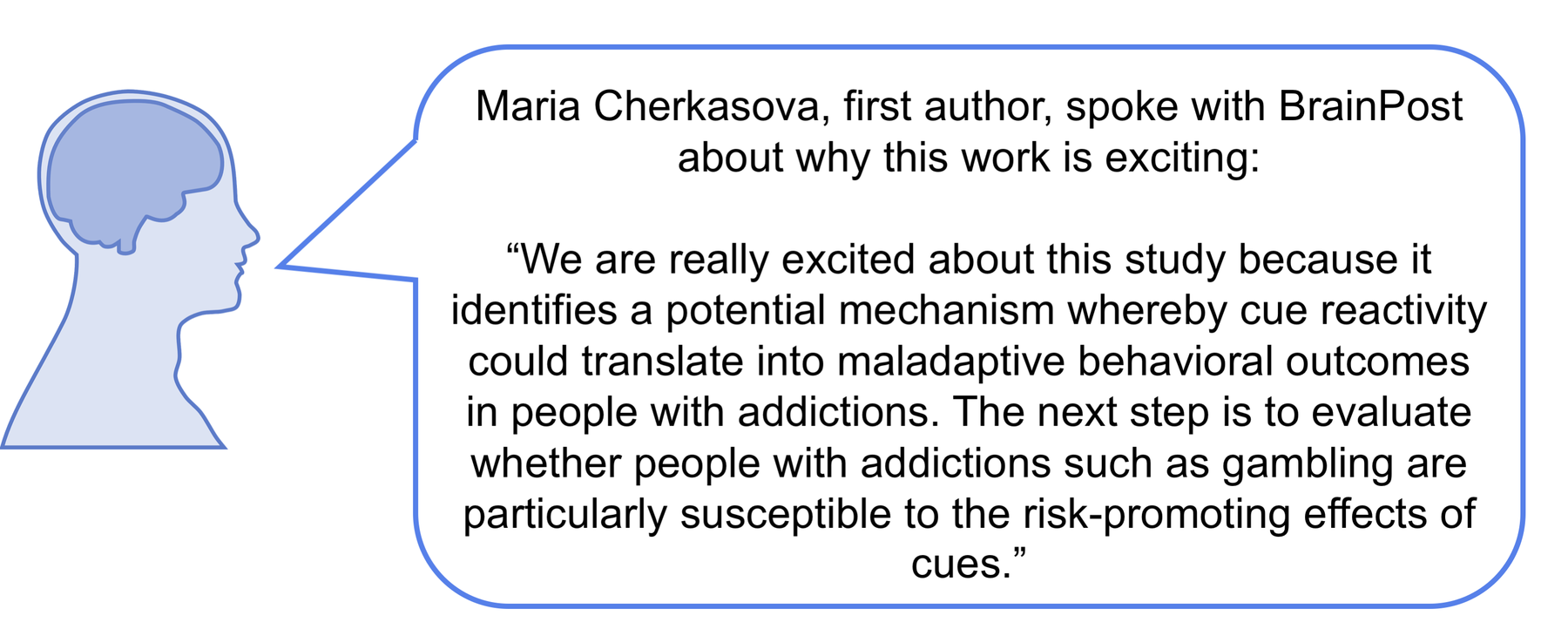
This is the first paper to confirm that sensory reward cues promote riskier decisions in humans. Previous studies had shown that reward sensory cues could increase arousal, and change the way people estimate profits, but no one had yet shown that they could directly affect choice. Their findings suggest that the sensory cues in particular environments (ie. Casinos) could affect decision making, which could be used to help explain why individuals suffering from addiction may make risky decisions.
risk_quote.png

Cherkasova, M. et al., Win-concurrent sensory cues can promote riskier choice. The Journal of Neuroscience (2018). Access the original scientific paper here.
Prenatal Exposure to Neurotransmitter-Targeting Medications and Autism

Post by Sarah Hill

What's the science?

Is the use of psychiatric or neurologic medications during pregnancy associated with higher (or lower) incidence of autism spectrum disorders (ASD) in children? This has been a difficult question to answer as pregnant women are often excluded from clinical trials. Further, separating out whether effects on children stem from exposure to medications or from increased risks associated with the mother's medical diagnosis has not been possible using prior study design methods. This week in JAMA Psychiatry, Janecka and colleagues use an innovative study design strategy to test whether prenatal exposure to drugs that act on neurotransmitter systems is associated with increased or decreased prevalence of ASD.  

How did they do it?

The authors obtained data for 95,978 children born between 1997 and 2007 from a health maintenance organization in Meuhedet, Israel, and verified that maternal prescription rates and ASD prevalence in the sample matched the national rates. The sample population consisted of all children who had received an ASD diagnosis before 2015, randomly sampled ASD and non-ASD individuals, and all siblings of ASD and non-ASD individuals. They then grouped individuals based on the neurotransmitter system that was targeted by the mother's medication (55 non-mutually exclusive medication groups in total; for example, the serotonin system), in contrast to previous studies which grouped individuals by medication. They next calculated the hazard ratios, a measure of the relative risk of outcome in one group compared to another group, using a statistical method that simultaneously evaluates how several factors influence the rate of a particular event happening (in this case, an ASD diagnosis) at a particular timepoint [Cox proportional hazards regression]. Importantly, the models tested also took into account the mothers' psychiatric or neurological conditions (e.g. anxiety disorder), number of maternal medical diagnoses within 1 year prior to birth (e.g. acute bronchitis), birth year, maternal and paternal age, and socioeconomic status.     

What did they find?

Due to the number of factors that may play a role, establishing a clear relationship between prenatal exposure to psychiatric drugs and altered risk of ASD is difficult. A link between neuronal acetylcholine receptor α antagonists, such as certain medications used to treat epilepsy, and increased rates of ASD was the only clear finding in this study that remained significant after accounting for all other factors, although there were very few women who took these medications during pregnancy. Certain medications used as anti-analgesic/anti-inflammatory agents were found to be associated with decreased rates of ASD when the number of maternal diagnoses was also taken into account, though the associations were not statistically significant in subsequent analyses. The authors found no other statistically significant links between medication group and ASD when all variables were considered, indicating that the use of most neurologic medications, including antidepressants and antipsychotics, during pregnancy is not associated with increased or decreased prevalence of ASD. Of all factors considered, the number of maternal medical diagnoses appeared to have the greatest effect on whether a relationship between medication group and ASD was found, suggesting it may be confounding previously observed associations.

What's the impact?

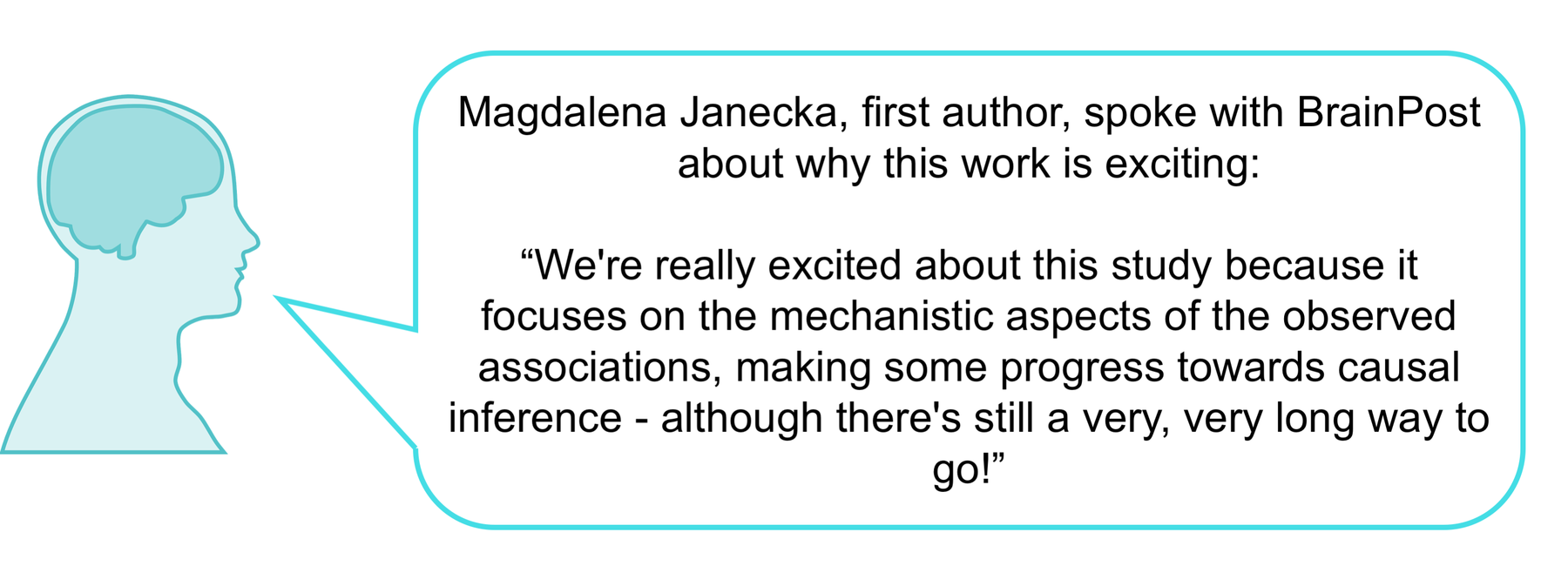
In contrast to previous reports, this study found no evidence that the use of drugs that act on the serotonin system (as well as most other neurotransmitter systems) during pregnancy increase a child's risk of ASD. Instead, it suggests that maternal general health can impact the risk of ASD, indicating that prior studies that found a link between prenatal medication use and ASD may need to be re-evaluated. Large-scale population-based studies such as this one are imperative for informing prescription practices of doctors treating pregnant patients.  

asd_quote.png

Janecka et al. Association of Autism Spectrum Disorder with prenatal exposure to medication affecting neurotransmitter systems. JAMA Psychiatry (2018). Access the original scientific publication here.

The Role of Theta and Beta Oscillations in Cognitive Control

Post by Shireen Parimoo

What's the science?

Cognitive control is the ability to flexibly adapt behavior in the face of changing goals or demands, and it involves suppressing irrelevant information in the presence of conflict. The medial prefrontal cortex (mPFC) is thought to be involved in exerting control during conflict or during errors, after which behavior must be adjusted. Recent research also suggests that neural oscillations in the subthalamic nucleus (STN) are closely linked with those in the mPFC during conflict. However, it is unclear how changes in neural activity in the mPFC and STN are related to behavioral responses during tasks requiring varying levels of cognitive control. This week in Brain, Zavala and colleagues used intracranial electroencephalography and electrode recordings to investigate oscillatory activity in the mPFC and STN during a cognitive control task.

How did they do it?

Neural activity was recorded from 22 Parkinson’s disease patients who were undergoing deep brain stimulation surgery. Local field potentials and multiunit spiking activity were recorded from the STN using depth electrodes, and intracranial electroencephalography recordings were obtained from the superior mPFC. The participants performed a cognitive control task with three trial types: Go, Conflict, and No-go trials. In the Go trials, an arrow was presented on the screen, and participants had to move a joystick in the direction of the arrow; in the Conflict trials, participants had to move the joystick in the opposite direction to the arrow on the screen. In the No-go trials, they had to withhold their response. Feedback was provided at the end of each trial. The authors determined the average oscillatory power (or amplitude) for each trial type in the theta (2-5 Hz) and beta (8-30 Hz) frequency bands, which provided an index of the strength of oscillatory activity on a given trial. They also computed the phase coherence between the STN and the mPFC, which is a measure of the consistency of the phase of oscillatory signals. Higher phase coherence indicates that there is greater synchronization of activity between the two regions.

What did they find?

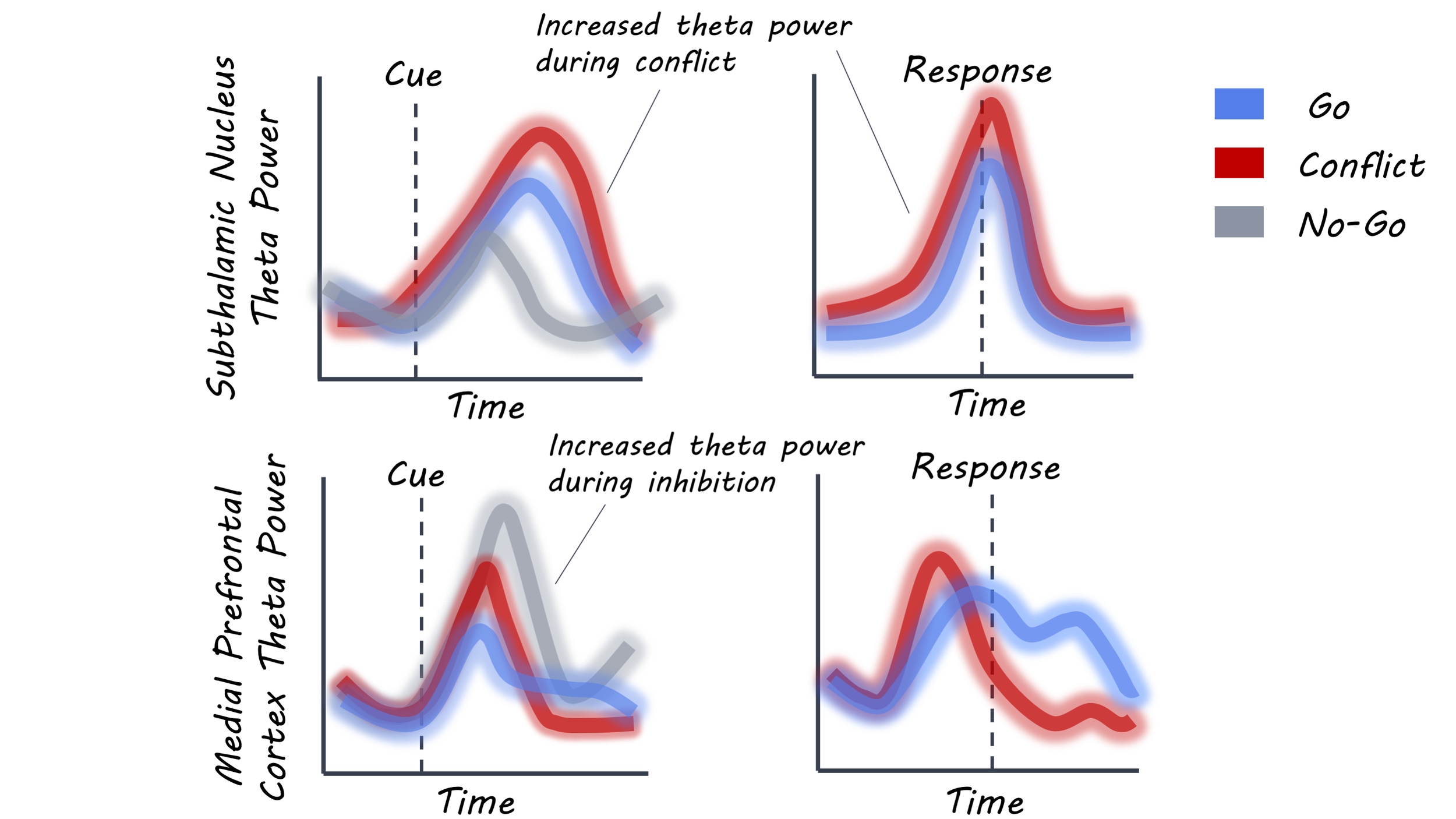
Participants made more errors and were slower on the Conflict trials. They were also slower and less accurate on Go trials that occurred after Conflict trials, compared to consecutive Go trials. In the No-go and Conflict trials, just before participants made a response, there was an increase in theta power in both the mPFC and the STN. This increase occurred several hundred milliseconds earlier in the mPFC than the STN and was greater during Conflict trials than the Go trials. During No-go trials in which a response had to be withheld, there was a large increase in theta power in the mPFC but a small change in the STN. Similarly, multiunit activity in the STN decreased during No-go trials, but greatly increased during Conflict trials that required inhibiting a prepotent response and performing the opposite movement. This indicates that the mPFC is involved in providing top-down signals to indicate that behavior must be adjusted, whereas the STN is responsible for modulating the actual behavioral response. Theta  phase coherence was higher during Conflict and No-go trials than during the Go trials. As pre-response theta power increased before participants made a response, it suggests that theta oscillations are involved in adjusting cognitive control within trials, especially when the demand for control is high.

theta_img.png

Beta power in the STN decreased prior to the participants’ response, whereas beta power in the mPFC increased after the response. In the mPFC, post-response beta power was lower during Conflict trials and when participants made an error. Conversely, beta power in the STN on a given Go trial was modulated by Conflict and errors on the previous trial. That is, beta power was higher on Go trials that occurred after Conflict trials. A similar pattern of activity was observed during Go trials that occurred after participants made an error, compared to Go trials that occurred after participants provided a correct response. Thus, beta oscillations in the STN may regulate responses in situations requiring a change in behavior, such as after an error is made or after high conflict trials.

What's the impact?

This study is the first to show how changes in oscillatory activity in the mPFC and the STN contribute to different aspects and temporal stages of cognitive control. Theta oscillations are involved in control during a trial, while beta oscillations play a role in exerting control across trials, particularly when control demands are higher. This research has important implications for understanding conditions in which cognitive control is impaired, such as schizophrenia and dementia.

Zavala et al. Cognitive control involves theta power within and beta power across trials in the prefrontal-subthalamic network. Brain (2018). Access the original scientific publication here.