
The Paraventricular Thalamus Encodes the Salience of Stimuli and Regulates Associative Learning

Post by: Amanda McFarlan

What's the science?

It is not well understood how the brain is able to filter complex sensory inputs and decide what is most important, or ‘salient’. Recent studies have shown that the thalamus, a hub for sensory information (among other functions) in the brain, may contribute to this filtering process. The paraventricular thalamus (PVT), one of the subnuclei in the thalamus, is of particular interest. This region of the thalamus is a relay station connecting the brainstem (which provides information related to internal bodily states) to limbic brain regions involved in learning in a variety of emotional contexts. The PVT is connected to several higher-level brain areas, including the frontal and insular cortices and innervates the amygdala (which is involved in processing salience in an emotional context) and therefore could play an important role in encoding the relevance of stimuli. This week in Science, Zhu and colleagues explored the role of PVT neurons in determining the salience of behaviourally relevant stimuli and their contribution to associative learning.

How did they do it?

In mice, the authors tested several behavioural paradigms using Pavlovian conditioning (see experiment described below), optogenetics and calcium imaging to determine the role of PVT neurons in encoding salient stimuli. First, they performed stereotaxic injections of a virus expressing a genetically encoded calcium indicator (AAV-GCaMP6m) in PVT neurons. After a minimum two-week recovery period from surgery, they used fiber photometry to record calcium signals in head-fixed mice across days of associative learning. The mice, either water-restricted or sated (not water-restricted), were trained to pair an odor (‘conditioned stimulus’ in Pavlovian conditioning) with an outcome (unconditioned stimulus). There were three possible outcomes: rewarding (5 µl or 15 µL of water), neutral (nothing) or aversive (puff of air or tail shock). In the associative learning paradigm, mice were presented with the odor for 1s, followed by a 2s-delay period and then the outcome. In a subsequent experiment, PVT neurons were transfected with a virus expressing a light-gated ion channel that inhibits neuronal activity (to determine the effects of PVT inactivation during associative learning). In this experiment, PVT neurons were optogenetically inhibited in water-restricted mice during associative learning at three possible time points: the odor cue + 2-s delay period, the outcome (water) or between trials (intertrial interval).

What did they find?

The authors determined that the initial exposure to an unfamiliar odor evoked a robust response in PVT neurons that rapidly diminished as the mice became habituated to that cue. In the first associative learning paradigm, water-restricted mice were trained to pair an odor with a rewarding or aversive cue of varying intensity or a neutral cue. They found that PVT neurons responded to both the odor and outcomes in rewarding and aversive trials and that the magnitude of the response was graded to reflect the intensity of the reward. For example, PVT neurons showed greater activity in response to 15  µL of water versus 5 µL, and to a tail shock versus a puff of air. Together, these findings suggest that PVT neurons can encode a variety of stimuli (i.e. novel, rewarding, aversive) and their behavioural relevance. In the second associative learning paradigm, water-restricted and sated mice were trained to pair an odor cue with a water reward. The authors determined that the odor cue evoked robust anticipatory licking in thirsty mice but not sated mice.

salience (1).png

Consistent with these findings, the activity of PVT neurons, as measured by calcium signals, was suppressed in sated compared to thirsty mice. Notably, PVT neurons had a greater response when sated mice were presented with an aversive cue (an air puff in the eye) compared to thirsty mice. This indicates that the aversive cue (air puff) became more salient when homeostatic needs had been satisfied. These findings suggest that PVT activity reflects the dynamic nature of stimulus salience after contextual changes. Finally, optogenetically inhibiting PVT neurons while delivering the odor cue or reward cue during training greatly decreased the number of anticipatory licks in water-restricted mice. In contrast, inhibiting PVT neurons between trials had no effect on the number of licks. Taken together, these findings indicate that the PVT is important for the formation but not expression of conditioned reward-seeking behaviour.

What's the impact?

This is the first study to show that the PVT encodes information about salient stimuli, including novel, rewarding and aversive stimuli, in a context-specific manner. The PVT has an important role in determining the salience of a stimulus, although how this salience information is communicated throughout the rest of the brain remains unknown. Elucidating the neural mechanisms involved in identifying salient stimuli and its impact on associative learning may provide insight into new therapies for the treatment of disorders like addiction.
salience_quote.png

Zhu et al. Dynamic salience processing in paraventricular thalamus gates associative learning. Science (2018). Access the original scientific publication here.

The Roles of Learning and Value Comparison in Suicidal Behavior

Post by Kayla Simanek

What's the science?

While society may view suicide attempts as strategic, from a clinical standpoint, suicidal behavior is often attributed to impaired decision-making in moments of crisis. One possibility may be that suicidal individuals do not optimally incorporate transient experience with long-term values, goals, and prior knowledge. However, this hypothesis may oversimplify the complexity of decision-making during crises. Two more specific factors related to learning that may contribute to a suicide attempt are: 1) poor integration of recent experience with prior experience and learned values (i.e. disrupted learning of expected values) and 2) an impaired ability to compare the worth or value of two options and (i.e. compare learned values when faced with choice). This week in Biological Psychiatry, Dombrovski and colleagues tested these two hypotheses to distinguish between the roles of value learning and value comparison in people with histories of suicide attempts.

How did they do it?

The authors conducted a three-choice decision making task. Across 300 trials in the task, participants picked from three pictures on a screen (each of which had a different probability of being the ‘correct’ picture over a series of trials) and were rewarded a small amount of money for picking the correct picture. 260 adults participated in the study and were separated into four groups: major depression with suicide attempts, major depression with suicidal thoughts, non-suicidal depression or healthy (non-depressed). Groups were further stratified by lethality of previous suicide attempts to assess the correlation between attempt severity and task performance. Learning during the task was analyzed by a participant’s responsiveness to reinforcement (monetary compensation). The time taken to decide between three choices was measured as a reflection of the participant’s ability to learn from feedback. Participants’ ability to differentiate between values was also measured by response time: choices close in value would theoretically increase the time taken to decide. Finally, analysis of decision trends within groups was conducted. The authors looked at whether each group chose the best or second-best option (exploitative choices) or a third, obscure option (exploratory choice) most regularly to determine difference in choice preference between groups.

suicide (1).png

What did they find?

The authors found that those who had attempted suicide were less responsive to reinforcement compared to other groups. Additionally, rewarding feedback slowed the decision time of suicide attempters more than non-attempters or those with suicidal thoughts. Participants with attempts considered to be highly lethal were even less responsive to reinforcement and made slower decisions compared to those participants with less lethal suicide attempts. This data suggests that participants with suicide attempts have difficulty learning worth based on outcomes (supports hypothesis #1). Suicide attempters’ decision time was also slowed by choices with subtle differences in value (probability of being the correct choice), suggesting that these participants have trouble distinguishing between closely ranked values. This conclusion supports hypothesis 2 and could explain the over-estimation of the value of suicide in times of crisis. Finally, analysis of answer choice frequency within groups revealed that suicide attempters more often chose exploitative options whereas non-attempters more often chose the exploratory option. This suggests that the suicidal individual’s ability to search for and consider alternative options is impaired.

What's the impact?

This is the first study to compare the contribution of learning expected value and comparison of learned value in depressed suicide attempters. This study found that both learning via reinforcement and value comparison are more impaired in individuals with major depression and a history of suicidal behavior than those without. This understanding may help shape treatment of suicidal individuals and prevent lethal outcomes in times of crisis.

Dombrovski et al. Value-based choice, contingency learning and suicidal behavior in mid-life and late-life depression. Biological Psychiatry (2018). Access the original scientific publication here.

The Choice to Socialize Prevents Drug Addiction in Rats

Post by Deborah Joye

What's the science?

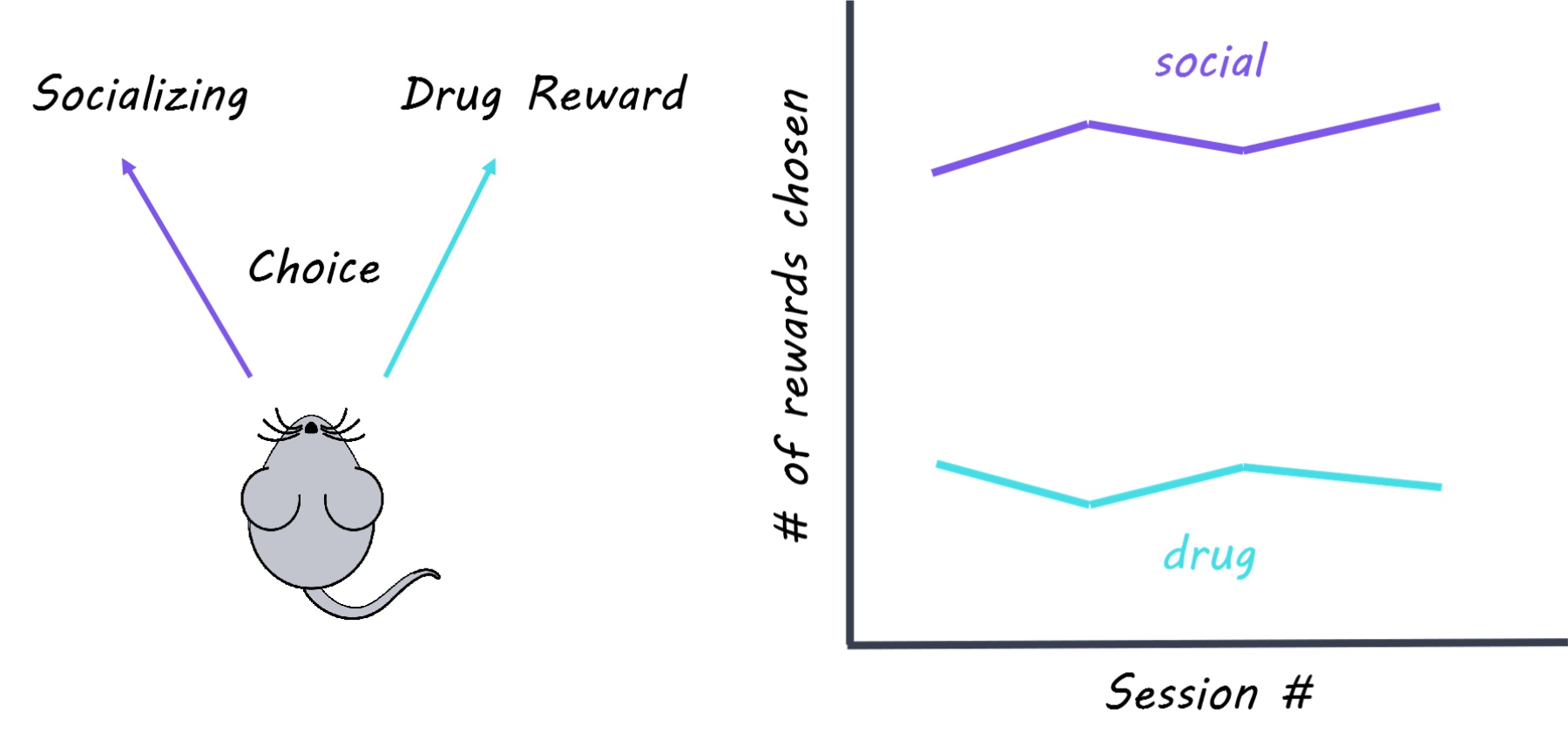
There are very few  treatment options for human addiction, despite the large amount of animal research on addiction mechanisms. One reason might be because the impact of social cues on drug use is not fully considered. For example, we know that rodents and monkeys will choose a good-tasting food over drugs. But for humans, social rewards are more likely than food rewards to protect against drug use. Research shows that rodents housed in groups are less likely to take drugs in the first place, and less likely to relapse if they have taken drugs in the past. Typically, social environments and drug use in animal studies are controlled by the experimenter. If the rats could control their choice between taking drugs or socializing, what would they choose? This week in Nature Neuroscience, Venniro and colleagues use operant conditioning to demonstrate that rats will choose a social reward over drug use regardless of the type of drug, the strength of drug, how long they’ve been taking drugs, and how long they’ve been abstinent.

How did they do it?

The authors used operant conditioning to train rats so that pressing a certain lever resulted in social time with another rat, while pressing a different lever resulted in an infusion of drug (methamphetamine or heroin depending on the experiment). They also measured how often rats hit an “inactive” lever which didn’t do anything, to make sure that rats weren’t randomly hitting levers. The choice between drugs or socializing was mutually exclusive, meaning that rats could only choose one or the other but not both. The authors performed several manipulations to see how the rats’ choices might change: they administered different drug dosages, progressively increased the time delay between lever pressing and socializing; punished social choice with a small shock; and compared rats based on their motivation to seek the drug (addiction score: high, medium, low). The authors then either removed access to drugs (forced abstinence) or let rats choose (i.e. voluntary) between drug and alternative non-drug rewards (either food or social ) then tested if rats were more or less likely to relapse into drug use. In relapse tests, rats were abstinent from drugs for some period, and then reintroduced to the environment they associated with drug use. Generally, the longer a rat had not had drugs, the more drug-seeking behavior they showed in a drug-related environment, a phenomenon called “incubation of craving.” Finally, to probe the underlying neural mechanisms, the authors tested whether different forms of abstinence (forced v. voluntary) were associated with changes in neuronal activity in brain regions involved in drug-seeking and relapse, such as the amygdala and insular cortex. Specifically, they used immunohistochemistry (which labels proteins) and in situ hybridization (which labels RNA) to visualize which cells were activated during a relapse test.

What did they find?

The authors found that rats trained to take drugs would consistently choose a social reward over drugs regardless of drug dosage and addiction score. Rats returned to taking drugs only when the social reward was delayed or punished. Rats that chose socializing over drug use showed less drug-seeking behavior in a relapse test, even if social choice and access to drugs were removed for a month. This suggests that social reward can be protective against incubation of craving and future relapse. Rats that were given the food reward choice showed more drug-seeking behavior in a relapse test than rats given the social reward choice, suggesting that socializing is more rewarding than food. Lastly, the authors found that rats who chose socializing over drugs had increased activation of inhibitory cells in the lateral portion of the central amygdala (protein kinase C-delta (PKCδ)-expressing cells), and decreased activation of the insular cortex. In contrast, rats that were forced into abstinence showed increased activation of different populations of cells associated with drug craving (somatostatin-expressing cells in the lateral central amygdala and output neurons in the medial central amygdala). These findings suggest that cells in the amygdala are recruited to block activity associated with drug craving and relapse while rats are socializing.

addiction1800.png

What's the impact?

This study is the first to show that when rats are given the choice between socializing or using drugs, rates of drug abstinence are almost 100%. These findings highlight the necessity of considering social factors when investigating the neuroscience of addiction and suggest that social reward is a better drug-alternative model than food reward. Finally, this study demonstrates that positive social interactions protect against addictive behaviors and addiction-related changes in the brain, which has significant implications for clinical treatment options for human addicts.

addictionquote1800.png

Venniro et al. Volitional social interaction prevents drug addiction in rat models. Nature Neuroscience (2018). Access the original scientific publication here