The Effects of Gut-Brain Axis Stimulation on Reward and Motivation

Post by Amanda McFarlan

What's the science?

Research studies have identified the gut as having a key role in the regulation of human motivational and emotional states. However, the mechanism by which emotion and motivation are regulated by the gut-brain axis is unknown. The vagus nerve, extending to the brain and to the gastrointestinal tract, has been the primary target for the study of the gut-brain axis. Initially thought to just be a negative-feedback mechanism for food intake, the vagal gut-brain axis is now known to be involved in emotional and motivational processes like anxiety, depression, and reinforcement learning. This week in Cell, Han and colleagues used virally delivered molecular tools to study the role of the vagal gut-brain axis in motivation and reward.

How did they do it?

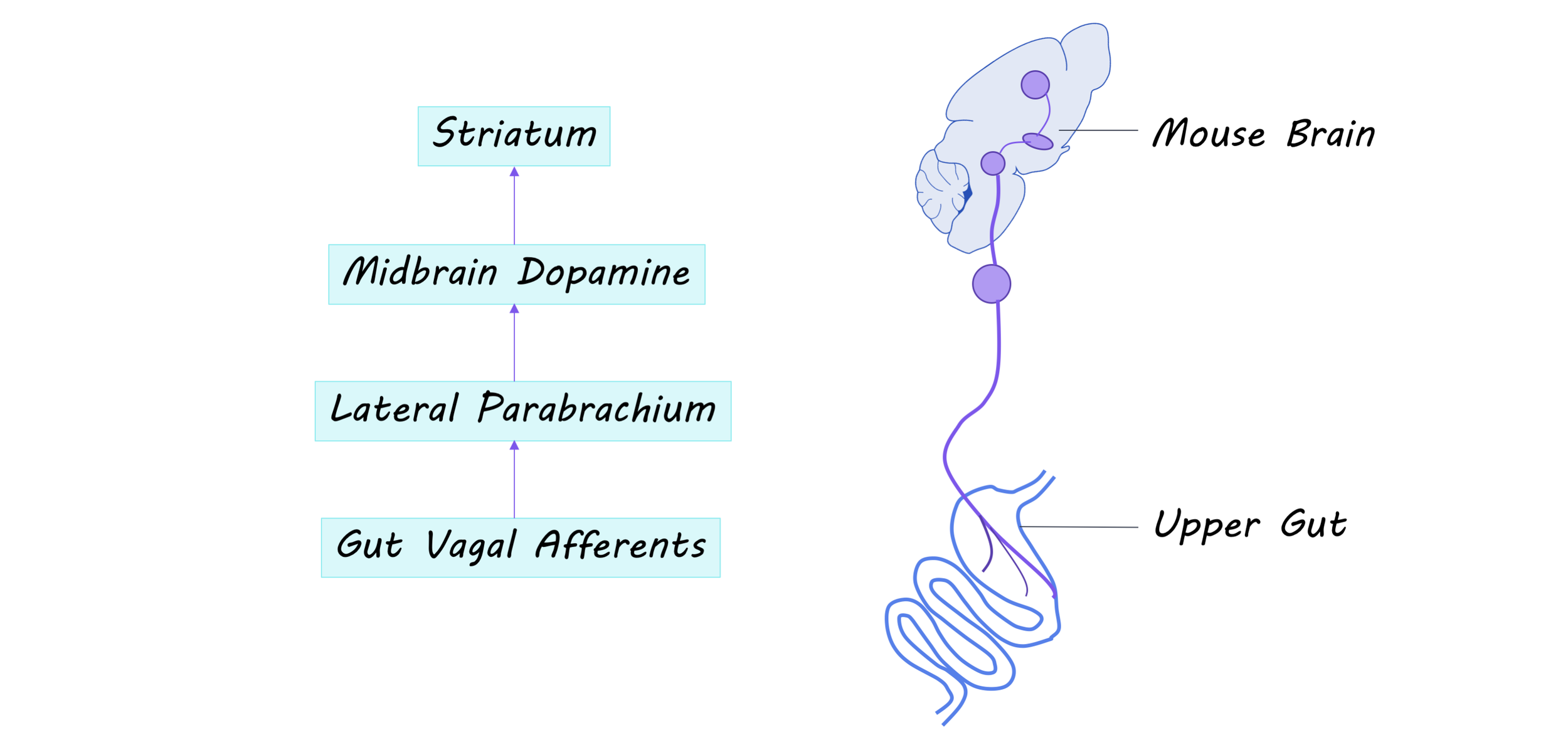
In the first experiment, the authors transfected the upper gut (stomach and duodenum) of mice with a virus carrying Cre-recombinase. This virus moves up the neuron towards the cell body, thus, Cre-recombinase was bilaterally transported into the sensory ganglia (cell bodies) of the vagus nerve via sensory afferents innervating the upper gut. Then, they expressed light-sensitive Channelrhodopsin-2 (depolarizing ion channel activated by light via optogenetic techniques) in the left or right sensory ganglia of the vagus nerve. Confocal microscopy was used to determine where the sensory ganglia of the vagus nerve terminated in the brain. The right vagus nerve neurons terminated in the nucleus of the solitary tract and the left vagus nerve neurons terminated in the posterior part of area postrema. Next, they used optic fibers placed in these brain regions to stimulate the left and right vagal nerve terminals, respectively. Finally, they performed behavioural tests like self-stimulation, place preference and flavour conditioning assays. They also measured dopamine levels in the dorsal striatum to determine the reinforcing value of optically stimulating vagal nerve terminals. In the second experiment, the authors used chemogenetics to activate the right and left vagal nerve terminals at the same time. They repeated the place preference behavioural test, flavour conditioning assays and measured dopamine levels in the dorsal striatum to determine the reinforcing value of simultaneous stimulation. They then performed experiments to further characterize any asymmetry between right and left vagal nerve gut-brain pathways.

What did they find?

The authors found that optogenetic activation of the right vagus nerve ganglion (cell bodies) specifically, exhibited reward-type behaviours in mice. These mice had significantly more nose pokes compared to controls to obtain vagal nerve stimulation (self stimulation), and also spent more time in areas of the cage that were paired with optogenetic activation (of the vagal nerve terminals) in the place preference test. Flavour conditioning assays revealed that these mice displayed robust preferences for flavours that were paired with optogenetic stimulation of the right vagal nerve terminals. Additionally, dopamine release in the dorsal striatum, a key requirement in reward learning, was increased with optical activation of the right vagus nerve terminals. Mice that had optogenetic activation of the left vagal nerve ganglion did not display any self-stimulation, place preference or dopamine release in response to optical activation. Activation of the right and left vagus nerve ganglia simultaneously (using chemogenetics) led to reward behaviors: robust place preference and flavour preferences as well as an increase in dopamine release in the dorsal striatum. Thus, the rewarding effects associated with the activation of the right vagus nerve terminal does not appear to be disrupted by the simultaneous activation of the left.
Gut_Brain_1800.png

The authors observed that the right and left vagus nerve ganglia project to the brain via asymmetric pathways. In a third experiment using transneuronal labeling, the authors found that glutamatergic neurons of the dorsolateral parabrachial region connect the right vagal sensory ganglion to the Substantia nigra (containing dopamine neurons). They also determined that optical activation of the dorsolateral parabrachial region had the same effects as optical activation of the right vagus nerve ganglion. Mice showed reward behaviors including self-stimulation, place preference for areas where they received optogenetic stimulation and preferences for flavours that were paired with optical stimulation. Mice also had increased levels of dopamine in the dorsal striatum.

What's the impact?

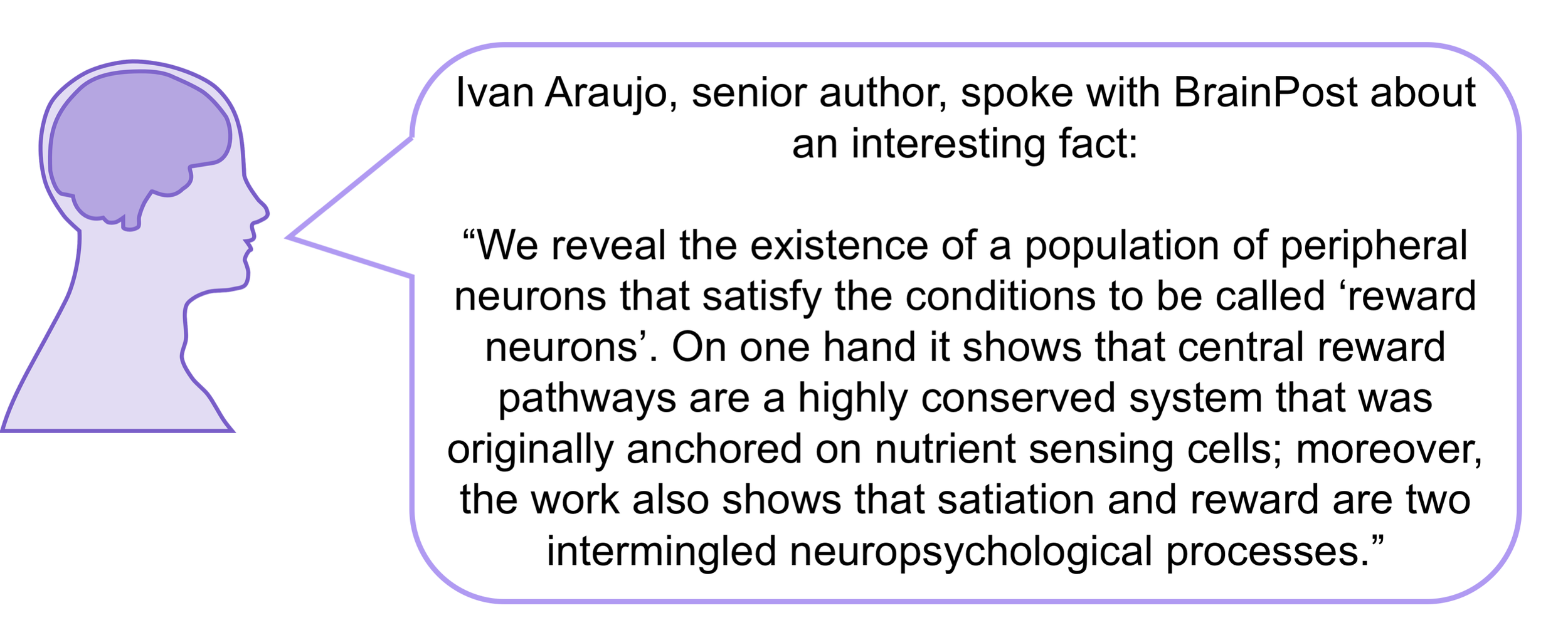
This study is the first to identify the critical role of the vagal gut-brain axis in motivation and reward. The authors show that the right, but not left vagal gut-brain pathway is crucial in mediating motivation and dopamine activity. These findings provide insight into a new direction to help improve treatments for disorders like depression by targeting vagal stimulation to the right side via the upper gut.  
Gut_quote_1800.png

Han et al. A neural circuit for gut-induced reward. Cell (2018). Access the original scientific publication here.
Effects of the Clinical SSRI Escitalopram on Cognitive Functions

Post by Kayla Simanek

What’s the science?

Serotonin is a neurotransmitter (chemical) known to influence learning, executive function, and emotion. Depletion of serotonin is thought to contribute to mood disorders like depression or obsessive-compulsive disorder. Selective serotonin reuptake inhibitors, or SSRIs), are drugs that prevent the breakdown of serotonin. However, studies on the clinical SSRI escitalopram (often a first line of treatment) show that acute doses can actually have effects suggestive of serotonin depletion (possibly due to inhibition of neurotransmission itself). Higher, sub-chronic doses of citalopram, on the other hand, have been shown to improve cognitive flexibility. As SSRIs are the first choice in treatment for people with mood disorders, understanding their effects on cognition is imperative. This week in Neuropsychopharmacology, Skandali and colleagues tested the effects of the clinical SSRI escitalopram in human volunteers, using a battery of tests designed to analyze cognitive functions.

How did they do it?

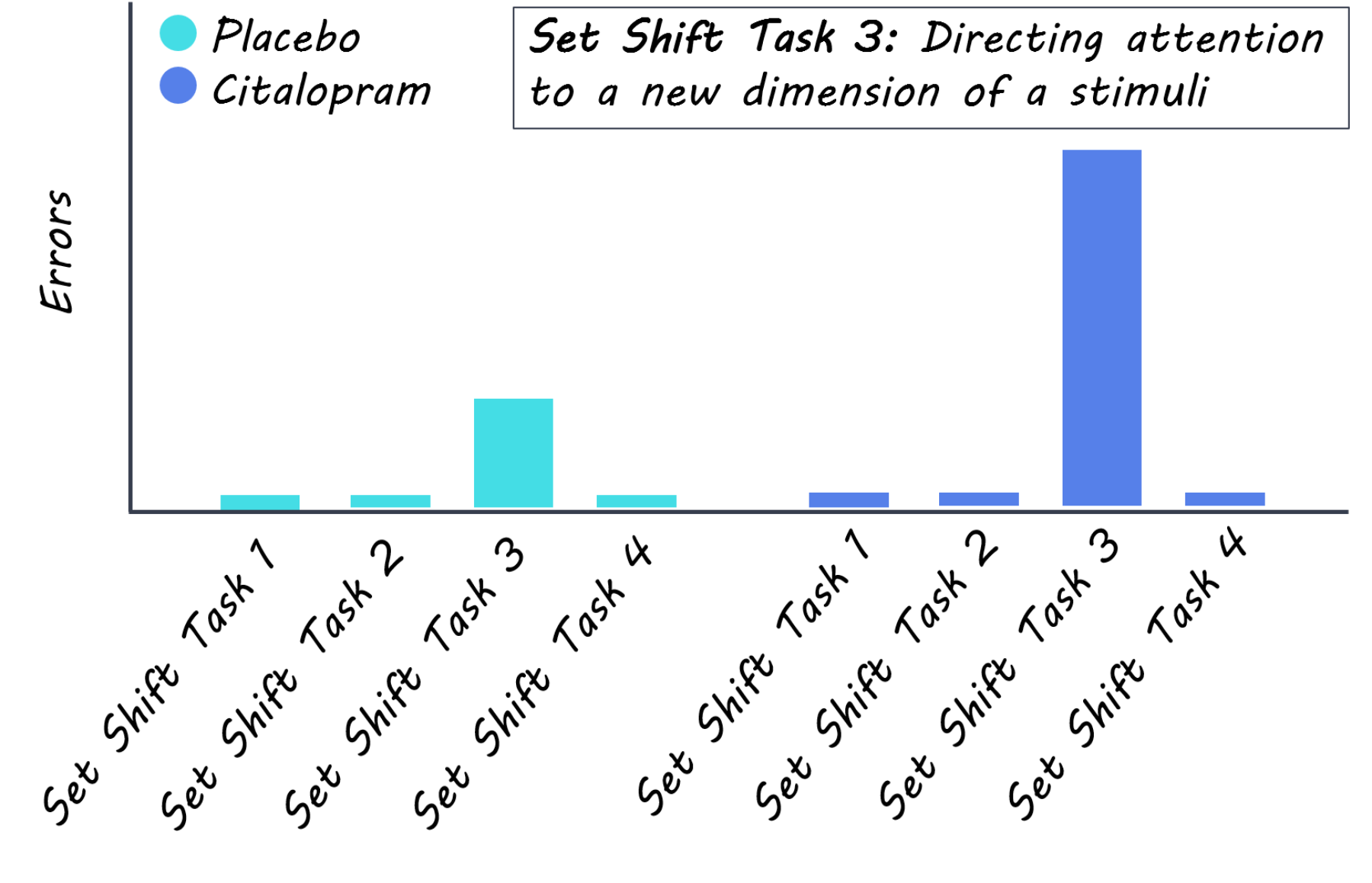
The authors randomly administered either acute (not chronic) dosage (20mg) of escitalopram or a placebo to sixty-five healthy volunteers. Three hours after drug administration, the authors conducted four tests to assess learning, cognitive flexibility, response control and emotional sensitivity: 1) A reversal learning task to determine ability to overcome misleading information and learn a rule based on positive and negative feedback. Subjects chose between two different patterns on a touchscreen and were provided immediate, sometimes misleading, feedback. After 40 trials, the rules changed and the subject had to re-learn the “correct” answer. 2) A set-shift test to detect symptoms of neurodegenerative disorders, like Alzheimer’s or Parkinson’s Disease (i.e. cognitive flexibility via analysis of visual, spatial and short-term memory functions). This tested their capacity to attend to multiple parameters simultaneously. 3) A response inhibition task in which subjects were required to respond to directional cues. Sometimes a “stop” cue was added, signaling to the subject to refrain from pressing a button, and the time to abort the action was measured (response control). 4) An emotional processing task. For example, one test asked subjects to create a scenario by choosing four of nine stimuli (faces, thoughts or facts) and then judge whether it was connotatively positive or negative.

What did they find?

For the reversal learning test (test #1), it was found that the acute dosage of escitalopram resulted in a deficit in learning by reinforcement and enhanced sensitivity to negative feedback (symptoms observed in people with mood disorders). Together, the set-shift and response inhibition tasks (tests #2 and #3) measured executive function but produced contradictory results. Although cognitive flexibility was impaired in some of the set-shift tasks, response control to a stop cue was surprisingly enhanced in the escitalopram group compared to placebo. Emotional processing (test #4) was largely unaffected. It is possible that different parts of the brain respond differently to serotonin, or more specifically, require different levels of serotonergic neurotransmission for optimal performance. However, the administration of the SSRI in this study was acute, and effects on cognition of chronic escitalopram treatment must also be investigated.

citalopram1800.png

What’s the impact?

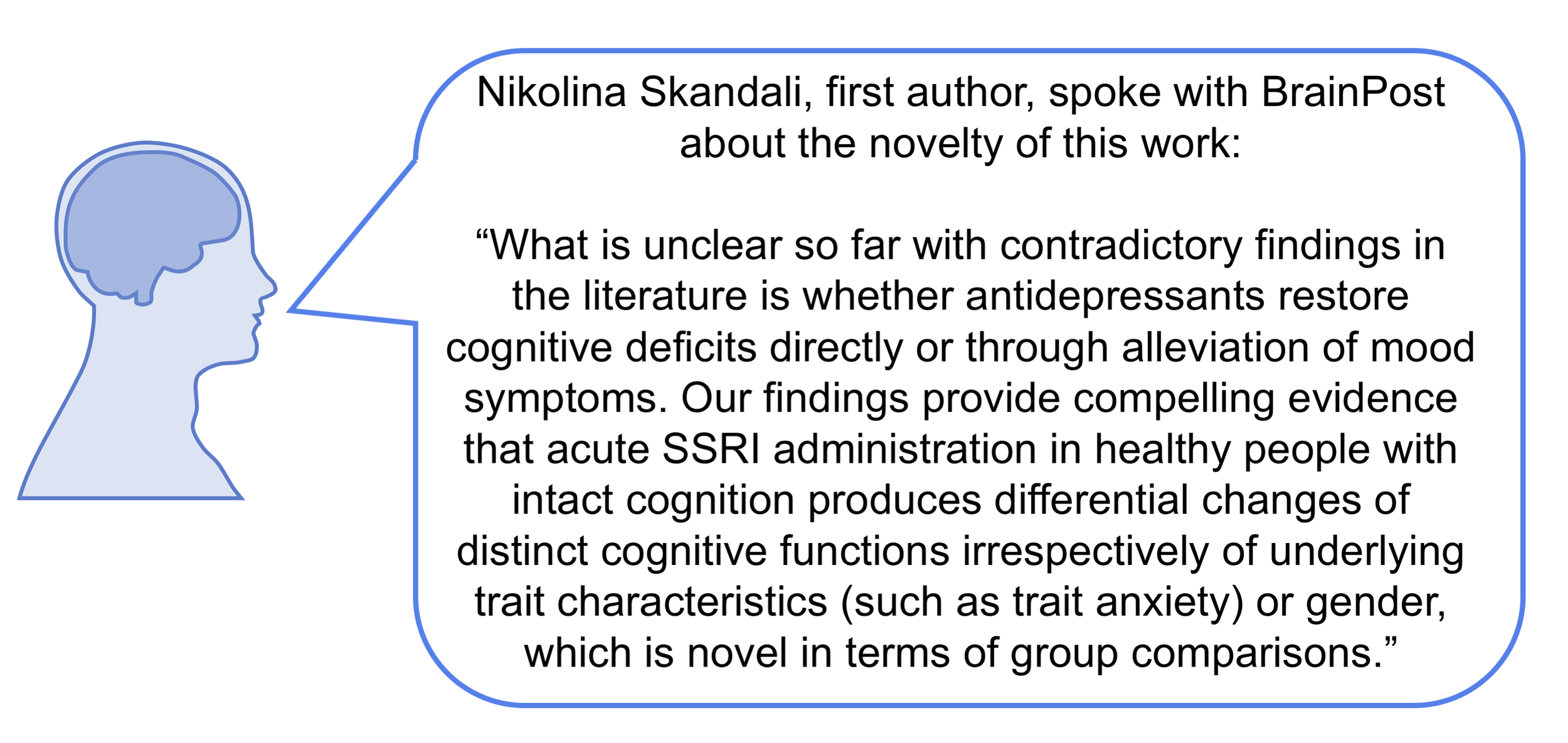
This study showed that the effects of an acute dosage of escitalopram in healthy adults has differential effects (either impairment or enhancement) on learning by reinforcement, executive function, and emotional processing. Understanding the effects of SSRI dosage and administration are critical because drugs like escitalopram are the first choice of treatment for people with mood disorders.

SSRI_1800.png

Skandali et al. Dissociable effects of acute SSRI (escitalopram) on executive, learning and emotional functions in healthy humans. Neuropsychopharmacology (2018). Access the original scientific publication here.

Number-Selective Neurons in the Medial Temporal Lobe

Post by Deborah Joye

What’s the science?

How does our brain represent numbers? Pre-verbal infants and non-human animals can’t recognize numeric symbols, but they can estimate numerosity: how many objects are in a group. Numerosity is intuitive, and young children leverage this to associate number values with specific symbols (i.e. Arabic numerals). There are ‘number networks’ in the brain that play a role in learning to use number symbols to solve math problems. The medial temporal lobe is one brain area connected to these number networks, including the hippocampus, parahippocampal cortex, and amygdala. Evidence from monkeys suggest that single neurons can preferentially respond to a specific numerosity and there is some evidence that humans may have neurons like this too. This week in Neuron, Kutter and colleagues record brain activity from participants performing a simple number task and demonstrate that single neurons in the human medial temporal lobe preferentially respond to specific numerosity and numeric symbols.

How did they do it?

Nine epilepsy patients had electrodes implanted in varying regions of their medial temporal lobes as part of their clinical treatment, and signals were recorded while they completed a simple calculation task. The authors presented numerosities (e.g.: a group of three dots) or number symbols (e.g.: “3”) and calculation rules (“+” or “add”) on a computer screen, each followed by blank delay frame to assess working memory activity. After presentation of a number, a rule cue, and another number, participants were asked to solve the calculation. After the task, the authors isolated recordings from individual neurons, then grouped them together according to brain region and time-matched them to the task sequence. They then analyzed how individual cells responded to numerosity and number symbols in the early part of the task (the presentation of the first number and delay frame) and later in the task (the presentation of the calculation rule and subsequent number). They also assessed whether single cells responded to both types of number representations or responded to the calculation component of the task (i.e. addition versus subtraction and whether the rule was a symbol or a word). Finally, to examine how the number information was encoded at the level of the neuronal population, the authors trained a machine learning algorithm (multi-class support vector machine ) to predict numerical value based on a subset of the recordings.

What did they find?

When examining neural activity from the first part of the task, the authors found that a significant proportion of individual cells in the medial temporal lobe responded to specific numerosities or number symbols, but not both simultaneously. More cells responded preferentially to numerosity than to symbolic numbers (29% vs. 6%), and only about 1% of all recorded neurons exhibited responses to both. Individual cells also had longer lasting responses to numerosity: they responded while the number value was shown, as well as the following delay period. In comparison, symbolic number-preferring cells responded only while the numeric symbol was present. However, neurons that preferred number symbols exhibited a greater selectivity for preferred values, showing a large response to the preferred number symbol and the same significantly decreased response to any other number symbol. This number discernment holds true on the population level as well. Their machine learning algorithm reliably predicted numerical value based on recordings from neuron populations, though it was more accurate for numerosity recordings. Interestingly, the closer the two values were on the number line, the more similar the population response pattern. This demonstrates a cellular version of the behavioral “numerical distance effect,” the idea that it’s easier to tell two numbers apart the further they are from each other.

deborah1800.png

When analyzing recordings from the later portion of the task (presentation of the calculation rule and second number), the authors found that a significant proportion of cells maintained preferential response to specific numerosities, though a much smaller proportion than responded to the first number presentation. Cells that responded to both the first and second numerosity also tended to prefer the same number value. Only a chance proportion of neurons responded preferentially to number symbols during the latter part of the task. Finally, the authors found that a very small proportion of cells selectively responded to the calculation rule (subtraction vs. addition) and of those, a subset responded preferentially to the format of the rule (symbol vs. word).

What’s the impact?

This is the first study to provide direct evidence that single neurons encode specific numerosity or number symbols. Past research has proposed two hypotheses: a “summation code” where cell firing systematically increases or decreases as numeric value increases or decreases or a “labelled-line code” where numerosity-selective neurons respond preferentially to specific number values. This study supports the latter hypothesis. Neurons demonstrate a unique capacity to prefer specific numeric symbols with a high degree of selectivity. These findings suggest that we may learn number symbols by linking them to evolutionarily conserved numerosity representations.

deborahquote1800.png

Kutter et al. Single neurons in the human brain encode numbers. Neuron (2018). Access the original scientific publication here.