The Effect of a Partial Loss of TREM2 on Microglia and Tau Pathology

Post by Thomas Brown

What's the science?

Alzheimer’s disease (AD) represents one of the greatest challenges faced by modern science, however, little is known about the mechanisms behind the disease. Many recent studies have drawn attention to the role of resident immune cells within the brain, known as microglia, in Alzheimer’s disease. A mutation within TREM2, a gene associated with microgliosis and increased AD risk, is believed to cause a ‘loss of function’ of one of its two alleles. This week in PNAS, Sayed et al. recreated this loss of TREM2 activity; in one, or both alleles of the gene, to test the effect on microglial function.  

How did they do it?

The authors utilized in vivo imaging to quantify microglial activity. Firstly, adult 9-14 month old mice were divided into three groups; wild-type (WT) (TREM2+/+), single-allele knockouts (TREM2 haploinsufficient mice: TREM2+/-,) and full knockouts (TREM2-/-). These mice were then crossed with a mouse with a green fluorescent protein marker linked with a receptor commonly found on microglia, ensuring that microglia would glow and allowing for live visualization. Through utilization of a microscope attached to the head of the mouse, the authors were able to see the microglial response to injury. The brains were then lesioned with a laser and the morphology of the microglia was inspected following the lesion. Additionally, they also analyzed the expression of different microglial genes using quantitative real time polymerase chain reaction. Finally, the expression of tau aggregates (a protein that aggregates in the brain in Alzheimer’s disease) was measured in TREM2+/+, TREM2+/-, and TREM2-/- mice genetically modified to express human tau, using an antibody that binds to tau.

What did they find?

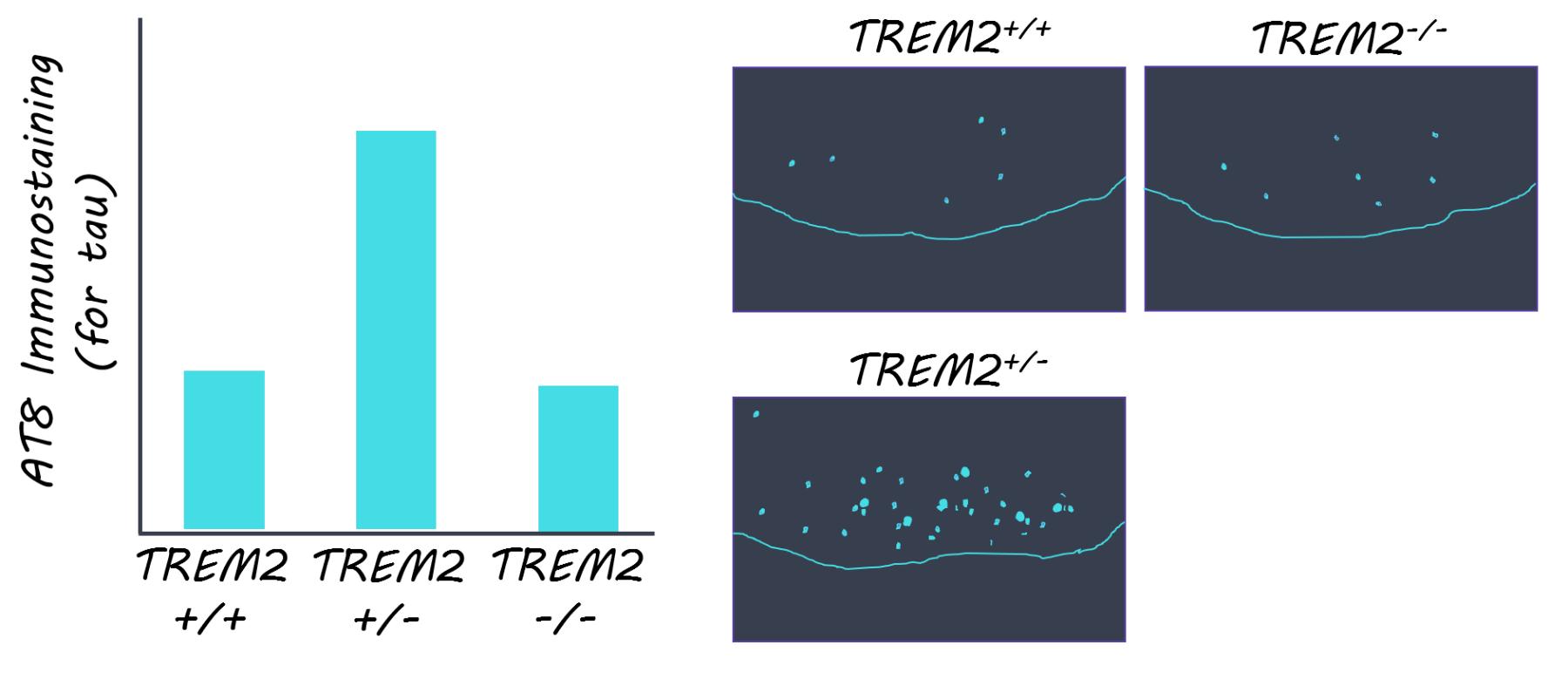
Microglial response to injury in TREM2+/- mice was slow, and these microglia extended less processes than wild-type controls (TREM-/- mice). This indicates that the brains of TREM2+/- mice were less responsive to injury. Additionally, gene expression of IL-1α, IL-1β and TNF-α (inflammatory markers) was elevated in TREM2+/- mice. The TREM2 haploinsufficient mice (with partial loss of TREM2) who were also expressing human tau demonstrated increased tau pathology, however, the full TREM2 knockout mice did not. The impaired microglial response to injury, increased expression of inflammatory markers, as well as an increase in tau levels, suggest that the haploinsufficient TREM2 mice had an AD-like pathology.
thomas1800.png

What's the impact?

The generation of a TREM2 knockout mouse is useful for the study of Alzheimer’s Disease, especially in the context of the brain’s immune system. Comparison between full and single-allele knockout mice revealed that inflammation and Alzheimer’s pathology were higher in single-allele knockouts (haploinsufficient mice) when compared to full-knockouts, indicating that TREM2-associated AD pathology may be exacerbated by a functional copy of the gene in addition to the mutated version. The study of neuroimmunology and related genes, such as TREM2, are crucial to understand Alzheimer’s progression and to generate treatments for the disease.   


Sayed et al. Differential effects of partial and complete loss of TREM2 on microglial injury response and tauopathy. PNAS (2018). Access the original scientific publication here.


Using Big Data to Identify Four Personality Types

Post by Anastasia Sares

What's the science?

The effort to understand and categorize human personalities has been going on for millennia. Still, we don’t have a very good intuition about how many personality types there should be, or what kinds of traits are important in defining personalities. The most well-established model of personality traits to date is the Big Five, or the Five-Factor Model, which defines five dimensions of personality: extraversion, openness to experience, conscientiousness, agreeableness, and neuroticism. If we mathematically assess the responses of many people, patterns emerge, and a small number of stable traits can often be found. How do we get from traits that everyone has to some degree, such as high extraversion or low agreeableness, to different ‘categories’ of people’s personality types? This week in Nature Human Behavior, Gerlach and colleagues attempt to categorize personalities using online survey data from over 1.5 million people. 

How did they do it?

The authors acquired four different data sets, each consisting of an online personality questionnaire with 100,000 to 500,000 responses. The questionnaires had different numbers of questions (44, 100, 120, and 300). They analyzed the 300-question data set to develop their initial typology. The authors first extracted the Big Five trait scores for each person using a factor analysis. The next step was to look for clusters of people that had similar profiles across the traits (using a clustering algorithm). At this point, they obtained 13 different clusters, a number that seemed quite high. So they took the data and randomized it, shuffling the trait scores comparing the random data to the real data. They identified the clusters where the density in the real data was distinctly larger than in the the randomized data, ending up with four clusters corresponding to four distinct personality types. Finally, the authors analyzed the other three data sets in the same way as the first one. This way, they could make sure that their results were reproducible.

What did they find?

The authors found four personality types, which they labeled average type, role model type, self-centered type, and reserved type. The average type was named for their average scores on all of the Big Five traits. The role model had low neuroticism and high scores in all the other traits. The self-centered type had low scores on openness, agreeableness and conscientiousness, while the reserved type had low scores on openness and neuroticism. In general, these types replicated well across the other three data sets, though they did not recover the self-centered type in the 100-question survey, nor the average type in the 44-question survey. This could be expected given the smaller number of questions (something the authors confirmed by simulation). They also found, based on demographic data, that older individuals were more likely to be role model types, and less likely to be self-centered. This pattern was also consistent across data sets.

anastasia1800.png

What's the impact?

The finding of four distinct personality types advances the field of personality psychology, and contributes to the debate on whether it is actually possible to quantify something as complex as human personality. The Big Five traits can predict behavior in mental health situations and other life patterns. Further, having a typing system might allow clinicians and researchers to measure the personality factors that affect their work. Beyond this, the study showed that the clustering algorithm used to find the personality traits, while being an advanced technique, can sometimes come up with spurious results. Therefore it’s important to analyze results in other ways, like randomizing the data.

Word of Caution: While the results suggest these four types, the findings do not suggest that every person belongs to one and only one type. In fact, many respondents' score on the 5 personality traits suggest they are located between personality types; nevertheless there are some clusters in the data which are much denser than others.

anastasia_quote1800.png


Gerlach et al., A robust data-driven approach identifies four personality types across four large data sets. Nature Human Behaviour (2018). Access the original scientific publication here

Traits that Affect Response to a Placebo Pill in Chronic Pain

Post by Amanda McFarlan

What's the science?

The placebo response is a phenomenon whereby an individual perceives or experiences an improvement in symptoms after receiving an inactive treatment. The relief of pain after exposure to placebo is of particular interest in the study of chronic pain, since many treatments for pain can have long-term adverse effects or addictive properties. So, the question remains – why do some people experience analgesia (pain relief) in response to an inert treatment? Efforts to study the underlying mechanisms of the placebo effect have been achieved using randomized placebo-controlled trials in chronic pain patients. These studies have provided evidence that individuals with chronic pain may exhibit different brain connectivity that predispose them to respond to a placebo treatment. This week in Nature Communications, Vachon-Presseau and colleagues examined the psychological and neural traits among individuals with chronic back pain to determine what traits predispose an individual to respond to a placebo.

How did they do it?

The authors analyzed a total of 63 participants in their randomized placebo-controlled clinical trial on placebo response. Participants were separated into three groups: placebo pill responding, placebo pill non-responding  and no treatment. The authors asked participants to visit the lab 6 times over an 8-week period for pain assessments, including verbal recall of pain ratings and questionnaires, and brain imaging using resting state fMRI. Participants received the placebo treatment during the second and fourth visits, both followed by a washout period in which no treatment was administered. In addition to assessments in the lab, participants used a smartphone app to rate their back-pain intensity twice a day in their natural environment. The participants’ pain ratings, questionnaire scores (for pain rating as well as psychological measures) and MRI scans were used to determine whether psychological, structural and functional differences were present in placebo responding individuals.

What did they find?

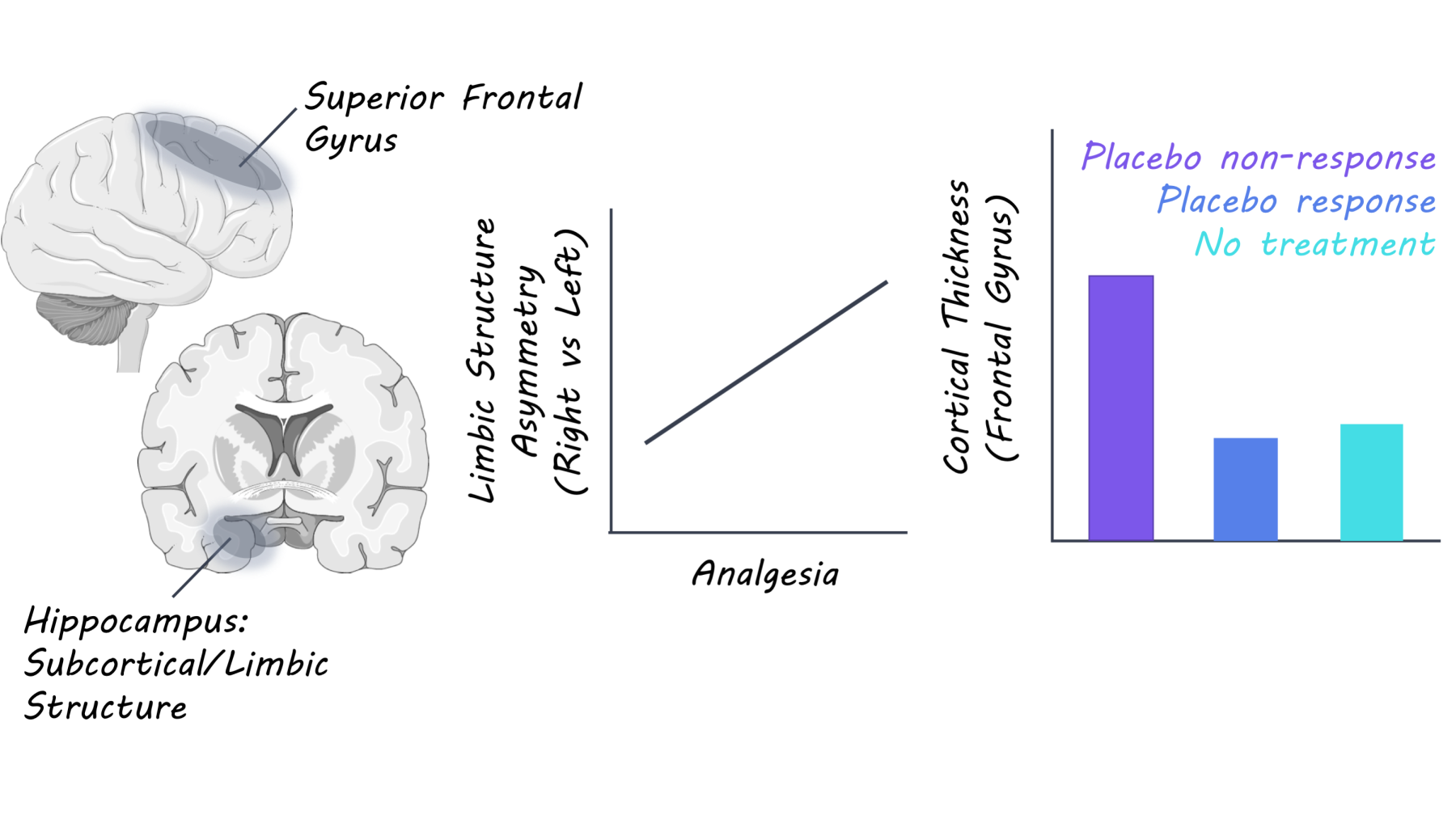
The authors determined that the placebo pill responding group had psychological, structural and functional differences in the brain compared to the placebo pill non-responding and no treatment groups. First, the participants’ daily pain rating using the smartphone app revealed that participants taking the placebo pill reported significantly lower levels of pain compared to those in the no treatment group, indicating the placebo pill was sufficient to induce analgesia. Second, the magnitude of analgesic response was found to be correlated with four sub-scales from the Multidimensional Assessment of Interoceptive Awareness questionnaire, including Emotional Awareness and Not Distracting, and the quality of ‘openness’ from the Neo-5 Personality Dimensions, suggesting these traits may be psychological factors predisposing an individual to a placebo pill response. Third, brain scans (structural MRI) obtained prior to the first placebo pill treatment revealed that the volume in limbic (subcortical) regions of the brain was asymmetric in patients who responded to placebo compared to non-responding individuals and that this asymmetry remained consistent in all four brain scans throughout the trial. Additionally, measurements of cortical thickness revealed that non-responding participants had thicker cortex in the prefrontal cortex (right superior frontal gyrus) compared to responding participants. Finally, an analysis of functional connectivity in the brain prior to the first treatment revealed that the patients who responded to placebo, compared to the non-responding group, had stronger connections between the ventrolateral prefrontal cortex and the precentral gyrus and weaker connections between the ventrolateral prefrontal cortex and the rostral anterior cingulate gyrus (these regions of the brain are generally involved in cognition, emotion, and movement). These differences in connections remained consistent throughout the trial, suggesting they may be predisposing factors to a placebo response. Anatomical and functional brain measurements in the no treatment group remained consistent throughout the trial.  

amanda1800.png

What's the impact?

This is the first study in chronic pain to compare a placebo-receiving group with a non-treatment group in a brain imaging randomized placebo-controlled clinical trial. The authors in this study found that there are psychological traits as well as structural and functional brain differences between individuals who respond to the placebo pill and individuals who do not. These findings suggest these factors are predisposing to the placebo pill response and may be used in computational models to predict the likelihood that an individual will respond to a placebo.

amandaquote1800.png

Vachon-Presseau et al. Brain and psychological determinants of placebo pill response in chronic pain patients. Nature Communications (2018). Access the original scientific publication here.