
Investigating Genetic Risk for Schizophrenia Using Neuronal Differentiation

What's the science?

Complex genetic variation contributes to psychiatric disorders like schizophrenia. Many single nucleotide polymorphisms (small commonly occurring changes in DNA) together contribute to risk for a psychiatric disorder. A major challenge is to understand how this “polygenic risk” (i.e. the cumulative risk across many regions of the DNA) affects biological pathways that contribute to brain function and disease. This week in Biological Psychiatry, Ori and colleagues explored whether an in vitro experimental model of neuronal differentiation can be informative to study polygenic risk of psychiatric disorders.

How did they do it?

The authors cultured human neural stem cells as they differentiated into neurons over a 30 day period. The authors measured gene expression across the whole genome at 7 timepoints during this period in order to capture changes to the function of genes over time. They first identified genes that have significant changes in expression during differentiation, and subsequently clustered these in separate groups based on their patterns of expression. They next integrated the identified gene expression ‘profiles’ with known risk polymorphisms for psychiatric disorders using information from previously published genome-wide association study (GWAS) data. Namely, they tested if the genes active during differentiation were associated with polygenic disease risk.

What did they find?

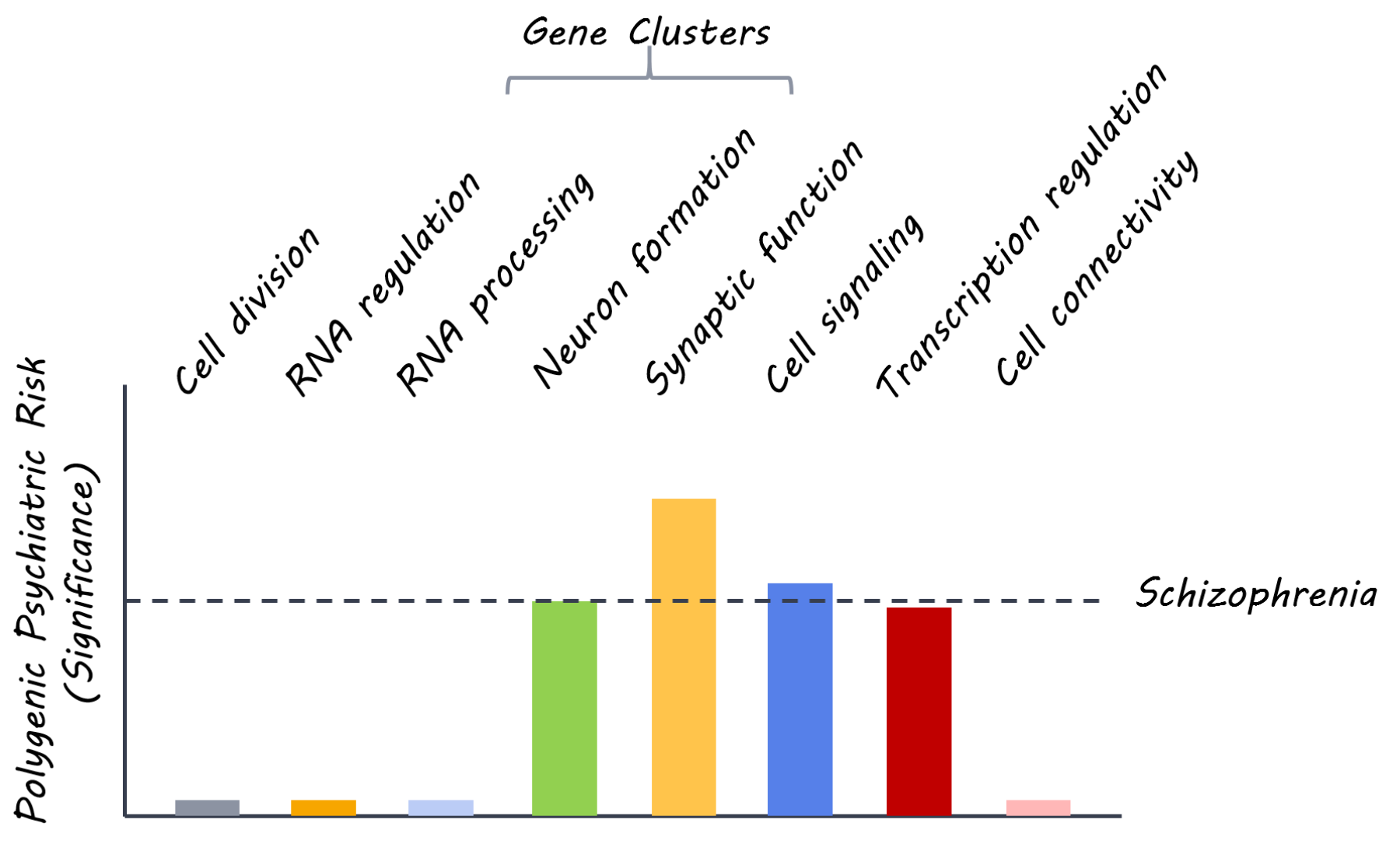
They found that gene expression of neuron specific genes generally increased over the course of cell differentiation into neurons. The pattern of gene expression in these developing neurons matched the gene expression patterns documented in the developing human brain (i.e. in vivo instead of in vitro). They next identified thousands of genes that change their expression throughout differentiation. These could be grouped into 8 distinct gene clusters. When they investigated further, they found that genetic risk of multiple psychiatric disorders is significantly associated with gene clusters that are up-regulated during differentiation, with the strongest signal for schizophrenia risk in genes involved in synaptic function. They further replicated their main findings in an independent dataset.   
leigh1800 (2).png

What's the impact?

This is the first study to examine how polygenic risk for psychiatric disease is associated with gene expression changes in an in vitro experimental model of neuronal differentiation. Many small variations throughout the genome contribute to genetic risk for psychiatric disease, and there is a need to understand how alterations act in concert and predispose one to disease. Unlike other organs, there is limited accessibility to the brain in living individuals. Therefore, there is a need for alternative models that capture and allow for the study of genetic risk of psychiatric disorders. This study puts forward a framework that helps to link schizophrenia polygenic risk to a distinct biological pathway, which now can be further modeled in a controlled laboratory environment.

leighquote1800 (1).png

Ori et al., A longitudinal model of human neuronal differentiation for functional investigation of schizophrenia polygenic risk. Biological Psychiatry (2018). Access the original scientific publication here.
The Relationship Between Brain Synchronization, Cooperation and Group Creativity

What's the science?

When people cooperate instead of compete, they are more likely to build on each other’s ideas and explore new ideas. Creativity in a group setting is important to produce original work, but how cooperation and competition can enhance or hinder group creativity is still unclear. The neural processes involved in a group’s creative performance also remain unclear. This week in Cerebral Cortex, Lu, Xue, and colleagues scanned the brains of two people simultaneously while they completed tasks in competitive or cooperative modes, and measured creative performance. Their goal was to understand which mode fosters group creativity and what brain regions are involved in this process (including how synchronous brain activity is between individuals in the group).

How did they do it?

The study included 104 young adults (64 women), and participants worked in pairs with other participants they did not know. Pairs of participants were randomly assigned to complete one of two tasks (the Alternative Uses task or the Object Characteristic task), and each pair completed their tasks in both cooperation and competition mode. In the Alternative Uses task, which measures divergent thinking, participants generate alternate uses for everyday objects. In the cooperation mode, participants were asked to cooperate with each other for better group performance, while in the competition mode, participants were told the other participant was their opponent and that the winner would be determined by comparing performance between the two participants. In the Object Characteristic task, participants thought of characteristics of everyday objects (testing their memory, but not divergent thinking). In this task, participants were similarly asked to perform the task in cooperation or competition mode. In both tasks, participants took turns stating their answers. Performance on the Alternative Uses task was quantified with the number and originality of the ideas generated, and performance on the Object Characteristic task was quantified based on the number of characteristics generated. The extent to which participants combined their ideas or thought of ideas in the same topic/category was also quantified as an index of cooperation. To measure brain activity during these tasks (while participants faced one another), the authors used functional near-infrared spectroscopy (fNIRS) – a technique in which sensors are placed on the scalp to detect changes in blood oxygenation in the brain. Probes that contained several measurement channels were placed over the prefrontal cortex and right temporoparietal junction (rTPJ), brain areas known to be involved in group creativity. Interpersonal brain synchronization was calculated as coherence between a given pair of measurement channels between two individuals. A frequency band of interest (0.042-0.045 Hz) was chosen as interpersonal brain synchronization increased during the Alternative Use task (compared to while at rest) in both the prefrontal cortex and rTPJ in this band.

What did they find?

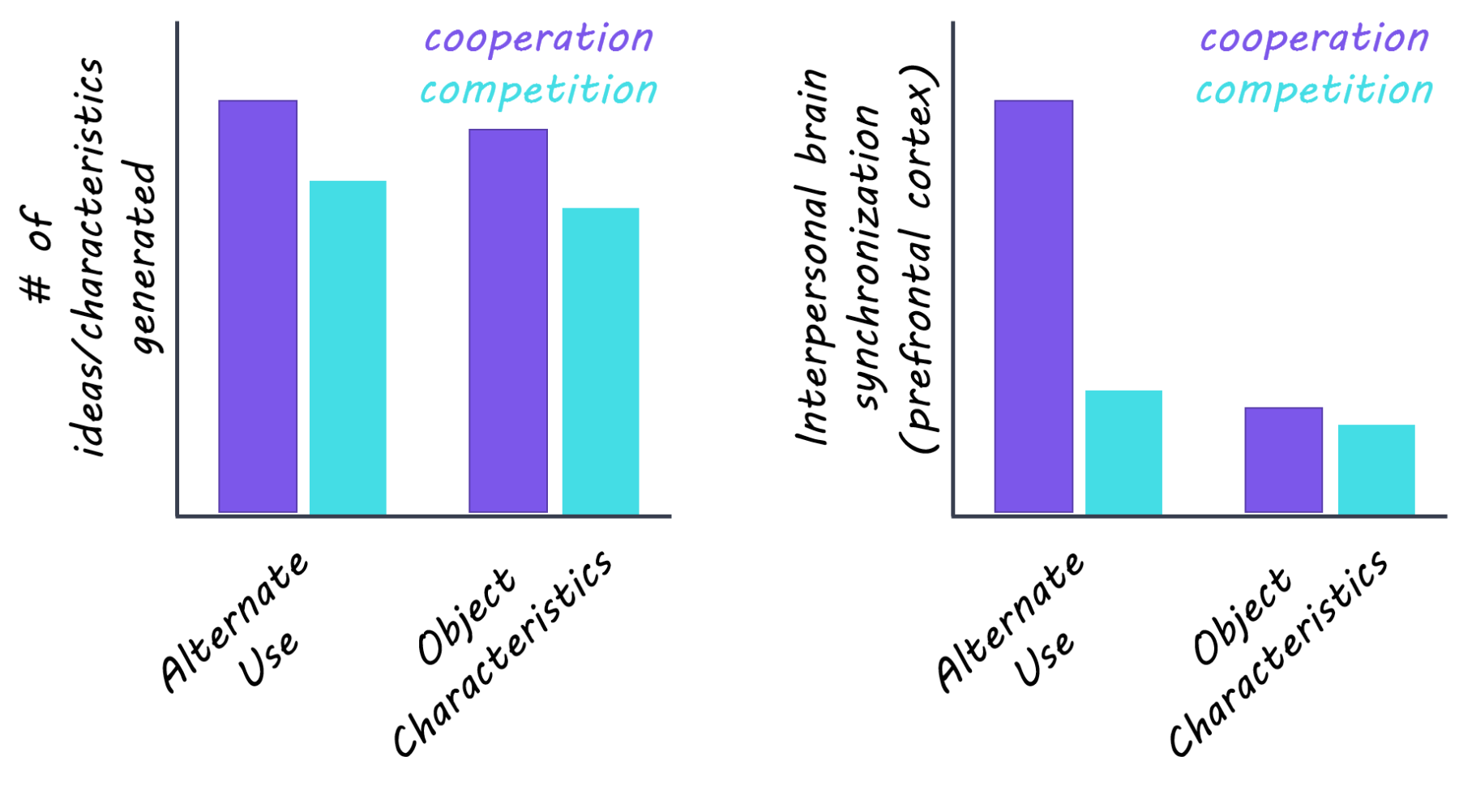
Across tasks, the number of idea/characteristics generated by participants was greater in cooperation mode versus competition mode. Originality of ideas in the Alternative Uses task and a behavioural index of cooperation (both participants having ideas in the same category) were higher in cooperation mode. In the prefrontal cortex (right dorsolateral prefrontal cortex region), interpersonal brain synchronization was higher compared to baseline/rest in the Alternate Use task during the cooperation mode, but not in any other task or mode. Higher interpersonal brain synchronization predicted greater cooperation. In the rTPJ, interpersonal brain synchronization was greater during the Alternative Use task versus the Object Characteristic Task, particularly during cooperation mode. Finally, interpersonal brain synchronization between the prefrontal cortex and rTPJ was also higher in the Alternative Uses task in the cooperation mode versus in the competition mode.

kasey1800 (2).png

What's the impact?

This study found that group creativity was greater when individuals cooperate to complete a task, and that brain synchronization between individuals predicts the level of cooperation on the task. These results have implications for understanding how creativity is cultivated in a group setting. Greater brain synchrony between people was associated with greater cooperation, suggesting that greater synchrony is indicative of better interpersonal interaction.

Lu et al., Cooperation Makes a Group be More Creative. Cerebral Cortex (2018). Access the original scientific publication here.

The ‘Rosehip Cell’: A GABAergic Neuron

What's the science?

A critical goal of neuroscience is to understand the types of cells that make up the brain. Typically, novel cell types have been identified by studying the expression of molecular markers in different cells, and then confirming that the cell appears to have a distinct pattern of morphology of its axon and dendrites (the main processes attached to the cell body of a neuron). Essentially, researchers try to determine the relationship between genotype and phenotype. Some cell types are conserved across species, so a large portion of this type of research is done in rats and also applies to humans. However, not every cell type is conserved across species, so doing research in humans is important too. This week in Nature Neuroscience, Boldog and colleagues study molecular expression of different brain cells and characterize neuron morphology in humans.

How did they do it?

The authors first used single nucleus transcriptomics or RNA sequencing in two healthy post-mortem human brains. This method involves dissecting regions of interest from the cortex, isolating cell nuclei using tissue homogenization, and staining to identify neuronal (NeuN+) and non-neuronal (NeuN-) cells. The region of interest within the cortex was layer 1 of the middle temporal gyrus, which contains mostly inhibitory neurons. The resulting nuclei were then grouped using a clustering method according to the similarity of their transcriptional profiles.

To establish cell morphology, the authors identified interneurons in layer 1 in brain slices prepared from the parietal, temporal, and frontal cortices of 42 patients. Whole-cell recording and light microscopy of the cells was performed. Finally, they authors performed immunohistochemistry on the cells for which morphology was examined to test whether these cells were positive for gene markers indicative of different identified clusters (of gene markers).

What did they find?

Using single nucleus transcriptomics, on average 9937 genes were detected in neurons and 6287 genes were detected in glia (non-neuronal cells). When cells with similar transcriptional profiles were grouped together, different cell types (e.g. oligodendrocytes, microglia, astrocytes, excitatory neurons) were clustered with other cells of the same type as expected. Surprisingly, 11 different clusters of GABAergic or inhibitory neurons were identified within layer 1 of the middle temporal gyrus (however, this doesn’t mean that neurons belonging to these clusters wouldn’t also appear in other layers of the cortex). Different cell types could be identified by different marker genes – for example, GABAergic neurons were identified by the expression of glutamic acid decarboxylase 1 (GAD1). 

rosehip1800 (1).png

Using light microscopy of layer 1 interneurons, the authors identified subsets of cells that had been previously described, as well as a novel type of interneuron, newly named the ‘rosehip cell’ for its rosehip-shaped axonal boutons (terminals of an axon). The shape of the dendrites of these neurons were relatively short and bushy. These neurons tended to have the same number of dendrites as basket cells but fewer than neurogliaform cells (two other brain cell types). Dendrites were, however, smaller and less frequent in rosehip cells compared to basket cells. The rosehip cell dendrites were also found to branch more frequently than other cell types, with large boutons. When immunohistochemistry was performed, it was found that the rosehip neurons matched a previously identified cluster of inhibitory neurons with unique transcriptional features. Notably, this cluster was associated with genes involved in axon growth and structure of the synapse, indicating these genes could have contributed to its unique shape. When the electrophysiology of these neurons was examined, they were found to be tuned to beta and gamma frequencies with variable interspike intervals (active and silent periods). The authors also noted which cells partnered with the rosehip cells. Rosehip cells predominantly formed synapses with layer 3 pyramidal cells. Calcium signalling was suppressed upon rosehip cell input to pyramidal cells in some cases, indicating that these cells may be involved in calcium signalling of human pyramidal cells.

What's the impact?

This is the first study to identify transcriptional and morphological characteristics of a unique group of interneuron cells in layer 1 of the human cortex. These new cells are called ‘rosehip cells’ for the shape of their axonal boutons. The identification of this new type of inhibitory cell is groundbreaking because it could lead to significant advances in our understanding of the brain’s circuitry.

rosehipquote1800.png

Boldog et al., Transcriptomic and morphophysiological evidence for a specialized human cortical GABAergic cell type. Nature Neuroscience (2018). Access the original scientific publication here.