Mapping Subjective Feelings

What's the science?

Subjective feelings are central to everyday human life from forgetfulness to feeling ill or having a good day with a friend. Subjective feeling is the current subjective phenomenological state of an individual. We currently do not have a clear understanding of the organization of inner feelings and where they can be mapped in the body or brain, despite how subjective feelings underlie most aspects of everyday life. Recently in PNAS, Nummenmaa and colleagues generate a map of different subjective feelings using subjective reports of feelings, bodily sensations and neuroimaging data associated with these feelings.

How did they do it?

1026 participants were interviewed and rated 100 subjective “feeling states” ranging from physiological sensations like hunger, to emotional and cognitive feelings like a pleasurable experience or the feeling of trying to remember something. They rated the intensity of these feelings in 4 dimensions 1) the mental experience 2) the bodily sensations associated with these feelings 3) the emotional contribution and 4) the level of control they had associated with these feelings. Participants were shown tokens associated with feelings as a list on a screen and were asked to arrange these feeling states in a box based on their similarity to one another. They were then asked to color on an image of the body where they felt a particular feeling state. They authors assessed how similar these feelings were to one another, how they map out topographically and onto the body, and lastly whether they were associated with patterns of brain activity using neuroimaging data (NeuroSynth: a database of brain activity studies and their associated topics). They performed a “representational similarity analysis” to determine how similar these feeling, body and brain maps were to one another.

What did they find?

The intensity of the mental experiences and bodily sensations associated with subjective feeling states were highly correlated. Almost all subjective feelings were associated with emotion. Less control was felt for unpleasant feelings than for pleasant feelings and for bodily states than cognitive/ mental states. Based on the rating of similarity between feelings, the authors created topographical map of the mental feeling space. Used density-based clustering they found 5 distinct clusters which included positive emotion, negative emotion, cognitive states, somatic states/illnesses and homeostatic states. They then used t-distributed stochastic neighbor embedding to determine how these clusters differed in the 4 dimensions of feeling. Mental involvement and positive vs. negative valence of a feeling were the most important dimensions. Negative and positive emotions were both mapped highly on the vertical scale of mental intensity, demonstrating that the more intense the emotion, the more strongly it is experienced in the mind. On the horizontal scale of emotional intensity, positive and negative emotions mapped on opposite ends of the spectrum. Homeostatic states (like eating), illnesses and cognitive states (like reasoning) were lower on the scale of mental intensity, demonstrating that they are experienced to a weaker degree in the mind. Cognitive processes were mapped towards the positive end of the spectrum of emotion, while illnesses are experienced as negative. Greater control (agency) was felt over positive feelings and cognitive processes, while less control was felt over negative feelings and illnesses.
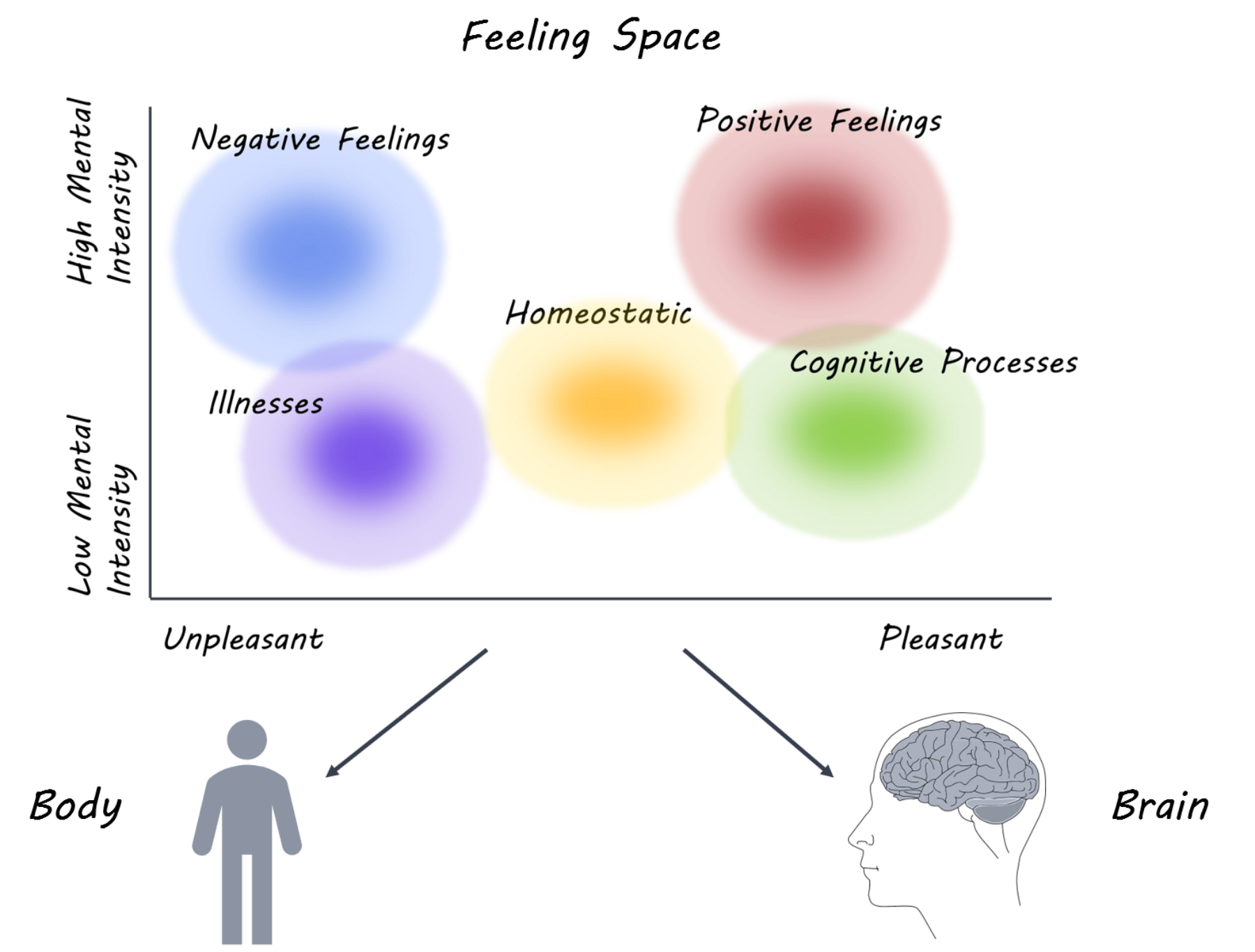
feeling1800.png

All feeling states were associated with distinct bodily sensation maps, even for cognitive processes like remembering or reasoning. This mapping of feeling state onto body regions also clustered in a similar way demonstrating a similar organization of feeling states in the body. Lastly, they found that the organization of bodily feeling was associated with the mapping of subjective feelings based on brain activation. This neural organization of feeling states was also associated with the semantic similarity (from words associated with brain activity recorded in the NeuroSynth database). This suggests that there are neural signatures of subjectively felt bodily states associated with feelings. The subjective experience of mental states, however, was not associated with patterns of brain activation.

What's the impact?

This is the first study to map subjective feelings in terms of their subjective experience, their bodily sensations and their location in the brain. We now know that subjective feelings cluster into different types of feelings and that these correspond to distinct maps on the body. These patterns of bodily sensation also map onto brain activity associated with particular feelings. Understanding how we feel things is important for everyday life and for understanding the human experience.

feelingquote1800.png

Nummenmaa et al., Maps of subjective feelings. PNAS (2018). Access the original scientific publication here.

Retina-Brain Projections Mediate Light-Dependent Changes in Mood and Cognition

Post by Shireen Parimoo

What's the science?

Light affects our biological circadian clock and sleep-wake patterns, and changes in our exposure to light or to the solar cycle (e.g. working night shifts, shorter days in the winter) can negatively impact our mood and cognition. In mammals, these effects are driven by intrinsically photosensitive retinal ganglion cells (ipRGCs) in the retina of the eye that project to various parts of the brain. For example, a sub-type of ipRGCs project to the suprachiasmatic nucleus (SCN) in the hypothalamus, which regulates our sleep-wake cycle based on light exposure. Similarly, removing ipRGCs eliminates the effect of light on mood and cognition, but it is unknown how this occurs in the brain. Specifically, which regions in the brain mediate these effects? This week in Cell, Fernandez and colleagues examined whether the SCN and the peri-habenular nucleus in the dorsal thalamus, both of which receive input from ipRGCs, mediate the effect of light on learning and mood in mice.

How did they do it?

To examine the role of the SCN, the authors measured the sleep patterns, locomotor activity, and gene expression in mice with intact ipRGC retinal projections (control mice) and mice that only had ipRGC projections to the SCN. These mice were either exposed to a 12-hour or a 3.5-hour alternating light-dark cycle for two weeks, after which changes in cognition and mood were evaluated. Cognitive performance was assessed with the Novel Object Recognition and the Morris water maze tasks, and mood was assessed using a sucrose preference task, the tail suspension test, and the forced swim test. To identify regions that perihabenular neurons project to, the authors used a cholera toxin ß-subunit (CTß) tracer. They also injected a retrograde viral vector into the target region and a vector carrying a fluorescent protein into the peri-habenular nucleus. This allowed them to identify the peri-habenular targets with more precision, as the peri-habenular nucleus projections would only fluoresce if they were infected by the retrograde vector from their targets. The authors then used designer receptors exclusively activated by designer drugs (DREADDs) to determine if peri-habenular neurons are involved in regulating light-dependent effects on mood and cognition. These DREADDs were chronically activated by clozapine-N-oxide (CNO), which was administered to the mice through their drinking water or through intraperitoneal injections (DREADD mice). Mood and cognitive performance of DREADD and control mice were assessed using the tasks described above. Mice underwent a learned helplessness paradigm, a forced swim test, and a social defeat paradigm in darkness to examine if the peri-habenular nucleus also regulates non-light-dependent changes in mood. Finally, the authors tested if the peri-habenular projections to the ventromedial prefrontal cortex (vmPFC) were sufficient to induce light-dependent changes in mood by selectively activating this circuit using DREADDs.

What did they find?

The SCN mediated light-dependent changes in cognitive processes, but not mood. The control mice and the SCN-only mice had similar sleep and locomotor activity patterns, demonstrating that ipRGC projections to the SCN regulate the sleep-wake cycle. The two groups of mice also did not differ in their cognitive performance, since both groups performed worse on the cognitive tasks after the 3.5 hour light-dark cycle than after the 24 hour light-dark cycle. No light-dependent effects on mood were observed in the SCN-only mice, compared to control mice that showed altered mood on the 3.5 hour light-dark cycle, as was previously published by LeGates et al. (2012, Nature). The peri-habenular nucleus of the thalamus, on the other hand, was involved in regulating light-dependent changes in mood, but not cognition. This is consistent with their finding that peri-habenular neurons project to mood-regulating regions such as the vmPFC and the nucleus accumbens.

shireen1800 (2).png

“DREADD mice” with chronically active perihabenular neurons spent more time immobile after the tail suspension test and the forced swim test and they showed less preference for sucrose than control mice (suggesting depression/loss of pleasure). These findings highlight the role of the peri-habenular nucleus in light-dependent mood alterations. In fact, specific activation of the perihabenular - vmPFC circuit was sufficient to induce these changes in mood. Inhibiting peri-habenular neurons did not lead to mood changes under the 3.5 hour light-dark cycle in animals whose ipRGC projections to the peri-habenular nucleus were intact. This result confirms that the peri-habenular nucleus is necessary for light-dependent mood effects to occur. Finally, the peri-habenular nucleus did not affect light-dependent changes in cognitive processes or non-light-dependent changes in mood.

What's the impact?

This is the first study to describe the independent pathways through which light-sensitive ipRGCs affect mood and cognition in mice. The authors showed that using input from ipRGCs, the SCN both acts as a circadian pacemaker and mediates the effect of light exposure on cognitive processes. Furthermore, they demonstrated that with input from a different population of ipRGCs, the peri-habenular nucleus regulates light-dependent changes in mood. These findings improve our understanding of the biological effects of light on mood and cognition.

shireenquote1800 (2).png

Fernandez et al., Light Affects Mood and Learning through Distinct Retina-Brain Pathways. Cell (2018). Access the original scientific publication here.
Toddlers Learn Better When Experiences are Predictable

What's the science?

There are many benefits to predictable learning. For example, when something is predictable there is time to build expectations and better understand when those expectations have been violated. In toddlers, there is mixed evidence for the benefits of both predictable and unpredictable learning. It is still unclear which method of learning is ideal for toddlers during development. Recently in Current Biology, Benitez and colleagues test whether toddlers learn words better in predictable versus unpredictable situations.

How did they do it?

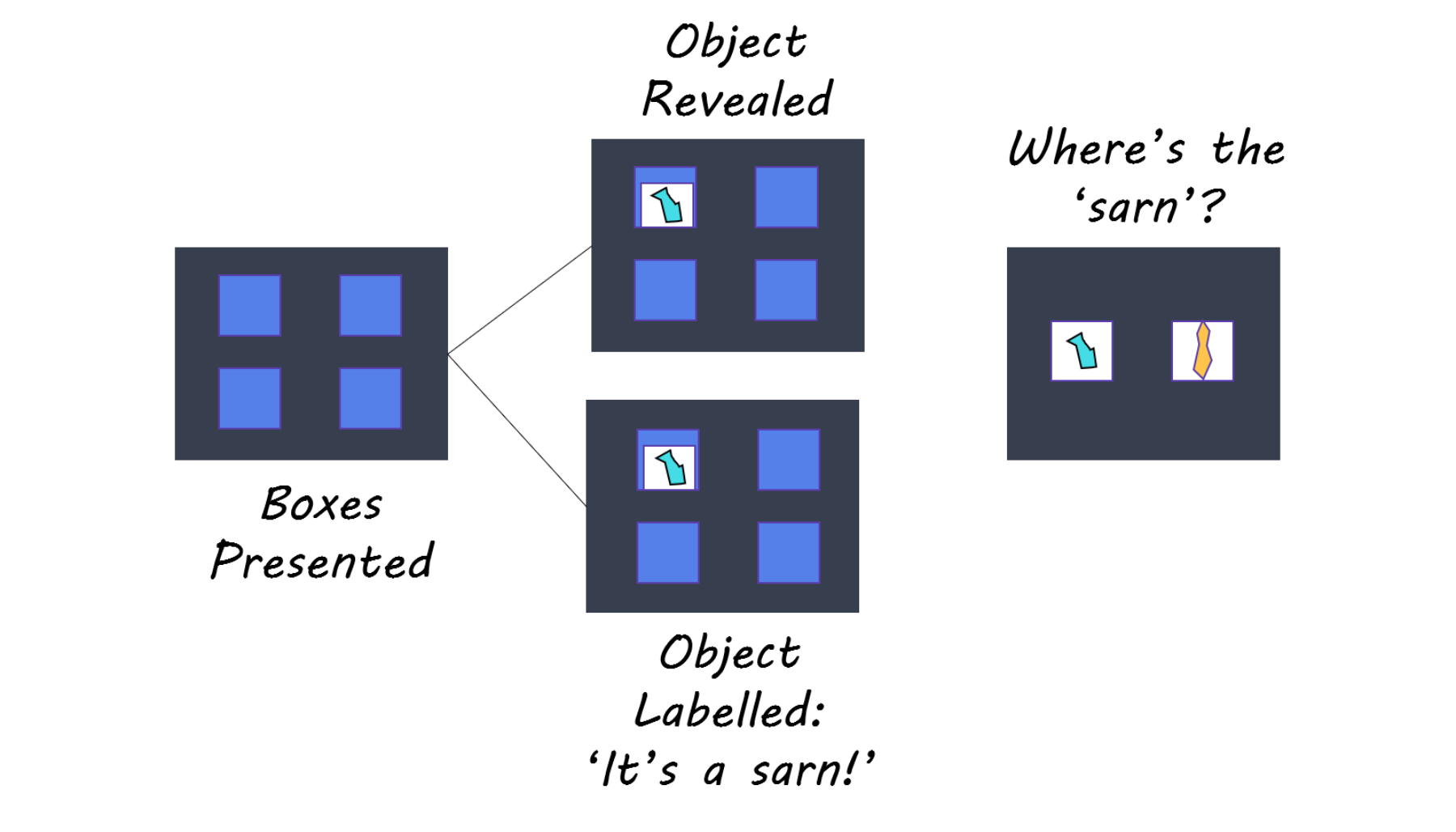
Toddlers were presented with a series of boxes that would open in a sequence to reveal a series of objects. The timing and location of box opening was predictable (always clockwise), however, the object to be revealed was unknown. This sequence exposure experiment was repeated 5 times. Then, a second labelling experiment was performed, where boxes would open either in the predictable sequence or in an unpredictable (i.e. an unexpected box would open that was different from the previously learned sequence) pattern to reveal an image paired with a recorded voice announcing what the object was. The authors used an eye tracking system to track how the toddlers attended to the objects and to rule out potential confounding effects of visual attention. They then tested, in a learning phase, whether the toddlers retained object-label pairs better for predictable vs. unpredictable events. They tested this using a “looking-while-listening” method where the object-label pair was presented and they were to look to the correct object.

What did they find?

Reaction times were greater for unpredictable events than predictable events in both the object revealing and labelling experiments suggesting that toddlers were tracking the sequence of events. They also demonstrated anticipatory looks towards a box where an object was about to be revealed meaning the toddlers developed expectations about the sequence of events. Toddlers were found to look at the correct object-label pair for a greater proportion of time than the incorrect object for the predictable events compared to the unpredictable events. Toddlers were also more accurate at looking to the object-label pair during predictable events.

toddler1800.png

What's the impact?

This is the first study to show that predictable events support word learning in toddlers. We now know that toddlers may learn better when new information is presented in a predictable way. Understanding how children learn during development is important for understanding developmental outcomes.

toddlerquote1800.png

Benitez et al., Predictable events enhance word learning in toddlers. Current Biology (2018). Access the original scientific publication here.