
The Presence of a Decoy Increases Cooperation in Decision-Making

What's the science?

Behavioral economics is a field of research examining how human cognitive biases often interfere with fully rational or 'optimal' behavior. One effect known as the 'decoy effect' shows that when given two options in a decision-making scenario, a third less desirable option can change the desirability of the other options (even when it wouldn’t be expected to). Evolutionary game theory is a field of research which studies how humans make decisions to optimize their payoff or reward in relation to others. One concept called ‘selection’ describes how we use rational thinking to eventually eliminate suboptimal behavior over time. We don’t know how the path to optimal behavior might change when attempting to make decisions involving others in the presence of a decoy effect. This week in Nature Communications Wang and colleagues examine how behavior is affected by the presence of a decoy during a decision-making task called the Prisoner’s Dilemma.

How did they do it?

Behavior was examined in 388 volunteers during the Prisoner’s Dilemma; a well-established decision-making task in which a participant is required to either cooperate (a safe option with less reward) or defect (betray the opponent for a greater payoff). The game centers around two players, one a human participant and the other a computer opponent who the participant is trying to play against to maximize their reward. The computer opponent is learning the behavior of the participant and therefore the game is a balancing act of cooperation and defection. Typically, participants have a tendency to defect more (the payoff is disproportionately greater) even though it is not in their best interest to do so, as cooperation of both parties would result in an optimal payoff. The authors introduced a third irrelevant option, a decoy called ‘reward’, where the participant could reward their opponent. They monitored the participants’ tendency to cooperate and defect with and without the presence of the ‘reward’ decoy option.

What did they find?

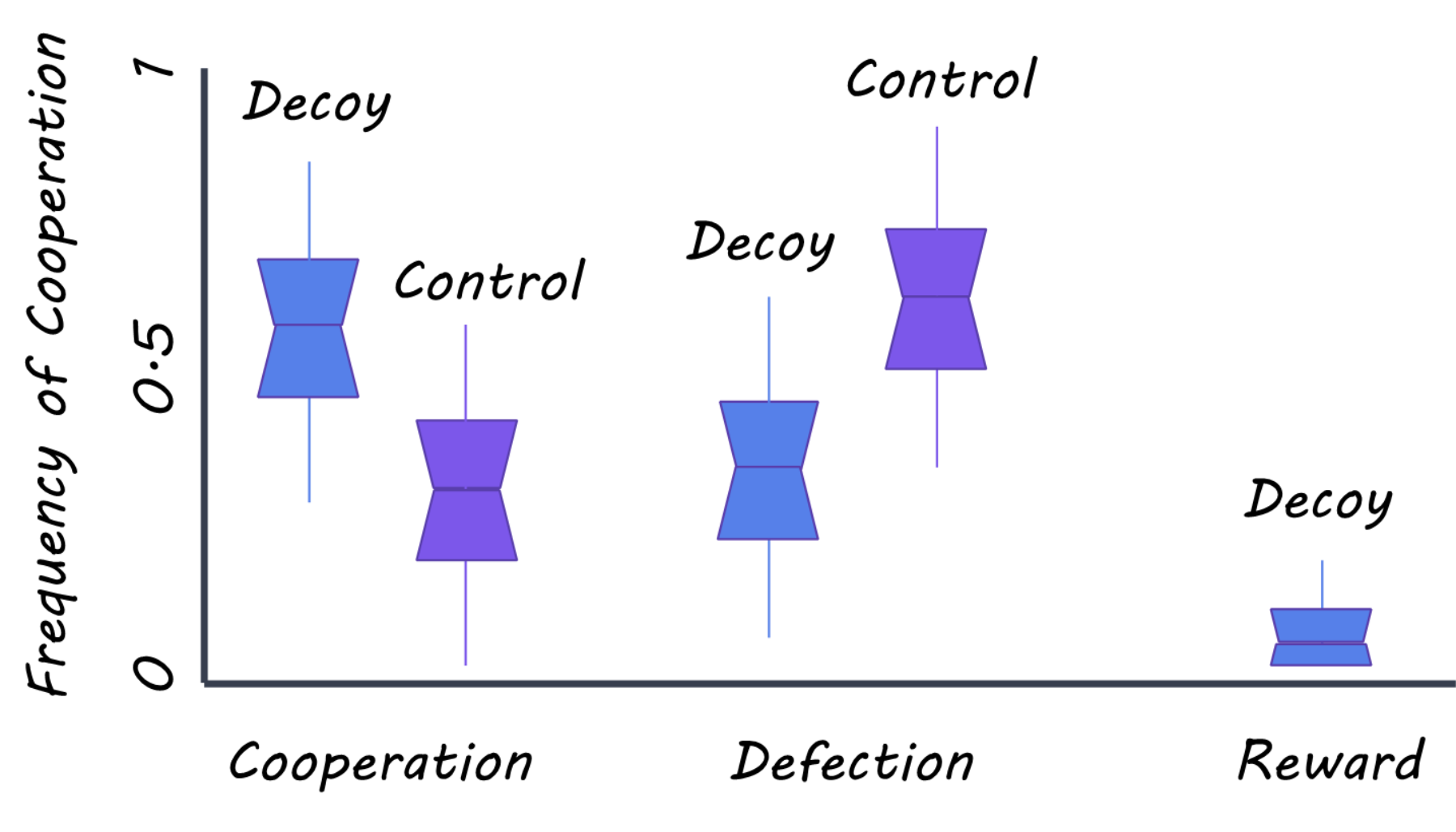
When the ‘reward’ decoy option (i.e. the option to reward the opponent) was present, the participants showed an increase in cooperative behavior (median frequency of 60.5%) compared to the control condition (median frequency of 31.4%), despite that fact that they did not choose the decoy option often. These results suggest that the mere presence of the option to reward an opponent results in greater cooperation. They found that the presence of the decoy resulted in both an increase in cooperation before the reward (i.e. decoy) option had even been chosen (i.e. first round) and increased the choice to cooperate following a cooperative choice or a reward (i.e. decoy) choice. Further, this effect was stabilized over time. These results suggest conditional cooperation by participants (also known as tit-for-tat) depending on their opponent’s most recent actions. They also found that this increased cooperativeness did not lead to a greater payoff overall, nor did choosing the reward option lead to a greater payoff overall. However, the probability of success was increased for those individuals who were more cooperative.
decoy1800.png

What's the impact?

This is the first study to demonstrate that the presence of a decoy (despite being an inferior option) promotes cooperative behavior in a game theory decision-making task. These findings suggest that decoys may ignite prosocial behavior across a range of social activities which could result in better outcomes for cooperative individuals. This study has important implications for social decision-making in society.

Wang et al., Exploiting a cognitive bias promotes cooperation in social dilemma experiments. Nature Communications (2018). Access the original scientific publication here.

Structure and Function of Presynaptic Inputs varies by Distance from the Postsynaptic Neuron Cell Body

What’s the science?

Neurons communicate by receiving signals from the terminals (boutons) of other neurons via their dendritic arbour (many branch-like processes/dendrites). Each connection between a bouton and a dendrite is a ‘synapse’. How do postsynaptic neurons differentiate between input from different presynaptic neurons? Most research on this topic has focused on postsynaptic neurons; it has been found that the size and strength of postsynaptic dendrites depend on the distance away from the soma or cell body of the neuron. Presynaptic inputs could also differ by location along the dendritic arbour. This week in Neuron, Grillo and colleagues explored whether the structure and function of presynaptic inputs to dendrites of CA1 pyramidal neurons of the hippocampus varied with distance from the soma of the postsynaptic neuron.

How did they do it?

The authors performed electron microscopy on the hippocampus of an adolescent mouse brain (postnatal day 22) at three locations (proximal – close to pyramidal cell layer with cell bodies, middle, and distal) to assess the structure of neuron bouton/terminal (presynaptic) and dendrite (postsynaptic) structure. They then used a patch-clamping technique to visualize CA1 pyramidal cells with fluorescent dye in order to understand which inputs to the neurons resulted in short term facilitation: Stimulating pipettes were placed in proximal and distal regions outside of the pyramidal cells to stimulate boutons on presynaptic neurons in those regions, and resulting AMPA currents (i.e. important for synaptic plasticity) were measured. The authors also administered paired electrical pulses to assess response of the postsynaptic neurons to multiple inputs. They then blocked NMDA receptor (neurotransmitter receptor) release (using a blocker; MK-801) to observe changes in neurotransmitter release (indicating neurotransmitter release potential). Finally, the authors created a computational model that mimicked the short-term potentiation/facilitation gradient they found between proximal and distal synapses.

What did they find?

They found that in proximal layers (closer to the soma), dendrite spines were larger. This is expected because dendrite size usually varies by distance from the soma. Critically, size of dendrite spine was related to the size of bouton active zones. Active zones themselves were also larger in proximal layers. These findings suggest that the structure of presynaptic neuron terminals (boutons) varied by distance from the pyramidal cell layer (somas of hippocampal neurons). When the authors used a fluorescent dye to assess AMPA (neurotransmitter) currents after stimulation, they found that excitation was greater for distal inputs (there were larger larger excitatory postsynaptic potentials). When paired pulses were administered at distal locations (versus proximal), neurons were more likely to exhibit larger responses to the second pulse in a supra-linear manner. However, when an NMDA receptor blocker was applied, decay in current was faster at proximal synapses, indicating more neurotransmitter release initially. Therefore, the results suggest that short-term potentiation was greater at distal synapses, but release probability was greater at proximal synapses. In a computational model, when distal synapses with greater short-term potentiation were stimulated, a larger response was generated. The authors suggest that greater short-term potentiation distally may counteract passive decay of a signal along a dendrite.

dendrite1800.png

What’s the impact?

This study is the first to show that structure and function of presynaptic boutons varies along a gradient in a distance-dependent manner; at more distal synapses, dendritic spines are smaller and have a lower release probability, but short-term excitation is greater, possibly as compensation for signal attenuation. This work has important implications for understanding how neurons integrate information from different locations.

Grillo et al., A Distance-Dependent Distribution of Presynaptic Boutons Tunes Frequency-Dependent Dendritic Integration. Neuron (2018). Access the original scientific publication here.

The Association between Performance Monitoring, Anterior Cingulate Volume and Obsessive-Compulsive Disorder in Early Development

What's the science?

Obsessive-compulsive disorder (OCD) has been associated with heightened performance monitoring. Although monitoring one's performance on tasks can be beneficial, too much performance monitoring may affect daily function. The anterior cingulate cortex is a brain region known to be involved in performance monitoring. It is unknown whether elevated performance monitoring in early childhood predicts later development of OCD, and whether this is associated with structural changes in anterior cingulate cortex. Identifying early markers of OCD has important implications for public health. This week in JAMA Psychiatry Gilbert and colleagues investigate the association between performance monitoring, OCD risk and anterior cingulate volume in a longitudinal cohort of preschool-aged children.

How did they do it?

292 preschool-aged children who were part of a longitudinal depression study completed an observational task where they received negative evaluation (i.e. performance based). The child’s performance monitoring behavior was rated by blinded observers. Performance monitoring was scored as the average of a number of measures representative of performance monitoring, including frustration, deliberateness and care while drawing circles and observed self-criticism and intensity. The participants were then followed up annually for 12 years with clinical assessments and received 1-3 MRI scans throughout the follow-up. 133 completed the final behavioral follow-up and 152 completed MRI scans. The development of OCD was recorded over the 12-year period (using the DSM-V criteria). The authors used logistic regression to test whether performance monitoring was associated with increased risk of OCD. They also measured anterior cingulate cortex volume using MRI and used multi-level modeling (this method can model changes over time) to test whether performance monitoring was associated with anterior cingulate volume over time.

What did they find?

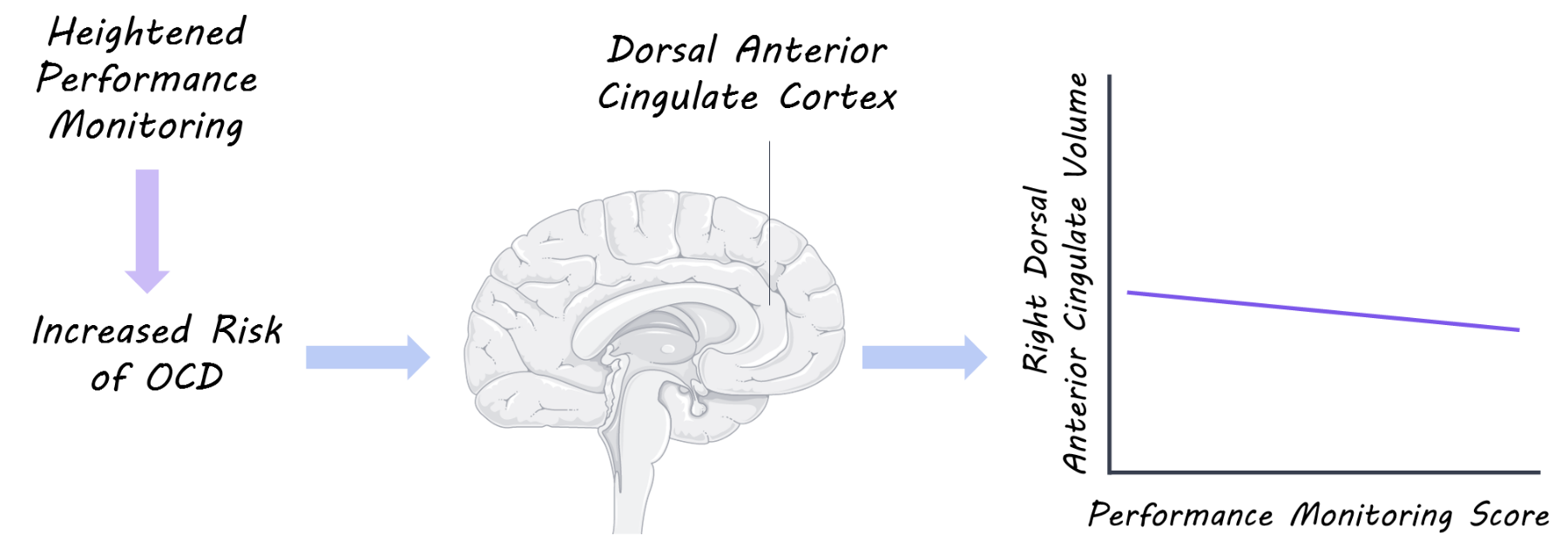
35 children in total developed OCD over the course of the follow-up. High performance monitoring of pre-school aged children (at initial assessment) was associated with a greater risk (2 times higher) of developing OCD later on after controlling for medication, clinical and demographic variables. This association was specific to OCD, meaning there was no association with performance monitoring and the development of other psychiatric disorders. High performance monitoring at baseline was also associated with reduced right dorsal anterior cingulate volume over time. Baseline anxiety was also associated with reduced right anterior cingulate volume. A follow-up exploratory analysis showed that high performance monitoring was also associated with larger left thalamus volume.

                                      Brain, Servier Medical Art, image by BrainPost, CC BY-SA 3.0

                                      Brain, Servier Medical Art, image by BrainPost, CC BY-SA 3.0

What's the impact?

This is the first study to demonstrate that performance monitoring in preschool-aged children is associated with later development of OCD. Further, heightened performance monitoring is also associated with reductions in anterior cingulate volume as children age. This study could help in the identification of children at high risk of developing OCD and furthers our understanding of the brain mechanisms involved.

OCDquote1800.png

Gilbert et al. Associations of Observed Performance Monitoring During Preschool With Obsessive-Compulsive Disorder and Anterior Cingulate Cortex Volume Over 12 Years. JAMA Psychiatry 2018.  Access the original scientific publication here.