
MicroRNAs Cause Astrocyte Dysfunction in ALS

What's the science?

ALS is a devastating disease where motor neurons degenerate over time. Astrocytes which normally support neurons function abnormally in ALS and play a role in ongoing cell death. MicroRNAs are naturally occurring small pieces of non-coding RNA that regulate (and often inhibit) the production of proteins in cells. One type of microRNA called miR-218 has recently been shown to be higher in motor neurons in ALS and is released from the neuron into the cerebrospinal fluid. This microRNA, which is released from dying neurons, could communicate with astrocytes to cause dysfunction. This week in Brain Hoye and colleagues examine whether microRNA released from neurons are taken up by astrocytes and regulate their protein expression.

How did they do it?

They identified potential targets that microRNA miR-218 might bind to or regulate in astrocytes to affect their function. They did this by looking for genes with enriched (i.e. higher) expression in astrocytes. They identified EAAT2, a glutamate reuptake transporter that is enriched in healthy astrocytes but lost in ALS. They injected cells with either random microRNA or miR-218 (specifically released from motor neurons in ALS) to see whether it would affect EAAT2 expression. They then assessed whether miR-218 is taken up by astrocytes using a sensor they developed and whether it is free, protein bound, or encapsulated in vesicles. Finally, they tested whether any potentially pathological effects of miR-218 on astrocyte EAAT2 expression could be altered using antisense oligonucleotide therapy.

What did they find?

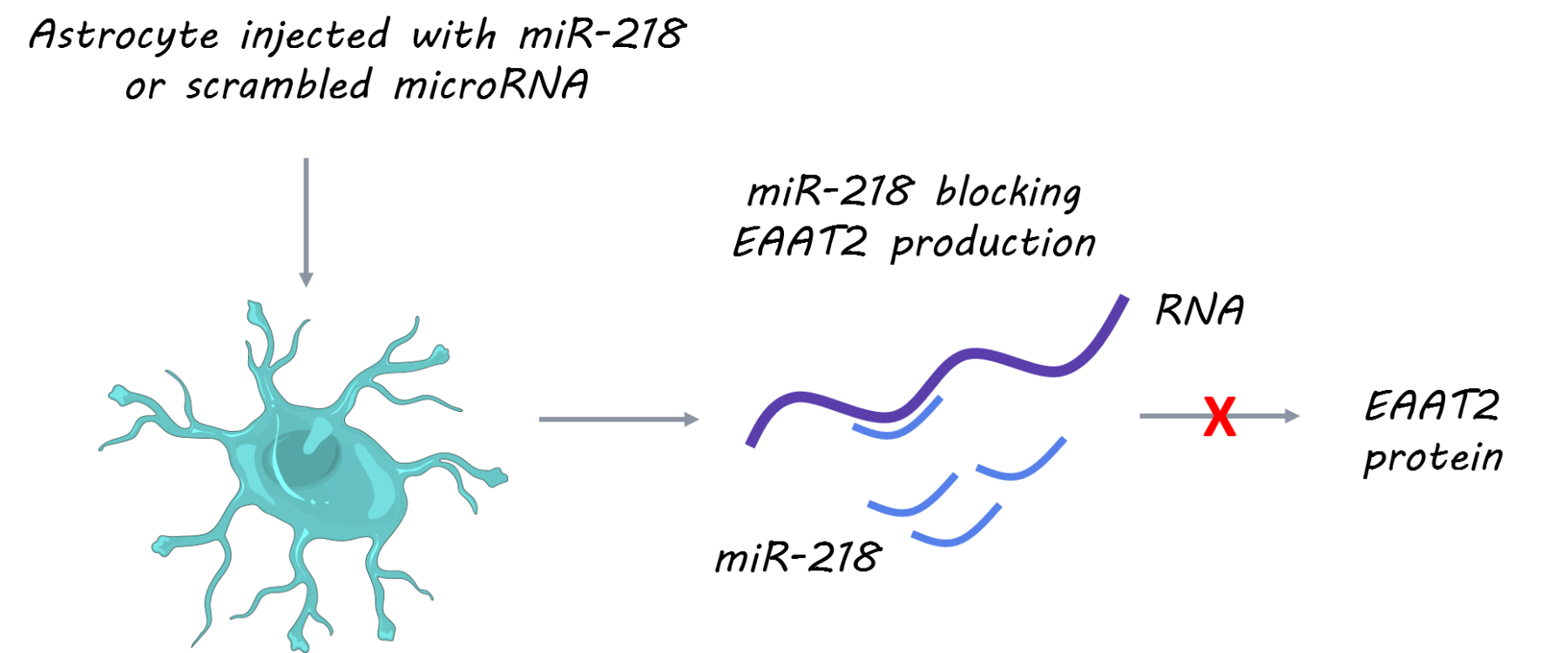
They found that miR-218 infected cells had reduced production of EAAT2 (measured with western blot) demonstrating that it can repress translation of this glutamate transporter in astrocytes. They then developed a ‘sensor’ to confirm that miR-218 is taken up by astrocytes. They found that the majority of miR-218 is protein bound in the cerebrospinal fluid (after it is released from the cell). They then tested whether they could block the miR-218 induced repression of EAAT2 expression in astrocytes using antisense oligonucleotides. They applied media from sporadic ALS patient iPSC-derived motor neurons to primary astrocytes that contained miR-218 with and without antisense oligonucleotides (a type of therapy for regulating protein production), and found that EAAT2 repression was blocked by antisense oligonucleotides. They then followed up by testing in a mouse model of ALS whether inhibiting miR-218 would block EAAT2 suppression. SOD1 mice (a mouse model of ALS) were treated with either antisense oligonucleotides or saline, and they found that the mice treated with the antisense oligonucleotides had less miR-218 activity in their brains. It also reduced astrogliosis (an abnormal increase in number of astrocytes) in ALS model mice.
Astrocyte, Servier Medical Art, image by BrainPost, CC BY-SA 3.0

Astrocyte, Servier Medical Art, image by BrainPost, CC BY-SA 3.0

What's the impact?

This is the first study to demonstrate that a microRNA (miR-218) release from dying motor neurons results in the repression of glutamate transporter (EAAT2) expression. Further, this study shows that blocking this repression using antisense oligonucleotides can reverse the effects of this microRNA on causing potentially damaging effects on astrocytes. Importantly, this study suggests that microRNAs play an important role in affecting astrocytes that contribute to ongoing neurodegeneration in ALS.
mrnaquote1800.png

Hoye et al., Motor neuron-derived microRNAs cause astrocyte dysfunction in amyotrophic lateral sclerosis. Brain (2018). Access the original scientific publication here.

A Neural Basis for Episodic Memory Deficits in Older Adults

What's the science?

Episodic memory, in which an individual uses contextual details to recall an entire event (as opposed to simply recalling a fact) is disproportionately affected in older adults. Older adults have been found to engage in a process known as ‘hyper-binding’, in which they remember additional irrelevant features while encoding the relationship between an item and its context (forming an episodic memory). Older adults may have to work harder to recall information. However, we don’t know what is happening in the brain when the memory is being encoded in older adults. This week in NeuroImage, Powell and colleagues had young and older adults perform an encoding task while EEG was recorded in order to understand how aging affects episodic memory encoding.

How did they do it?

22 young (18-35) and 21 older (60-80 years) participated in the study. Over a series of mini blocks of trials within four larger blocks, participants were presented with 288 images of objects flanked by a coloured square on one side and a scene on the other side. During the memory encoding phase of the experiment, for each mini block, the ‘target context’ (i.e. the association between the object and either a color or scene) was manipulated: Participants were asked to judge either a) whether the color of the square was a color likely to be associated with the the object or b) whether the object was likely to be found in the scene. In sum, in each trial they were required to memorize either the color or scene associated with the object while the other acted as a distractor. During the test phase of the experiment, the 288 images were presented interspersed with 144 new images/objects. Participants were first asked to recall whether the images were new or old (whether they had seen them before), and, if they correctly guessed old, whether the colour and the scene matched the object as it had originally been presented. Sometimes, the target context matched the image, sometimes the distractor matched the image, and sometimes both matched the image.

Scenes shown in study and test phases of experiment

Multi-voxel pattern analysis (MVPA; a pattern classification technique) was used to predict the target context of a given trial based on the pattern of brain activity during encoding. The data were divided into bins by frequency (3-80 Hz) and time during the trial (0-2000 ms) and the MVPA classifier was able to ‘learn’ which target context (colour vs. scene) was presented during the memory encoding period. The purpose of the classifier was to see whether EEG oscillatory power could predict selective attention to the target context feature (color or scene). A follow-up analysis/classification was performed in which data was binned into delta, theta, alpha, beta, and gamma frequency bands (different frequencies of brain activation measured by EEG). The relationship between classifier accuracy (correct identification of scene vs. colour as the target context during encoding) and participant accuracy of the target context and distractor during the test phase was explored.

What did they find?

Context memory was worse in older adults compared to young adults, suggesting hyper-binding of both the target and distractor during encoding. Older adults were also more likely to correctly identify the target context if the distractor context also matched the original image, further suggesting hyper-binding. The peak frequency (of brain activity) and time period in which the classifier (which uses brain activity to predict attention to target context) correctly identified the target context presented (colour vs. scene) were 2-20 Hz and 300-1200 ms respectively. When the classifier was run with the data divided into frequency bins, a positive relationship between beta band power and the correct identification of the target context was observed. A negative relationship between beta and alpha band power and correct identification of the distractor (i.e. lower beta and alpha band power, better distractor identification) were found. This indicates that the classifier ‘learned’ the brain activity pattern and used it to correctly identify the target context (color vs. scene) better on trials in which the individuals later recalled the target context correctly (demonstrating better selective attention), but had poor accuracy on trials for which the participant correctly identified the distractor. There was no relationship with age, which suggests that there were no differences between classifier performance across age groups. Electrodes located over the cortex contralateral to the location of the target context exhibited better performance. Therefore, a follow-up analysis was performed using only the contralateral electrodes: greater decline from 0-500 ms to 500-100 ms in classifier accuracy was associated with poorer target context accuracy and better distractor accuracy, suggesting poor selective attention and greater hyper-binding was associated with worse classification performance. This result was driven by the older adults group and could reflect a shift in attention away from target and towards distractor that may result in greater hyper-binding.  

What's the impact?

This is the first study to examine age-related changes in memory encoding using a pattern classification of EEG oscillatory activity. Target context was predicted by alpha and beta power features of the classifier, which play roles in behavioural inhibition and attention respectively. Poor selective attention or poor inhibition of a distractor may underlie episodic memory deficits in older adults. These finding improve our understanding of episodic memory impairment associated with aging.

olderadultmemquote1800.png

Powell et al., Decoding selective attention to context memory: An aging study. NeuroImage (2018). Access the original scientific publication here.
Deep Brain Stimulation of the Thalamus as a Treatment for Epilepsy

What's the science?

Patients with epilepsy demonstrate abnormally elevated neuron firing and synchronization which contributes to seizures. Developing treatments that can reduce this neuron excitability and synchrony is a promising area of research. Many patients do not respond to anti-epileptic drugs or are not good candidates for surgery (for removal of seizure-generating brain tissue). In particular, deep brain stimulation of the anterior nucleus of the thalamus has shown promising results, however, the mechanism through which it improves symptoms remains unclear. This week in Brain, Yu and colleagues investigate the mechanism by which deep brain stimulation of the thalamus alters activity in brain regions of seizure onset.

How did they do it?

Nine patients with drug-resistant epilepsy underwent surgery for deep brain stimulation where electrodes are implanted deep in the brain. Intermittent high frequency stimulation of the anterior thalamus (130 Hz) was applied 5 days after surgery on the same side of the brain as the seizure onset region and local field potentials (neuronal activity) were recorded simultaneously from the seizure onset site using stereoelectroencephalography (SEEG) to better understand the resulting changes in neuronal activity and synchrony. Stimulation was  applied in a range of frequencies (5 Hz-130 Hz) to assess the effect of frequency on brain activity at the seizure onset site. The seizure onset site varied among patients, but was located either in the hippocampus (6 patients), frontal lobe (2 patients) or temporal lobe (1 patient). Activity was recorded for 7 to 10 days in the seizure onset zones to ensure that at least 3 seizures were captured. They also tested ‘cortico-cortical evoked potentials’ by stimulating the thalamus and measuring the response in the hippocampus and vice versa to understand how these two brain regions interact in response to an electrical stimulus.

What did they find?

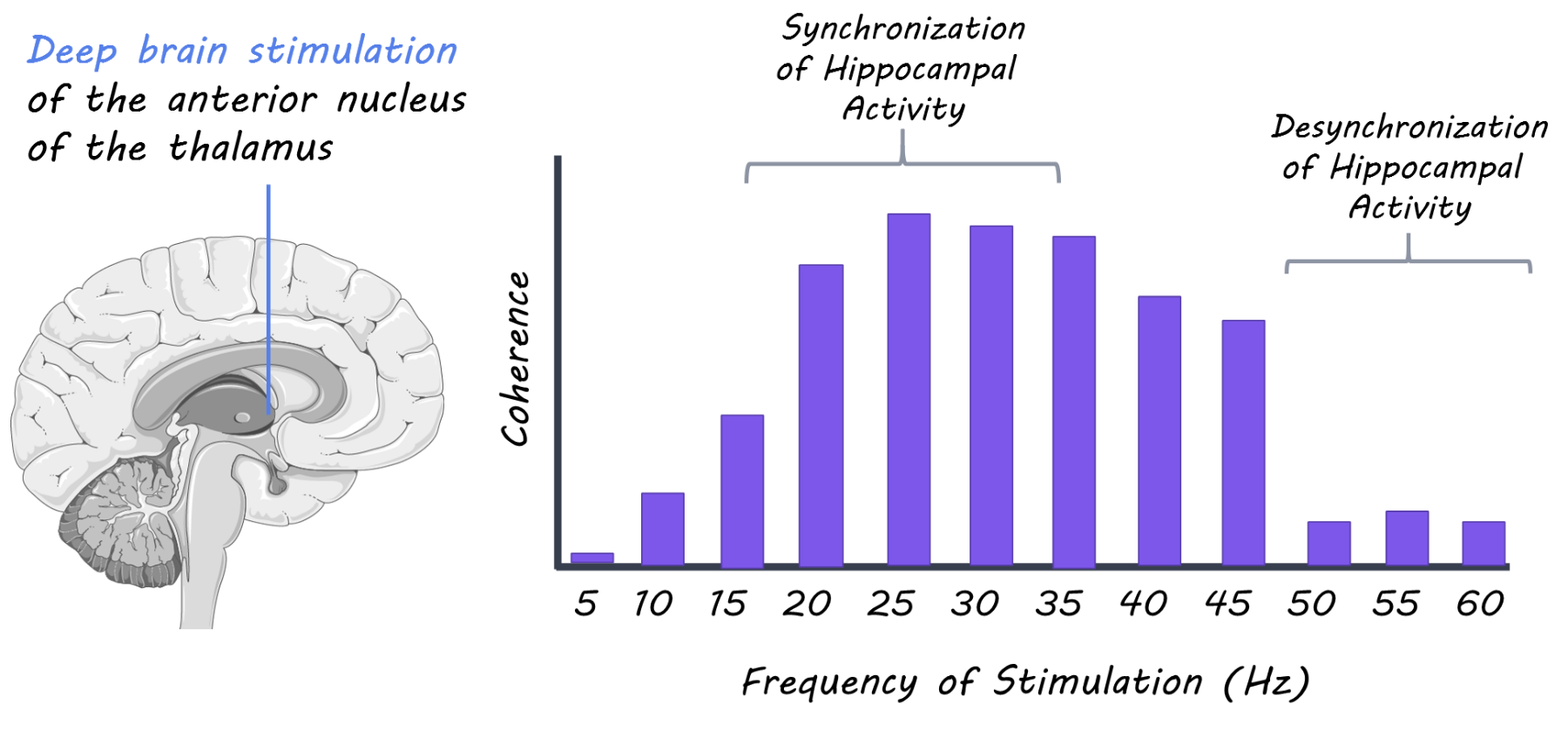
For patients with seizure onset in the hippocampus, high frequency stimulation of the anterior nucleus of the thalamus resulted in immediate desynchronization and reduction of neuronal activity in the hippocampus. This effect lasted while stimulation was turned on, and neuronal activity returned to baseline levels once stimulation was turned off. This effect was specific to the anterior nucleus of the thalamus (i.e. there was no similar effect for stimulation on other regions of the thalamus). This effect was also specific to patients with seizures originating in the hippocampus, as no activity changes were seen for patients with other seizure onset zones (i.e. frontal cortex or temporal lobe). Seizure-associated spiking activity of neurons in the hippocampus (also known as interictal spikes) and high frequency oscillations were reduced during high frequency stimulation of the anterior nucleus of the thalamus, but not during stimulation of other thalamic regions or for other seizure onset zones. This indicates that seizure-related activity was reduced in the seizure onset zone. Low frequency stimulation of the thalamus resulted in increased synchrony of neuronal activity in the hippocampus, while frequencies higher than 45 Hz resulted in desynchronization. They then examined cortico-cortical evoked potentials between the thalamus and the hippocampus and demonstrated that these regions are directly and reciprocally connected, which helps to explain why thalamic stimulation reduced seizure activity in the hippocampus.

Brain, Servier Medical Art, image by BrainPost, CC BY-SA 3.0

Brain, Servier Medical Art, image by BrainPost, CC BY-SA 3.0

What's the impact?

This is the first study to demonstrate the mechanism underlying the effects of deep brain stimulation of the anterior nucleus of the thalamus on seizure activity in epilepsy. Deep brain stimulation of the anterior nucleus of the thalamus results in desynchronization and reduction of activity in the hippocampus which are reciprocally connected. These findings improve our understanding of epilepsy originating in the hippocampus and suggest that deep brain stimulation of the anterior nucleus of the thalamus may be a promising treatment for epilepsy patients.

Word of caution: As the number of patients was low and there were few patients with neocortical seizure onset areas, the specific seizure type and seizure areas that respond to deep brain stimulation need to be clarified in a larger patient group.

Yu et al., High-frequency stimulation of anterior nucleus of thalamus desynchronizes epileptic network in humans. Brain (2018). Access the original scientific publication here.