Aggressive Intent is Reduced by Stimulation of the Dorsolateral Prefrontal Cortex

What's the science?

Injury or impairment of the prefrontal cortex is known to be a risk factor for aggressive and antisocial behaviour, including aggressive sexual behaviour. In particular, the dorsolateral prefrontal cortex (DLPFC) is known to play a role in aggressive behaviour, however, the neuroimaging evidence for this is correlational rather than causal. The causal role of the DLPFC on aggressive behaviour is not known. This week in the Journal of Neuroscience, Choy and colleagues used transcranial direct current stimulation (tDCS) to stimulate the DLPFC and assess intent to commit aggressive behaviour.

How did they do it?

The authors designed a double-blind randomized trial in which anodal, active tDCS and sham tDCS (as a placebo) were administered bilaterally to the DLPFC. Eighty-one healthy adults were included in the final sample. A standard 20-minute tDCS protocol was applied to half of the participants, while the other half received sham tDCS, in which the stimulation was turned off after the first 30 seconds. Participants then completed questionnaires in which they a) read scenarios describing physical or sexual aggression and described how likely they would be to commit them and b) rated how morally wrong it would be to act in an aggressive scenario. Participants were also given a ‘voodoo doll’ and asked how much ‘negative energy’ they would like to release by inserting pins into the doll, which represents a family member or close friend. Finally, they assess whether moral wrongfulness mediated the group differences (active tDCS versus sham tDCS) in intent to commit an aggressive act. Participants also self-reported previous criminal activity and baseline aggression levels.

What did they find?

Participants in the active tDCS group were less likely to report intent to engage in aggressive acts, physical assault, and sexual assault compared to participants in the sham tDCS group after controlling for baseline criminal activity and aggression levels. No differences between groups on the voodoo doll aggression task were found. The active tDCS group perceived aggressive acts as more morally wrong, and moral wrongfulness partly mediated the relationship between group and intent to commit aggressive acts. Moral wrongfulness also mediated the relationship between group and intent to commit sexual but not physical assault.

What's the impact?

This is the first study to assess the effects of tDCS of the DLPFC on aggressive intent. Further, the perception of these acts as immoral mediated the relationship between tDCS stimulation and aggression. Damage to the prefrontal cortex is a known risk factor for aggressive behaviour, so understanding the causal role of the DLPFC in inhibiting aggression is critical for addressing aggression as a public health issue and for disorders such as antisocial and borderline personality disorders.

aggressionquote1800.png

Choy et al., Stimulation of the Prefrontal Cortex Reduces Intentions to Commit Aggression: A Randomized, Double-Blind, Placebo-Controlled, Stratified, Parallel-Group Trial. Journal of Neuroscience (2018). Access the original scientific publication here.
New Hippocampal Neurons are Involved in Stress Resilience

What’s the science?

The hippocampus plays an important role in memory and cognition, but also in stress and anxiety. In many brain regions there is no neurogenesis (new neurons generated) in adulthood, however, neurogenesis does occur in the ventral dentate gyrus of the hippocampus. These adult-born neurons are known to play a role in mood regulation, but their role in protecting against stress-induced anxiety behaviours is not known. This week in Nature, Anacker and colleagues inhibited adult-born neurons in the ventral dentate gyrus to assess their role in resilience to chronic stress.

How did they do it?

The authors developed a new model to silence adult-born neurons (granule cells) of the ventral dentate gyrus in mice by expressing a ‘designer receptor exclusively activated by designer drugs’ (DREADD). Specifically, they crossed a tamoxifen-induced CreERT2 recombinase transgenic mouse line with mice expressing loxP-STOP-mCherry-loxP-hM4Di. Then, they could administer an agonist for the DREADD (clozapine-N-oxide) to decrease activity of adult-born neurons. Mice with DREADDs (Cre+ mice) underwent a short social-defeat paradigm (5 days) in which they fought and were defeated by an aggressive mouse. Then, the authors tested whether mice would change their social behaviour or exploration patterns (less exploring an open area indicates anxiety) after the social-defeat paradigm. In control mice, this social-defeat paradigm had been shown to be short enough not to change the mouse’s subsequent response to social interactions. To examine any effects of adult-born neuron silencing on neural activity of mature neurons of the ventral dentate gyrus, the authors examined Fos gene expression and performed electrophysiological recordings during perforant path stimulation (the main glutamatergic input into the ventral dentate gyrus) in vivoTo test whether neurogenesis could promote resilience to stress, they deleted the Bax gene (‘iBax mice’) to promote increased neurogenesis. Control mice and iBax mice were subjected to a 10 day chronic social-defeat paradigm, which usually increases anxiety and reduces social behaviours in control mice. They also assessed whether the activity of mature neurons (indicated by c-Fos+ neurons) increased in iBax mice. Finally, they performed cell selectivity analyses using calcium imaging to assess whether certain cells were selective for different neuronal events in control mice and iBax mice during the chronic social-defeat task.

What did they find?

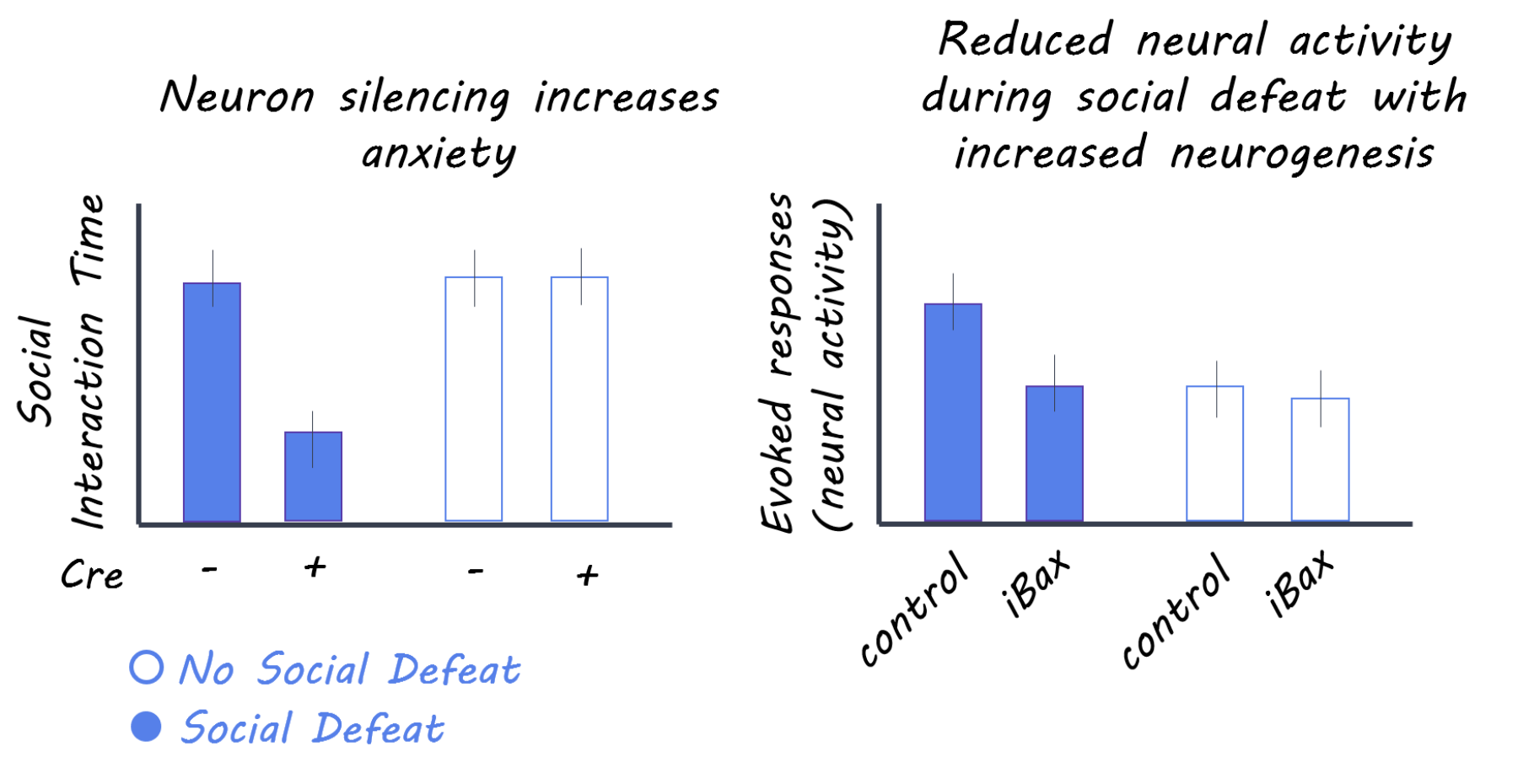
After mice with activated DREADDs underwent the social-defeat paradigm, they explored an open area and approached novel mice less in a social interaction test. This indicates that the inhibition of young neurons increases stress responses/anxiety. Fos gene expression was increased in mature neurons following social-defeat in Cre+ mice (versus control mice), and increased mature neuronal activity was found following performant path stimulation. This indicates that mature neurons may be more activated by stress after silencing young neurons. In iBax mice (who had increased neurogenesis) compared with control mice, the authors found normal levels of social interaction following a chronic social defeat paradigm, suggesting that increased neurogenesis in iBax mice made them resilient to stress. After X-ray irradiation of the ventral dentate gyrus in iBax mice, these effects were no longer seen, providing further evidence that adult-born neurons are responsible for resilience to stress.

Reduced neural activity during social defeat with increased neurogenesis

When the authors assessed activity of mature neurons (c-Fos+ levels) they found that iBax mice had less c-Fos+ cells after stress, indicating that new neurons can decrease the activity of the dentate gyrus. During attack periods, using cell selectivity analysis, they found 17% of ventral dentate gyrus cells to be selective for the attack periods during the chronic social defeat task. This population of attack-selective cells increased to over 30% after chronic stress. Interestingly, these cells were less active (lower calcium transient rates) during attacks in iBax mice. This indicates that neurogenesis could result in lower activity of attack-selective cells (i.e. inhibition). The authors then mimicked the effect of neurogenesis on inhibiting the dentate gyrus by directly expressing inhibitory DREADD receptors in mature granule cells. By doing this, they found that directly inhibiting the ventral dentate gyrus is sufficient to confer stress resilience.

What’s the impact?

This is the first study to demonstrate the role of new neurons in the ventral dentate gyrus of the hippocampus in response to stress and anxiety in mice. Neurogenesis in the ventral dentate gyrus appears to reduce the response to stress, and silencing new neurons in this region appears to increase the response to stress. Understanding the role of new neurons in this region is critical to understand vulnerability to stress and could be applicable in psychiatric disorders. The study also suggests that novel strategies aimed at inhibiting the ventral dentate gyrus could be used to treat or prevent stress-induced psychiatric disorders.

hippocampusquote1800.png

Anacker et al., Hippocampal neurogenesis confers stress resilience by inhibiting the ventral dentate gyrus. Nature (2018). Access the original scientific publication here.
Prevalence of a Concept Changes How We View It

What's the science?

The term ‘creep’ describes the (sometimes unwanted) expansion of something over time, like the mission of a company or features of a product. It can also apply to abstract concepts such as aggression, a term which has expanded over time to apply to less aggressive acts than it used to. Many studies from neuroscience have taught us that humans judge things compared to their recent context (i.e. if there is less aggression, then an aggressive act may be seen as more aggressive than it did in the past). This can be a problem when the goal is to reduce the prevalence of something; if you are succeeding at getting rid of something bad, but keep calling a wider range of things bad, how will you ever know that you are making progress? This week in Science, Levari and colleagues investigate this phenomenon of ‘prevalence-induced concept change’ in humans.

How did they do it?

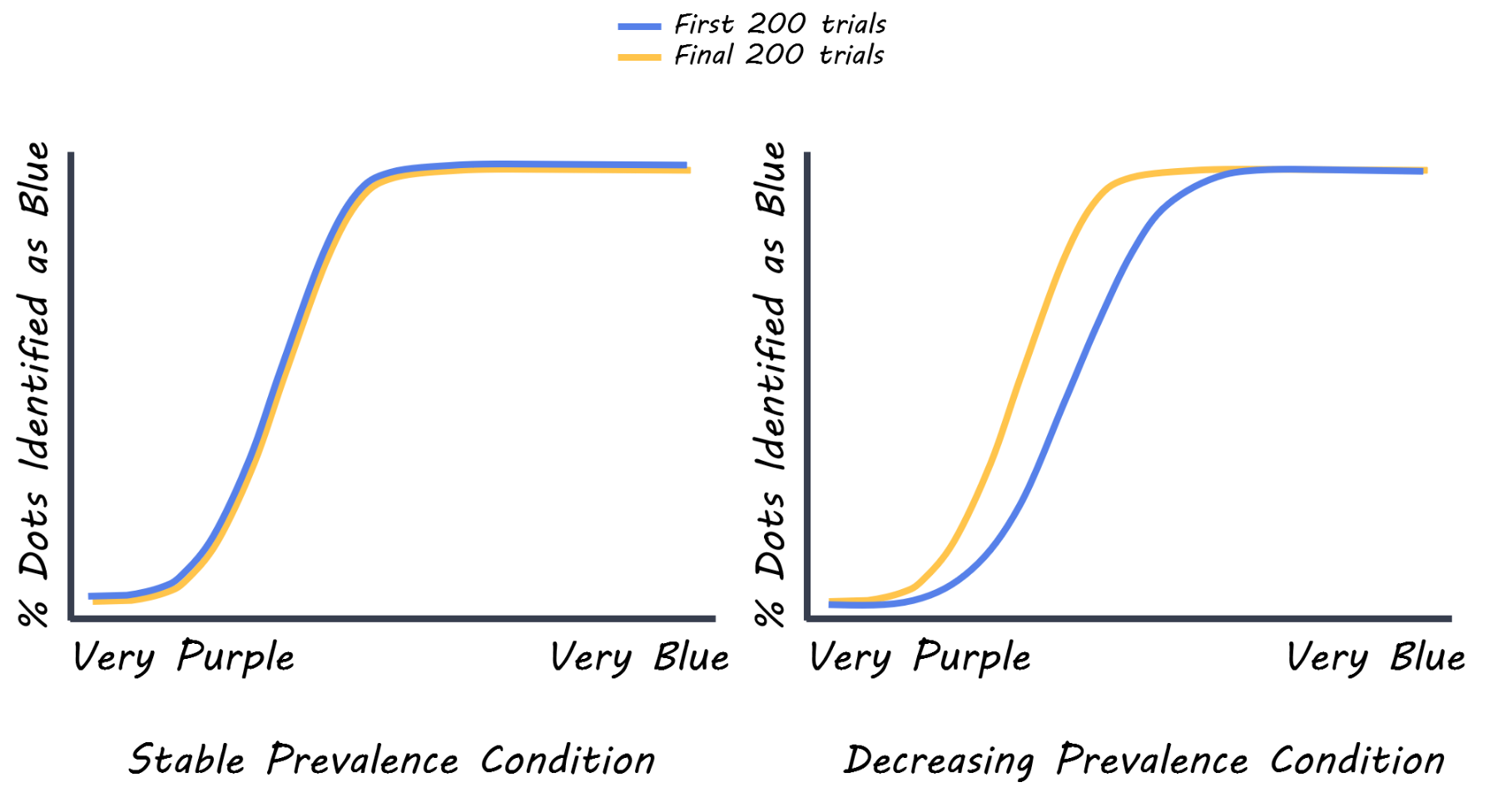
Participants were shown stimuli and were asked to determine whether a stimulus was an example of a particular concept. In the first experiment, participants were shown 1000 dots that varied from purple to blue. Over time, the prevalence of blue dots was reduced and participants’ responses were analyzed to see whether they called a wider range of colors blue (i.e. whether the concept expanded). A second condition with a stable prevalence of these concepts was also carried out as a control (i.e. the number of blue and purple dots was consistent over time). The authors then performed several replication experiments to test whether a) telling the participant that the prevalence would change, b) instructing them be consistent or c) changing the rate of reduction in prevalence would affect their behavior. They also tested what effect increasing the prevalence of a certain stimulus (i.e. increasing blue dots or purple dots) would have. They then repeated the experiments above with a more complex stimulus: faces that varied from non-threatening to very threatening. Finally, they performed another similar experiment in which they asked participants to judge the abstract concept of whether proposed scientific experiments were ethical or not. Participants were shown proposals for scientific studies and asked to determine whether they should be allowed.

What did they find?

Over time, participants were more likely to report a dot as being blue after the prevalence of the blue dots decreased. This result was robust, and persisted even after participants were told that the prevalence would decrease, and after they were instructed to be consistent. A more rapid decline in the prevalence of blue dots did not change this effect. Increasing the prevalence of the blue dots resulted in participants being less likely to report blue dots towards the end of the trials, demonstrating a reversal of this effect. When stimuli were changed to faces (a range of non-threatening to very threatening) the same effect was observed: participants reported more faces as threatening after a reduction in the prevalence of threatening faces. This also applied to the concept of judging whether a scientific proposal is ethical or not: the fewer unethical proposals presented, the more likely a participant was to reject a proposal as unethical. These behavioral results demonstrate a robust effect of “prevalence-induced concept change” that can apply to a variety of concepts.

Concept prevalence

What's the impact?

This study demonstrates how widespread prevalence effects can be, ranging from simple color judgements to complex ethical judgments. Humans are likely to expand the definition of concepts when they become less prevalent. These findings have important implications for institutions that make decisions that need to stay consistent over time, like medicine or law enforcement. This phenomenon may help to explain why individuals fail to recognize progress, even as some problems really do get better.

conceptquote1800.png

Levari et al., Prevalence-induced concept change in human judgement. Science (2018). Access the original scientific publication here.