
Dopamine is Involved in Switching from Feelings of Fear to Safety

What's the science?

Moving on from negative experiences requires identifying when it is no longer appropriate to be fearful. Understanding the neurobiology of fear is important for disorders like post-traumatic stress disorder. Dopamine neurons originating in the brainstem (the ventral tegmental area) release dopamine in limbic (i.e. emotional) regions of the brain and are involved in signalling when outcomes are better than expected. Therefore, these neurons may be involved in transitioning from ‘fear responding’ to ‘safety’. This week in Nature Communications Luo and colleagues investigate how midbrain dopamine neurons are involved in extinguishing fear responses.

How did they do it?

Rats were exposed to a foot shock paired with an auditory stimulus. One day later, rats were exposed to the auditory stimulus (without foot shock) and underwent an ‘extinction learning’ session where the freezing (i.e. fear) response to the auditory stimulus is reduced or unlearned over time. Another day later, they were cued with the auditory stimulus again to see whether the fear response was completely gone. They used an optogenetic approach to silence the activity of midbrain dopamine neurons in these rats during the precise time period of extinction learning when the expected shock did not occur, to see whether midbrain dopamine was responsible for the extinction of fear memories. They then tested how extinction is occurring on a molecular level using optogenetics combined with immunohistochemistry.

What did they find?

Control mice demonstrated reduced freezing responses typical of fear extinction, while mice with silenced midbrain dopamine neuron firing showed a reduction in fear extinction (i.e. they still had freezing responses despite the extinction training). Since the phosphorylation of MAP kinase (MAPK) has been shown to mediate fear extinction, they tested to see whether levels of phosphorylated MAPK were lower in the rats who lacked fear extinction. They found, using immunohistochemistry, that MAPK levels were lower during the extinction training in mice whose dopamine neurons were inhibited. This suggests that dopamine neuron activity engages this molecular process during fear extinction. They then examined whether dopamine release has different effects on fear extinction learning at different release sites. They found that specifically inhibiting nerve terminals in the nucleus accumbens (a brain region involved in reward) reduced fear extinction, whereas inhibiting terminals in the ventromedial prefrontal cortex enhanced fear extinction (i.e. rats more effectively reduced their fear response). This suggests that nucleus accumbens dopamine mediates (i.e. promotes) fear extinction, while dopamine in the ventromedial prefrontal cortex opposes fear extinction. Using retrograde tracers, they found that the projections to the shell of the nucleus accumbens, rather than the core of the nucleus accumbens, mediated fear extinction.
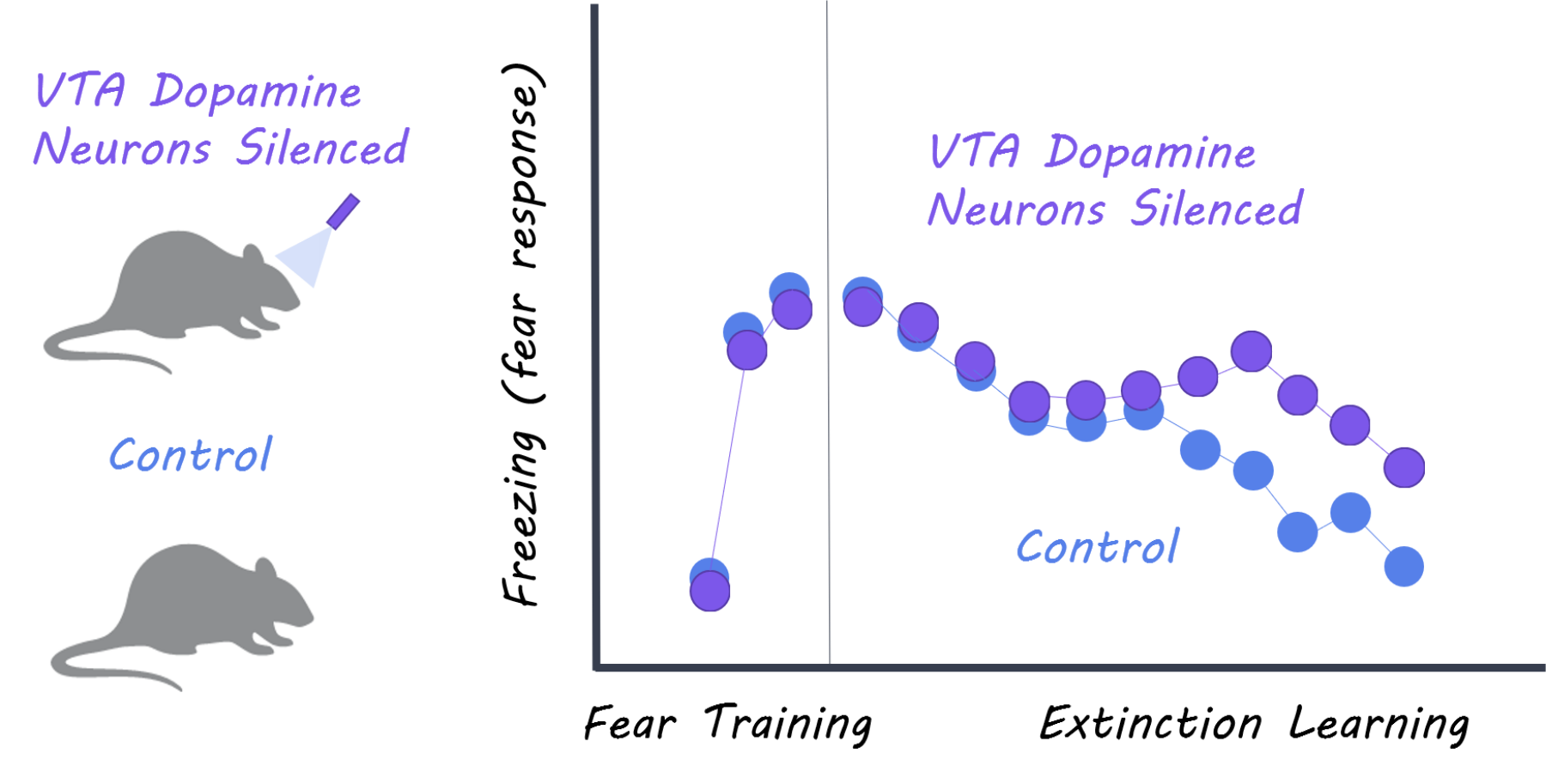
Reduced fear extinction when VTA dopamine neuron firing silenced

What's the impact?

This is the first study to demonstrate that dopamine activity that occurs when an expected aversive outcome does not occur is involved in reducing fear responses to a fearful stimulus. We now know that midbrain dopamine neurons projecting to the nucleus accumbens play a critical role in overcoming fear responses when they are no longer appropriate (i.e. safe situations). Understanding the biology of fear extinction provides a better understanding of detrimental fear responses in anxiety disorders.

VTAquote1800.png

Luo et al., A dopaminergic switch for fear to safety transitions. Nature Communications (2018). Access the original scientific publication here.
A New Cell Type in the Hippocampus Contributes to Sharp Waves Involved in Memory

What's the science?

The dentate gyrus and the CA3 are two important regions involved in memory in the hippocampus. The dentate gyrus separates out incoming signals from the cortex and relays patterns of information to the CA3 pyramidal cells via thorny “mossy fiber” projections. Cues can then reactivate this pattern of information in the CA3 cells (also known as pattern completion). The way in which CA3 neurons are able to reactivate the neurons encoding a memory involves recurrent network activity, however the details are not well understood. Understanding differences in cell types within the CA3 of the hippocampus could improve our understanding of this process of reactivating memories. This week in Nature Neuroscience, Hunt and colleagues examine different pyramidal cell types within the CA3 and their activity patterns during sharp waves (i.e. spontaneous reactivation of memory neurons) to understand their role in the “replay” of memory.

How did they do it?

They performed whole-cell patch-clamp on hippocampal tissue slices from mice to assess how the neurons in the CA3 would fire in response to current injection (to cause action potential firing). They then examined the structural and molecular properties of these neurons to see how cell types within the CA3 differed. Next, they used a transgenic mouse line and optogenetics to express light activated channels in mossy fiber axons projecting to CA3 cells from the dentate gyrus. They activated these fibers and measured excitatory post-synaptic currents to map input from dentate gyrus to different pyramidal cells within the CA3. In mice, they measured activity (local field potentials and multi-unit activity) of different labelled pyramidal cells during “sharp wave” events, which are the spontaneous neuron firing events in the CA3, known to be important for memory. The goal was to understand how different pyramidal cells and their firing properties contribute to memory. They used optogenetic activation of cholinergic neurons, which are known to regulate memory in the hippocampus, to test how different pyramidal cell types responded to cholinergic modulation. Lastly, they constructed an “attractor network model” to show how these different cell types contribute to network dynamics in the hippocampus during memory replay.

What did they find?

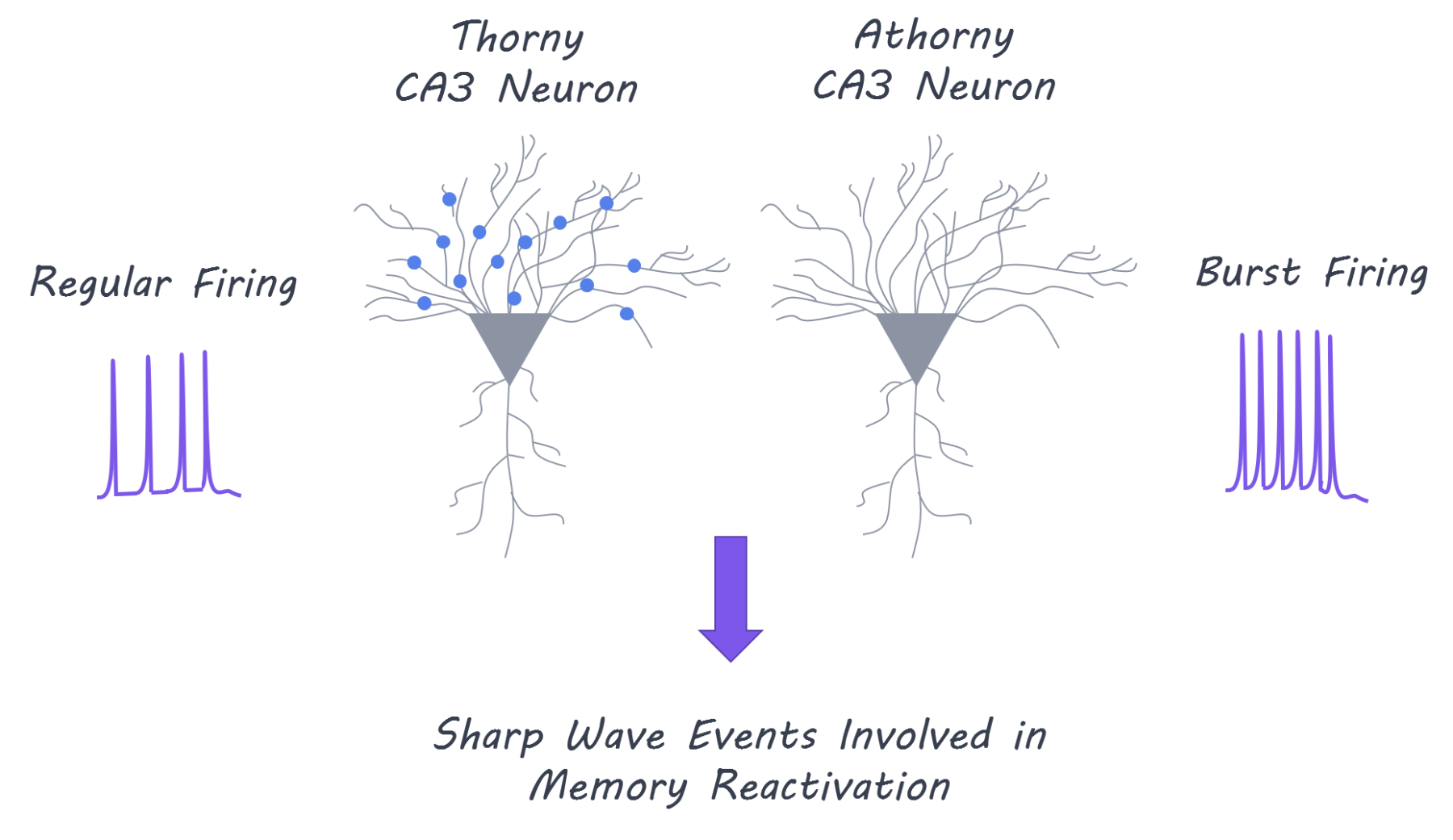
There were two types of responses from neurons within the CA3 after current injection: neurons that fired in a regular pattern and neurons that fired in a “burst” pattern. The regular firing neurons had thorny spines as expected of CA3 cells, however the burst firing neurons did not have thorny spines (i.e athorny cells). Using a clustering approach, the two cell types were segregated based on their different electrophysiological and structural properties. Using optogenetic activation of mossy fibers, they found that mossy fibers project to regular thorny neurons but not to athorny burst firing neurons in the CA3. However, both thorny and athorny neurons were excited by recurrent activation (i.e. by neurons nearby).

Sharp wave events involved in memory reactivation

In mice, they measured neuron activity during sharp wave events, which had two phases: an initial ramp phase followed by an exponential increase in firing. They measured properties of firing of the two cell types and found that they behaved differently: thorny cells contribute to initial single spike activity and this spiking peaked during the exponential phase of the sharp wave event, while athorny cells weakly increased their single spike rate during the ramp and exponential phase of the sharp wave event. Athorny neurons contributed more to the complex burst firing (as opposed to single unit firing) component of sharp wave events. Optogenetic activation of cholinergic cells abolished sharp wave events, indicating that sharp waves are regulated by acetylcholine (a neurotransmitter that modulates activity). Further, activation of cholinergic neurons downregulated the burst firing of the athorny pyramidal cells, suggesting that low acetylcholine levels may facilitate the reactivation of pyramidal cells during the “replay” of memory during sharp wave events. Using an “attractor network model” they found that burst firing (driven by athorny cells) were important for evoking sharp wave events, suggesting that these newly defined cells are crucial for memory replay.

What's the impact?

This is the first study to demonstrate that a new “athorny” cell type in the CA3 region of the hippocampus is involved in memory. This new athorny neuron plays a role in burst firing associated with “sharp wave” events that are important for the reactivation of memory (i.e. memory replay). Understanding the cell types involved in memory circuits in the hippocampus is crucial to understanding how memory is encoded and retrieved.

thornyquote1800.png

Hunt et al., A novel pyramidal cell type promotes sharp-wave synchronization in the hippocampus. Nature Neuroscience (2018). Access the original scientific publication here.
Dialectical Behaviour Therapy is Effective For Adolescents at Risk of Suicide

What's the science?

Suicide rates among adolescents have increased in recent years, but no well-established treatment exists to decrease death by suicide in at-risk youth. Dialectical behavioural therapy (DBT) involves cognitive-behavioural treatment focused on reducing self-harm, skills for managing distress and emotion regulation. It was recently demonstrated to be effective in reducing self-harm and suicidal ideation in adolescents, however, it is critical to understand the effects of DBT on suicide attempts. This week in JAMA Psychiatry, McCauley and colleagues report on a randomized clinical trial comparing the effects of DBT with individual and group supportive therapy (IGST), which acts as a control that matches DBT on nonspecific treatment factors closely. 

How did they do it?

173 adolescents across multiple sites participated (aged 12-18). Participants had previously attempted suicide one or more times, had high levels of suicide ideation within the past year (Suicide Ideation Questionnaire Junior), had self-injured recently, and had 3 or more criteria for Borderline Personality Disorder. Participants were randomized to the DBT or IGST group, and both treatments involved 6 months of weekly individual and group therapies as well as parental participation. IGST treatment included group therapy, weekly consultation with a therapist, and emphasized belonging and connectedness. DBT treatment included skills training, group training with multiple families, and validation of interaction between families and adolescents. DBT treatment is similar to standard cognitive behavioural therapy but focuses on helping adolescents to ‘build a life worth living’ and on commitment to change. Suicide attempts and self harm were measured using the Suicide Attempt Self-Injury Interview (SASII), and suicidal ideation was measured using the Suicide Ideation Questionnaire Junior (SIQ-JR). A mixed model repeated measures analysis was used to compare treatment groups at four timepoints (baseline, 3, 6 (end of therapy), 9, and 12 months)

What did they find?

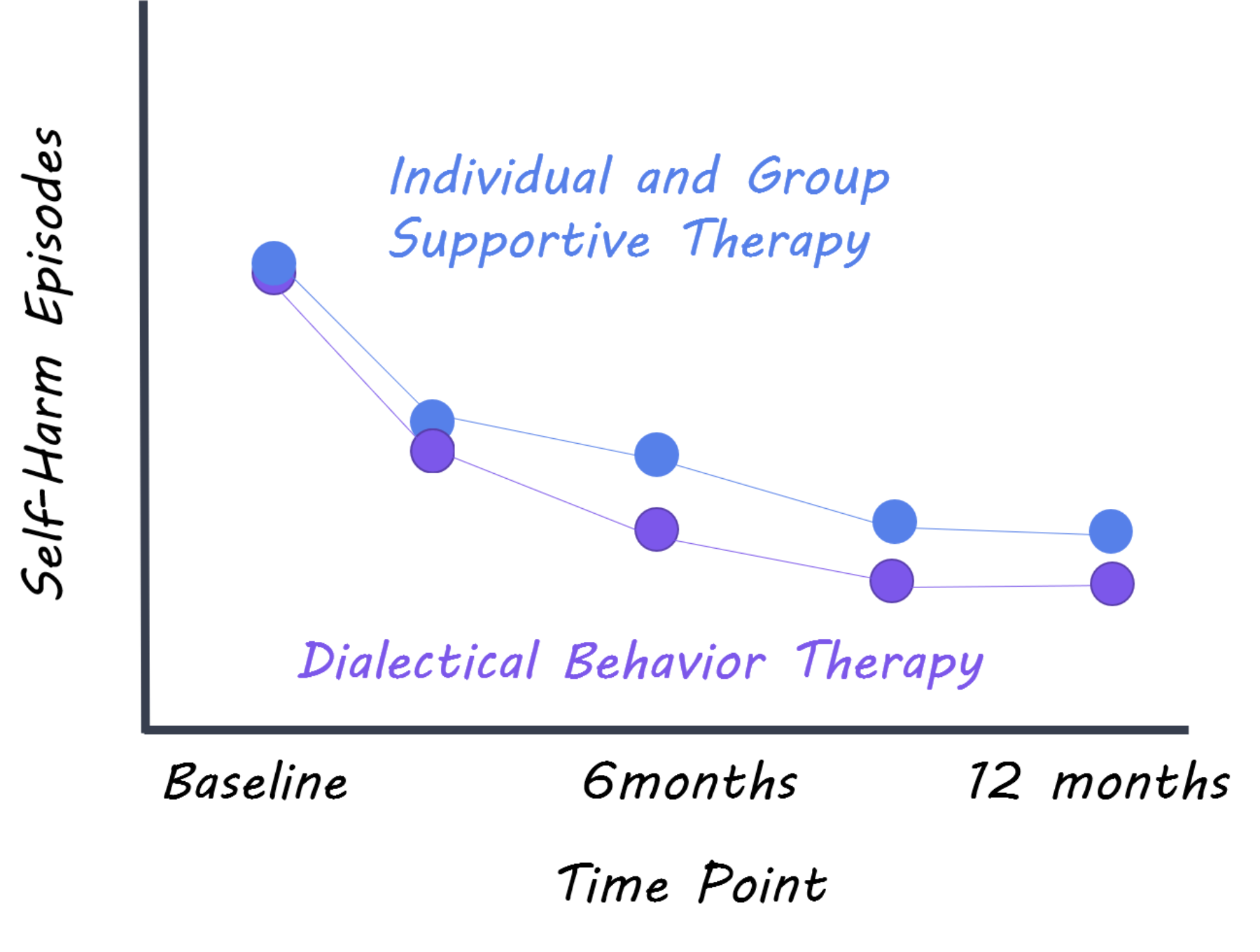
Between 0 (baseline) and 6 months of treatment, 10% of the DBT group and 22% of the IGST group attempted suicide. Between 6-12 months (a six month follow-up period), the rates were 7% of the DBT group and 10% of the IGST group. To analyze the number of suicide attempts and non-suicidal self injuries, a generalized linear mixed-effects model was used, and each participant was given a severity score. DBT improved each outcome measure. When the authors assessed the ‘number needed to treat’ they found that for each 8.46 youth who completed DBT instead of IGST, one additional youth would be free of suicide attempts (a small-medium effect size). Overall, the effects of DBT on primary outcomes were significant at 6 months but not at 12 months (after 6 months of follow-up). In a secondary analysis, self harm was classified in a binary manner instead of on a severity scale. A significantly larger proportion (46%) of youth who underwent DBT did not self harm by 6 months, compared to only 28% for IGST. By 12 months, the rates were 51% for the DBT group and 32% for the IGST group. There was also a large effect of DBT on reducing suicide ideation at 6 months (versus IGST), and a smaller effect at 12 months.

Self-harm episodes over time  - Dialectical behavioral therapy

What's the impact?

This is the first study to demonstrate the effectiveness of DBT on reducing suicide attempts in youth. As there was less evidence for the effectiveness of DBT compared to the control treatment (IGST) at 12 months (versus immediately following treatment cessation at 6 months), long-term treatment may be recommended. Intensive family involvement and active coping skills (hallmarks of DBT) may be beneficial for youths at risk of self harm and suicide.

suicidequote1800.png

McCauley et al., Efficacy of Dialectical Behavior Therapy for Adolescents at High Risk for Suicide. JAMA Psychiatry (2018). Access the original scientific publication here.