
Dialectical Behaviour Therapy is Effective For Adolescents at Risk of Suicide

What's the science?

Suicide rates among adolescents have increased in recent years, but no well-established treatment exists to decrease death by suicide in at-risk youth. Dialectical behavioural therapy (DBT) involves cognitive-behavioural treatment focused on reducing self-harm, skills for managing distress and emotion regulation. It was recently demonstrated to be effective in reducing self-harm and suicidal ideation in adolescents, however, it is critical to understand the effects of DBT on suicide attempts. This week in JAMA Psychiatry, McCauley and colleagues report on a randomized clinical trial comparing the effects of DBT with individual and group supportive therapy (IGST), which acts as a control that matches DBT on nonspecific treatment factors closely. 

How did they do it?

173 adolescents across multiple sites participated (aged 12-18). Participants had previously attempted suicide one or more times, had high levels of suicide ideation within the past year (Suicide Ideation Questionnaire Junior), had self-injured recently, and had 3 or more criteria for Borderline Personality Disorder. Participants were randomized to the DBT or IGST group, and both treatments involved 6 months of weekly individual and group therapies as well as parental participation. IGST treatment included group therapy, weekly consultation with a therapist, and emphasized belonging and connectedness. DBT treatment included skills training, group training with multiple families, and validation of interaction between families and adolescents. DBT treatment is similar to standard cognitive behavioural therapy but focuses on helping adolescents to ‘build a life worth living’ and on commitment to change. Suicide attempts and self harm were measured using the Suicide Attempt Self-Injury Interview (SASII), and suicidal ideation was measured using the Suicide Ideation Questionnaire Junior (SIQ-JR). A mixed model repeated measures analysis was used to compare treatment groups at four timepoints (baseline, 3, 6 (end of therapy), 9, and 12 months)

What did they find?

Between 0 (baseline) and 6 months of treatment, 10% of the DBT group and 22% of the IGST group attempted suicide. Between 6-12 months (a six month follow-up period), the rates were 7% of the DBT group and 10% of the IGST group. To analyze the number of suicide attempts and non-suicidal self injuries, a generalized linear mixed-effects model was used, and each participant was given a severity score. DBT improved each outcome measure. When the authors assessed the ‘number needed to treat’ they found that for each 8.46 youth who completed DBT instead of IGST, one additional youth would be free of suicide attempts (a small-medium effect size). Overall, the effects of DBT on primary outcomes were significant at 6 months but not at 12 months (after 6 months of follow-up). In a secondary analysis, self harm was classified in a binary manner instead of on a severity scale. A significantly larger proportion (46%) of youth who underwent DBT did not self harm by 6 months, compared to only 28% for IGST. By 12 months, the rates were 51% for the DBT group and 32% for the IGST group. There was also a large effect of DBT on reducing suicide ideation at 6 months (versus IGST), and a smaller effect at 12 months.
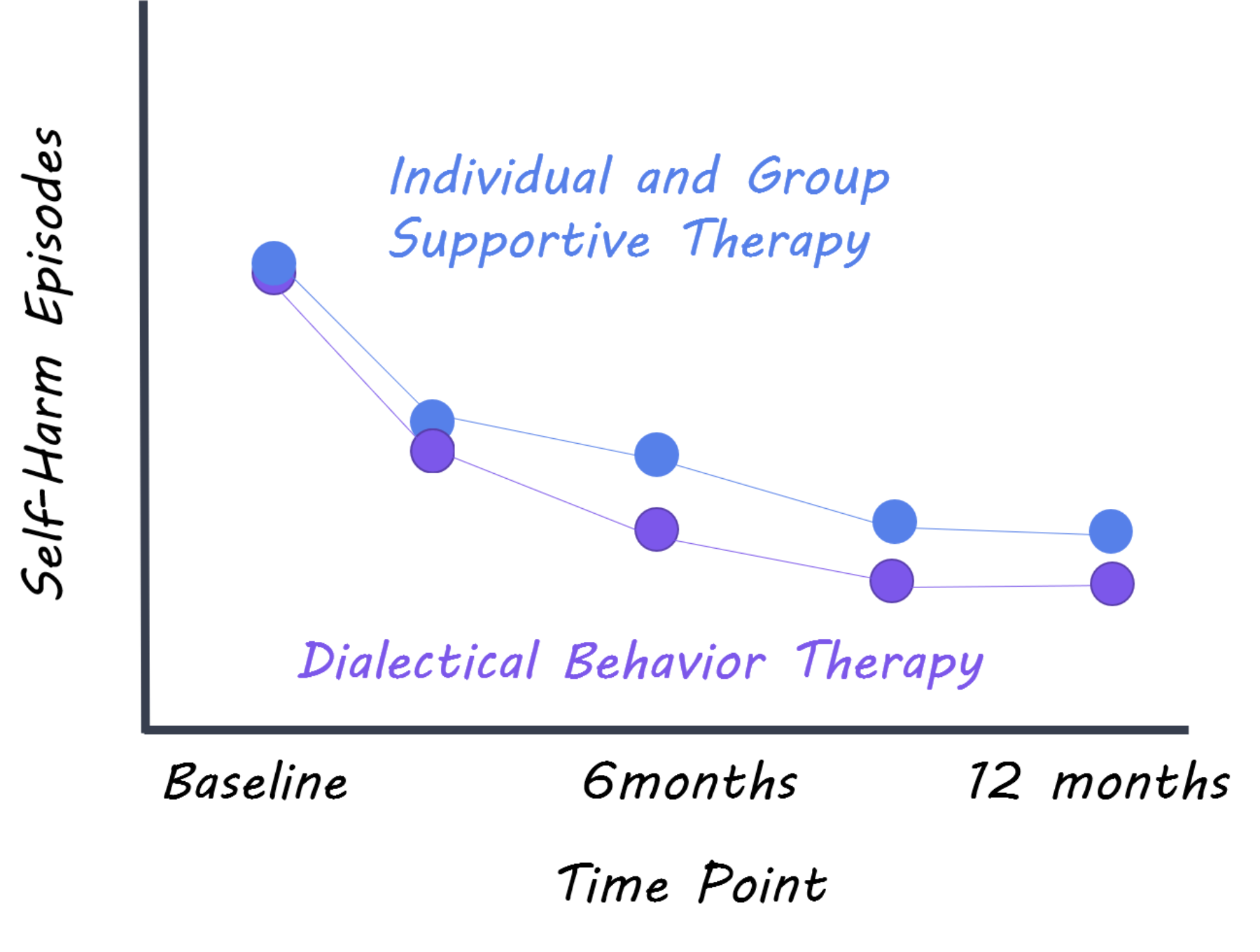
Self-harm episodes over time  - Dialectical behavioral therapy

What's the impact?

This is the first study to demonstrate the effectiveness of DBT on reducing suicide attempts in youth. As there was less evidence for the effectiveness of DBT compared to the control treatment (IGST) at 12 months (versus immediately following treatment cessation at 6 months), long-term treatment may be recommended. Intensive family involvement and active coping skills (hallmarks of DBT) may be beneficial for youths at risk of self harm and suicide.

suicidequote1800.png

McCauley et al., Efficacy of Dialectical Behavior Therapy for Adolescents at High Risk for Suicide. JAMA Psychiatry (2018). Access the original scientific publication here.

A Role for Human Herpesvirus in Alzheimer’s disease

What's the science?

Alzheimer’s disease has previously been associated with various bacteria and viruses — in particular herpes simplex virus. However, the mechanism by which viruses may contribute to Alzheimer’s disease is not clear. This week in Neuron, Readhead and colleagues used a neuropathological network model (at the gene, transcription, protein, and histopathology levels) to understand the contribution of viruses to Alzheimer’s. 

How did they do it?

The authors obtained data from brains (after death) of healthy individuals, those with ‘pre-clinical’ Alzheimer’s (i.e. early, visible pathology but no cognitive impairment at time of death), and those with later stage Alzheimer’s disease. They first used computational modelling (they created probabilistic causal networks) to understand the differences in gene expression networks between healthy individuals and those with pre-clinical Alzheimer’s disease. They focused analyses on the entorhinal cortex and hippocampus (two regions affected by the disease). From the pre-clinical and control groups, they found genes they referred to as ‘network drivers’ that regulated a large portion of the gene expression in the network.

They then evaluated viral activity (viral RNA and DNA sequences) in patients with clinical Alzheimer’s (four independent cohorts) versus healthy controls. They first performed RNA sequencing in tissue from the superior temporal gyrus, anterior prefrontal cortex, inferior frontal gyrus, and parahippocampal gyrus obtained from one of the four cohorts, and looked for the presence of genes associated with viruses known to infect the human transcriptome. They also performed whole-exome sequencing to assess viral DNA in the same regions. The relationship between Alzheimer’s traits (Clinical Dementia Rating, Amyloid Plaque Density) and elevated viral RNA and DNA levels was also examined.

What did they find?

When the authors assessed pre-clinical Alzheimer’s versus healthy control gene networks, they found that promoters (i.e. the region of the gene that turns on transcription) for gene network drivers lost or gained in pre-clinical Alzheimer’s were enriched for C2H2 zinc factor transcription factor binding motifs. The “lost in pre-clinical Alzheimer’s disease” drivers had more G-quadruplex motifs within their genes. There was also a negative relationship between the density of G-quadruplex (co-regulatory with C2H2 transcription factor) and the expression of these genes in the entorhinal cortex in the pre-clinical Alzheimer’s and Alzheimer’s disease samples. These types of changes have been previously associated with viral biology/viral infection, suggesting that viral activity is associated with Alzheimer’s. As a second line of evidence, they found overlap between identified gene network drivers and gene targets of human microRNAs that had been previously associated with innate immunity and DNA viral activity.

Alzheimer’s disease traits and viral abundance

When the authors assessed viral abundance in the brains of patients with Alzheimer’s, they found increased viral species in the anterior prefrontal cortex and superior temporal gyrus; in particular, HHV-7 and HHV-6A (i.e. herpesviruses). These elevated levels were also found in other brain regions in two additional cohorts of patients, suggesting that these viruses are increased across different tissues. The same findings were not present in samples of pathological aging or progressive supranuclear palsy (another neurodegenerative disorder), suggesting they are specific to Alzheimer’s. Increased viral DNA for HHV-6A was also detected. An HHV-7 gene and HHV-6A region were associated with Alzheimer’s traits (dementia ratings & plaque density) and viral abundance mediated gene expression of genes involved in disease risk and beta-amyloid processing (which form plaques). They also identified that some host genes (in particular the MIR155 host gene) regulated by HHV-6A (a herpesvirus) could form a network associated with neuronal loss, indicating that HHV-6A may be implicated in neurodegeneration. Finally, the authors performed some follow-up analyses in mice and found that MIR155 knockout mice had larger cortical amyloid plaques. Upregulated genes in MIR155 knockout mice were similar to those upregulated by the HHV-6A virus, suggesting that HHV-6A could act by inhibiting MIR155.

What's the impact?

This study provides genetic, clinical, and neuropathological evidence that there may be viral and host factors that interact to contribute to Alzheimer’s pathology. Viruses could potentially disturb biological processes (e.g. leading to plaque formation) or alter transcription or regulatory mechanisms. The contribution of viral activity in Alzheimer’s should be further investigated.

Readhead et al., Multiscale Analysis of Independent Alzheimer’s Cohorts Finds Disruption of Molecular, Genetic, and Clinical Networks by Human Herpesvirus. Neuron (2018). Access the original scientific publication here.

Oscillations in Neural Activity Travel in Waves Through the Human Brain

What's the science?

Oscillations in neural activity (sometimes referred to as ‘brain waves’) are important for brain function, as they help to coordinate activity across the brain and help spatially separated brain regions to communicate. The brain oscillates at different frequencies, including ‘alpha’ and ‘theta’ frequencies. Animal studies have shown that brain oscillations can travel across the cortex in the form of a wave, however this has not been investigated in humans. Recently in Neuron, Zhang and colleagues examine whether oscillations in neural activity can travel across the human cortex in the form of a wave and if wave propagation correlates with behavior and cognition.

How did they do it?

Electrocorticography (ECoG) - which is the measurement of neural activity from electrodes placed on the brain’s surface - was performed on 77 patients undergoing brain surgery. Neural activity was recorded while participants performed a working memory task where participants tried to memorize a list of stimuli, followed by a retrieval cue where they recalled presented stimuli. The authors used a technique designed to test whether oscillations in the brain travel across the cortex. They did this by locating electrodes where neuronal oscillations were present at the same frequency simultaneously, and showed a timing (i.e. phase) gradient across space (i.e. the cortex). Neural activity was recorded while participants performed a working memory task. They used a clustering approach to identify clusters of spatially contiguous electrodes that showed the same frequency of oscillations. They then examined the timing of the activity across each cluster to look for patterns of phase synchrony to see whether the oscillations travelled in the form of a wave. They did this by calculating the phase of the oscillations at each electrode across space. Lastly, they tested whether travelling waves in the cortex were associated with behavior.

What did they find?

Most patients (96%) had ‘clusters’ of electrodes that showed the same frequency of oscillations (with a phase gradient) across space. They found a total of 208 clusters in the 77 patients. Clusters were in frequencies ranging from 2-15 Hz (alpha and theta). Clusters at given electrodes within one patient did not necessarily have the same frequency as the (spatially) identical clusters in another patient, suggesting that neuronal oscillations vary from individual to individual. They found that frequencies within patients showed a strong spatial correlation. They also found that many of the clusters had oscillation cycles that varied systematically with the electrode location within the cluster, indicating a traveling wave. They used a circular-linear model to examine the relationship between electrode location and phase of the wave to demonstrate the direction and the robustness of the travelling wave. 140 of the clusters (67%) showed consistent travelling waves and a consistent propagation direction across multiple trials. The clusters with travelling waves were found across all lobes of the cortex. The direction of travelling waves was most consistent in the frontal and temporal lobes, and most waves demonstrated a posterior-to-anterior directionality in these regions. Direction was more varied in the parietal and occipital lobes. They authors tested whether these travelling waves were related to the working memory task and found that directional consistency (how consistently the wave propagated in one direction) was higher in the frontal and temporal lobes after the retrieval cue onset (where they were required to recall previously shown stimuli) in the working memory task. Directional consistency was also positively correlated with performance, suggesting that waves travelling in a consistent direction are associated with better working memory efficiency.

Brain, Servier Medical Art, image by BrainPost, CC BY-SA 3.0

Brain, Servier Medical Art, image by BrainPost, CC BY-SA 3.0

What's the impact?

This is the first study to show that oscillations in neural activity at particular frequencies travel across the human cortex in waves. The consistency of propagation of these waves was related to an individual’s working memory. Understanding how neural activity is coordinated and associated with behavioral factors like working memory is crucial for understanding how the brain works. Future research will be need to further understand the importance of travelling waves in the brain.

travelwavesquote1800.png

Zhang et al., Theta and Alpha Oscillations Are Traveling Waves in the Human Neocortex. Neuron (2018). Access the original scientific publication here.