
Stress Hormones Sensitize Fear Circuits in the Brain

What's the science?

Fear and stress can induce the ‘fight-or-flight’ active response or a passive ‘freezing’ response. Associative memories can form when a cue is associated with an aversive (i.e. negative) experience, and these cues often trigger a freezing (i.e. fear) response later on. Dysfunction of the brain circuitry involved in this response can lead to disorders such as post-traumatic-stress disorder and generalized anxiety disorder. We know that thalamus-amygdala circuitry and hormones released within the amygdala are involved in these disorders, however, we still don’t understand how it underlies ‘freezing’ behavior. This week in Molecular Psychiatry, Pliota and colleagues test whether thalamus-amygdala circuitry and hormones within the amygdala contribute to freezing behavior after stress.

How did they do it?

Part1 -- Mice underwent two elevated maze exploration task trials (a task typically used to assess anxiety behavior in mice including ‘fight or flight’ vs. freezing responses) separated by ten unpredictable foot shocks to induce fear memory. Passive freezing responses generally act as a coping mechanism when dealing with unpredictable stressful stimuli. The authors used an early gene approach (an approach that measures early gene responses to stimuli) to assess which brain regions were involved in the anxiety response after foot shock. They then performed calcium imaging (to measure neuronal activity) during unpredictable foot shock, and during a maze exploration task that followed. This imaging technique determined which brain regions were activated by these two paradigms.

Part 2 -- They then performed a series of experiments including optogenetics, electrophysiology & chemogenetics to test how the stress circuitry found underlies anxiety behavior (active vs. passive).

What did they find?

Part1 -- Mice exposed to the unpredictable foot shock later demonstrated less exploration in the maze task, indicating greater passive ‘freezing’ responses compared to control mice. They found that the periaqueductal grey area and the periventricular thalamus (previously implicated in anxiety) were brain regions recruited after foot shock. Using Calcium imaging, they found that the thalamus was 1) activated in response to foot shock, and 2) more active during the maze exploration following the unpredictable foot shock (as opposed to no previous foot shock).

Part 2 -- They used a retrograde tracer to show that thalamus projections to the amygdala were more active during the maze exploration after foot shock. They then used optogenetics to activate the thalamus-amygdala circuit and found that in later maze exploration, behavior mimicked that after foot shock, whereas deactivation of this circuit counteracted the passive behaviors seen in the maze exploration after foot shock. These results suggest that the thalamus-amygdala circuit specifically is reinforced during stress and leads to future ‘freezing behavior’. They used electrophysiology to show that activation of neurons in thalamus selectively activates neurons in the amygdala that express corticotropin releasing hormone (a stress hormone). Using designer drugs (genetically engineered receptors) to activate neurons that release corticotropin releasing hormone increased passive behaviors in the maze task. Lastly, they used microdialysis to show that corticotropin releasing hormone is actually released in the amygdala after foot shock. They blocked this hormone by injecting an antagonist to block the receptors on neurons, and found that the passive behaviors were reduced, suggesting that this hormone (typically released from the amygdala) mediates the passive freezing response to foot shock.
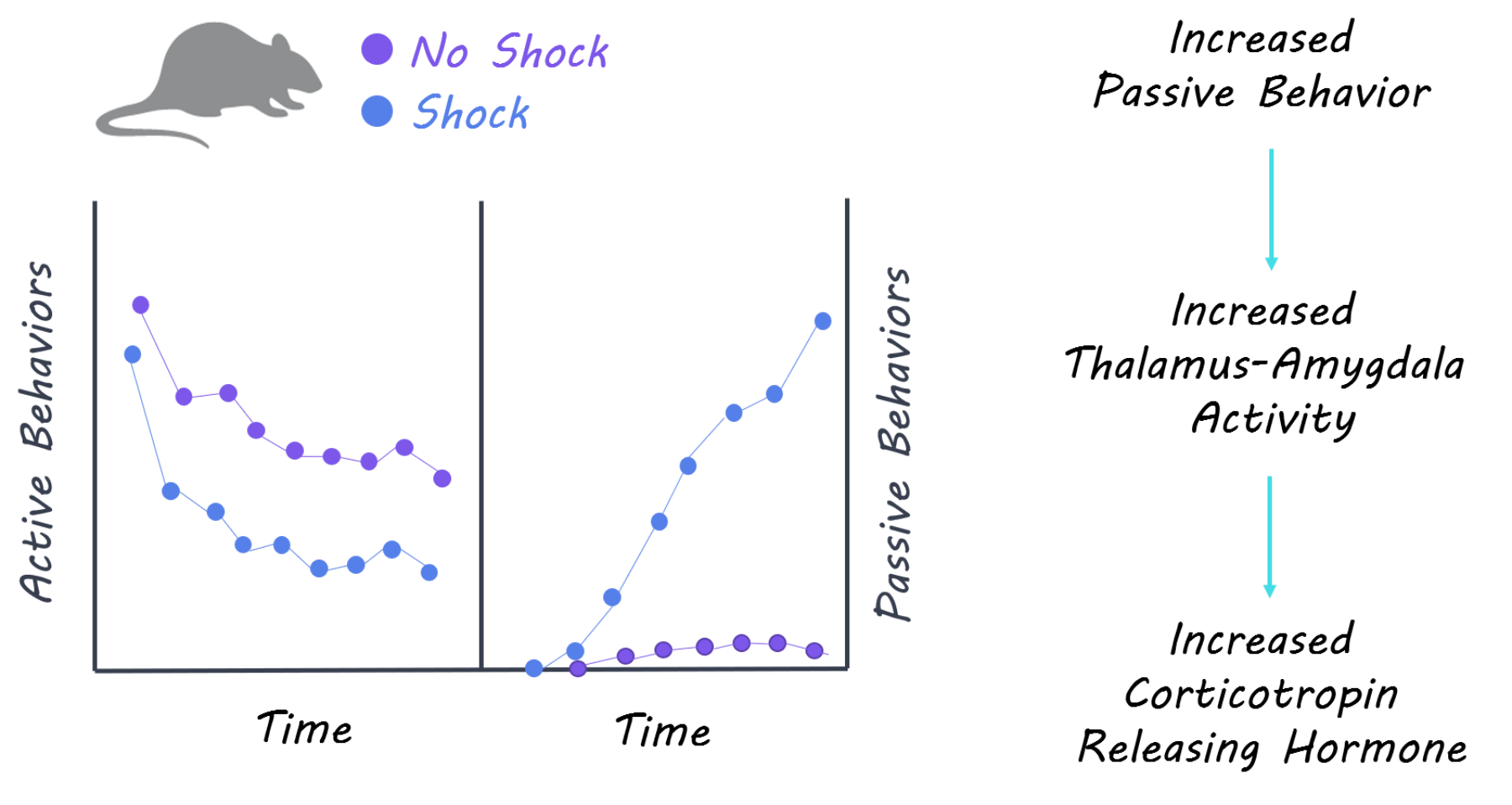
Passive behaviour, thalamus-amygdala activity and increased corticotropin releasing hormone

What's the impact?

This is the first study to show a specific thalamus-amygdala pathway and the release of corticotropin releasing hormone mediates passive anxiety behaviors. We now have a better understanding of the brain circuitry involved in the 'freezing' response to stressful events. These findings have important implications for understanding the dysfunctional circuitry in disorders like post-traumatic stress disorder and generalized anxiety disorder.

thalamusquote1800.png

Pilota et al., Stress peptides sensitize fear circuitry to promote passive coping. Molecular Psychiatry (2018). Access the original scientific publication here.

Sensory Gating in Cerebral Palsy

What's the science?

Around the time of birth, brain injury can result in cerebral palsy. Children with cerebral palsy have deficits in motor function, and these deficits are known to be due in part to sensory deficits. Further, the neural responses (‘event-related potentials’) and oscillations in the somatosensory cortex at alpha, theta and beta frequency ranges have been linked to the severity of both perceptual and motor deficits. Sensory gating’ is when two sensory stimuli are presented in a row and the second stimulus results in a smaller neural response. This phenomenon occurs normally and may be due to the fact that the second sensory stimulus is somewhat redundant and not novel in the environment. How sensory gating manifests in children with cerebral palsy is not known. This week in Cerebral Cortex, Kurz and colleagues performed a sensory gating task and magnetoencephalography (MEG) to understand more about the sensory deficits in children with cerebral palsy.

How did they do it?

Fifteen children with cerebral palsy and nineteen healthy children participated. The mean age for both groups was 14 years old. Children were seated while MEG data was recorded – this type of brain scan measures magnetic fields that are generated due to the brain’s electrical activity (e.g. neuron firing). Electrical stimulation was applied to a nerve (tibial nerve) on the leg. The non-dominant leg in healthy children and the most affected leg in children with cerebral palsy was used. 120 trials consisting of two electrical pulses each (500ms between pulses) were administered. Each participant also completed an MRI scan to map their brain structure, and the MEG data was mapped to their brain structure. Power at different frequency bands across sensors in the MEG scanner was calculated. Next beamforming (a technique which uses data from sensors in the MEG scanner to estimate activity at specific locations in the brain) was performed. Locations of peak activity within the somatosensory cortex (during nerve stimulation) were noted for participants who had their right leg and those who had their left leg stimulated separately. A mixed model was used to assess differences between children with and without cerebral palsy. Sensory gating was calculated as a ratio (higher/closer to one is less gating).

What did they find?

When they looked at the sensor data from the MEG system, they found synchronization across several frequency bands (10-75Hz) at central and frontal parietal electrodes (approximately over the somatosensory cortex) in the first 100 ms following each stimulus. After beamforming, the peak activation was found to be near the paracentral lobule of the somatosensory cortex (this area of the somatosensory cortex is typically activated when sensory stimulation is applied to the leg). Main effects for group and for stimulus were found; responses were weaker for the cerebral palsy group, and for the second stimulus compared to the first. An interaction was also noted; there was greater attenuation of the response to the second stimuli in children with cerebral palsy. There was also a stronger somatosensory gating response in children with cerebral palsy (0.45 versus 0.75 in healthy children), indicating that this response was unusually strong in the group with cerebral palsy.

Neural activity in Cerebral Palsy

What's the impact?

This is the first study to assess sensory gating (a dampened neural response to a second stimulus when two are presented) in children with cerebral palsy. Children with cerebral palsy demonstrated more sensory gating and weaker activity in the somatosensory cortex following application of a sensory stimulus. Neurophysiological abnormalities in sensory gating may be an underlying cause of sensory and motor deficits. Future studies should assess the link between structural and functional damage to the central nervous system in cerebral palsy.


Kurz et al., Children with Cerebral Palsy Hyper-Gate Somatosensory Stimulations of the Foot. Cerebral Cortex (2018). Access the original scientific publication here.
Reading Intervention in Children is Associated with White Matter Plasticity

What's the science?

Reading ability has been linked to properties of white matter tracts; the myelinated (i.e. insulated) bundles of nerve fibers that connect various brain regions. Variation in the integrity of white matter is associated with certain aspects of reading ability. White matter plasticity including myelination in response to brain activity can occur on short time scales (days to weeks) and evidence suggests that it may promote learning. This week in Nature Neuroscience, Huber and colleagues test whether white matter plasticity occurs during a longitudinal reading intervention in children who are struggling readers.

How did they do it?

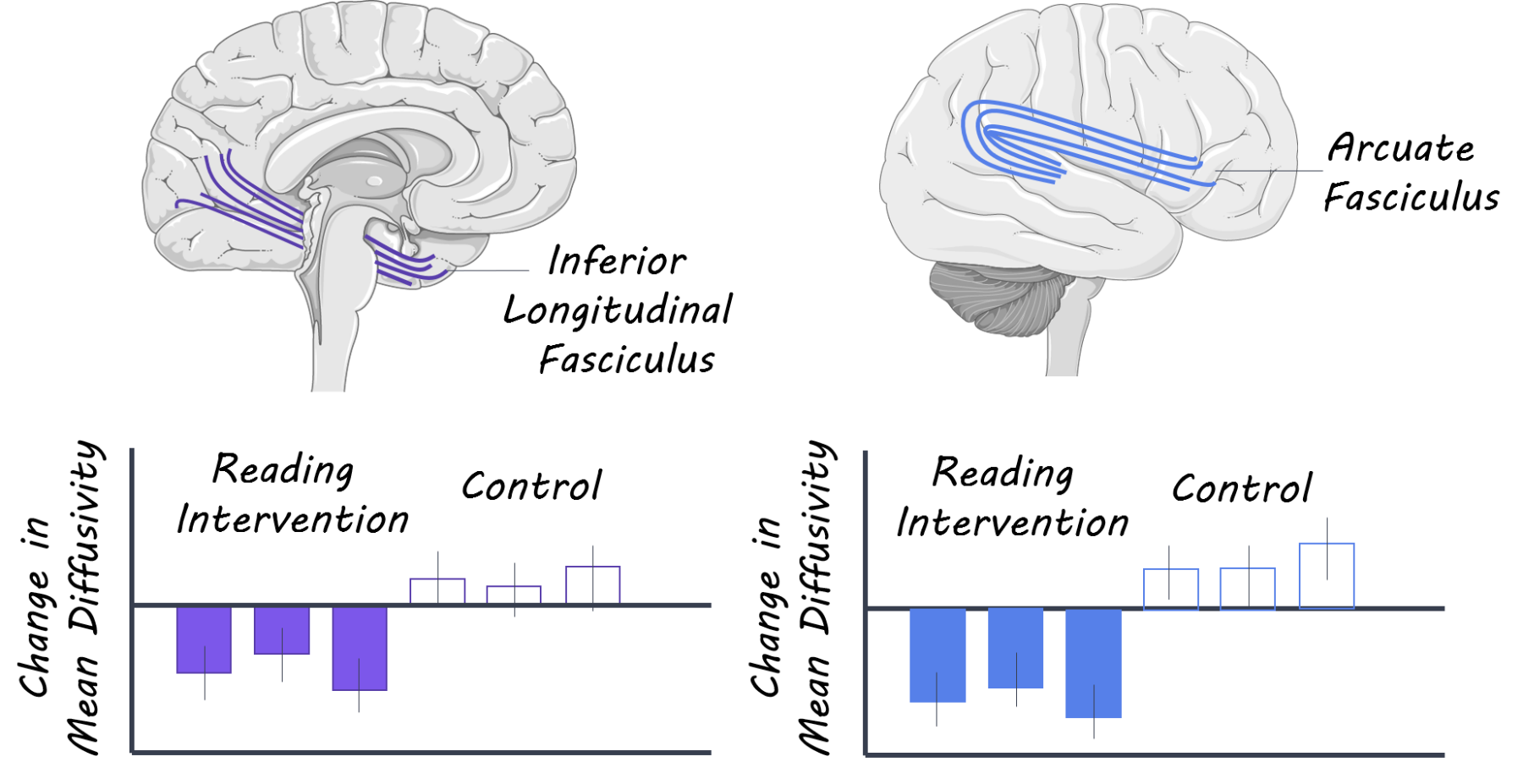
Grade-school aged youth were recruited and underwent intensive reading training for 4 hours a day, 5 days a week for 8 weeks. The participants were tested for reading skills and scanned using diffusion MRI (which measures white matter) prior to the reading intervention and throughout the intervention at 2.5 weeks, 5 weeks and 8 weeks (the end of intervention). A control group who did not receive the intervention was also tested and scanned. Individual differences in reading skill were measured using a composite score from a battery of reading tests. White matter structural properties were measured using diffusion tensor imaging in 3 major white matter tracts of the brain (the arcuate fasciculus, inferior longitudinal fasciculus and the corpus callosum) and reading skill was tracked over time in the reading intervention group and controls.

What did they find?

Prior to reading intervention, reading skill level was correlated with fractional anisotropy, which is a measure of the directionality of water diffusion within brain tissue. This measure is informative because water diffusion is more directional when tracts are organized coherently, as opposed to dispersed, and also when tracts are highly myelinated (i.e., well insulated). A significant improvement in reading skills and white matter tract changes were seen in response to the reading intervention. White matter structure changed: mean diffusivity (a measure that decreases with tissue density) was reduced over time while fractional anisotropy was increased over time in two major white matter tracts (the arcuate fasciculus and the inferior longitudinal fasciculus). Plasticity was also observed in a large collection of tracts extending beyond those conventionally associated with reading skills. These results suggest that reading intervention induces plasticity in white matter in general, which is related to improvements in reading skills in struggling readers. Lastly, they tested whether changes in the different white matter tracts occurred simultaneously along with improvement in reading skill and found that these changes were highly correlated over the intervention period, suggesting that the learning is happening along with changes in white matter tract structure.

Brain, Servier Medical Art, image by BrainPost, CC BY-SA 3.0

Brain, Servier Medical Art, image by BrainPost, CC BY-SA 3.0

What's the impact?

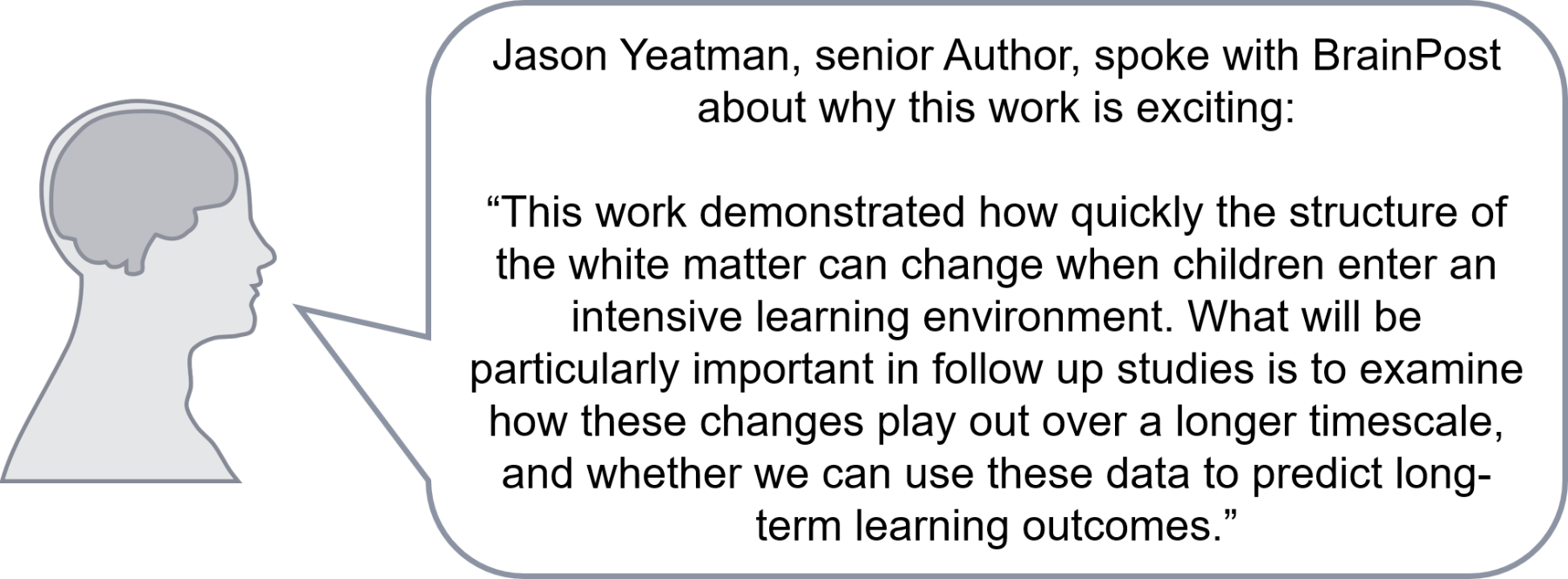
This is the first study to show that reading intervention can change white matter structure in a matter of weeks. White matter changes were seen in important tracts that connect brain regions involved in reading. We now have a better understanding of how reading can change brain structure and potentially improve reading ability in youth on a short time-scale.

diffusionquote1800.png

Huber et al., Rapid and widespread white matter plasticity during an intensive reading intervention. Nature Communications (2018). Access the original scientific publication here.