Understanding how TMS can Functionally Remodel the Brain

What's the science?

Transcranial magnetic stimulation (TMS) is capable of remodelling how the brain functions and is used to treat some disorders like depression. During TMS, the brain is stimulated via pulses from a magnetic coil resting on the scalp. However, certain techniques used to map the effects of TMS on brain function (magnetic resonance imaging and electroencephalography, for example), do not have sufficient spatial resolution to be able to visualize how TMS induces changes in the brain. This week in PNAS, Kozyrev and colleagues imaged the brain using voltage-sensitive dye to track the functional changes caused by TMS in the brain at high spatial resolution (sub-millimeter range).

How did they do it?

In anesthetized cats, the authors performed TMS of the visual cortex for 30 minutes. Either sham TMS (coil positioned away from head as a control), high frequency (10Hz) or low frequency (1Hz) TMS was applied. Next, passive visual stimulation (a grid with lines oriented in a particular direction) was shown for 30 minutes. Before and after visual stimulation, they used a voltage sensitive dye applied to the visual cortex to optically image which regions of the cortex responded to different line orientations. The optical imaging detects voltage changes using fluorescence. They also compared the visual cortex before and after TMS in order test whether just TMS (before visual stimulation) lead to any changes.

What did they find?

Normally, different parts of the visual cortex are activated by different line orientations. After high frequency TMS (not low frequency or sham) and visual stimulus, however, a larger portion of the visual cortex tissue (18.6% more) was found to be activated by the specific line orientation that had been shown in the visual stimulus. Different line orientations were tested with the same result; the area of cortex that previously corresponded to that particular orientation expanded after high frequency TMS and visual stimuli at that orientation. These new, remodelled maps were stable for up to 6 hours. They observed that regions neighbouring these patches of cortex that were usually activated by slightly different orientations prior to TMS became the patches that responded to orientation of the visual stimulus presented during the experiment. When they looked at the visual cortex after (versus before) TMS, they found that most regions of the visual cortex were less selective across all orientations (orientation tuning was less reproducible across several trials of visual stimulation). Finally, there was a small 'dip' or 'notch' in the upwards phase of the voltage sensitive dye that disappeared after TMS. This suggests that inhibitory processes which could strengthen orientation tuning are erased by TMS, meaning the cortex is more excitable and vulnerable to remodelling.
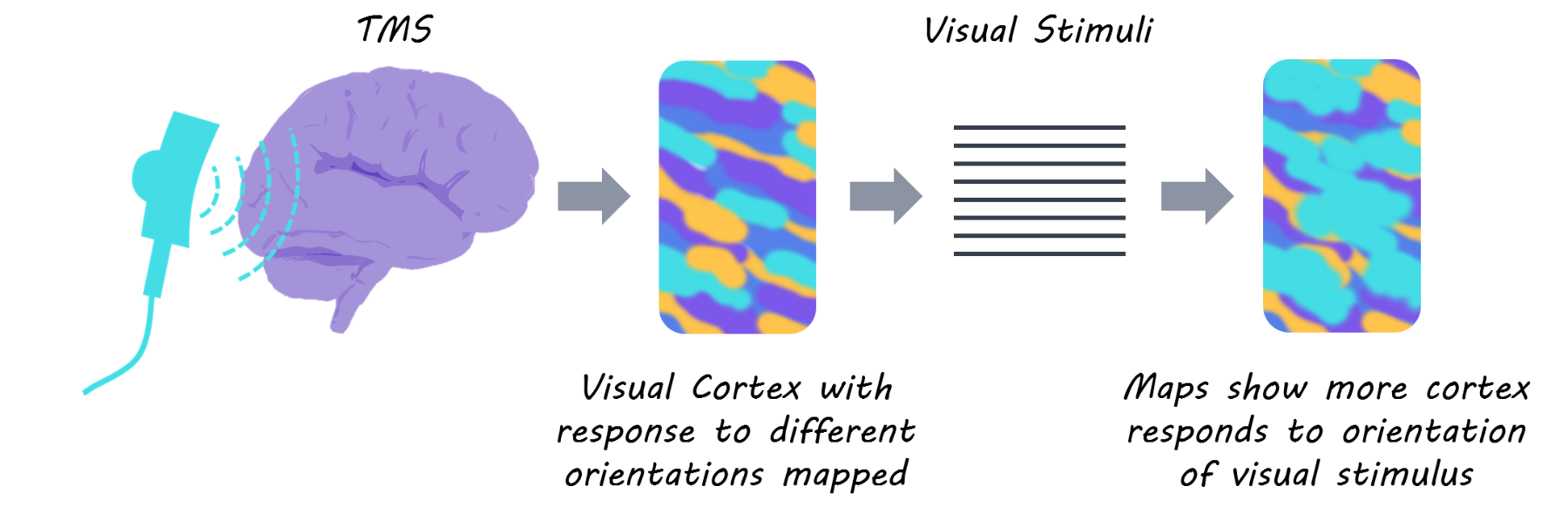
TMS and visual cortex reorganization

What's the impact?

In this study, functional cortical remodelling was found following TMS in the visual cortex using a voltage sensitive dye. After TMS, different areas of the visual cortex become less particular to the orientation that they are normally activated by, suggesting that the cortex becomes destabilized by TMS. After TMS, more regions of visual cortex respond to the specific orientation of a stimuli presented. These findings suggest that TMS may work by destabilizing and then allowing for remodelling of the cortex.

tmsquote1800.png

Kozyrev et al., TMS-induced neuronal plasticity enables targeted remodelling of visual cortical maps. PNAS (2018). Access the original scientific publication here.


Patterns of Brain Activity During Breathlessness in Athletes

What's the science?

Being an athlete can affect the body in many ways, but how does it affect brain function? For example, in high performance endurance athletes the brain may adapt to perceive or control breathing differently. This week in NeuroImage, Faull and colleagues used fMRI to understand how brain networks might differ during breathlessness in endurance athletes versus sedentary individuals.

How did they do it?

Twenty endurance athletes and twenty sedentary individuals participated. While undergoing fMRI, participants rested as well as completed a task in which they learned to associate shapes shown on a screen with periods of upcoming breathlessness (in order to measure changes during anticipation of breathlessness). The sensation of breathlessness was created by applying inspiratory resistance via a mouthpiece. One shape always predicted upcoming breathlessness, while another shape always predicted upcoming unrestricted breathing. Participants rated how difficult the previous stimulus was (0-100%) after each trial, and how anxious it made them feel at the end of the experiment. The authors used a general linear model to analyze the anticipation of upcoming breathlessness and anticipation of no upcoming breathlessness, among other factors. They measured functional connectivity – a metric that captures how activity from different brain regions fluctuates together over time – between breathlessness brain networks in athletes.

What did they find?

There were no differences in average anxiety or breathlessness intensity perception between groups, nor group average brain activity in any task. However, during anticipation of breathlessness, the activity in athletes’ brains in regions of the salience (a network involved in salient events) and sensorimotor (a network involved in touch and movement) networks (including the anterior insula and primary motor cortex, among others) was proportional to how intense they were going to find their breathlessness in an upcoming stimulus. This relationship was reversed in sedentary subjects, where their brain activity was negatively proportional to their upcoming breathing sensations. Furthermore, while individuals were at rest (not performing the task), there was greater connectivity between the salience/task-positive brain network (active when paying attention to an important stimulus such as breathlessness) and the primary motor cortex in athletes. 

Brain, Servier Medical Art, image by BrainPost, CC BY-SA 3.0

Brain, Servier Medical Art, image by BrainPost, CC BY-SA 3.0

What's the impact?

This study identifies a network of brain regions that positively predict breathlessness in athletes but negatively predict breathlessness in sedentary individuals - thus certain brain networks are altered in athletes. The salience network was found to be differently connected in athletes versus sedentary individuals, which may indicate that functional connections between brain regions are also altered in these athletes. This work could be used to understand breathlessness in clinical conditions in the future, where exercise is prescribed for treatment.

athletequote1800.png

Faull et al., Cortical processing of breathing perceptions in the athletic brain. Neuroimage (2018). Access the original scientific publication here.
In Vivo Imaging of REM Sleep Behavior Disorder

What's the science?

Rapid Eye Movement (REM) Sleep Behavior disorder often precedes the development of Parkinson’s disease, which is characterized by the accumulation of the protein alpha-synuclein inside of neurons. Recent research suggests that alpha-synuclein first accumulates in peripheral autonomic neurons (in the gut) and in the olfactory bulb (in the brain). Alpha-synuclein is hypothesized to then spread to the brain via autonomic nerve fibres, causing further damage via neuron-to-neuron transmission from peripheral neurons through the spinal cord and brainstem to the brain. This week in The Lancet Neurology, Knudsen and colleagues imaged pathology in the periphery and in the brain of multiple affected systems in patients with REM Sleep Behavior Disorder to better understand how alpha-synuclein might progress prior to the onset of the classical motor symptoms in Parkinson’s disease. 

How did they do it?

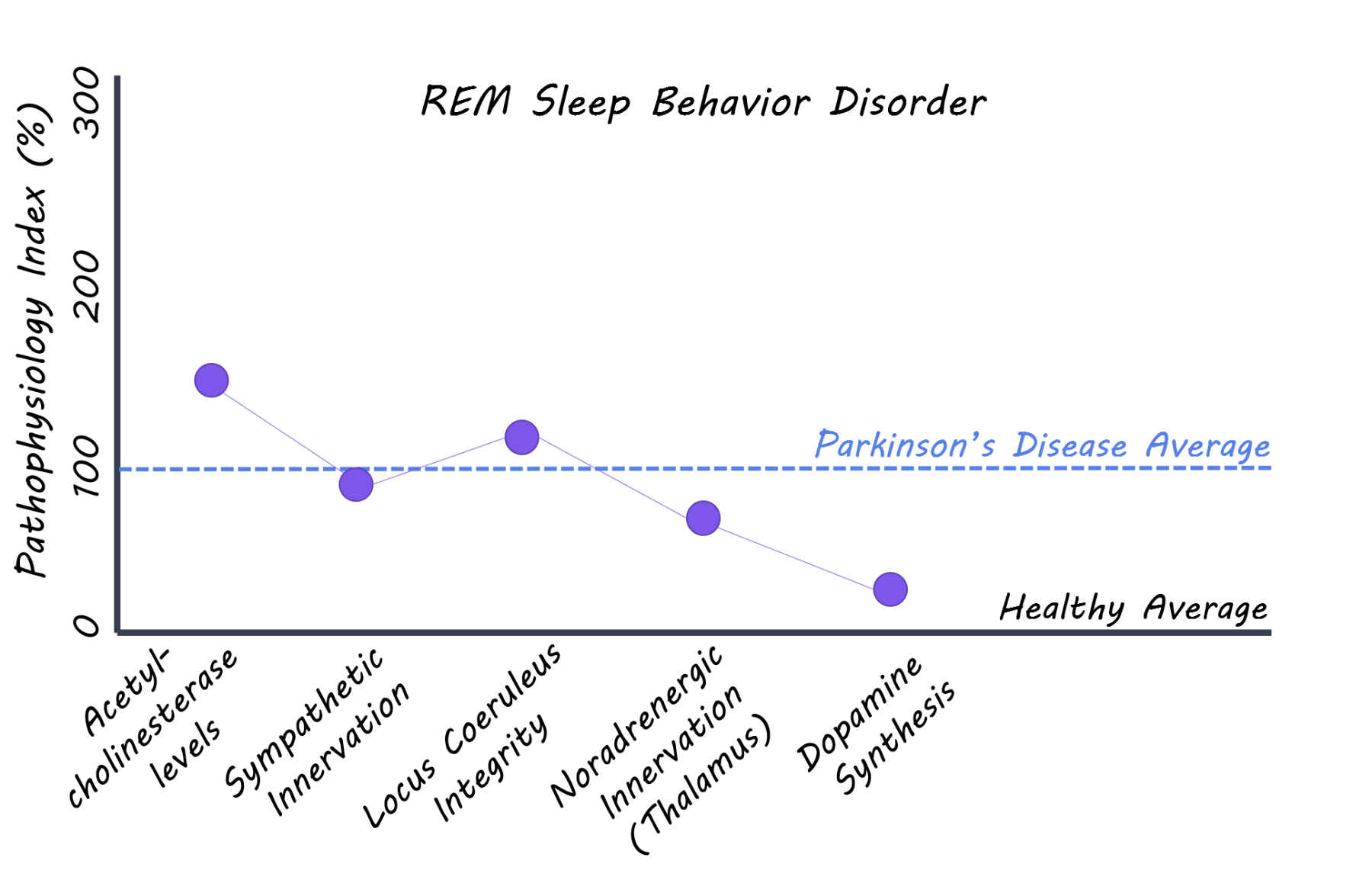
Patients with REM sleep behavior disorder (with no signs of parkinsonism or dementia), patients with diagnosed Parkinson’s disease, and a healthy control group all aged 50-85 years were recruited for the study and underwent a series of imaging scans. 11C donezepil (a radiotracer that measures acetylcholinesterase concentrations) PET imaging was used to assess the level of cholinergic innervation in the gut reflecting, in part, parasympathetic nerve fibres. 123I-MIBG (radiotracer measuring cardiac innervation) scintigraphy was used to measure the level of sympathetic innervation of the heart. Neuromelanin sensitive MRI was used to evaluate the integrity of neurons in the locus coeruleus (brainstem nucleus). 11C-methylreboxetine (a radiotracer that binds to noradrenaline transporters) was used to measure the level of noradrenergic nerve terminals in the locus coeruleus projections to the thalamus. Lastly, 18F-DOPA PET (a radiotracer that measures dopamine synthesis) was used as a measure of dopamine neuron integrity in the brain. Imaging measures between REM sleep behavior disorder and control groups were compared. Imaging multiple systems — from the peripheral autonomic nervous system through to the brainstem — allowed for an assessment of the degree of damage to these important neuronal systems.

What did they find?

Patients with REM sleep behavior disorder had significantly less cholinergic innervation in the small intestine and the colon compared to the healthy control group, while there was no significant difference between REM sleep behavior disorder and Parkinson’s disease patients. Patients with REM sleep behavior disorder also showed significantly lower cardiac innervation compared to controls and lower neuron integrity in the locus coeruleus (brainstem), while again no difference was seen when compared to the Parkinson’s disease group. Locus coeruleus neuron innervation of the thalamus was lower in REM sleep behavior patients compared to controls, but no difference was seen in any other comparison. In contrast, the dopamine synthesis capacity measured by 18F-DOPA PET was normal in 70% of REM sleep behavior patients, while all patients with Parkinson's disease show markedly reduced dopaminergic function in the striatum (the cause of their motor symptoms). Combined, these observed differences support the hypothesis that the autonomic nerve fibres of the gut and other internal organs are affected many years prior to the Parkinson's disease diagnosis. The finding also supports that the initial alpha-synuclein damage in Parkinson's disease may originate in the gut and spread via the autonomic nervous system to the spinal cord and brainstem. 

REM Sleep Behavior Disorder

What's the impact?

This is the first comprehensive imaging study of patients with REM sleep behavior disorder (prodromal Parkinson’s disease) to assess damage in vivo to the autonomic nervous system and multiple brainstem systems. The study supports the hypothesis that alpha-synuclein pathology may initially form in peripheral organs and spread neuron-to-neuron via the autonomic nervous system to the brainstem. If Parkinson's disease pathology truly originates in nerve terminals of peripheral organs, different strategies of neuro-protection might be possible, including the use of drugs which do not cross the blood-brain barrier or modification of the intestinal microbiome. 

remquote1800.png

Knudsen et al., In-vivo staging of pathology in REM sleep behaviour disorder: a multimodality imaging case-control study. The Lancet Neurology (2018). Access the original scientific publication here.