One Salience Network, Two Functions?

What’s the science?

The anterior insula and dorsal anterior cingulate cortex (dACC) are two brain regions that are often active together as part of the brain’s ‘salience network’. A ‘salient’ stimulus is one that is able to capture our attention easily. The anterior insula is active during many cognitive and emotional processes - this has been assumed to be due to its role in orienting attention towards salient stimuli. However, the role of the anterior insula and dACC in specific aspects of the attention-capturing process in the anterior insula and dACC have not actually been delineated. This week in Cerebral Cortex, Han and colleagues performed two experiments using both emotional and emotionally neutral events to assess the functional roles of these two brain regions in salience and emotion.

How did they do it?

Experiment 1: Fifteen healthy young adults participated. While performing functional magnetic resonance imaging (fMRI), the authors had participants look for ‘target’ images of a dining or living room which were presented in rapid succession (sequentially) among other (distraction) pictures on a screen (144 images total per trial, 135 trials). Participants were asked to press one of two buttons when they saw a living room or dining room. In a few trials, a 10-second movie was presented instead of distraction pictures. This movie was either emotional (e.g. of a person in pain or a spider on an arm), or emotionally neutral (e.g. waves or swirls). This task can help to measure the brain’s involvement in processing salient and behaviourally relevant stimuli.

Experiment 2: Fourteen healthy young adults participated. While performing fMRI, a stream of digits was presented in rapid succession, interspersed with letters indicating to the participant had to perform one of two tasks: either to judge either whether the number was odd or even or to judge whether the digit was smaller or bigger than 4 (indicated with a button press). Other letters were also interspersed between digits to indicate whether to stay on the same task (‘hold’ cue) or switch to the other task (‘switch’ cue). This task can help to measure the brain’s involvement in attention switching.

In both experiments, the authors compared brain activation between conditions/tasks.

What did they find?

Experiment 1: As expected, trials in which video clips were presented lowered performance (reaction time), likely because they captured attention and distracted from the task (finding the target - living room or dining room scene). When the fMRI response was examined, the authors found that both the anterior insula and dACC were active at the onset and offset of the emotionally neutral and emotional stimuli (video clips). However, the anterior insula only was also active throughout the presentation of the emotional clips. This indicates that the anterior insula is not simply active during relevant changes in the environment (at the beginning and end of the clip). A smaller sustained response was also found in two other brain regions; the thalamus and putamen. Overall, the authors suggest that the anterior insula and dACC are active when attention is captured by behaviourally significant events.

Experiment 2: The authors found that the dACC was more active during switch cues than hold cues, while there was no such difference for the anterior insula. Therefore, the dACC may be involved in attention set switching/goal directed behaviour (i.e. updating), while the anterior insula is involved in detection of behaviourally relevant events. In a whole brain analysis, another brain region activated by ‘switch’ cues was the medial superior parietal lobe.

fMRI signal  in anterior insula and anterior cingulate cortex

What’s the impact?

This study demonstrates, via fMRI, the different functional roles of the anterior insula and dACC in fine grain detail. The anterior insula is active during behaviourally relevant events - and the dACC is active during attention switching. We now know more about how these regions function within the brain’s salience network.

saliencequote1800.png

S.W. Han et al., Functional Fractionation of the Cingulo-opercular Network: Alerting Insula and Updating Cingulate. Cerebral Cortex (2018). Access the original scientific publication here.

A Molecular Network for Cognitive Decline in the Human Prefrontal Cortex

What's the science?

There are currently no therapies available to treat or prevent Alzheimer’s disease. This may be due to the complexity and heterogeneity of the disease. Although we know that the accumulation of beta-amyloid peptides and tau proteins occurs in the brain in Alzheimer’s disease and that certain susceptibility genes are involved, we do not understand the sequence of events that lead from genetic risk to brain pathology and cognitive decline. Brain gene expression data and network based analysis can  potentially gather nuanced information about the complex interactions among genes that lead to brain pathology. This week in Nature Neuroscience, Mostafavi and colleagues use network-based analysis of gene expression data from the aging prefrontal cortex to elucidate a network involved in aging and Alzheimer’s disease. 

How did they do it?

Prefrontal cortex RNA-sequencing (RNA-seq) data (gene transcript levels representing gene expression) from participants in longitudinal datasets of aging called the Religious Orders Study (ROS) and the Memory and Aging Project (MAP) were used. These datasets also contain post-mortem brain pathology data and longitudinal measures of cognitive performance. They ran a standard association analysis to look for genes whose expression levels associate with Alzheimer’s disease and cognitive decline. They then used an approach called gene module-trait network analysis that links key networks of genes that are co-expressed (related expression patterns) to cognitive decline and Alzheimer’s disease traits, and then selects the most strongly and directly associated networks. The goal of this was to gain more information on gene networks and their associated biological pathways than can be obtained from analyzing single gene-disease associations.

What did they find?

The known risk variant for Alzheimer’s disease in the APOE gene (strongest Alzheimer's risk gene) only explained 2.2% of the variance in Alzheimer’s disease (heterogeneity) and 5.1% of cognitive decline. When examining 21 other known Alzheimer’s risk variants, they only explain 2.1% of disease variance and 7.6% of cognitive decline, emphasizing that these genes alone do not explain disease heterogeneity and decline. In the gene module-trait network analysis, 47 modules of genes (from the RNA-seq gene expression data) were identified representing related networks of genes. 11 of these modules were associated with cognitive decline or Alzheimer’s disease related traits (beta-amyloid or tau), and they found that these modules replicated in their association (with Alzheimer’s disease) in an independent gene expression dataset.

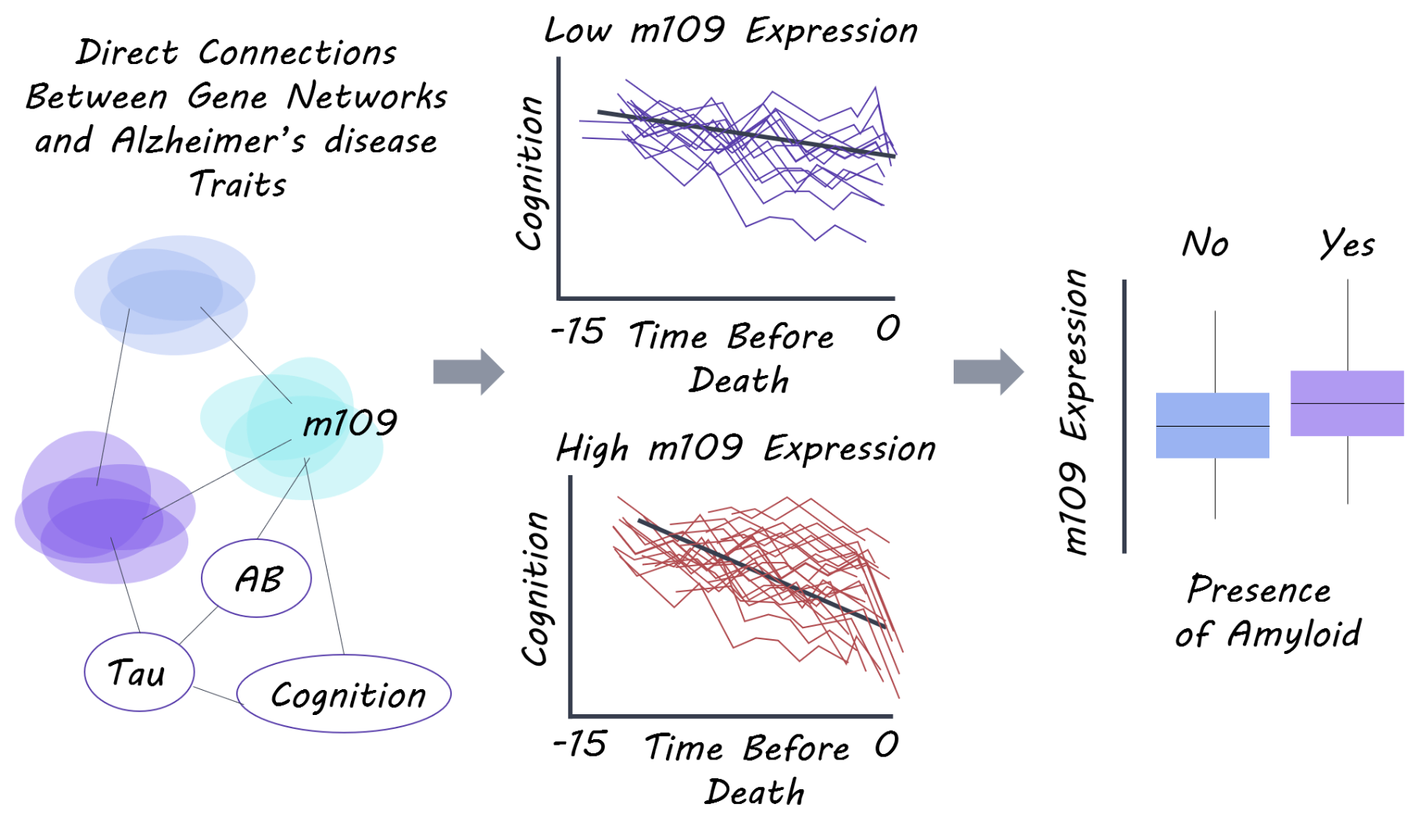
Connections between gene networks and Alzheimer’s disease traits

They then used Bayesian network inference to determine direct gene module-trait associations while accounting for the heterogeneity of cell types in the brain (neurons, astrocytes etc). One module (module number 109) consisting of 390 genes involved in regulation of cell cycle and chromatin modification was most strongly associated with cognitive decline. They found that this module was strongly associated with beta-amyloid pathology. They then selected key genes from this module that were strongly expressed in neurons and astrocytes and showed the strongest gene-disease associations. They performed a knockdown experiment on these genes in astrocytes and stem cell derived neurons and found that knocking down 2 of these genes, INPPL1 (involved in lipid signalling) and PLXNB1 (involved in synaptic plasticity) significantly lowered beta-amyloid levels. INPPL1 explained 5.5% of variance in cognitive decline, while PLXNB1 explained 4.4%. They confirmed that these two genes drive a significant proportion of the effect of the m109 module (which explained 8.5% of cognitive decline) on beta-amyloid load, indicating that these two genes may be important for amyloid pathology and cognitive decline.

What's the impact?

This is the first study to use a network-based approach to identify direct gene network associations with Alzheimer’s disease traits and cognitive decline. This study identified a network of genes strongly associated with beta-amyloid load and cognitive decline, which are important measures of disease progression. This study demonstrates that a network-based approach can provide more information on networks of genes associated with cognitive decline that single gene associations might miss.

philquote1800.png

Mostafavi et al., A molecular network of the aging human brain provides insights into the pathology and cognitive decline of Alzheimer’s disease. Nature Neuroscience (2018). Access the original scientific publication here.
 

Risk Factors for Aggression in Individuals with and without Mental Illness

What’s the science?

Childhood exposure to head trauma, sexual or physical abuse, or maltreatment, can have detrimental effects. These environmental risk factors as well as urban dwelling (urbanicity) and migration (moving to a new country), and secondary risk factors (alcohol and cannabis use) have previously been found to influence — when accumulated —  the onset and severity of mental illnesses, including schizophrenia. Individuals with schizophrenia who had more of these risk factors have been found to be more likely to be hospitalized in forensic units (due to criminal conduct or violence) than those who had fewer risk factors. This week in Molecular Psychiatry, Mitjans and colleagues explored whether the presence of risk factors in childhood predicted criminal conduct independent of mental illness.

How did they do it?

The authors studied childhood risk factors in four separate cohorts of individuals who had schizophrenia or were schizoaffective (schizophrenia symptoms + mood symptoms), as well as in two cohorts of healthy individuals. First, in a discovery sample of individuals with schizophrenia, they studied males who had <1 (low risk) or >3 (high risk) risk factors. The authors examined the relationship between risk factors with forensic hospitalization, as well as with a violent aggression severity score (VASS). In other schizophrenia cohorts, a VASS was not available, so a proxy for aggression (past forensic hospitalization or conviction for a violent crime) was used. Finally, they also modelled the effect of risk factors on a proxy for aggression in healthy individuals of the Spanish general population (urbanicity was not available for this population).

What did they find?

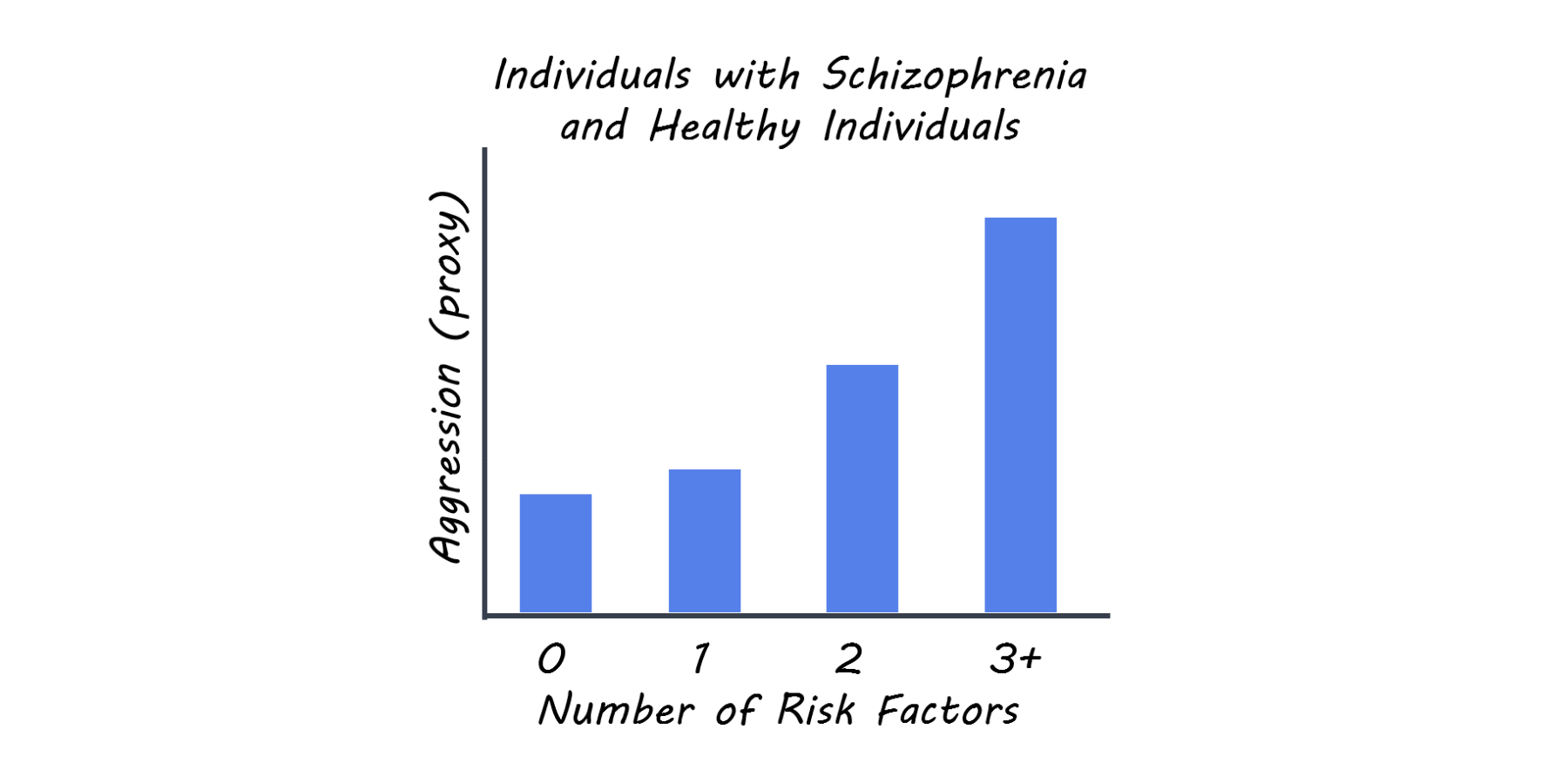
In the discovery sample as well as in a replication sample of individuals with schizophrenia, 27% of high-risk individuals were in a forensic unit, while only 6% of low-risk individuals were. The addition of each risk factor increased the risk of forensic hospitalization as well as an aggression score in a step-wise fashion (more risk factors=more risk for aggression). The same step-wise pattern was noted for other cohorts of individuals with schizophrenia, using the proxy for aggression. In the discovery sample, the authors noted that risk factors increased early aggression (before 18 years old) occurring before schizophrenia onset, suggesting aggression (due to underlying risk factors) may be independent of mental illness. The same step-wise pattern for the effect of risk factors on aggression was found in two cohorts of healthy individuals. This finding provided further evidence that the relationship between risk factors and aggression was independent of mental illness.

Risk factors for aggression

What’s the impact?

This study is the first to suggest that aggression in individuals with or without mental illness may be related to risk factors in childhood — and not to the presence of mental illness itself. In both individuals with and without mental illness, the effect of risk factors on aggression or violence appears to be cumulative — a greater number of risk factors leads to a greater risk for aggression or violence. This work has important social implications and underscores the importance of preventative measures for at-risk individuals.

schizophreniaquote1800.png

M. Mitjans et al., Violent aggression predicted by multiple pre-adult environmental hits. Molecular Psychiatry (2018). Access the original scientific publication here.