
A Pattern of Brain Activity related to Cognitive Reserve

What’s the science?

‘Cognitive reserve’ refers to an individual’s capacity to maintain good brain function despite aging or a disease affecting the brain, such as Alzheimer’s. IQ is often used as a proxy for measuring cognitive reserve, however, cognitive reserve specifically refers to the resilience of the brain. Several studies have attempted to use functional magnetic resonance imaging (fMRI) to understand how the brain’s cognitive networks might be resilient. These studies have focused on performance on (typically one) cognitive task, but cognitive reserve is likely utilized for a range of tasks. This week in NeuroImage, Stern and colleagues performed fMRI experiments to elucidate a brain network related to cognitive reserve across many tasks.

How did they do it?

The authors included healthy individuals (ages 20-80: 255 individuals in main sample, 149 in a replication sample), who completed 12 cognitive tasks as part of the Reference Ability Neural Network study, while undergoing fMRI. The 12 tasks probed cognitive abilities: vocabulary, perceptual speed, fluid reasoning, and episodic memory. An additional memory task and executive control task were used for validation of the cognitive reserve network identified during analysis. Brain structure (cortical thickness) and brain function (fMRI) data were collected. IQ was measured using the NART IQ test. The authors analyzed brain regions where activity (fMRI blood oxygen-dependent signal) covaried with IQ in a task-invariant way. Age was included as a covariate in analyses because it was correlated with IQ.

What did they find?

The authors identified a cognitive network/activity pattern of brain regions in which activity co-varied with IQ in a task-invariant way (during cognition, across all tasks). Generally, the network was located in the cerebellum, temporal and parietal lobes, the medial frontal gyrus, inferior frontal gyrus, and anterior cingulate. Brain activity in the identified cognitive reserve brain network was significantly positively or negatively related to IQ in different brain regions. After accounting for brain structure (cortical thickness), brain function in the identified cognitive reserve network explained additional variance in fluid reasoning (beyond variance in fluid reasoning explained by brain structure). Further, the authors found an interaction whereby there was a greater relationship between fluid reasoning and brain structure in individuals with a lower cognitive reserve network score (less strong expression of the pattern/network).

Cognitive reserve functional brain network

What’s the impact?

This is the first study to assess the concept of cognitive reserve in a wide array of tasks, using neuroimaging. A pattern of brain activity during a variety of cognitive tasks was found to be related to IQ, and is referred to as a cognitive reserve network. The study has future implications for diseases in which cognitive reserve may be critical for protection against cognitive decline, such as Alzheimer’s.

sternquote1800.png

Y. Stern et al., A task-invariant cognitive reserve network. NeuroImage (2018). Access the original scientific publication here.
Activation of Astrocytes Strengthens Synapses and Enhances Memory

What's the science?

Astrocytes can do more than just surround and insulate neurons: they can actually sense and modify neuronal activity. Memory disruption is easy to produce; however, techniques that can enhance memory are rare. Previous work suggests that astrocytes are required for long-term potentiation and memory. Whether astrocytes may also be able to induce long-term potentiation on their own, however, is unclear. This week in Cell, Adamsky, Kol and colleagues test whether activation of astrocytes using chemogenetics is sufficient to induce potentiation in neurons and enhance memory.

How did they do it?

The authors used a chemogenetic (chemically engineering molecules) approach in mice: they expressed a G-protein coupled receptor specifically in astrocytes, and used this engineered receptor to activate astrocytes in the CA1 region of the hippocampus (important for memory) via increasing their intracellular calcium levels. They measured the excitatory post-synaptic currents in neurons in the hippocampus using whole-cell patch clamp and field recordings. These experiments allowed them to observe whether there was any long-term potentiation (plasticity required for memory) as a result of the astrocyte activation compared to control slices without astrocyte activation. Lastly, they tested to see whether chemogenetic astrocyte activation had any effect on spatial (a maze exploration task) and contextual memory (fear conditioning).

What did they find?

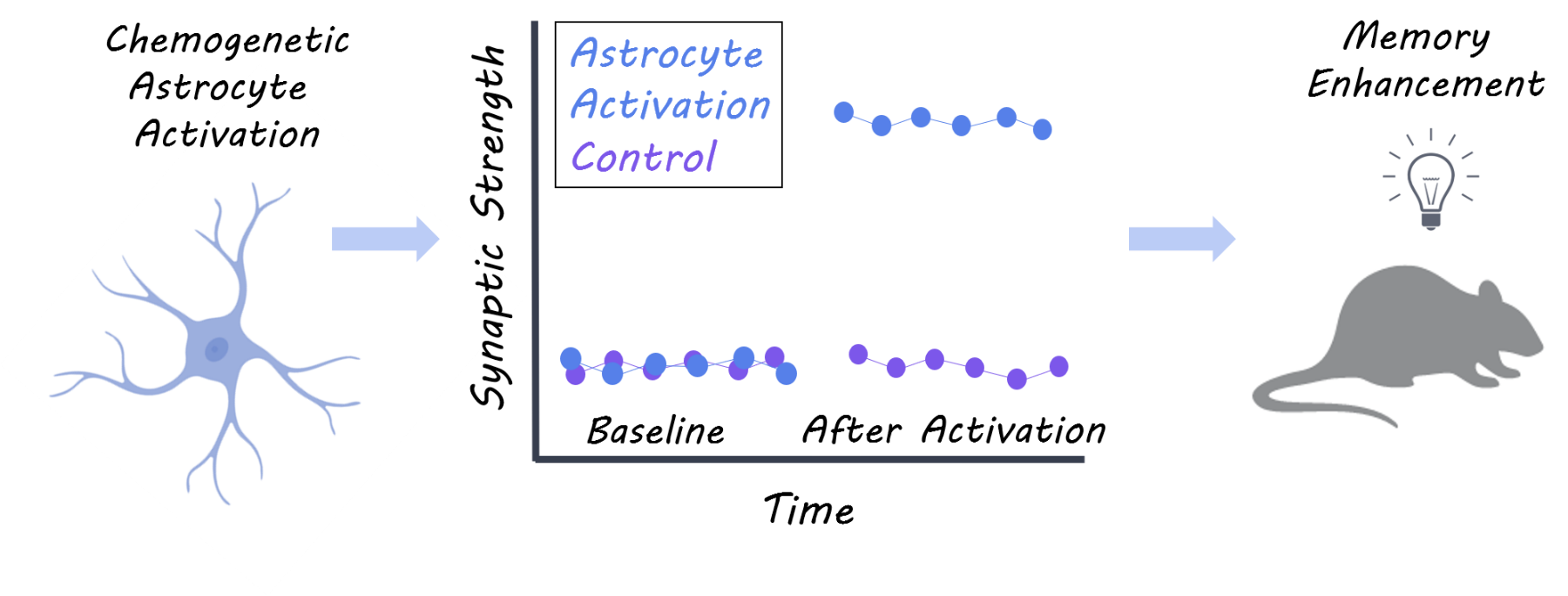
There was a 50% increase in the excitatory post-synaptic current amplitude of hippocampal neurons after astrocyte activation, demonstrating that astrocyte activation was sufficient to induce long-term potentiation. No similar potentiation was seen in control slices. This potentiation lingered long after the astrocytes were no longer activated, and was mediated by the same mechanisms of 'regular' potentiation (i.e. via the NMDA receptor). Mice treated to induce astrocyte activation 30 minutes prior to a maze task, performed significantly better than control mice. These mice also showed 40% more freezing (indicating enhanced memory of the context in which the foot shock was delivered ) than control mice. Astrocyte activation induced memory enhancement only when induced before acquisition (not before recall) showing that the astrocyte activation plays an important role during the learning process, rather than the retrieval. They then tested whether general neuronal activation (not astrocytic) has any effect on potentiation and memory to see whether these effects were specific to astrocytes and found that increasing neuronal activation did not enhance memory, but rather impaired it. They showed that this is due to the fact that astrocytic activity increases neuronal activity in a task-dependent manner - only in learning mice, but not in home-caged mice. Finally, they used optogenetics (which has better temporal resolution) to test whether astrocyte activation was enhancing memory specifically at the acquisition stage, and found it to induce an even bigger improvement in the contextual memory task.

Astrocyte activation and synaptic strength

What's the impact?

This is the first study to show that astrocyte activation is sufficient to produce long-term potentiation in hippocampal neurons and enhance memory performance. Previous research showed that astrocyte inhibition could impair memory, however, now we know that astrocytes alone can induce memory enhancement and that astrocytes may be more important for cognitive function than we once thought. Astrocyte activation could be one target for developing memory-enhancing drugs.

Adamsky, Kol et al., Astrocytic Activation Generates De Novo Neuronal Potentiation and Memory Enhancement. Cell (2018). Access the original scientific publication here.

Resistance Training is Associated with a Reduction in Depressive Symptoms

What's the science?

Current treatments for depression include medication and psychotherapy, however, these options can be expensive or show limited efficacy, and symptoms often persist. Resistance training has been associated with a reduction in anxiety symptoms. Although the physical benefits of resistance training are well understood, the mental benefits of resistance training have not been thoroughly investigated. This week in JAMA Psychiatry, Gordon and colleagues performed a meta-analysis of randomized clinical trials to assess the efficacy of resistance training in reducing depression symptoms.

How did they do it?

They included all randomized clinical trials in which participants were randomized to a resistance training intervention or to a non-active control group, and depression symptoms were assessed at baseline and mid and/or post-intervention. They accounted for other measures potentially related to depression such as age, sex, resistance training intensity, and trial duration and whether there was an increase in strength. They performed a meta-analysis, calculating the effect sizes for the association between depressive symptoms and resistance training for each study. They used a meta-regression (regression amongst all of the studies) in a moderator analysis which accounts for multiple moderator variables related to the effect of resistance training on depressive symptoms. There were four primary moderators of interest in the analysis: total volume of resistance training, health status, whether their assessment/allocation was blinded and whether there was an increase in strength.

What did they find?

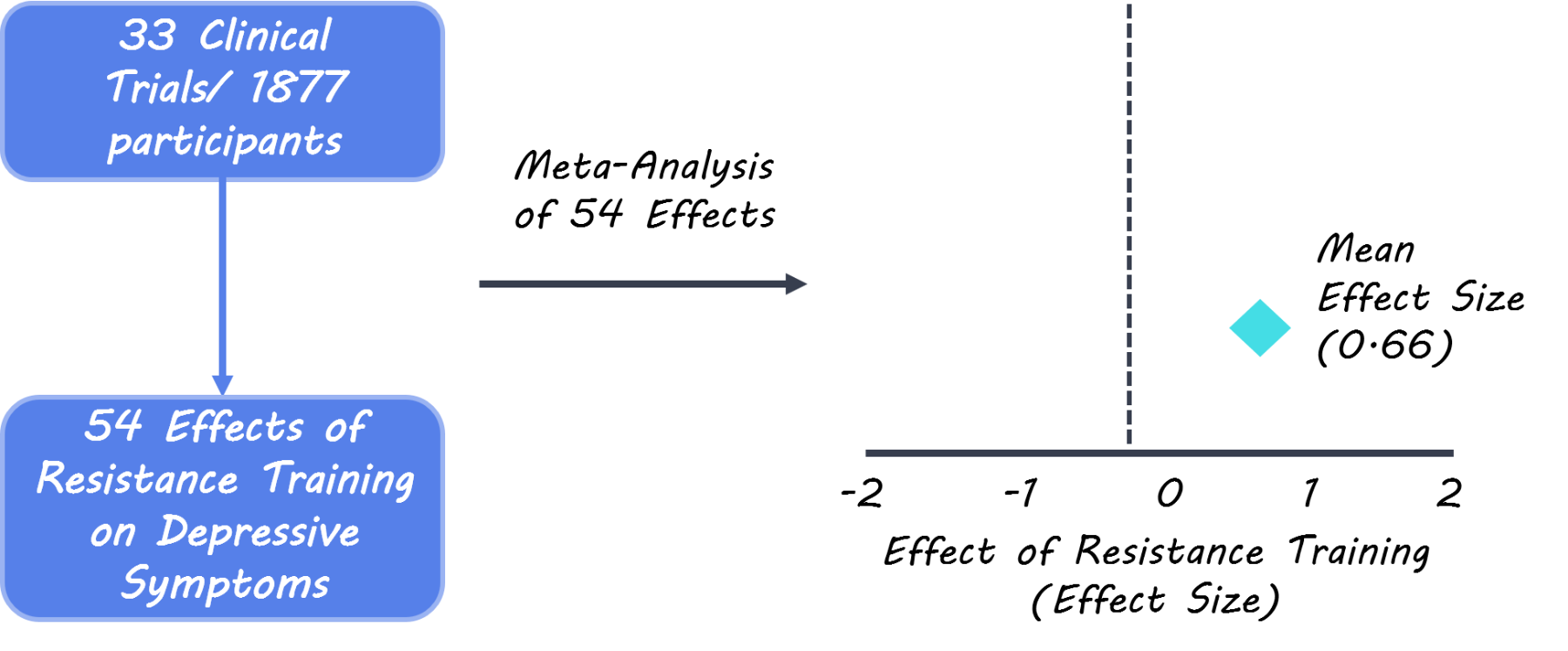
They had a total of 33 clinical trials including 1877 participants that met their criteria for the analysis. They extracted 54 effects from these trials. Overall there was a significant moderate effect of resistance training on depressive symptoms (training reduced symptoms). This effect did not change dependent on the frequency, duration or volume of resistance training. In the moderator analysis they found that whether participants were healthy or physically or mentally ill, the total volume of resistance training or an increase in strength did not affect the reduction in depressive symptoms. Whether or not the participant was blinded to their outcome assessment had a significant effect on depression outcomes where effects on depressive outcomes were lower when the group allocation/depressive symptom assessments were blinded.

Meta-analysis of effects of resistance training on depressive symptoms

What's the impact?

This is the first study to show, across 33 clinical trials, an overall effect of resistance training on reducing depressive symptoms. Resistance training could be used for some individuals as an alternative form of treatment for depression or in combination with other frontline treatments. Future studies will need to gather more information on features of the resistance training performed to have a better understanding of its effects.

gordonquotefull.png

Gordon et al., Association of Efficacy of Resistance Training with Depressive Symptoms. JAMA Psychiatry (2018). Access the original scientific publication here.