
The Neural Encoding of Human Speech in the Sensorimotor Cortex

What's the science?

What happens in the brain when we speak? The ventral sensorimotor cortex (vSMC) in the cortex encodes neural activity underlying movement of muscles in our lips, jaw, tongue, and larynx (these are the ‘articulators’). Neural activity of the vSMC corresponding to the speaking of isolated syllables has well been studied. However, how each articulator moves in conjunction with other articulators in complex patterns to form natural language has not been studied. This week in Neuron, Chartier, Anumanchipalli, and colleagues recorded brain activity while participants spoke sentences to decipher how articulator movements worked together, and to understand the corresponding patterns of vSMC activity.

How did they do it?

Five epilepsy patients who had electrodes placed on the surface of their brain (ECoG; electrocorticography) as part of their clinical treatment participated in a task that involved speaking a wide variety of sentences out loud. In order to know how each participants’ vocal tract articulators were likely moving during the production of different sounds, the authors used a technique called acoustic-to-articulatory inversion (AAI) in which a statistical model was created to infer the likely movements of the vocal cords during the production of particular sounds. The authors took care to improve upon past AAI models to create a model with high predictive accuracy; they used a deep learning (machine learning) approach on a publicly available dataset (in which vocal tract movements of participants were monitored) to create the model, and then used the AAI model for their own participants (who did not have their vocal tract movements monitored - this often interferes with simultaneous recording from electrodes in the brain). They then used the AAI model of muscle activity in their five participants to predict activity of electrodes placed on the surface of the brain.

What did they find?

Using the AAI model to infer articulator movements in the five participants, the authors found that activity in the vSMC (during speech) was significantly predicted by a movement trajectory model, while activity in other regions of the cortex was not. Next, they looked at patterns of articulator co-activation. They found that patterns of multiple artriculators working together described the activity of vSMC electrodes better than activity of single articulators, indicating that coordinated movements of multiple articulators together was closely related to brain activity. It is commonly thought that one body part corresponds to one location in the sensorimotor cortex, but this finding suggests multiple coordinated movements correspond to one location together. They also found that electrodes on the brain’s surface classified into four groups by the patterns of articulator movement they encode; each cluster represents a different pattern of articulator muscles activation. When activation is coordinated, these articulators are together responsible for different configurations of the vocal tract. These groups of electrodes also clustered spatially over the vSMC, indicating that different parts of the vSMC are responsible for different vocal tract constrictions. Finally, they found that the different modeled movement patterns corresponding to each cluster of electrodes appeared to represent ‘out and back’ motions, allowing the muscle to reach a particular position (during speech) to shape the vocal tract in a certain way, and then returning straight back to their original position.
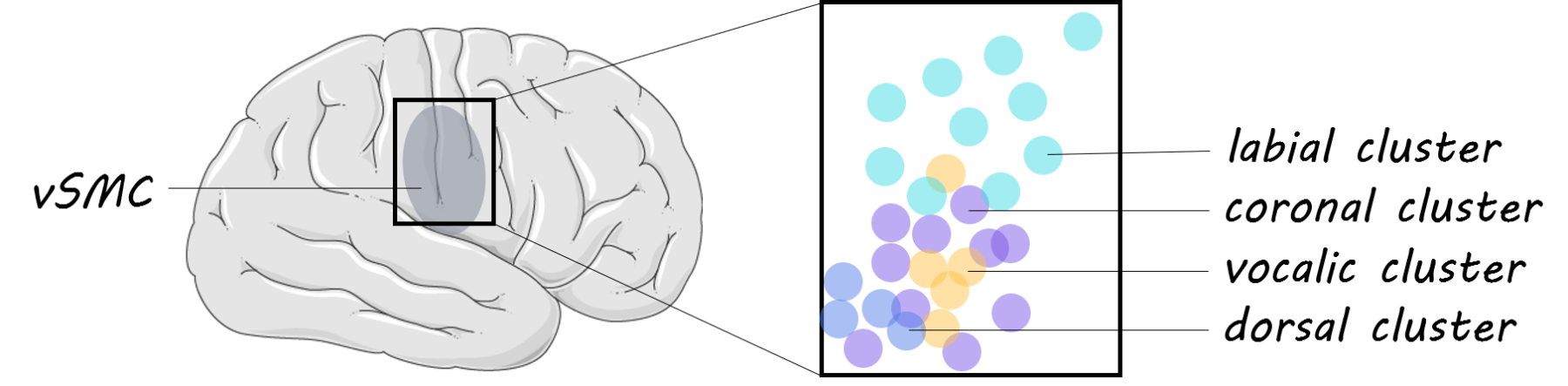
ventral sensorimotor cortex

What's the impact?

This is the first study to find that neural activity of the sensorimotor corresponds to coordinated activity of articulator movements responsible for particular configurations of the vocal tract necessary for speech. Specifically, brain activity in the sensorimotor cortex at certain spatial locations was related to co-activation of multiple articulators, as opposed to single muscles. Now, we know more about how movements for speech are encoded in the brain.
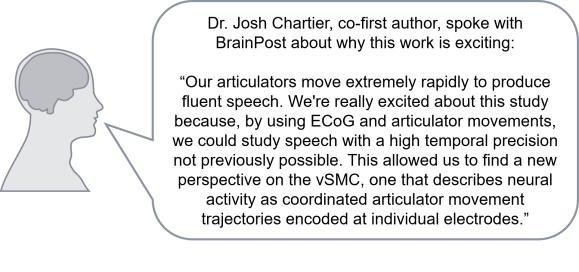
chartierquotefull.png

J. Chartier, G. K. Anumanchipalli et al., Encoding of Articulatory Kinematic Trajectories in Human Speech Sensorimotor Cortex. Neuron (2018). Access the original scientific publication here.
Neurite Density and Arborization Predict Intelligence

What's the science?

Intelligence has been associated with higher gray matter volume (the outer layer of neurons in the brain composed of cell bodies), in particular in the frontal and parietal regions of the brain, suggesting that people with higher intelligence have a greater number of neurons and greater computational power. Other research suggests that neural efficiency may be more important for intelligence, and that higher intelligence is associated with lower rates of brain activity when reasoning. The neural structure contributing to efficiency in intelligence remains unclear. This week in Nature Communications, Genc and colleagues use a diffusion tensor imaging technique to examine how neurite (i.e. projections from the cell body of a neuron) density and microstructure contributes to intelligence.

How did they do it?

They scanned two groups of healthy individuals (a test sample and a validation sample) using a diffusion tensor imaging technique called neurite orientation dispersion and density imaging (NODDI). They measured gray matter and white matter volume, neurite density, neurite orientation dispersion (a measure of branching of dendrites), and isotropic diffusion (a measure of the orientation of neurons) in the cortex of each individual. Intelligence was measured using a matrix-reasoning test. The then tested for correlations between these brain structural features and intelligence in both samples to see how intelligence and brain structure are related.

What did they find?

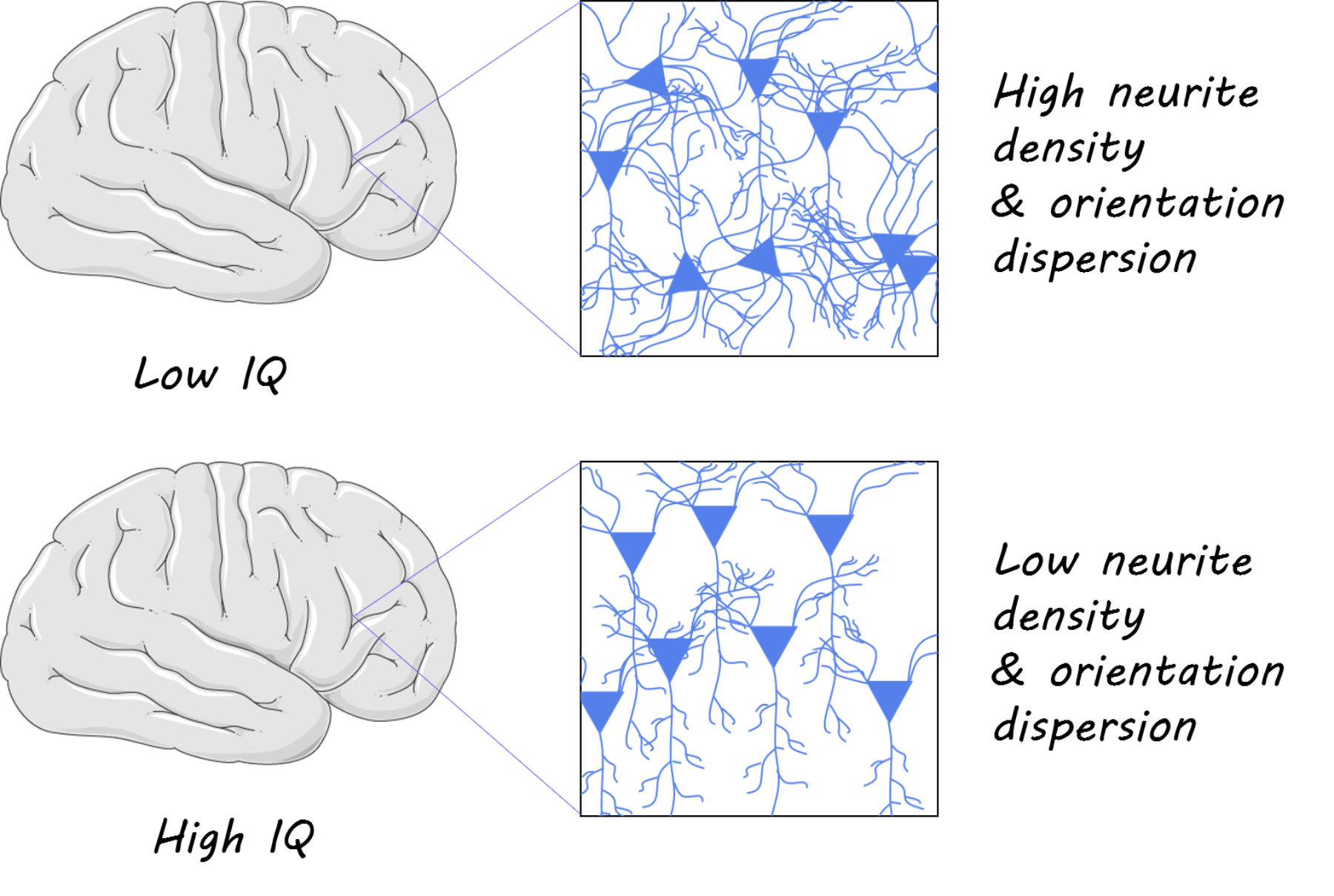
They found a negative correlation between neurite density & orientation dispersion and intelligence, indicating that people with higher intelligence have less neurite density and less orientation dispersion. There was also a positive correlation between gray matter volume and intelligence, suggesting that greater brain volume corresponds to greater intelligence. They ran a multiple regression analysis to ensure that these findings were not due to differences in age or between brain structure in males and females. They also tested for correlations across 180 brain regions to see whether associations were driven by frontal and parietal brain regions. They found that neurite density was negatively correlated with intelligence in several frontal and parietal brain regions, confirming previous research. They confirmed all results in the replication sample.

Neurite density, arborization, intelligence

What's the impact?

This is the first study to demonstrate associations between specific neural architecture and intelligence. This study shows that intelligence is associated with brain volume, however, also with a low neurite density and dispersion, supporting the hypothesis that neural efficiency is important for intelligence. These findings help us to understand how neuron structure contributes to a complex trait like intelligence.


Genc et al., Diffusion markers of dendritic density and arborization in gray matter predict differences in intelligence. Nature Communications (2018). Access the original scientific publication here.

Dopamine Receptor Expression is Associated with Prefrontal Activity and Working Memory

What's the science?

The dopamine D1 receptor is found throughout the prefrontal cortex, where it mediates working memory (the ability to hold things in memory for a short period of time). Working memory ability is genetically inherited to some degree. Single nucleotide polymorphisms, which are variations at one point in the genetic code, can alter dopamine D1 receptor levels and could potentially affect working memory. The gene encoding the dopamine D1 receptor may also be part of a larger ‘network’ of genes (many genes co-expressed at the same time) that may affect working memory, however this has not been investigated. This week in PNAS, Fazio, Pergola and colleagues test whether genetic differences in D1 receptor expression and co-expressed networks of genes affect working memory as well as brain activity during working memory using functional magnetic resonance imaging (fMRI). 

How did they do it?

They used RNA quantification obtained via microarray (mRNA transcript levels representing gene expression levels) to identify a focused network of genes that were co-expressed with the dopamine D1 receptor. They then identified single nucleotide polymorphisms in these genes and created an index for each individual representing the level of gene co-expression in this dopamine receptor D1 network. Using fMRI, they scanned two independent groups of people while they performed a working memory task. They tested for association between the gene co-expression index for each individual and a) brain activity associated with working memory b) working memory performance.

What did they find?

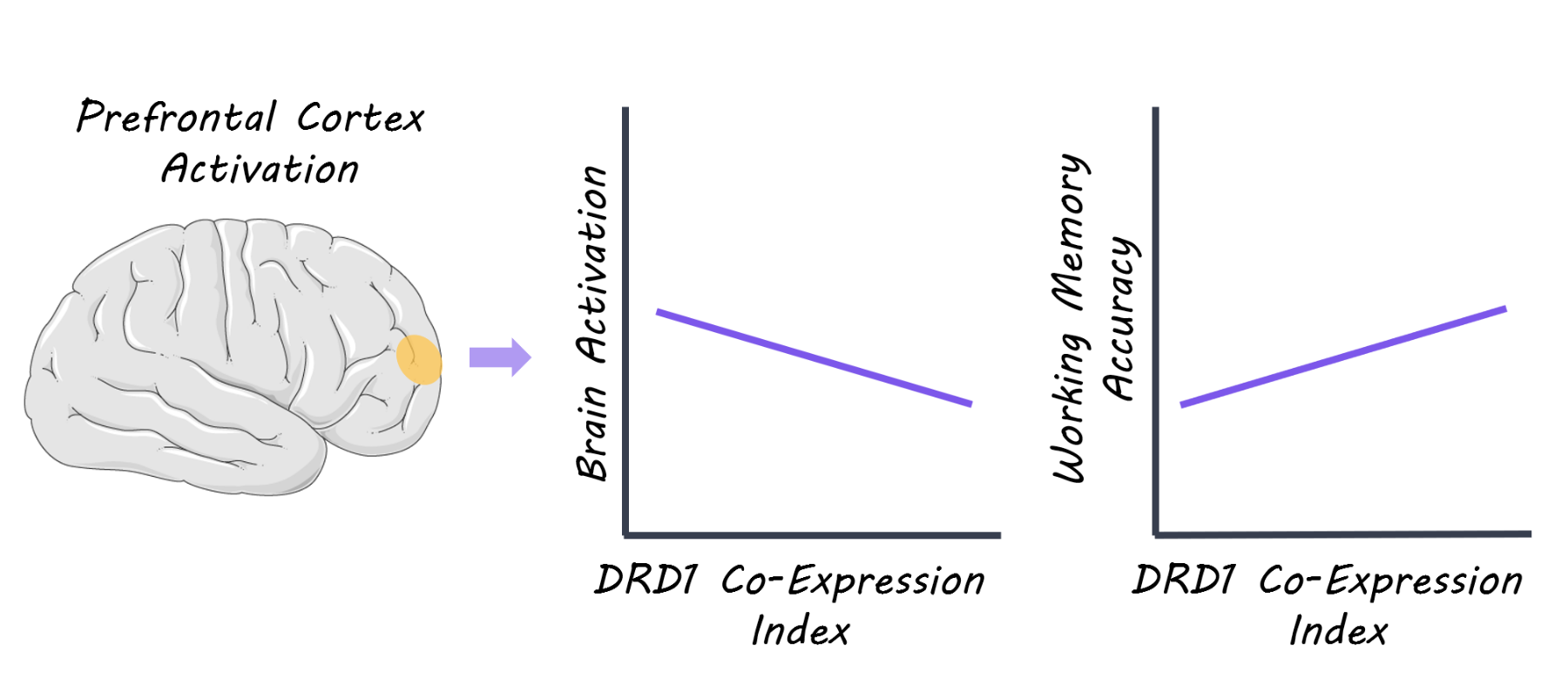
They found 3079 single nucleotide polymorphisms associated with the dopamine receptor D1 gene network: 13 of these polymorphisms were associated with changes in dopamine receptor expression. The index for each individual representing the level of gene co-expression in the dopamine receptor D1 network was found to be reliable in predicting gene expression. D1 receptor expression was inversely correlated with expression of other genes in the network, meaning when D1 receptor expression was higher, the expression of the other genes was lower. They found that a higher dopamine D1 receptor gene co-expression index (representing higher predicted dopamine D1 receptor expression) was associated with lower brain activation in the prefrontal cortex during a working memory task, as well as greater working memory accuracy. Similar results could be found in both independent groups of people. Combined, the results demonstrate that higher dopamine D1 receptor expression is associated with lower prefrontal cortex activity and better working memory capacity.

Brain, Servier Medical Art, image by BrainPost, CC BY-SA 3.0

Brain, Servier Medical Art, image by BrainPost, CC BY-SA 3.0

What's the impact?

This is the first study to show that genetic differences in D1 receptor expression (and co-expression of associated genes) are associated with changes in working memory and prefrontal cortex activity. We now know that genetic variation resulting in changes in dopamine D1 receptor levels can affect working memory performance. Knowing the association between dopamine receptor expression and working memory performance is important for developing medications that could target gene expression or the D1 receptor to improve working memory.

quote1800.png

Fazio et al., Transcriptomic context of DRD1 is associated with prefrontal activity and behavior during working memory. PNAS (2018). Access the original scientific publication here.