
Neurite Density and Arborization Predict Intelligence

What's the science?

Intelligence has been associated with higher gray matter volume (the outer layer of neurons in the brain composed of cell bodies), in particular in the frontal and parietal regions of the brain, suggesting that people with higher intelligence have a greater number of neurons and greater computational power. Other research suggests that neural efficiency may be more important for intelligence, and that higher intelligence is associated with lower rates of brain activity when reasoning. The neural structure contributing to efficiency in intelligence remains unclear. This week in Nature Communications, Genc and colleagues use a diffusion tensor imaging technique to examine how neurite (i.e. projections from the cell body of a neuron) density and microstructure contributes to intelligence.

How did they do it?

They scanned two groups of healthy individuals (a test sample and a validation sample) using a diffusion tensor imaging technique called neurite orientation dispersion and density imaging (NODDI). They measured gray matter and white matter volume, neurite density, neurite orientation dispersion (a measure of branching of dendrites), and isotropic diffusion (a measure of the orientation of neurons) in the cortex of each individual. Intelligence was measured using a matrix-reasoning test. The then tested for correlations between these brain structural features and intelligence in both samples to see how intelligence and brain structure are related.

What did they find?

They found a negative correlation between neurite density & orientation dispersion and intelligence, indicating that people with higher intelligence have less neurite density and less orientation dispersion. There was also a positive correlation between gray matter volume and intelligence, suggesting that greater brain volume corresponds to greater intelligence. They ran a multiple regression analysis to ensure that these findings were not due to differences in age or between brain structure in males and females. They also tested for correlations across 180 brain regions to see whether associations were driven by frontal and parietal brain regions. They found that neurite density was negatively correlated with intelligence in several frontal and parietal brain regions, confirming previous research. They confirmed all results in the replication sample.
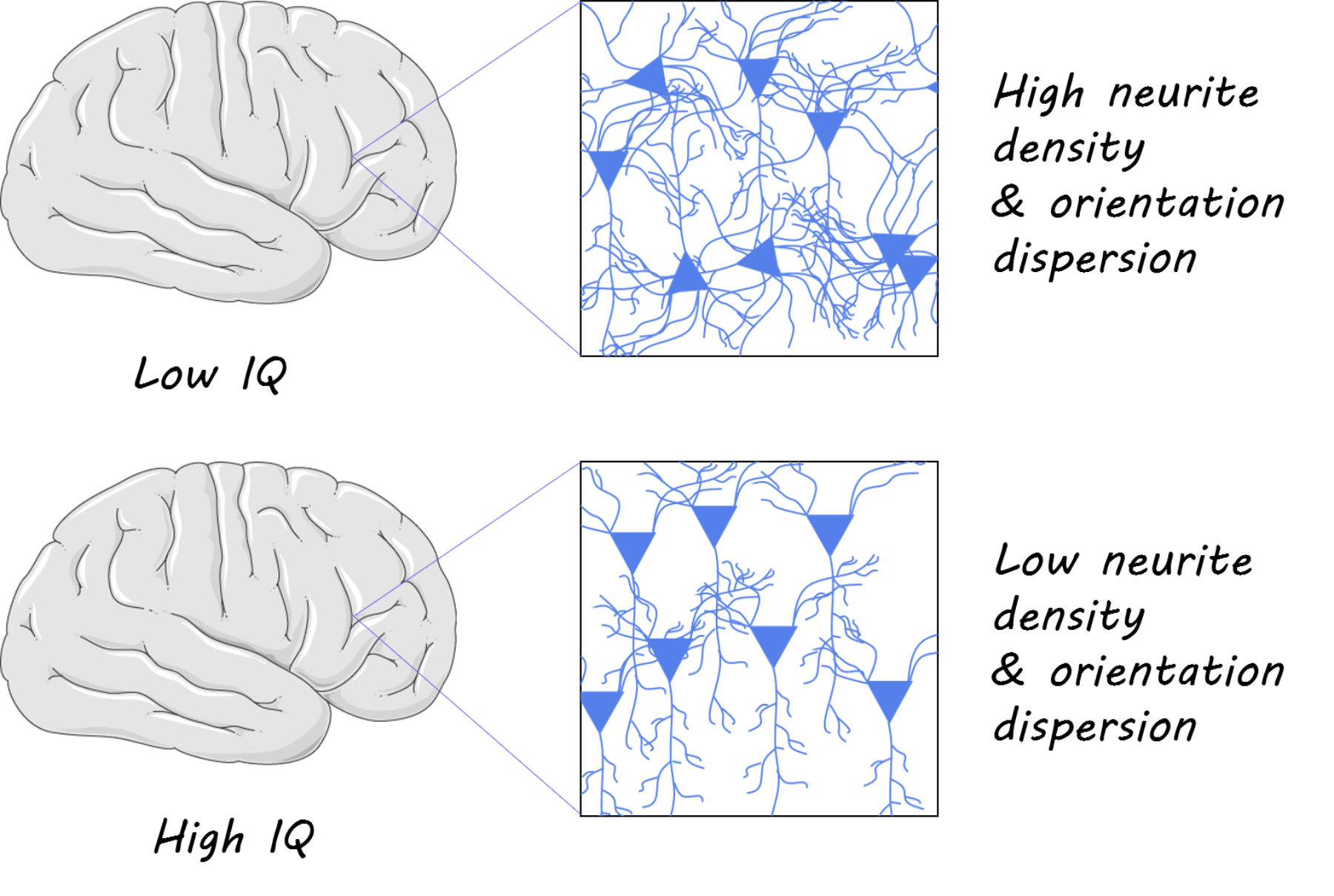
Neurite density, arborization, intelligence

What's the impact?

This is the first study to demonstrate associations between specific neural architecture and intelligence. This study shows that intelligence is associated with brain volume, however, also with a low neurite density and dispersion, supporting the hypothesis that neural efficiency is important for intelligence. These findings help us to understand how neuron structure contributes to a complex trait like intelligence.


Genc et al., Diffusion markers of dendritic density and arborization in gray matter predict differences in intelligence. Nature Communications (2018). Access the original scientific publication here.
Dopamine Receptor Expression is Associated with Prefrontal Activity and Working Memory

What's the science?

The dopamine D1 receptor is found throughout the prefrontal cortex, where it mediates working memory (the ability to hold things in memory for a short period of time). Working memory ability is genetically inherited to some degree. Single nucleotide polymorphisms, which are variations at one point in the genetic code, can alter dopamine D1 receptor levels and could potentially affect working memory. The gene encoding the dopamine D1 receptor may also be part of a larger ‘network’ of genes (many genes co-expressed at the same time) that may affect working memory, however this has not been investigated. This week in PNAS, Fazio, Pergola and colleagues test whether genetic differences in D1 receptor expression and co-expressed networks of genes affect working memory as well as brain activity during working memory using functional magnetic resonance imaging (fMRI). 

How did they do it?

They used RNA quantification obtained via microarray (mRNA transcript levels representing gene expression levels) to identify a focused network of genes that were co-expressed with the dopamine D1 receptor. They then identified single nucleotide polymorphisms in these genes and created an index for each individual representing the level of gene co-expression in this dopamine receptor D1 network. Using fMRI, they scanned two independent groups of people while they performed a working memory task. They tested for association between the gene co-expression index for each individual and a) brain activity associated with working memory b) working memory performance.

What did they find?

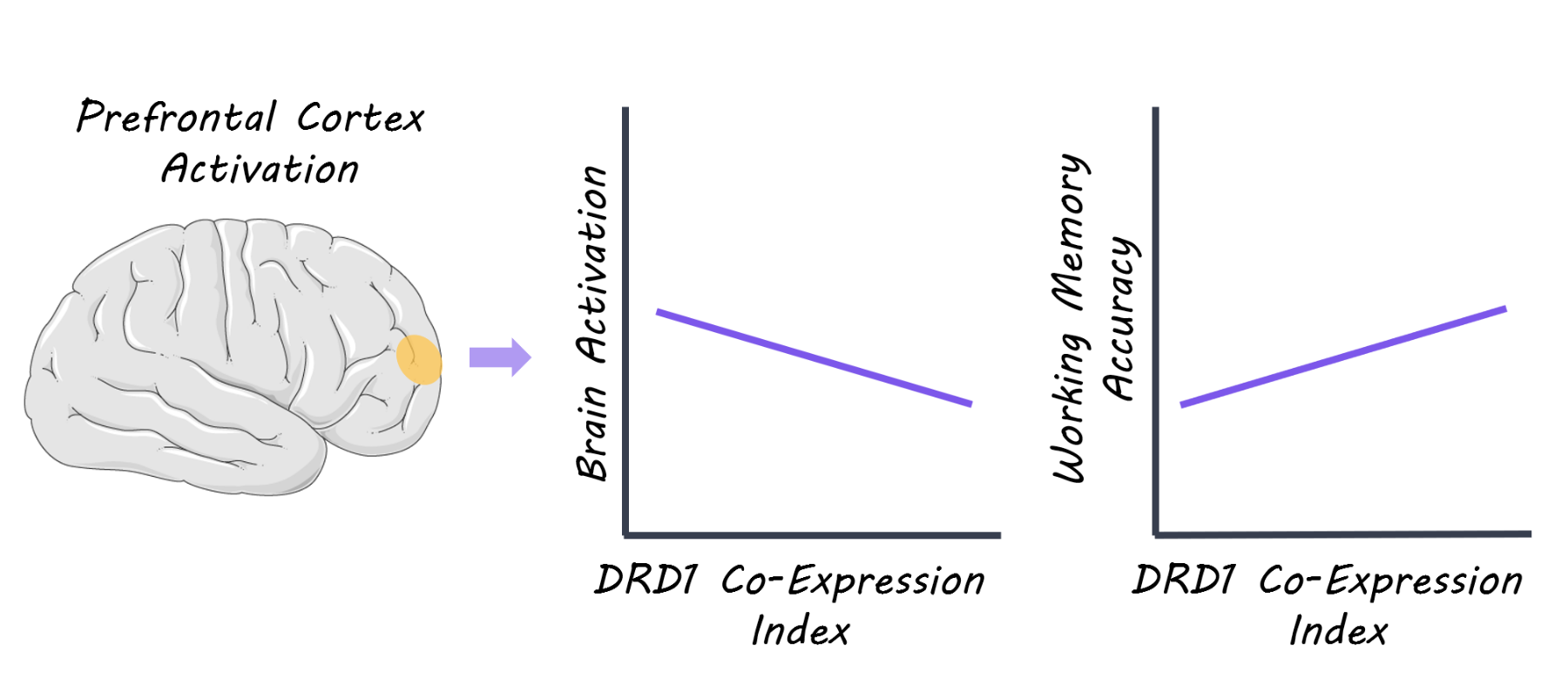
They found 3079 single nucleotide polymorphisms associated with the dopamine receptor D1 gene network: 13 of these polymorphisms were associated with changes in dopamine receptor expression. The index for each individual representing the level of gene co-expression in the dopamine receptor D1 network was found to be reliable in predicting gene expression. D1 receptor expression was inversely correlated with expression of other genes in the network, meaning when D1 receptor expression was higher, the expression of the other genes was lower. They found that a higher dopamine D1 receptor gene co-expression index (representing higher predicted dopamine D1 receptor expression) was associated with lower brain activation in the prefrontal cortex during a working memory task, as well as greater working memory accuracy. Similar results could be found in both independent groups of people. Combined, the results demonstrate that higher dopamine D1 receptor expression is associated with lower prefrontal cortex activity and better working memory capacity.

Brain, Servier Medical Art, image by BrainPost, CC BY-SA 3.0

Brain, Servier Medical Art, image by BrainPost, CC BY-SA 3.0

What's the impact?

This is the first study to show that genetic differences in D1 receptor expression (and co-expression of associated genes) are associated with changes in working memory and prefrontal cortex activity. We now know that genetic variation resulting in changes in dopamine D1 receptor levels can affect working memory performance. Knowing the association between dopamine receptor expression and working memory performance is important for developing medications that could target gene expression or the D1 receptor to improve working memory.

quote1800.png

Fazio et al., Transcriptomic context of DRD1 is associated with prefrontal activity and behavior during working memory. PNAS (2018). Access the original scientific publication here.
Lysophosphatidic Acid Involved in a Mechanism of Neuronal Hyperexcitability in Psychiatric Disorders

What's the science?

In some psychiatric disorders (e.g. schizophrenia), communication between neurons in the brain (via synapses: the connections between neurons) is altered. Lysophosphatidic acid (LPA) signaling in the brain’s synapses is also known to be altered in psychiatric disorders, leading to hyperexcitability in the brain (a loss of balance between excitation and inhibition due to increased excitation of glutamatergic (i.e. excitatory) neurons). LPA is synthesized by the enzyme autotaxin, but we don’t know what the source of LPA is in the synapse. This week in Molecular Psychiatry, Thalman and colleagues explored the source of LPA in the brain, and whether inhibition of autotaxin could control hyperexcitability in the brain.

How did they do it?

Experiments were performed using mice. First, the authors used immunohistochemistry and electron microscopy techniques to assess whether autotaxin was colocalized with excitatory or inhibitory neurons, and where in the synapse autotaxin was located. Next, they imaged astrocytes in vivo using green fluorescent protein, to assess whether autotaxin transport was occurring within astrocyte endfeet (i.e. processes) near synapses. The authors also examined knockout mice without a gene that regulates/lowers LPA levels (PRG-1-/- mice), and mice without autotaxin in astrocytes (ATXfl/fl). Finally, in a ketamine animal model of schizophrenia (ketamine induces hyperexcitability), the authors explored the potential of an autotaxin inhibitor on hyperexcitability.

What did they find?

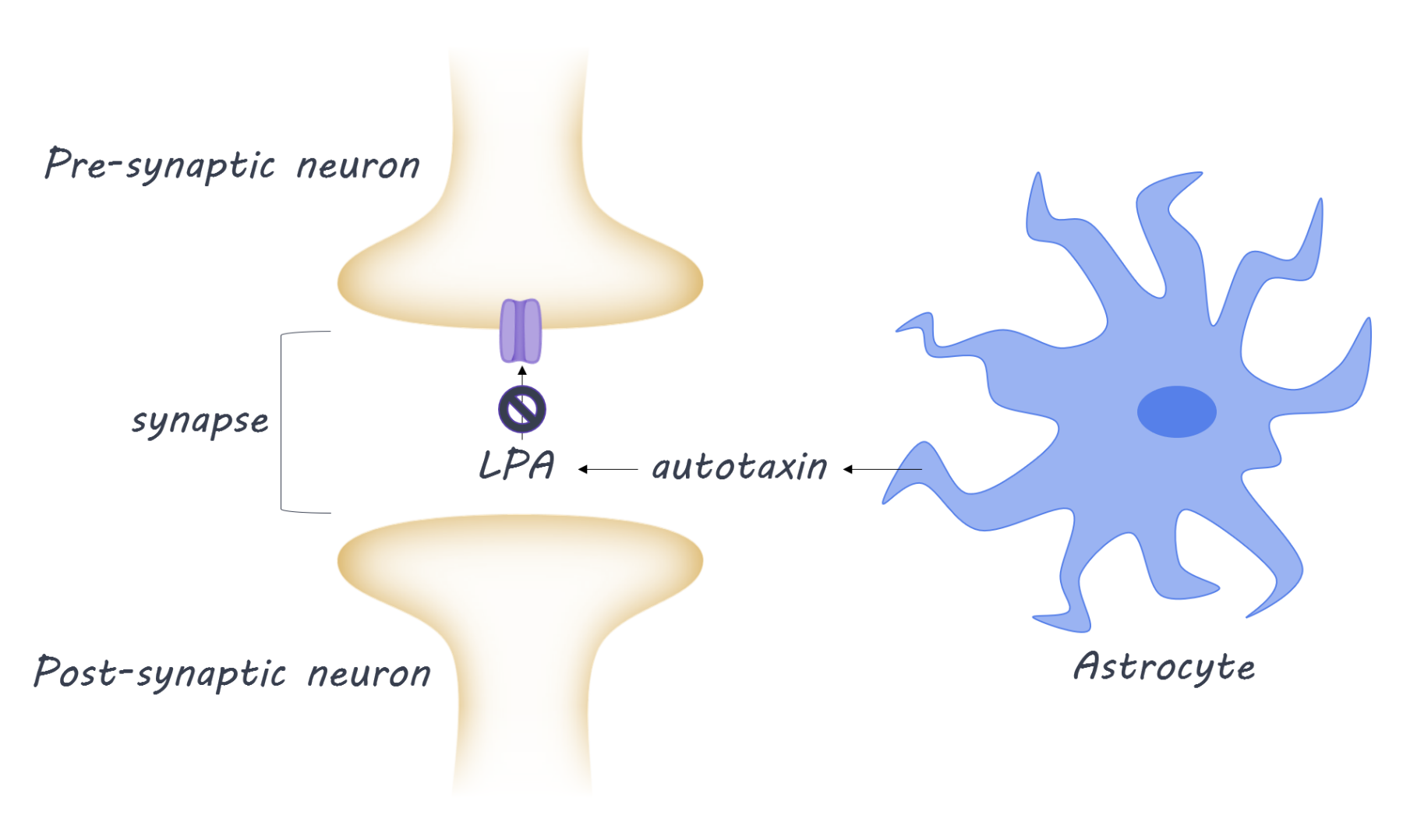
The authors found that autotaxin was colocalized with excitatory neurons but not inhibitory neurons. Specifically, autotaxin was present in astrocyte processes at these synapses. They confirmed the location of autotaxin in astrocyte processes of both the hippocampus and cortex using electron microscopy. Using green fluorescent protein to image autotaxin, they found that it’s transport within the astrocytes was stimulated via glutamate (excitatory neurotransmitter). In mice with PRG-1 deletion (causing dysregulated LPA), autotaxin inhibition reduced excitation (excitatory post-synaptic currents) of pyramidal neurons in the hippocampus to normal levels, but in normal mice, autotaxin inhibition did not reduce excitation. This indicates that autotaxin inhibition can bring activity levels back to normal in hyperexcitable neurons. A similar observation was made when autotaxin was genetically deleted in astrocytes (ATXfl/fl mice). In a ketamine animal model of schizophrenia, ketamine caused cortical hyperexcitability as expected, while autotaxin inhibition reduced it to normal levels. Autotaxin inhibition also reduced behaviors associated with hyperexcitability such as hyperlocomotion to normal levels.

Role of astrocytes at synapses for regulating cortical excitability

What's the impact?

In this study, the authors explored regulation of a phospholipid (LPA) known to regulate cortical excitability and be disrupted in psychiatric disorders. This study demonstrates that autotaxin from astrocytes at the synapse are likely responsible for regulating LPA levels and therefore cortical hyperexcitability. Targeting autotaxin could prove viable in reducing cortical hyperexcitability and related behavioral symptoms associated with psychiatric disorders.

Thalman et al., Synaptic phospholipids as a new target for cortical hyperexcitability and E/I balance in psychiatric disorders. Molecular Psychiatry (2018). Access the original scientific publication here.