
The Representation of Cost, Benefit and Gratitude in the Brain

What's the science?

What happens in the brain when we experience gratitude? Gratitude has previously been found to be associated with activity in the medial prefrontal cortex (mPFC) and perigenual anterior cingulate cortex (pACC), which are brain regions associated with value. In social interactions, how the giver perceives the cost of an action, and the receiver perceives the benefit, and how these two components are integrated in the brain, have not been studied in the context of gratitude. This week in Journal of Neuroscience, Yu and colleagues used functional magnetic resonance imaging (fMRI) to understand the experience of gratitude.

How did they do it?

The authors hypothesized that evaluation of cost and benefit would be related to activity in the mPFC (brain regions associated with valuation), and the experience of gratitude would be related to activity of the pACC. Thirty-one healthy young participants were included in data analysis. The authors first applied painful stimuli (electrical) and determined four pain levels calibrated to each individual. In the main experiment, during fMRI scanning, participants experienced many trials in which they were told they would receive a shock (at one of their four pain levels) unless their ‘partner’ in the experiment paid (at one of five payment levels, pre-determined per trial) to relieve their pain. The partner was actually a confederate, working with the experimenters.

What did they find?

The authors only analyzed trials in which the partner ‘helped’ the participant (by paying to reduce the participant’s pain). High cost (versus low cost) trials, where the partner paid more to help the participant, were associated with greater activation in the dorsomedial prefrontal cortex, right temporoparietal junction, and precuneus of the participant being helped. These regions are known to be involved in mentalizing and empathy. High benefit (partner pays to remove high pain) versus low benefit trials were associated with greater activity in regions associated with valuation; the ventromedial prefrontal cortex, and ventral and dorsal striatum. Gratitude was calculated using a formula that combined the cost and benefit for each trial together. Activity in the pgACC was found to track this measure of gratitude. pgACC activity also tracked how grateful participants reported feeling overall, at the end of the experiment. Finally, after measuring connectivity between the aforementioned brain regions, the authors found that a model in which ventral striatum and right temporoparietal junction influenced the pgACC was the best fit for the data. This suggests that gratitude is integrated in the pgACC.

Brain, Servier Medical Art, image by BrainPost, CC BY-SA 3.0

Brain, Servier Medical Art, image by BrainPost, CC BY-SA 3.0

What's the impact?

This is the first study to examine brain activity associated with gratitude using an index of gratitude on a trial-by-trial basis, and to consider how cost (to the helper) and benefit (to the receiver) are integrated into a perception of gratitude. The study found that cost was associated with brain regions involved in mentalizing, benefit was associated with brain regions involved in valuation, and gratitude was integrated in the pgACC. These findings help us to understand the representation of complex emotions like gratitude in the brain.

H. Yu et al., Decomposing gratitude: representation and integration of cognitive antecedents of gratitude in the brain. Journal of Neuroscience (2018). Access the original scientific publication here.

Common Genetic Variation Contributes to Migraines in Families

What's the science?

Migraine is an extremely common disorder affecting up to 20% of adults in developed countries. Migraines tend to run in families, however, the genetic risk underlying this is not well understood. A typical way to study genetic risk is to look at rare genetic mutations, which often put a person at high risk for a disease disease. However, ‘common’ genetic variations (i.e. single nucleotide polymorphisms) in the population could have a significant contribution to risk of migraine that runs in families. This week in Neuron, Gormley and colleagues test whether a genetic risk score (of common genetic variants) is associated with migraines that aggregate in families.

How did they do it?

They used a dataset including 1589 families (a total of 8319 family members) with genotype information. They generated a polygenic risk score for each individual using a set of SNPs (single nucleotide polymorphisms; commonly occurring changes in the genetic code), that were previously shown to be associated with migraine risk. They tested for the association between this polygenic risk score and risk of different migraine subtypes including migraine with aura, migraine without aura and a rare form of migraine (hemiplegic migraine) in families (using ‘logistic mixed modelling’ which controlled for sex, age and genetic relatedness) compared to a large group of controls. They also compared the risk of migraine explained by the genetic risk score in families to a large sample population of unrelated individuals with migraine.  

What did they find?

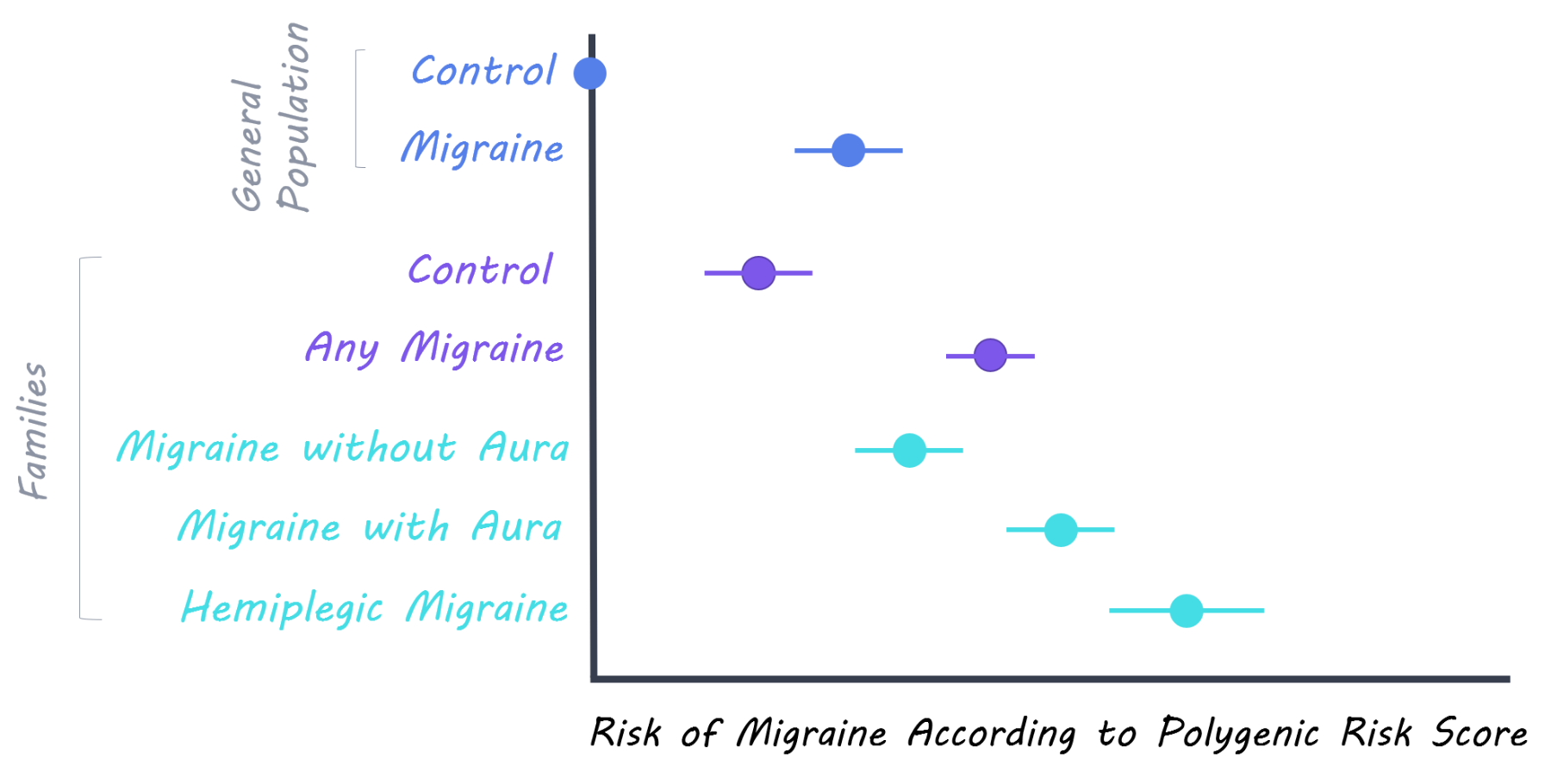
They found that the genotypes associated with risk for migraine (from the polygenic risk score) were enriched (i.e. more common) in families with all forms of migraine compared to controls. The strongest association was for the migraine with aura, followed by hemiplegic migraine and migraine without aura. In particular, a subtype of migraine hemiplegic migraine had the strongest enrichment of polygenic risk. Polygenic risk score explained 3.5% of the variance in families (for presence of migraine) compared to 1.6% variance explained (for presence of migraine) in the general population. When compared to people with migraine in the general population, family members with migraine showed a greater burden of polygenic risk (more risk variants in their genome) and this was strongest for hemiplegic migraine followed by migraine with typical aura and migraine without aura. Furthermore, in a genetic transmission test they found that in families, offspring with migraine received a higher percentage of common migraine risk variants from their parents then would be expected by chance, suggesting that these common genetic risk variants are over-transmitted to family members with migraine.

Risk of migraine according to polygenic risk score

What's the impact?

This is the first study to show that common genetic variation known to associate with migraine risk, is enriched (more common) in families compared to those with migraines in the general population. Before this study, the contributions of common genetic variants to migraine risk in families was unclear. We now know that common genetic risk variants that contribute to all forms of migraine risk are transmitted through families.

imigrainequote.png

Gormley et al., Common Variant Burden Contributes to the Familial Aggregation of Migraine in 1589 Families. Neuron (2018). Access the original scientific publication here.
A New Technique Using Holography and Optics to Precisely Control Neuronal Activity

What's the science?

Different information in the brain is encoded by the firing of specific neurons, but also by the timing, rate of that firing, and synchrony of firing with other neurons. Therefore, in order to understand and control neural activity, we must be able to control each of these parameters. The ideal experimental technique would have both high spatial and high temporal resolution over a large volume of brain tissue, and be able to create as well as remove existing activity. Two-photon optogenetics is a technique used to stimulate specific neurons: genes are inserted into neurons, which allows these neurons to produce light-sensitive proteins (opsins), and then light is shone on these neurons, generating action potentials. However, there are limitations to how precise the timing of stimulation, number of neurons stimulated and location of stimulation can be with optogenetics. This week in Nature NeuroscienceMardinly and colleagues engineered a new technique that allows for precise temporal and spatial control of neural activity using special opsins and holography (a technique that can illuminate the entire cell body/soma of a neuron) to ‘write’ neural activity, along with simultaneous volumetric calcium imaging to ‘read’ neural activity.

How did they do it?

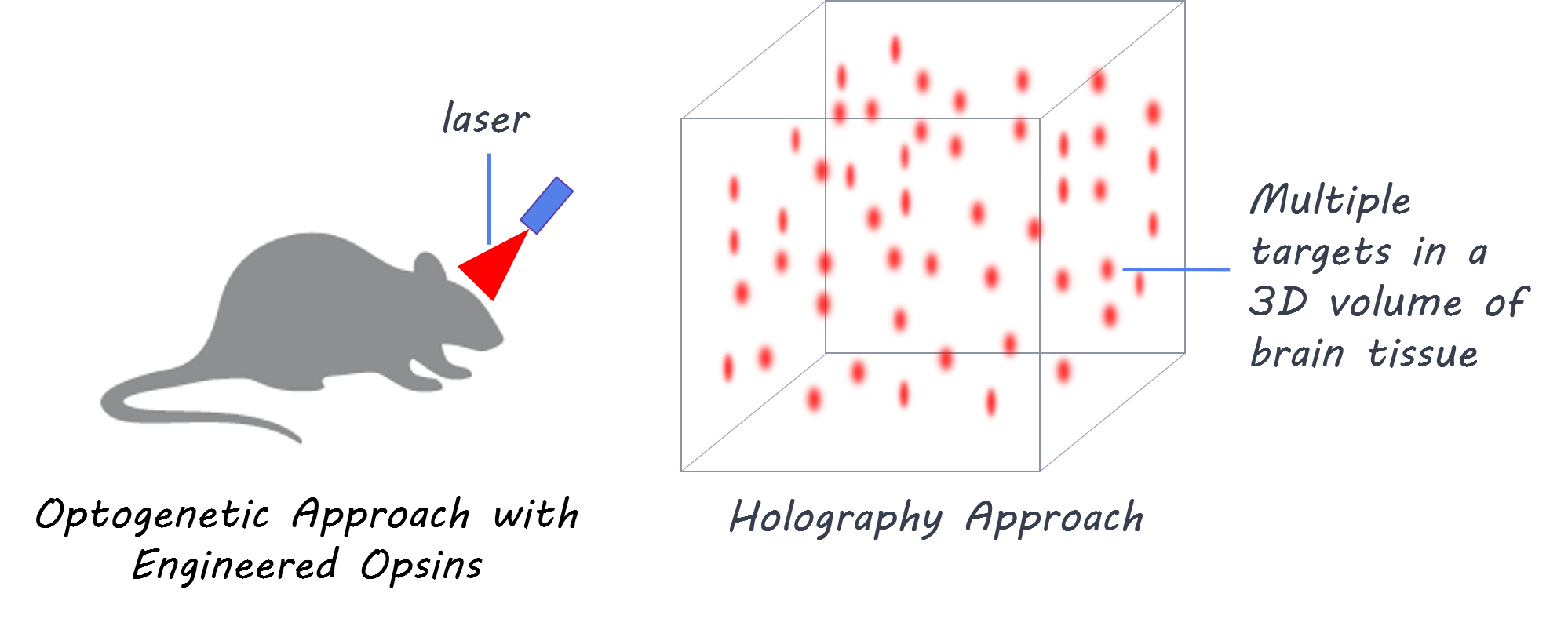
They used an experimental setup that incorporated holography, which involves lasers and bending light to illuminate multiple specific neurons in 3D space, allowing for fast excitation of neurons at precise spatial locations.

Experiment Set 1 → First, they studied the characteristics of several opsins with the goal of developing two opsins: one that could generate large excitatory currents quickly to activate cells and one that generated large inhibitory currents to suppress cells. Using patch clamping (in anesthetized mice) and brain slice recording techniques in mice, they tested several opsins for the amplitude and kinetics of the photocurrent elicited. They mutated the chosen opsins to optimally generate or suppress activity. They then tested the precision and speed with which neurons with this opsin elicited action potentials.

Experiment Set 2 → Next, they used holography (to stimulate or suppress neurons) and calcium imaging (to ‘read’ (i.e. record) the resulting neural activity) at the same time. Mice who expressed neurons with both chosen opsins ran on a treadmill with their heads fixed in place, and neurons in the primary somatosensory cortex were activated or suppressed (depending on the opsin) using a holographic technique. Neurons were activated or suppressed one at a time, and later in random groupings, to test whether the activity of multiple different types of neurons could successfully be altered at the same time.

Optogenetic and holography approach to control neural activity

What did they find?

Experiment Set 1 → After testing several excitatory opsins, they mutated the fastest opsin tested to create a highly potent but still equally fast version, that they call ST-ChroME. After genetic mutation of this opsin they observed that it required low laser power (i.e. light shone) to produce action potentials with short latency and low temporal variability (which is desirable) during brain slice recordings. Using patch-clamp recordings, they found that neurons with ST-ChroME exhibited action potentials reliably (89% of the time). ST-eGtACR1 was the opsin found to be the most effective at suppressing neural activity. Using patch-clamp recording, the firing rate of neurons with ST-eGtACR1 was reduced to 8% of normal firing rate during holographic suppression.  

Experiment Set 2 → Next, mice ran on a treadmill and neuronal activity was simultaneously stimulated and recorded. Neurons (with ST-ChroME) activated one at a time produced reliable calcium signals, indicating they could be reliably activated in vivo. In vivo optical suppression resulted in a reliably reduced calcium response. Finally, when entire groups of neurons were stimulated, calcium signalling was as expected, indicating neurons of different sizes or functions can be activated simultaneously. Up to 50 neurons could be activated at the same time, allowing for thousands of light-evoked action potentials per second.

What's the impact?

In this study, optogenetic techniques (newly engineered opsins—proteins activated by light) were combined with holography (bending of light to be distributed over a 3D volume) to stimulate neurons precisely. By combining holography with calcium imaging, the authors facilitated spatially and temporally precise simultaneous stimulation and recording (‘write’ and ‘read’) of neuronal activity respectively. Holography allowed for specific neurons at various different locations in a 3D volume of the brain to be activated at the same time. This study expands on previous optogenetic techniques which lacked a high level of spatial and temporal precision and will help us to perform a wide variety of experiments where the activity of multiple neurons can be altered with high spatial and temporal precision.

hologrpahquote.png

A. R. Mardinly et al., Precise multimodal optical control of neural ensemble activity. Nature Neuroscience (2018). Access the original scientific publication here.