
A Polymorphism in GAD65 Modulates Anxiety Vulnerability in Women

What's the science?

Anxiety disorders are common and debilitating and occur more frequently in women. Understanding the brain chemistry and genetic predisposition to anxiety will be critical for developing treatments. A brain region called the pregenual anterior cingulate cortex is known to be involved in anxiety and to regulate amygdala activity (another brain region involved in anxiety and emotion). The balance of neurotransmitters, GABA (inhibitory) and glutamate (excitatory), in the pregenual anterior cingulate is thought to be important for modulating brain activity and anxiety. Different genetics affecting the synthesis of GABA in the brain could affect anxiety, however this is not yet clear. This week in The Journal of Neuroscience, Colic and colleagues test whether a genetic polymorphism (change in the code of a gene) can alter GABA levels in the brain and also influence brain activity and anxiety.

How did they do it?

They sorted 105 healthy participants (mean age = 27) into two groups based on their genotype for the GAD65 gene (carriers vs. non-carriers of a G allele) which is responsible for GABA synthesis. Carriers of the G allele of this genotype are associated with drastic increases in GABA transcription (production) in peripheral cells. They scanned the participants (mean age of 27) using an imaging technique called MR Spectroscopy which can measure GABA/glutamate neurotransmitter ratios in the brain. They used resting state fMRI to measure brain activity at rest in the pregenual anterior cingulate cortex of these participants. They then tested a) the effect of genotype on brain activity, b) GABA/glutamate levels and c) whether there was any genotype by sex interaction (whether genotype affects these brain measures depending on sex) d) whether measured vulnerability to anxiety using a harm avoidance scale (correlates with anxiety) from the Temperament and Character Inventory was correlated with these brain measures.

What did they find?

Resting brain activity in the pregenual anterior cingulate was significantly lower in carriers of the G allele, but there was no interaction effect of GAD65 or sex on brain activity. However, there was a significant interaction between sex and genotype in the pregenual anterior cingulate on GABA/ glutamate levels, with female G allele carriers showing higher GABA levels. The level of reported harm avoidance was negatively correlated with the level of GABA in the pregenual anterior cingulate cortex in females (and not in males), suggesting that the lower GABA could be underlying anxiety vulnerability in females. To confirm the relationships between genotype, brain activity, GABA and harm avoidance they performed a ‘moderated mediation analysis’ including genotype as a predictor and harm avoidance as an outcome, brain activity and GABA as mediators, and sex as a moderator. Genotype significantly predicted harm avoidance, mediated by GABA/ glutamate levels in females only.

Brain, Servier Medical Art, image by BrainPost, CC BY-SA 3.0

Brain, Servier Medical Art, image by BrainPost, CC BY-SA 3.0

What's the impact?

This is the first study to show that a polymorphism in a gene producing GABA is associated with differences in GABA levels in the brain. Further, these polymorphisms affect anxiety in females (not in males), and this relationship is mediated by GABA levels in the brain. This study highlights the importance of studying genetic differences that could influence brain chemistry or activity and that these differences may differ depending on sex. We now know that female vulnerability to anxiety could be related to genetic predisposition and inhibitory neurotransmitter levels in the pregenual anterior cingulate cortex.

GABAquote.png

Colic et al., GAD65 promoter polymorphism rs2236418 modulates harm avoidance in women via inhibition/excitation balance in the rostral ACC. The Journal of Neuroscience (2018). Access the original scientific publication here.
Memory is Dependent on Synapses Between Engram Cells

What's the science?

Memory is thought to be encoded in the brain by a set or pattern of dispersed neurons in the brain called an ‘engram’. It has also been suggested that changes in the strength of the connections between neurons (i.e. synapses) in the brain is how memories are formed. This week in Science, Choi and colleagues used a new green fluorescent protein technique in mice to better understand how engram cells are connected in the brain and whether synaptic connections between engram cells underlie memory formation.

How did they do it?

Mice underwent a fear conditioning task, in which some mice received foot shocks (either weaker or stronger) during an experiment and some mice did not. Mice typically freeze due to fear when placed in a particular environment in which they remember experiencing something negative (such as a shock to their foot). Using doxycycline, they labeled the brain cells which were activated during the conditioning - these are referred to as the engram cells, because they are involved in memory during the fear conditioning task. Next, they designed a novel modified green fluorescent protein labelling technique called dual-eGRASP, which allows for visualization of the synapse between neurons, including identifying synapses formed by two separate groups of pre-synaptic (input) neurons as well as post-synaptic neurons. They then used this technique to visualize the connectivity (strength) of synapses in engram cells (labeled as active during fear conditioning) versus non-engram cells.

What did they find?

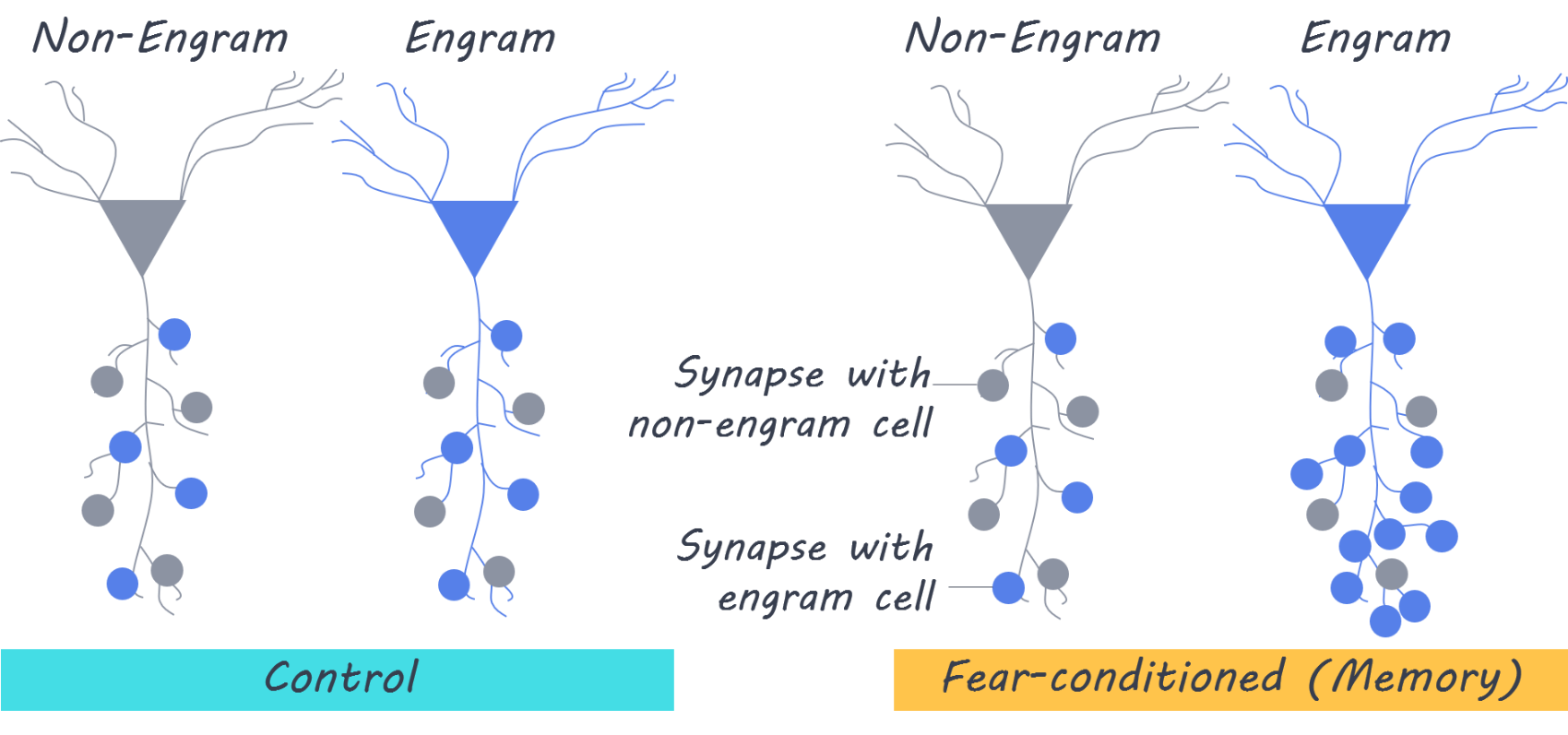
The dual-eGRASP technique successfully visualized synapses from separate populations of pre-synaptic neurons to hippocampal CA1 neurons from two different inputs, even when the synapses from the two populations were interspersed. When comparing engram-engram synapses versus synapses that involved non-engram cells (which were not labeled as active during fear conditioning), they found that dendritic spines were larger and more numerous on engram cells receiving input from other engram cells only. This indicates that synapses activated between engram cells during fear conditioning could cause synaptic connectivity between these cells to strengthen. When assessing the relationship between synaptic strength and memory, the authors found that synapses between engram cells were stronger and denser after receiving a stronger shock versus after receiving a weaker shock. This indicates that strength of a memory (due to strength of a foot shock) is related to synaptic connectivity and the strength of connections between engram cells in the hippocampus.

Synapses with engram and non-engram cells

What's the impact?

This is the first study to show that engram neurons that are activated during a learning task (fear conditioning) are more likely to have stronger, denser synaptic connections with each other. We now know that the, strength of connections between engram cells in the hippocampus underlies memory formation and strength.

Engram_quote.png

J. Choi et al., Interregional synaptic maps among engram cells underlie memory formation. Science (2018). Access the original scientific publication here.
The Association Between Cannabis Use and Cognitive Function

What's the science?

Recent policies in North America have shifted towards increased acceptance of cannabis use, and perceived harm has decreased. Chronic cannabis use could have effects on cognitive function in developing adolescents, however, this risk is not well understood. This week in JAMA PsychiatryScott and colleagues perform a meta-analysis of studies on cannabis use to determine whether there is an association between cannabis use and cognitive function in youth and young adults. 

How did they do it?

They performed a systematic review of the literature. They included all cross-sectional studies where participants were adolescents or young adults, frequent or heavy cannabis use was assessed as a variable of interest (not just acute cannabis use) and cognitive performance on at least one neuropsychological test was measured. They also ensured that each of these studies had sufficient power to calculate effect sizes. 69 studies met their criteria (2152 cannabis users and 6575 control participants with minimal cannabis use). They performed the statistical analysis using a mixed effects multivariate model, which accounts for correlated within-study effects and multiple different effect sizes between studies. Cognitive performance on neuropsychological tests was the measure of interest.

What did they find?

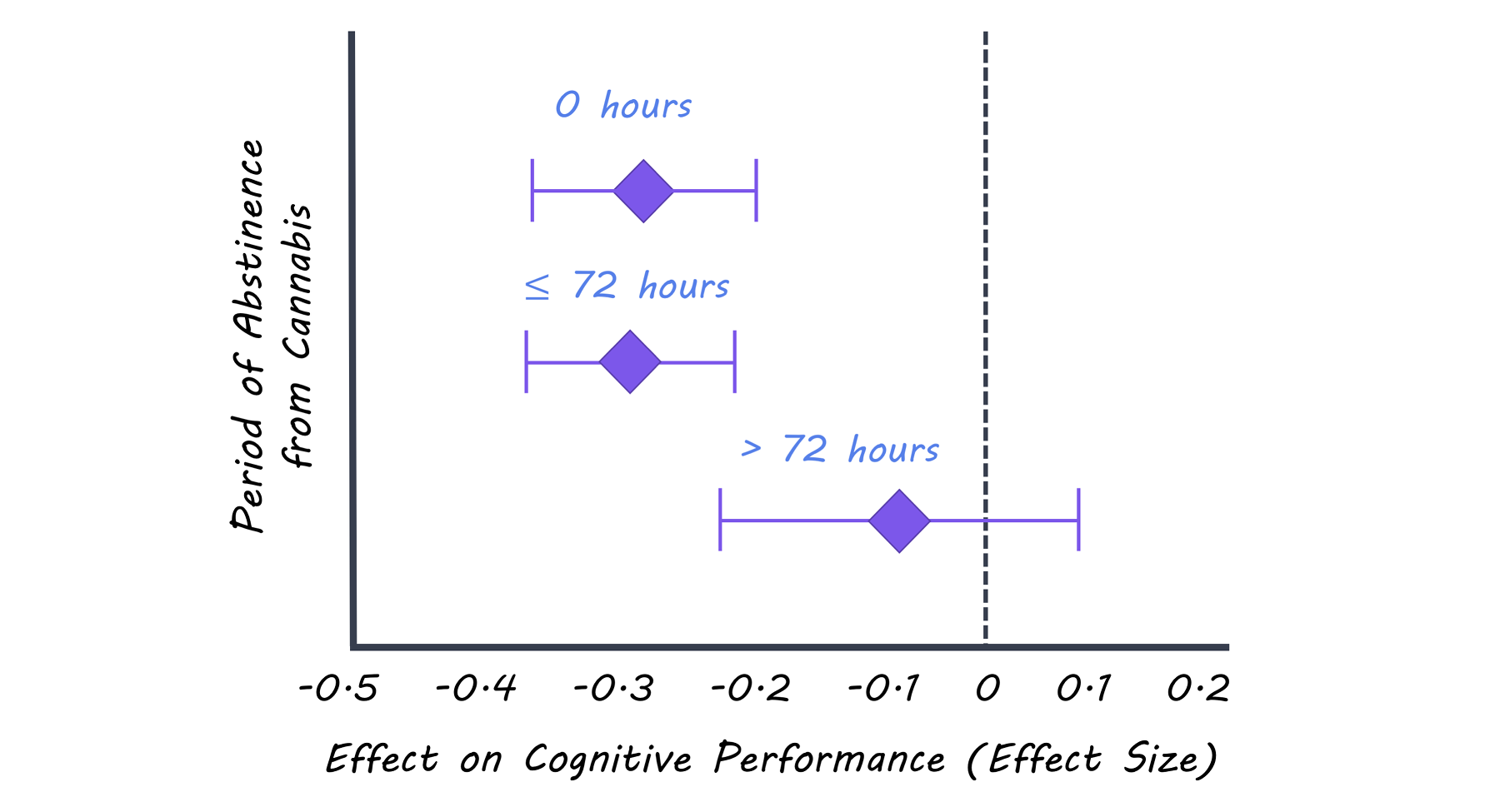
The overall effect size in a model without explanatory variables (i.e. variables that could potentially affect the association between cannabis and cognitive function such as age) was small but significant, showing a lower cognitive performance in cannabis users compared to the comparison group. Cognitive performance in heavy cannabis users was lower in the domains of learning, executive function, information processing speed, delayed memory, inhibition, working memory and attention. When explanatory variables were included, the effects were not explained by age category, age at first cannabis use or alcohol use. Hours of abstinence from cannabis (self-reported) was associated with a lower effect size, suggesting that a longer period of abstinence from cannabis reduced the negative effects on cognitive performance. When looking at studies where a period of greater than 72 hours of abstinence prior to study participation was required, effect size was no longer significant.

Relationship between cannabis use and cognitive function

What's the impact?

This is the first meta-analysis of the effects of heavy cannabis use specifically in youth and young adults. This study confirms findings from studies in adults, suggesting that in youth, the effects of cannabis use on cognition are small and abstaining from cannabis for at least 3 days, may reduce negative effects on cognitive performance.

A Word of Caution: Studies which take into account the type and amount of cannabis used will be needed to better understand the effects on cognitive performance. Additionally, studies looking at functional outcomes like employment or other health measures (not just cognitive performance) with cannabis use over time may provide more meaningful information. Furthermore, even a small effect on cognitive performance may impact youth differently depending on their genetic makeup or life circumstances.

iquotecannibis.png

C. Scott et al., Association of Cannabis with Cognitive Functioning in Adolescents and Young Adults: A Systematic Review and Meta-Analysis. JAMA Psychiatry (2018). Access the original scientific publication here.