Brain Activity Predicts How Much Individuals Like Each Other

What's the science?

Within a group, people tend to like each other over time as they get to know one another. When considering interpersonal factors, if Person A likes Person B, this can lead Person B to like Person A over time (reciprocal liking). Interpersonal reward might affect this process; if a person experiences something rewarding during a social encounter, this can further influence reciprocal liking (a positive feedback loop). Two brain regions, the ventromedial prefrontal cortex and the ventral striatum are known to be involved in processing reward. In some cases, activity in these brain regions can predict an individual’s preferences, and therefore may also be able to predict how much an individual will like someone else. This week in PNAS, Zerubavel and colleagues tested whether interpersonal liking and brain activity in reward-related regions could predict how much people liked each other after a period of time.

How did they do it?

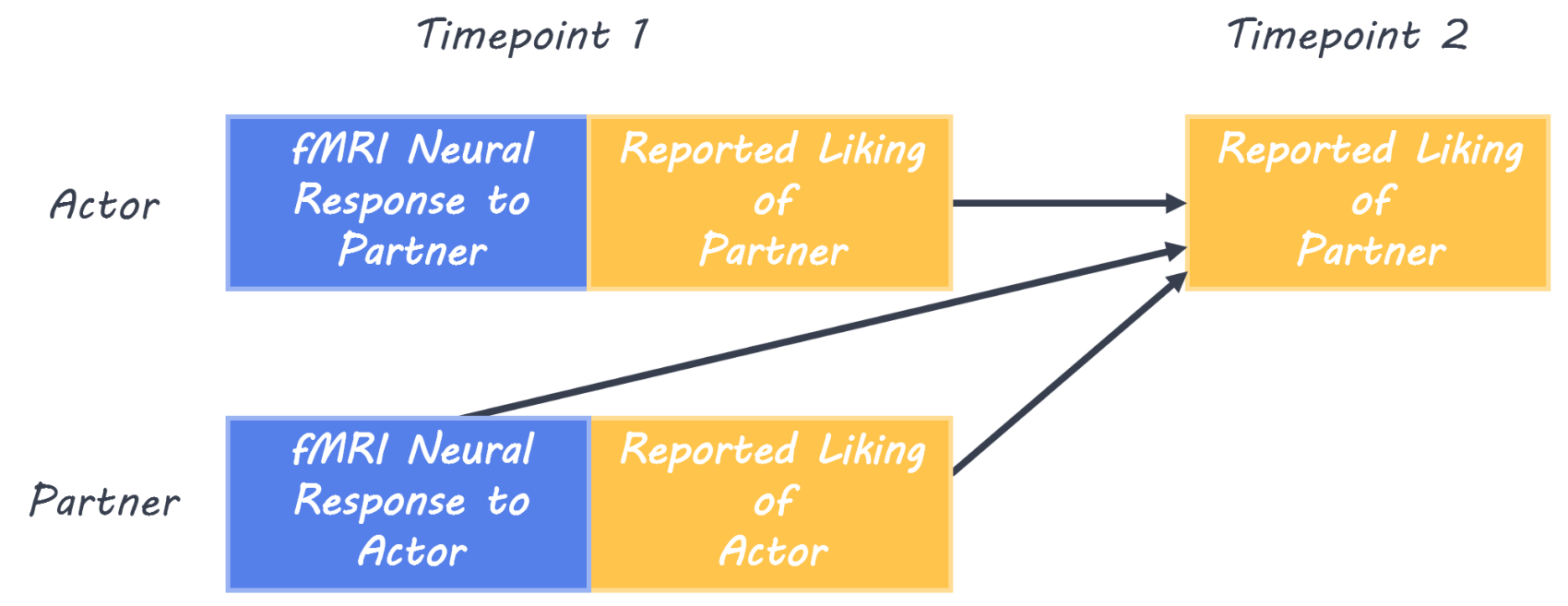
Sixteen healthy young adults, most of whom did not previously know each other, were recruited for the study while volunteering for a summer program that took place over nine weeks. At two timepoints, once at the beginning of the summer program and again 9 weeks later, participants rated how much they liked each other ‘not very’ to ‘very’, 0-100 scale, and also viewed pictures of each other's faces while undergoing functional magnetic resonance imaging (fMRI) scans. The authors employed structural equation modelling (which can account for multiple interrelated variables) to assess liking cross all possible pairs of participants. Each participant was in turn referred to as the ‘actor’ and other participants were referred to as ‘partners.’ The authors assessed: a) the effects of both the actor and the partner’s liking of each other at timepoint 1 on the actor’s liking of the partner at timepoint 2 and b) the effects of both the actor’s and the partner’s neural responses in the ventromedial prefrontal cortex and ventral striatum at timepoint 1 on how much the actor liked the partner at timepoint 2 (i.e. whether either person’s brain activity at timepoint 1 predicted how much the actor liked the partner, controlling for how much they reported liking each other).

What did they find?

The authors found that how much the actor liked the partner, and how much the partner liked the actor at time point 1 predicted how much the actor liked the partner at timepoint 2. Next, after accounting for how much the partner and actor liked each other at timepoint 1 (and other known predictors of future liking) the authors found that neural responses in the ventromedial prefrontal cortex and ventral striatum in both the actor and the partner (brain activity in response to viewing each other's face) at timepoint 1 predicted how much the actor liked the partner at timepoint 2. This indicates that neural processes leading to future liking could be occurring subconsciously.
fMRI brain response predicts how much people like each other

What's the impact?

This is the first study to demonstrate that fMRI responses (measuring brain activity) in reward-related regions of the brain can predict how much one individual will like another individual months in the future. Specifically, neural responses in both people can affect how much one person likes the other person at a later timepoint. The study furthers our understanding of the neural basis for interpersonal relationships.

iquoteliking.png

N. Zerubavel et al., Neural precursors of future liking and affective reciprocity. PNAS (2018). Access the original scientific publication here.

Mild Traumatic Brain Injury Increases Risk of Parkinson’s Disease

What's the science?

Mild traumatic brain injury, also referred to as a concussion, is defined as a loss of consciousness or confusion due to head injury that lasts less than 30 minutes. Mild traumatic brain injury is especially common among the elderly, athletes and in the military, and is increasingly associated with risk for psychiatric and neurodegenerative diseases. The relationship between mild traumatic brain injury and risk for Parkinson’s disease is not well understood. This week in Neurology, Gardner and colleagues assess the risk of Parkinson’s disease after mild traumatic brain injury in a large sample of patients.

How did they do it?

Participants (18 years or older) from the Veterans Health Association (military veterans) with a diagnosis of traumatic brain injury were included and were age matched to a random sample of participants without brain injury (325,870 total participants). They diagnosed Traumatic brain injury using detailed clinical assessments or criteria from the Department of Defense (IC-9 codes). They also assessed other diseases at baseline and Parkinson’s disease at least one year after baseline in this longitudinal study. They then used a Cox Proportional Hazards model (a standard statistical model for assessing longitudinal risk) to determine risk of developing Parkinson’s disease with and without traumatic brain injury, including assessment of risk specifically after mild traumatic brain injury. They controlled for confounding variables including medical conditions, psychiatric disease and demographics: age, sex, ethnicity, education and level of income.

What did they find?

A total of 1462 participants developed Parkinson’s disease over the course of the study (average 4.6 years follow-up), 65% of whom had previously experienced traumatic brain injury. Participants with previous traumatic brain injury were significantly more likely to develop Parkinson’s disease than those without traumatic brain injury (hazards ratio: 1.71). Even mild traumatic brain injury was associated with increased risk (56%) of developing Parkinson’s disease after adjusting for all confounding variables.

Relationship between Traumatic Brain Injury and Parkinson’s disease

What's the impact?

This is the first large-scale, nationwide study to demonstrate that mild traumatic brain injury is associated with an increased risk of Parkinson’s disease. We now know that focusing on the prevention of mild traumatic brain injury will be important for reducing risk of Parkinson’s disease.

itbiquote.png

R. Gardner et al., Mild TBI and risk of Parkinson disease: A Chronic Effects of Neurotrauma Consortium Study. Neurology (2018). Access the original scientific publication here.
Stimulating an Entorhinal Cortex Circuit is Antidepressive

What's the science?

Major depressive disorder can lead to many structural and functional changes in  the hippocampus, including slowed neurogenesis (new neuron formation). Stimulation of the entorhinal cortex (which sends information to the hippocampus) can improve learning and memory. It is possible that entorhinal cortex stimulation could also relieve depression. Current depression therapies, including transcranial magnetic stimulation and electroconvulsive therapy, often have side effects, so more treatment options are needed. This week in Nature MedicineYun and colleagues test whether stimulating an entorhinal circuit is antidepressive in mice and uncover the mechanisms involved.  

How did they do it?

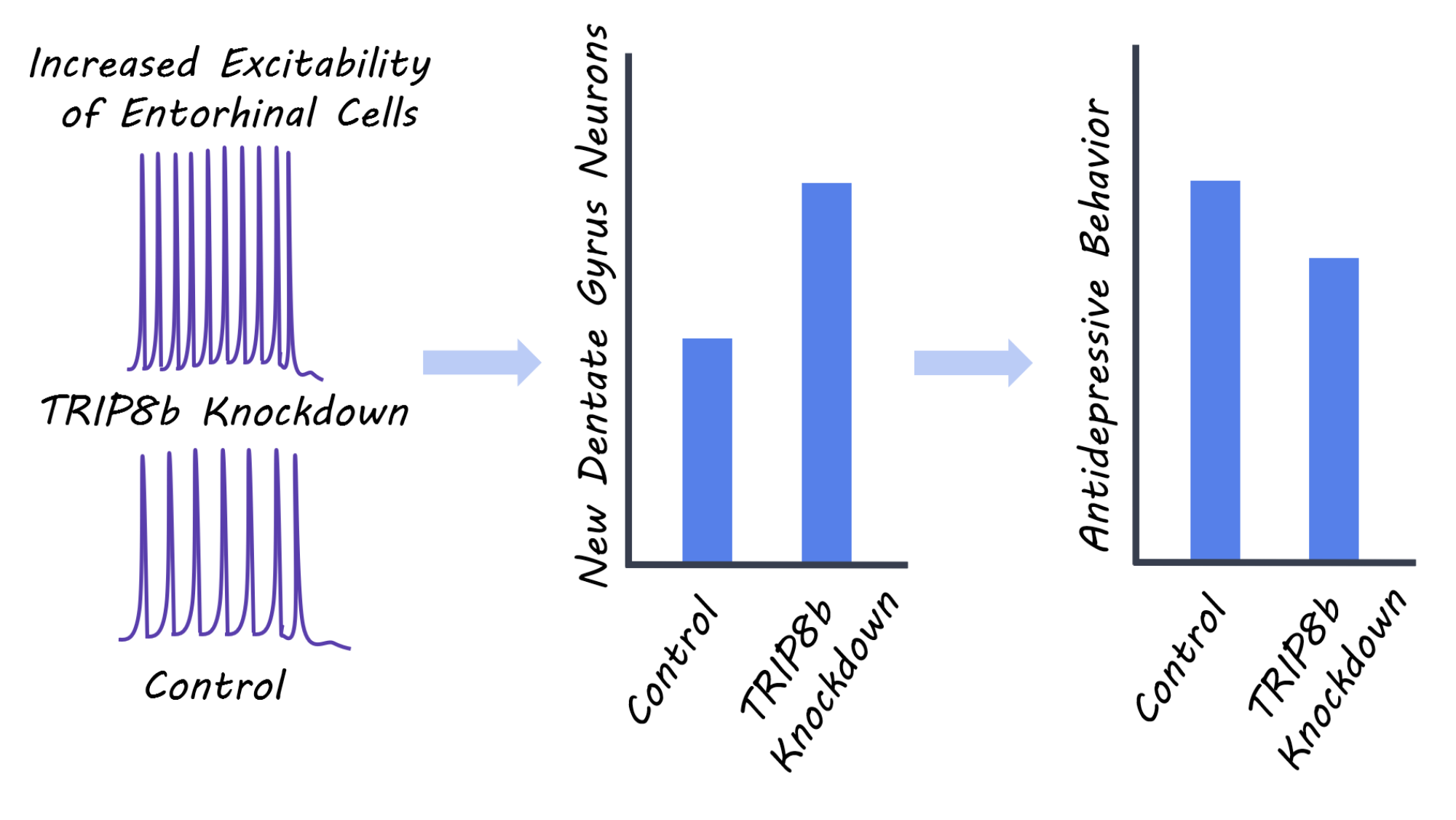
They knocked down a protein subunit (TRIP8b) of a protein channel (hyperpolarization channel) using a viral-mediated approach which reduces the number and sensitivity of these protein channels found on neurons. This increases the excitability of neurons in the entorhinal cortex. The hypothesis was that increased excitation in the entorhinal cortex would increase neurogenesis in the hippocampus, and in turn reduce depressive behavior in mice. They performed several experiments: They tested whether psychosocial stress (a model of depression) increases TRIP8b levels in neurons. Using viral-mediated TRIP8b knockdown, they confirmed the increased excitability of entorhinal cortex neurons that project to the hippocampus (dentate gyrus). They measured neurogenesis in the hippocampus (dentate gyrus) in TRIP8b knockdown and controls. They then tested whether antidepressive behavior and memory were changed in knockdown vs. controls and whether this was dependent on neurogenesis. Lastly, they used gene transfer and transgenic mice combined with chemogenetics to activate glutamatergic neurons (i.e. excitatory neurons) in the entorhinal cortex, in order to observe the effects on antidepressive behavior.

What did they find?

They found that psychosocial stress in mice resulted in increased levels of TRIB8b in entorhinal neurons that project to the dentate gyrus. After knockdown of TRIP8b, they found increased excitability of entorhinal cells and increased neurogenesis in the connected hippocampus (in the dentate gyrus), confirming the hypothesis that increased activity in the entorhinal cortex results in neurogenesis in the hippocampus. TRIP8b knockdown in the entorhinal cortex also resulted in antidepressive-like behavior and improved memory in mice. To test whether this was dependent on neurogenesis in the hippocampus, they used X-ray irradiation to ablate new neurons and found that antidepressive behavior was dependent on hippocampal neurogenesis. Using chemogenetics to chronically stimulate glutamatergic neurons in the entorhinal cortex, they found that glutamatergic neurons drove neurogenesis in the hippocampus and were responsible for antidepressive behavior.

Dentate gyrus neurons

What's the impact?

This is the first study to show that activity in the entorhinal-hippocampal circuit results in both the formation of new neurons in the hippocampus and antidepressive behaviors in mice. Altering activity in this entorhinal cortex circuit - previously appreciated only as a memory circuit - by stimulating it could be a new way to reduce symptoms of depression in humans.

ihippoquote.png

S. Yun et al., Stimulation of entorhinal cortex–dentate gyrus circuitry is antidepressive. Nature Medicine (2018). Access the original scientific publication here.