Dopamine Synthesis Predicts Treatment Response in Patients with Psychosis

What's the science?

One type of medication that can help patients with schizophrenia and other forms of psychosis is dopamine antagonists (medications that block the neurotransmitter dopamine), however, not all patients respond well to this medication. Whether or not a patient responds may be related to dopamine synthesis capacity, whereby patients with high levels of dopamine may respond while those with low levels of dopamine do not. This week in Molecular Psychiatry, Jauhar and colleagues studied patients experiencing a first episode of psychosis, to understand whether differences in dopamine synthesis capacity were related to future treatment response.

How did they do it?

Twenty-six patients who had recently experienced a first episode of psychosis and were diagnosed with a psychosis disorder participated, along with 14 healthy controls. Psychosis symptoms were assessed using the Positive and Negative Syndrome Scale (PANSS) before treatment, 4 weeks into treatment, and at 6 months follow-up. Response was defined as a 50% reduction in PANSS score from baseline. Participants underwent a positron emission tomography (PET) scan at baseline after injection of 18F-DOPA, in order to measure dopamine synthesis capacity in the striatum (using the ‘striatal influx constant’).

What did they find?

At baseline, the striatal influx constant in the associative striatum (a region of the striatum involved in cognitive function) was higher in responders compared to non-responders and healthy controls, indicating dopamine synthesis capacity was higher in this group. Dopamine synthesis capacity was positively correlated with percent change in PANSS score, indicating those with higher synthesis capacity were more likely to experience fewer psychosis symptoms after treatment. Higher dopamine synthesis capacity was also found in responders in two specific parts of the associative striatum: in the caudate (compared to healthy controls & non-responders) and in the putamen (compared to non-responders).

Brain, Servier Medical Art, image by BrainPost, CC BY-SA 3.0

Brain, Servier Medical Art, image by BrainPost, CC BY-SA 3.0

What's the impact?

This study is the first to find that dopamine synthesis capacity (i.e. dopamine level) in the striatum is higher in individuals who respond well to treatment after a first episode of psychosis. PET imaging to measure dopamine synthesis capacity could be used to help predict who will respond well to treatment for psychosis.

ipsychosisquote.png

S. Jauhar et al., Determinants of treatment response in first-episode psychosis: an 18F-DOPA PET study. Molecular Psychiatry (2018). Access the original scientific publication here.


Brain Beta-Amyloid Levels Increase after Sleep Deprivation

What's the science?

Beta-amyloid is a protein that accumulates in the brain in Alzheimer’s disease and with aging. Sleep is thought to be important for clearance of beta-amyloid as a “waste product” and a lack of sleep over time has been associated with higher beta-amyloid in the brain. There is evidence that beta-amyloid is elevated in brain fluid in mice after acute sleep deprivation, however, it is not clear how acute sleep deprivation affects beta-amyloid levels in the human brain. This week in PNAS, Shokri-Kojori and colleagues use Positron Emission Tomography (PET) to assess whether beta-amyloid is elevated after short-term sleep deprivation in humans.

How did they do it?

PET imaging with a radiotracer called 18F-florbetaben which binds to beta-amyloid in the living human brain, was used to measure beta-amyloid levels in 20 healthy participants. Participants were scanned once after a healthy night of sleep and once after a night of sleep deprivation (no sleep) to compare beta-amyloid levels with and without proper sleep. Participants were given questionnaires related to their mood. Data about sleep history and quality were also collected. The authors hypothesized that beta-amyloid levels would be higher in the hippocampus (one of the first brain regions affected by Alzheimer’s disease) after one night of sleep deprivation and that a poor sleep history would be associated with higher beta-amyloid in brain regions known to be affected by Alzheimer’s disease: the medial prefrontal cortex, the hippocampus and the precuneus.

What did they find?

Beta-amyloid accumulation (measured with 18F-florbetaben) was higher in the right hippocampus after one night of sleep deprivation compared to after a good night’s sleep. The extent to which beta-amyloid increased varied between individuals. Mood was found to be worse after sleep deprivation, and this was correlated with the level of beta-amyloid in the regions showing elevated beta-amyloid such as the hippocampus. Reported hours of sleep per night was negatively correlated with beta-amyloid accumulation (i.e. higher sleep, lower beta-amyloid) in the right hippocampus and thalamus where acute sleep deprivation effects were seen. In a separate whole-brain regression analysis, hours of sleep was also negatively correlated with beta-amyloid levels in the putamen, parahippocampal gyrus and right precuneus (brain regions affected by beta-amyloid in Alzheimer’s disease) confirming that these are key regions affected by hours of sleep.

Brain, Servier Medical Art, image by BrainPost, CC BY-SA 3.0

Brain, Servier Medical Art, image by BrainPost, CC BY-SA 3.0

What's the impact?

This is the first study to show that one night of sleep deprivation is associated with higher beta-amyloid in the human brain. This study also highlights the relationship between hours of sleep (self-reported sleep history) and beta-amyloid accumulation. This study emphasizes that sleep is important for regulating beta-amyloid levels and that sleep deprivation could be one risk factor for brain protein accumulation in Alzheimer’s disease and aging.

beta.png

E. Shokri-Kojori et al., β-Amyloid accumulation in the human brain after one night of sleep deprivation. PNAS (2018).  Access the original scientific publication here.
How Bullying, Disordered Eating, and Depression Symptoms are Related

What's the science?

Adolescent bullying is a serious issue affecting approximately 30% of adolescents, and can have negative effects on mental health. In particular, bullying is associated with eating disorders and depression, but the longitudinal relationship between bullying, disordered eating and depression is not well understood. This week in JAMA Psychiatry, Lee and Vaillancourt tested the longitudinal relationship between these factors, in order to determine targets for intervention.

How did they do it?

The authors recruited adolescents aged 13-17, who were part of the McMaster Teen Study (a Canadian longitudinal study). 612 students completed questionnaires at several timepoints between ages 13 and 17 (a 5 year period). Students reported the frequency and type of bullying, to comprise a bullying severity score. The Short Screen for Eating Disorders questionnaire was used to measure the severity of disordered eating behaviour, and the Behaviour Assessment System for Children 2 was used to measure depression. The authors built several statistical models using these three variables plus control variables (sex, family income, race) to examine the relationships between these three factors, and assessed how well these models fit the data. In one model, ‘cross-lag’, meaning the effect of one factor at one timepoint on a different factor at a later timepoint, was modeled using a cascade modeling approach.

What did they find?

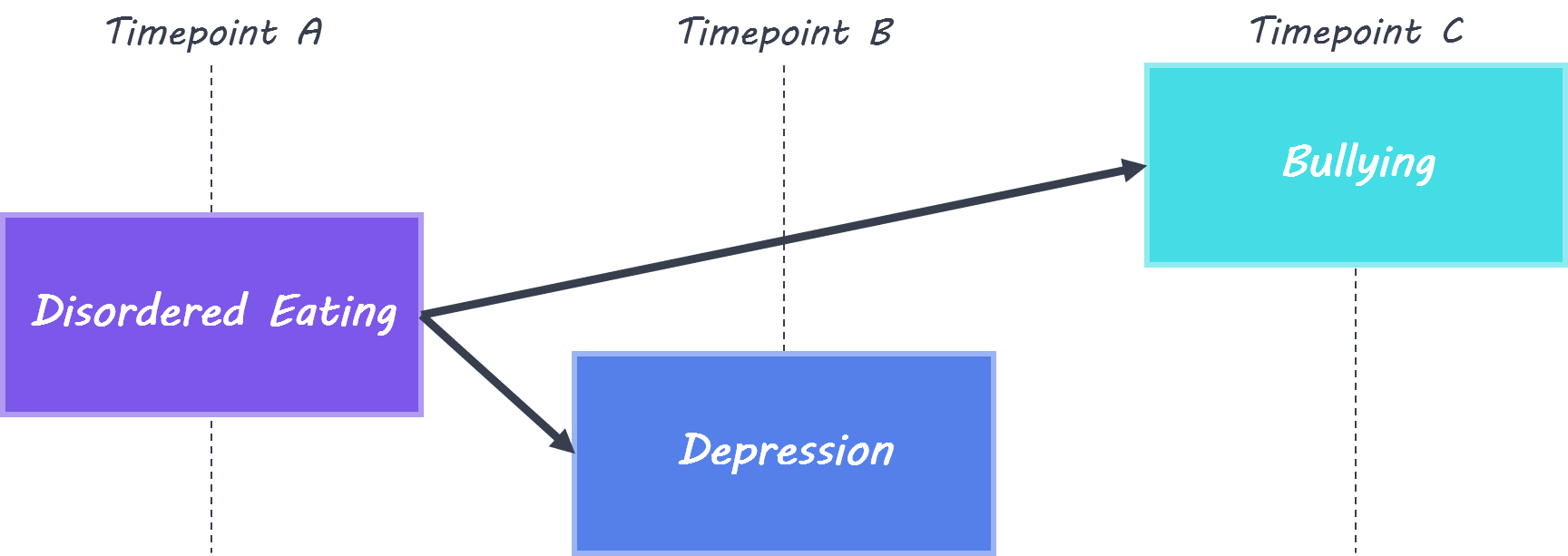
At each timepoint, there were significant positive relationships between the severity of bullying, disordered eating, and depressive symptoms. Girls reported more severe bullying, disordered eating, and depressive symptoms than boys. In the model which included ‘cross-lag’ effects, disordered eating was linked to depression one year later (at all timepoints) and to bullying two years later (at two timepoints). When sex differences were included in the model, it was discovered that there was a stronger relationship between disordered eating and depression in girls at most timepoints, while depression was more stable over time in boys.

Relationship between disordered eating, depression and bullying

What's the impact?

This is the first study to assess the relationship between bullying, disordered eating and depression in adolescents longitudinally. The results indicate that disordered eating at an earlier timepoint can predict both depression and bullying at later timepoints. This could be due to shared genetic factors underlying disordered eating, depression and bullying, or emotional dysregulation which is tied to disordered eating and could be a risk factor for bullying. This study suggests that targeting disordered eating and associated symptoms could reduce future depression and bullying in adolescents.

bully.png

K.S. Lee and T. Vaillancourt, Longitudinal Associations Among Bullying by Peers, Disordered Eating Behavior, and Symptoms of Depression During Adolescence. JAMA Psychiatry (2018). Access the original scientific publication here.