
A Lack of New Neurons in the Adult Hippocampus

What's the science?

Throughout fetal development and into childhood, many new neurons are being made in the brain -- this process plays an important role in learning and memory. In adults, things slow down, but it has been generally accepted that new neurons are still being made in a particular brain region called the hippocampus. Understanding whether or not new neurons are made in adults is critical because neurogenesis represents an important target for neurological diseases. This week in Nature, Sorrells and colleagues assessed neurogenesis across the lifespan in humans. 

How did they do it?

They assessed the young neurons and progenitor cells (cells that would eventually become neurons) in the hippocampus of 59 individuals. These individuals ranged in age between 14 weeks gestation and 77 years. Brain tissue was examined either a) after death or b) following resection due to epilepsy. Using light and electron microscopy, and staining, they imaged and counted rapidly dividing cells (Ki-67+ progenitor cells), and young neurons (DCX+PSA-NCAM+ neurons).

What did they find?

Many progenitor cells and young neurons were found during fetal development stages, but few were found after 7 years of age. There were no rapidly dividing Ki-67+ cells located in the subgranular zone of the hippocampus (where progenitor cells usually are) in brains older than 22 weeks gestational age. In surgical resections from epileptic patients, young neurons were found at 10 months gestational age (in the dentate gyrus region of the hippocampus), but few were found by 7 years and none were found in adults.
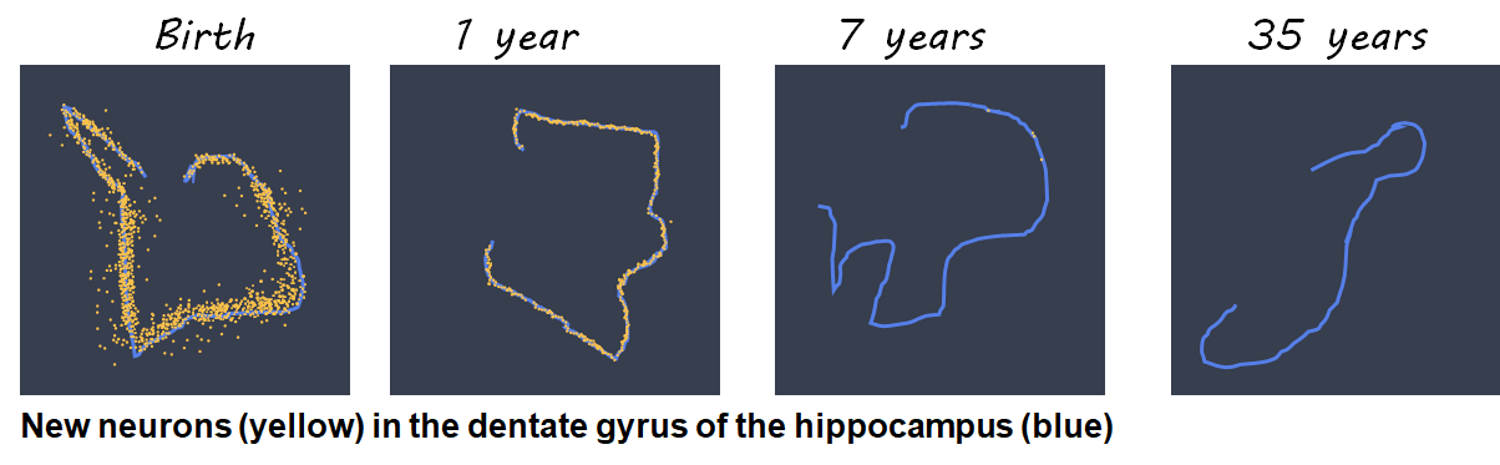
New neurons in the dentate gyrus of the hippocampus

What's the impact?

This study suggests that the generation of new neurons in the hippocampus of adults may be rare or non-existent in humans, contrary to commonly held beliefs. Researchers are now examining other species with little neurogenesis during the adult years, in order to find clues about why new neurons might not be generated in adults, despite their role in learning and memory.

S.F. Sorrells et al., Human hippocampal neurogenesis drops sharply in children to undetectable levels in adults. Nature (2018). Access the original scientific publication here.
Serotonin is Involved in Persistence

What's the science?

Serotonin is a neurochemical in the brain important for feelings of happiness. A current theory of serotonin function suggests that serotonin is involved in patience and inhibiting actions. Currently, we do not understand whether this involves patience in the sense of behavioral inhibition (i.e. not acting) or patience in the form continuing to act (i.e. persistence).This week in Nature Communications, Lottem and colleagues show that serotonin release in the brain is responsible for persistent behavior in mice.

How did they do it?

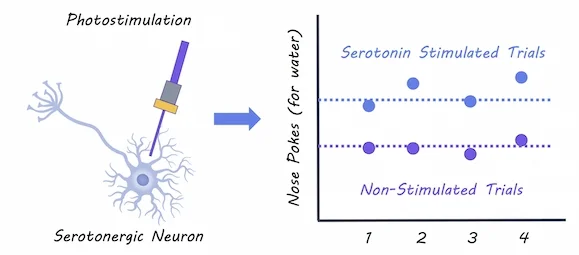
They used optogenetics to activate serotonin neurons (in the dorsal raphe nucleus) in the brains of mice during a foraging experiment. During foraging, animals explore an area for food or water, and at some point, they must give up and move on to a different area. This means the animal requires active patience (persistence) when exhausting their search in a given area. Water-restricted mice were required to “nose poke” to obtain a water reward while foraging an area. The probability of obtaining water at each reward station was reduced with each nose poke. The authors used a higher number of nose pokes as a measure of persistence, while a reduced number of nose pokes meant inhibition of behavior. They also used video tracking to measure how long it took for mice to switch to another area.

What did they find?

Mice exhibited optimal foraging behavior, meaning they optimized the trade-off between time spent searching an area for water and leaving to find reward in another area. The mice that received serotonin neuron stimulation performed a greater number of nose pokes compared to mice who did not receive stimulation. They also took longer to leave an area (but not to move in general) suggesting they were more persistent. The authors modelled this leaving behavior using a proportional hazards model to show that serotonin neuron stimulation reduced the probability of a mouse leaving an area.

Photostimulation of a serotonergic neuron

What's the impact?

This is the first study to show that serotonin neuron firing is responsible for active persistent behavior. Previously, it was hypothesized that serotonin was involved in patience through inhibiting behavior. We now know that serotonin neuron firing is involved in persistence. This extends what we know about the role of serotonin in behavior.

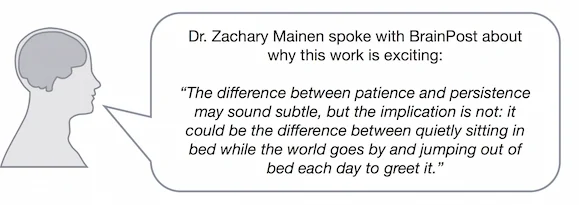
mainen_quote_week8_small.jpg

Reach out to study author Dr. Zachary F. Mainen on Twitter @zmainen and @mainenlab

E. Lottem et al., Activation of serotonin neurons promotes active persistence in a probabilistic foraging task. Nature Communications (2018). Access the original scientific publication here.
Synchrony Between Brains is Associated with Pain Relief During Social Touch

What's the science?

Skin-to-skin touch has been shown to reduce pain - for example, in a baby undergoing a medical procedure or in a person experiencing experimental pain. How this pain relief happens is unclear. When a person experiences pain, some of the same brain regions that activate are also active when expressing empathy for another person in pain. This week in PNAS, Goldstein and colleagues explored brain-to-brain synchrony during social touch to understand how it is related to pain perception.  

How did they do it?

They measured brain activity using electroencephalography (EEG) in two individuals (one man and one woman) simultaneously, 1) while the individuals were sitting together - not touching 2) sitting together - holding hands and 3) sitting in separate rooms. Then they repeated these scenarios as the woman was subjected to mild heat pain on her arm. The aim was to understand whether brain-to-brain synchrony was enhanced while one experiences pain and touch, and whether this was related to pain relief and their partner’s empathy. Neural activity in frontal and central brain regions was measured at the ‘alpha-mu’ frequency (8-12Hz). This frequency band has been shown to be involved in inter-brain interaction (when brain activity synchronizes in social interaction).

What did they find?

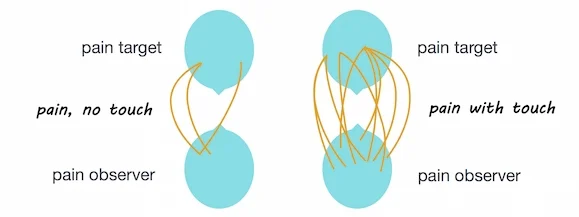
When partners held hands, the male partner was more empathetic, meaning he was more likely to accurately guess what level of pain his partner reported experiencing. Women reported lower pain overall when holding hands, indicating that touch reduced pain. While experiencing both pain and touch, there was a greater degree of inter-brain synchrony between partners than during any other experimental condition - predominantly between sensory brain regions in women and the right hemisphere of the brain in their male partners. In the touch + pain condition, pain reduction in women during touch was correlated with strong synchrony between the sensory brain regions and frontal brain regions in their partner.

Artistic rendering of Figure 2: Inter-brain coupling.

Artistic rendering of Figure 2: Inter-brain coupling.

What's the impact?

This is the first study to assess brain communication between different individuals during pain to understand the brain mechanisms underlying touch-related pain relief during social interaction. These findings suggest that certain patterns of inter-brain communication are related to pain relief by social touch. 

pain_quote_small.jpg

Reach out to study authors Dr. Pavel Goldstein and Dr. Guillaume Dumas on Twitter: @pavelgoldstein and @introspection

P. Goldstein et al., Brain-to-brain coupling during handholding is associated with pain reduction. PNAS (2018). Access the original scientific publication here.