Genetic Risk Score for Alzheimer’s Disease Predicts Early Cognitive Impairment

What's the science?

Alzheimer’s disease pathology in the brain occurs years before symptoms show up. Identifying younger adults who may be genetically at risk is crucial so that therapies can be given early on in the disease. This week in Molecular Psychiatry, Logue and colleagues demonstrate how a genetic risk score can help to predict cognitive problems.

How did they do it?

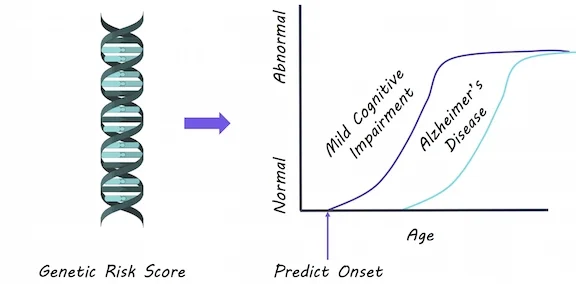
They analyzed genetic data for 1176 participants in their 50’s, some of whom were diagnosed with mild cognitive impairment, a condition preceding Alzheimer’s disease involving memory and thinking problems. Using genetic polymorphisms (changes in the DNA code) that are known to increase risk for Alzheimer’s disease, they created a score for each individual based on the number of risk alleles they had and the likelihood that they would increase risk. They then tested whether this score was associated with increased odds of having mild cognitive impairment, after accounting for other factors that can increase Alzheimer’s risk: age, depression, hypertension, diabetes and head trauma. They also tested a second score after removing the effect of APOE (a gene known to drastically increase risk) to ensure that the risk score was not driven by APOE alone.
Genetic Risk Score for Alzheimer’s Disease Predicts Early Cognitive Impairment

What did they find?

A genetic risk score was associated with higher chances of having mild cognitive impairment (impaired memory specifically). The risk score was able to predict who had mild cognitive impairment, even after excluding the effects of APOE. Diabetes was associated with a greater risk of mild cognitive impairment (specifically non-memory related cognitive impairment). This risk score was better able to predict mild cognitive impairment than age, other risk factors and APOE alone.

What's the impact?

This is the first study to show that an Alzheimer’s disease risk score can predict mild cognitive impairment in younger adults in their 50’s. Previously, most studies attempted to predict cognitive problems in older adults, however, by this time Alzheimer’s pathology in the brain can be too advanced for therapies to work. Genetic risk scores may be able to predict cognitive problems at an earlier stage, so that therapies can be used to slow Alzheimer’s disease.

M Logue et al., Use of an Alzheimer’s disease polygenic risk score to identify mild cognitive impairment in adults in their 50s. Molecular Psychiatry (2018). Access the original scientific publication here.
Immune Activation During Development Affects Brain Circuitry Involved in Social Interaction

What's the science?

The immune system could contribute to developmental disorders including Autism Spectrum Disorder. Evidence suggests that immune system activation during pregnancy and shortly after birth can lead to symptoms of autism in mice, however, the brain circuits involved are not known. This week in The Journal of Neuroscience, Li and colleagues test how maternal and postnatal immune activation in mice affect brain circuits implicated in autism.

How did they do it?

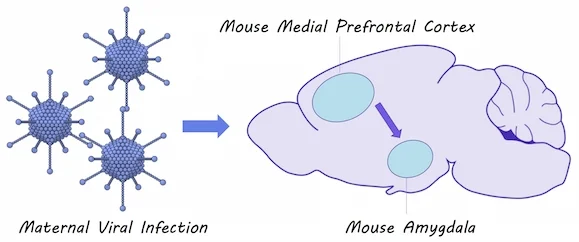
They simulated a viral infection in pregnant mice to induce immune system activation. They also simulated an infection in newborn mice to induce immune system activation shortly after birth. They measured the amount of time that mice spent socially interacting and whether they had more anxiety-like behavior. Using optogenetics and whole cell patch clamp recordings, they tested how early immune system activation would affect the flow of neural signals between the medial prefrontal cortex and the amygdala, a brain circuit known to be involved in social interaction and anxiety. They also used immunohistochemistry to measure the number of microglia (i.e. the brain’s immune cells) present in the amygdala of mice after immune responses.

Immune response to infection

What did they find?

 Mice who were affected by maternal immune activation as well as mice that were affected by postnatal immune activation displayed more anxiety-related behaviors and decreased social interaction compared to unaffected mice. There were also increased numbers of microglia found in the amygdala of these mice. They found that neural connections were stronger between the medial prefrontal cortex and the amygdala in mice affected by maternal immune activation and when maternal and postnatal immune activation were combined. They also found that inhibition of the amygdala by inhibitory neurons, activated by projections form the medial prefrontal cortex, was reduced in mice affected by postnatal immune activation (but not maternal immune activation), suggesting two distinct mechanisms for brain circuit changes in response to immune activation.

What's the impact?

This study confirms that immune responses to infections in early development can result in changes to a brain circuit involved in social interaction and anxiety. Brain changes occurring after immune system activation could contribute to the development of disorders like Autism Spectrum Disorder.

asd_quote_small.jpg

Y Li et al., Maternal and Early Postnatal Immune Activation Produce Dissociable Effects on Neurotransmission in mPFC-Amygdala Circuits. The Journal of Neuroscience (2018). Access the original scientific publication here.

The Brain’s Immune Cells Help Motor Neurons Recover in a Mouse Model of ALS

What's the science?

ALS is a devastating disease where motor neurons degenerate. TDP-43 is a toxic protein that builds up in ALS and contributes to this degeneration. It is unclear whether the immune cells of the nervous system, microglia, react to TDP-43 and whether they play a protective role or make neurodegeneration worse. This week in Nature Neuroscience, Spiller and colleagues test whether microglia contribute to neurodegeneration in a mouse model of ALS.

How did they do it?

They used a transgenic mouse model for ALS in which TDP-43 (toxic protein) build-up can be induced or reversed by suppressing or activating TDP-43 gene expression. With this model they can simulate motor neuron degeneration or recovery. The authors measured whether there were any changes in the number of microglia or their activation state (indicated by the size and shape of the cells) at several time points using immunostaining in the spinal cord, both after inducing TDP-43 damage and after reversing this process. Increases in microglia number and activation indicate that the microglia are actively responding to neuron damage. They also measured gene expression changes in the microglia during the degeneration and recovery of motor neurons. They then measured whether TDP-43 could be found inside the microglial cells, indicating that the microglia are “eating” the proteins to clear them. Finally, they blocked microglia cell replication to test how motor neuron function would recover in regenerating motor neurons.

What did they find?

Microglia were not initially reactive to toxic protein buildup. By the time the motor neurons were severely degenerated, there was a slight increase in the number of microglia and a change in the activation state (i.e. the number of microglia reacting). After reversing the TDP-43 pathology, microglia number and activation increased immediately and dramatically, suggesting that the microglia play a more important role in helping motor neurons recover. This activation of microglia was specific to TDP-43 proteins, and not just a response to neuron death in general. The microglia also showed many changes in gene expression during early recovery (and not early disease), indicating that they are involved in the early recovery process. TDP-43 was found inside microglia, showing that these immune cells actually clear TDP-43 during recovery. When microglial cells were not able to multiply, the motor neurons that were damaged by TDP-43 did not fully recover, and the mouse did not regain full motor function, indicating that microglia are required for a full motor recovery.

Microglia, Servier Medical Art, image by BrainPost, CC BY-SA 3.0

Microglia, Servier Medical Art, image by BrainPost, CC BY-SA 3.0

What's the impact?

This is the first study to show that microglia are involved in the recovery of motor neurons in a reversible mouse model of ALS. Previously, we weren’t sure whether these immune cells of the nervous system actually make things worse or protect neurons from damage in ALS. We now know that microglia play an active role in restoring motor function in neurons damaged by TDP-43 protein buildup in this mouse model of ALS. Currently, we do not have therapies to restore motor function in ALS, and this study suggests that we may be able to target microglia.

krista_test_small.png

Reach out to study author Dr. Krista Spiller on Twitter @krista_spiller

K. Spiller et al., Microglia-mediated recovery from ALS-relevant motor neuron degeneration in a mouse model of TDP-43 proteinopathy. Nature Neuroscience (2018). Access the original scientific publication here.