Your Brain Reacting to Social Injustice

What's the science?

How do we perceive injustice? Many neuroimaging studies have looked at how we perceive the violation of social norms by analyzing brain activity while participants play a computer game. For example, participants might have the option to punish one player who is acting unfairly (e.g. stealing) towards another. Further, different hormones, like oxytocin, influence our social behaviour, suggesting they can play a role in our perception of injustice. This week in The Journal of Neuroscience, Stallen and colleagues performed a new set of experiments using brain imaging to analyze the perception of injustice.

How did they do it?

First, oxytocin was administered to half of the participants. Next, all participants underwent an fMRI brain scan, while playing three computer games: 1) Participants played against an opponent, called a ‘taker’. The taker had the opportunity to steal up to 100 chips away from the participant, and the participant could then punish the taker by giving up up to 100 of their own chips. For each chip they gave up 3 would be taken from the taker, (injustice happening to them) 2) Participants received 200 chips and observed a taker stealing chips from another player, and could then punish the taker (using up to 100 chips, 3 taken from the taker for each chip given up), (observing social injustice, punishing as a third party) and 3) Participants observed a taker stealing chips from another player, and could compensate the disadvantaged player using up to 100 chips (the disadvantaged player was given 3 chips per chip given up) (observing social injustice, compensating as a third party). Participants knew they would receive real monetary compensation after the games according to their performance, and all games were anonymous.
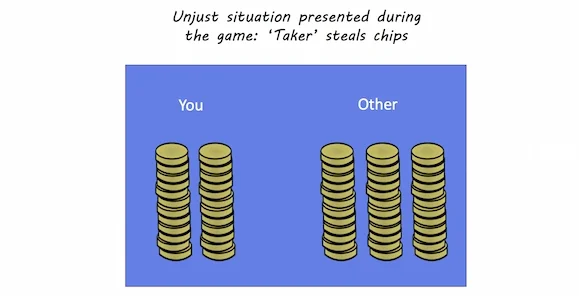
Perception of injustice computer game

What did they find?

Participants who received oxytocin were more likely to dole out small punishments, frequently, to a taker who took chips from the participant or another player, versus participants who did not receive oxytocin. When the authors compared trials in which a participant doled out punishment to the taker versus compensating the disadvantaged player, there was greater activity in the ventral striatum -- a brain region involved in processing rewards. The decision to administer punishment was associated with activity in the anterior insula -- a brain region involved in “gut feelings” and decision making involving risk. Activity in the amygdala, a brain region associated with affective arousal, was correlated with the severity of punishment administered but only in experiment #2, when participants observed a taker behaving unfairly towards someone else.

What's the impact?

This is the first study to assess the perception of social justice in situations where an individual is experiencing injustice firsthand compared to observing injustice as a third party. This study suggests two distinct brain mechanisms might be at play during these unjust situations.

A word of caution: Different brain regions are activated in many different situations. Just because a brain region is known to be activated during reward, for example, does not necessarily mean that brain region will always be active during reward processing.
Stallen_comment_new_small.jpg

M. Stallen et al., Neurobiological Mechanisms of Responding to Injustice. Journal of Neuroscience. (2018). Access the original scientific publication here.
Astrocytes Become Reactive with Normal Aging

What's the science?

Astrocytes are are the most abundant cell in the brain. They help to respond to injury and are important for maintaining overall brain health by supporting neurons, recycling neurotransmitters and regulating the formation and elimination of the connections between neurons. Astrocyte dysfunction is known to play a role in neurodegenerative diseases, but how astrocytes change throughout normal aging is not well known. One way to understand these changes is by looking at the transcription of genes in astrocytes. This week in PNAS, Clarke and colleagues performed RNA sequencing in mice at different stages of life to understand how astrocytes change over time.

How did they do it?

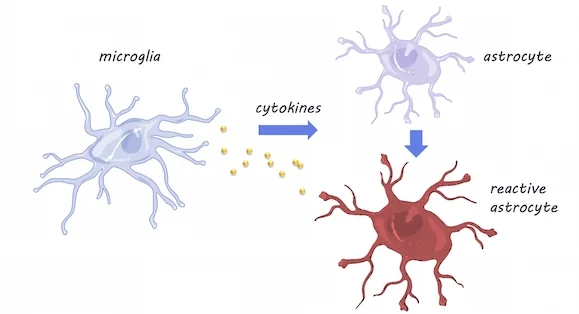
RNA sequencing was performed in mice at five time points between adolescence and old age, in three different brain areas: the cortex, hippocampus (involved in memory), and striatum (involved in movement and reward). They validated their findings using fluorescence in situ hybridization and quantitative polymerase chain reaction (qPCR) techniques (these techniques can confirm gene expression changes). To investigate whether the resident immune cells of the brain - microglia - play a role in inducing changes in astrocytes with aging, they compared astrocyte gene expression in mice with and without (knock-out mice) cytokines. Cytokines are released by microglia in response to neuroinflammation. 

What did they find?

Using RNA sequencing, they found that as astrocytes age, they are more likely to express genes associated with reactivity (this is when astrocytes become dysfunctional -- typically associated with neuroinflammation). Astrocytes were especially likely to become reactive in the hippocampus and striatum, which are areas particularly susceptible to neurodegeneration in aging. Using qPCR, a method used to observe DNA sequences, they found that reactive gene expression was not increased in the knock-out mice without cytokines, indicating that microglia expression of cytokines may be partially responsible for changes in astrocyte gene expression. Aged brains also formed many more reactive astrocytes in response to the neuroinflammation inducer ‘lipopolysaccharide’, which may indicate vulnerability of the aged brain to disease and inflammation.

                       Microglia & Astrocytes, Servier Medical Art, image by BrainPost, CC BY-SA 3.0

                       Microglia & Astrocytes, Servier Medical Art, image by BrainPost, CC BY-SA 3.0

What's the impact?

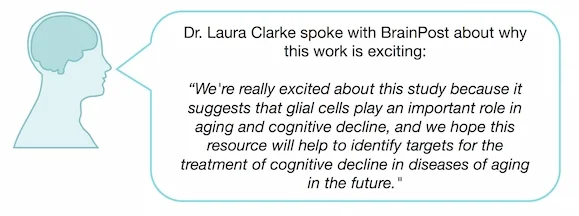
This is the first study to demonstrate that astrocytes become reactive as they age and that microglia- the immune cells of the brain- may be responsible through cytokine activity. More reactive astrocytes were found in brain regions vulnerable to degeneration, suggesting that changes in astrocyte gene expression may help explain neurodegenerative diseases or cognitive decline in aging.

Clarke_comment_new_small.jpg

Reach out to study author Dr. Laura E. Clarke on Twitter@ClarkeLauraE

Clarke et al., Normal aging induces A1-like astrocyte reactivity. (2018). Access the original scientific publication here.
Resting Brain Activity Predicts Who Responds to Cognitive Behavioral Therapy for OCD

What's the science?

Obsessive Compulsive Disorder (OCD) affects 1-2% of the population and can affect quality of life. Cognitive behavioral therapy (CBT) is a method of treatment that has been shown to be effective in some individuals, but not all. Currently, there is no method to predict who will benefit from CBT. Recently, functional MRI of individuals at rest has emerged as a promising tool for predicting treatment outcomes. This week in PNAS, Reggente and colleagues test whether resting brain activity patterns can predict treatment response.

How did they do it?

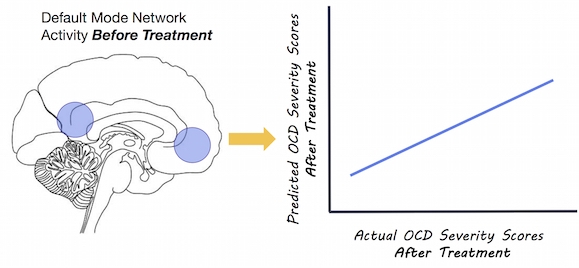
Adults with a diagnosis of OCD underwent resting state functional MRI scans before and after 4 weeks of daily CBT. They analyzed the resting state fMRI scans using a multivariate approach and machine learning to detect whether patterns of resting state activity before treatment could predict individual OCD symptom severity scores after treatment. Resting brain activity was extracted from 196 brain regions and patterns of activity in all regions were correlated with one another. Multivariate analyses have the ability to capture multiple patterns of brain activity, and may be better than univariate approaches for predicting individualized responses to treatment. OCD symptom severity was also assessed before and after the 4 weeks of treatment.

What did they find?

OCD symptom severity scores improved after treatment in almost all participants. The authors found that pre-treatment resting state patterns in two brain networks -the default mode network and the visual network - strongly predicted individual variability in OCD symptom severity score. The default mode network (active while an individual is at rest) accounted for 67% of the variation in post-treatment symptom severity scores, while the visual network accounted for 51%. The activity in these networks better predicted post-treatment severity scores than the severity of OCD before treatment.

Brain by cronodon.com, Image by BrainPost

Brain by cronodon.com, Image by BrainPost

What's the impact?

Knowing who will respond to treatment is important as CBT is time consuming and expensive. This is the first study to report resting state network patterns as a reliable predictor of individual response to CBT treatment for obsessive compulsive disorder. Individual resting state patterns could reflect the plasticity or adaptability of brain networks to treatment. This study brings us one step closer to using individualized treatment plans for complex disorders.

Reggente_author_week5_small.jpg

Reach out to study author Dr. Nicco Reggente on Twitter @mobiuscydonia

N. Reggente et al., Multivariate resting-state functional connectivity predicts response to cognitive behavioral therapy in obsessive–compulsive disorder. PNAS. (2018). Access the original scientific publication here.