
Amyloid-β Proteins Differ Between Alzheimer’s Disease Subtypes

What’s the science?

Alzheimer’s disease can be genetically inherited (familial/heritable) or sporadic. A key feature of the disease is the build up of amyloid-β proteins in the brain. A mutant form of amyloid-β is found in heritable Alzheimer’s disease, and is thought to cause the misfolding of normal amyloid-β proteins, leading to a more rapid build up. Recently in PNASCondello and colleagues probed the structure of different conformations or strains of amyloid-β proteins, to see whether they differ between heritable and sporadic Alzheimer’s.

How did they do it?

They performed confocal spectral imaging using three fluorescent dyes that bind to amyloid protein and are sensitive to protein structure in mouse and human brains. Different dyes bind differently to distinct protein conformations. In mice, they combined mutated and non-mutated amyloid-β, to test whether the mutated form could cause protein misfolding.

What did they find?

The heritable and sporadic amyloid-β plaques exhibited different fluorescence intensities after staining with the three dyes, meaning they could be differentiated. The fluorescence emission spectra also differed between disease types, suggesting different protein conformations. In mice, when mutated and non-mutated amyloid-β were mixed, the mutated amyloid-β acted as a template allowing the normal amyloid-β to misfold.
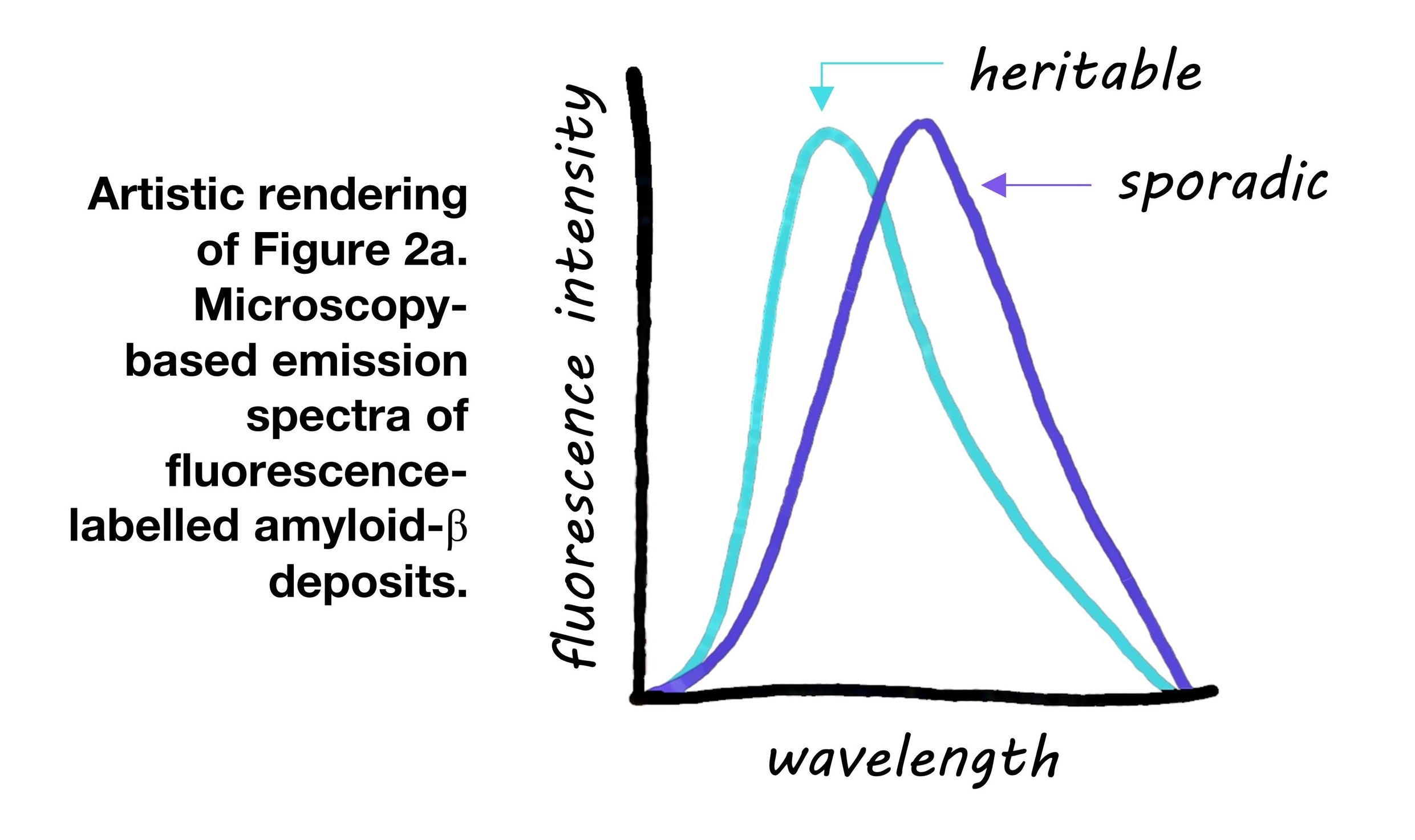
amyloid-beta deposits

What’s the impact?

This is the first study to use this fluorescence microscopy technique to assess different strains of amyloid-β. The different protein structure in these amyloid-β strains could help to explain differences in the rate of disease progression, for example between familial Alzheimer’s disease compared to sporadic Alzheimer’s disease. Understanding the differences in protein structure between these amyloid strains may help clarify how they cause other proteins to misfold and the disease to spread.

C. Condello et al., Structural heterogeneity and intersubject variability of Aβ in familial and sporadic Alzheimer’s disease. PNAS. 115(4) (2018).

Access the original scientific publication here.

Your Brain is Right on Time

What's the science?

Everyday we need to speak and move at different speeds depending on the situation, but the way we control the timing of our speech and movements is not well understood. This week in Nature NeuroscienceWang and colleagues report a new mechanism in the brain for controlling how we time things in a flexible way. 

Brain, light bulb, clock

How did they do it?

They performed an experiment where monkeys were trained to flexibly make movements after both short and long time intervals. They recorded the rate of neuron firing during this time using electrodes in two brain regions known to be involved in brain timing: the medial frontal cortex and the caudate.

What did they find?

They demonstrate that in both of these regions, the longer the time interval before the monkey's movement, the slower the neuron firing rate. This means that the speed of neuron firing is scaled according to the time interval. In other words, the brain has a mechanism for adjusting its firing rate so that movements can stay flexible. This scaling of neuron firing explained both the timing and flexibility of the monkey's movements. 

What's the impact?

This is the first study to clarify the mechanism through which the brain controls timing of movements. Previous models of timing didn't quite fit with the data recorded from the brain. Now we have a better understanding of how we can play music, speak at different speeds and move when we want to.
 

Read the original journal article here.

J. Wang, D. Narain, E. A. Hosseini, M. Jazayeri, Flexible timing by temporal scaling of cortical responses. Nat. Neurosci. 21, 102–110 (2017).


The Nature vs. Nurture of Song Learning

What's the Science?

Learning is affected by individual genetic differences and previous experience. The way that genetics and experience interact to affect learning is not fully understood. This week in PNASMets and colleagues set out to determine whether song learning by birds is influenced by genetics and whether quality of instruction has any impact on this genetic influence.

Birds singing different song tempos

How did they do it?

To test whether genetics has an impact on learning, they performed an experiment where birds (finches) from different genetic backgrounds learned a song tempo after receiving computer instruction. To see whether the quality of instruction changes the influence of genetics on learning, a second set of birds received enriched instruction (tutoring by other birds).

What did they find?

They found that the birds with different genetic backgrounds and the same level of experience produced songs with a range of different tempos. This shows that genetics alone has a strong impact on learning song tempo. When they factored in the quality of instruction, they found that the genetic influence on learning became weaker, meaning that experience also has a strong impact on learning and can even override the impact of genetics. 

What's the Impact?

This is one of the first studies to test the contribution of genetics and experience on learning. Importantly, this study highlights that the influence of genetics on learning can depend a lot on our experience. Rather than ‘Nature vs. Nurture’, learning seems to be all about the interaction between the two.
 

Read the original journal article here.
 

D. G. Mets, M. S. Brainard, Genetic variation interacts with experience to determine interindividual differences in learned song. Proc. Natl. Acad. Sci. 115, 421–426 (2017).