
How Word Processing and Facial Recognition Adapt After Stroke
Post by Amanda Engstrom
The takeaway
Within the brain, facial recognition is lateralized to the right, and word processing is lateralized to the left. In individuals who suffer an early stroke in the left hemisphere, both word processing and facial recognition occur on the right without any impairment to facial recognition ability.
What's the science?
In the neurotypical human brain, the fusiform face area (FFA), a region within the ventro-occipital temporal cortex (vOTC), responds preferentially to faces. Face processing is right-lateralized, meaning the right hemisphere of the FFA is more active and dominant than the left. Conversely, language and visual word form processing are left-lateralized in a region called the visual word form area (VWFA) within the left VOTC. It has been hypothesized that these two lateralization patterns are linked: as children learn to read, the VWFA establishes itself in the left vOTC, either displacing or blocking the expansion of facial processing there, causing face processing to rely more heavily on the right vOTC. While correlations between literacy and face lateralization support this idea, evidence of direct competition between word and face processing remains mixed. This week in the Journal of Neuroscience, Seydell-Greenwald and colleagues used functional MRI (fMRI) to test whether face processing is altered in individuals who suffered a left-hemisphere perinatal stroke (LHPS) and consequently developed right-lateralized language and word processing.
How did they do it?
The authors performed fMRI on 15 individuals with LHPS (mean age 19 years) who had previously established right-hemisphere language dominance and right-lateralized VWFA and compared them to 14 neurotypical individuals (mean age 16 years) with typical left-hemisphere language dominance. Both groups were fluent readers with comparable language comprehension scores. Participants completed a visual localizer task in which they viewed rapid sequences of images from three categories: faces, places, and word forms, allowing the authors to map and compare the lateralization of face and word form processing across groups. Participants then completed the Cambridge Face Memory Test, a standardized assessment of unfamiliar face recognition, requiring them to learn six faces and then identify them across different viewing angles and conditions. Together, these two tasks allowed the authors to assess both the neural lateralization of face processing and its behavioral consequences in individuals with LHPS relative to unaffected control participants.
What did they find?
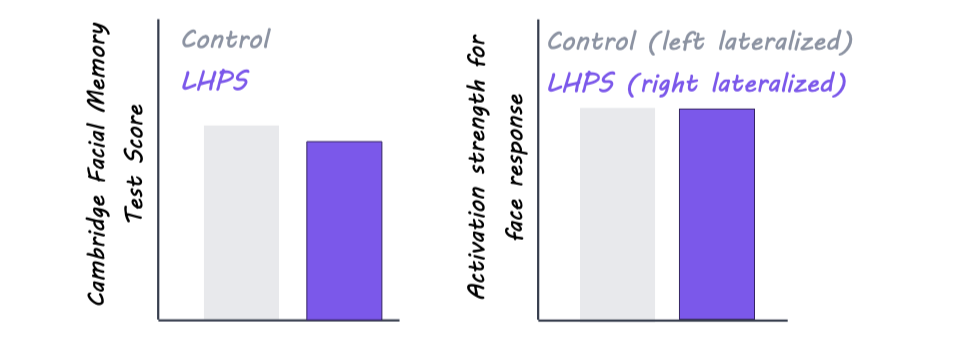
Control participants showed the typical pattern of left-lateralization for word forms and right-lateralization for faces, while the LHPS group was right-lateralized for both. This indicates that when word processing reorganizes to the right hemisphere after an early stroke, face processing does not compensate by shifting to the left. Instead, both functions are supported by the same hemisphere. There were no significant differences in the strength, spatial extent, or peak activation of face responses between the two groups, and both groups showed a positive correlation between face lateralization and word form lateralization, meaning stronger right-lateralization for words was associated with stronger right-lateralization for faces. Lastly, LHPS participants performed slightly but not significantly worse than controls on the Cambridge Face Memory Test, and both groups scored within normal range. Together, these findings suggest that sharing the right vOTC with word form processing does not meaningfully compromise the neural representation of faces or the ability to recognize them.
What's the impact?
This study was the first to show that although the neurotypical brain delineates facial processing and visual word processing to either the right or left hemisphere, respectively, patients who have experienced early stroke to the left hemisphere can process both faces and written words together in the right hemisphere without any meaningful cost to either. This challenges the long-standing idea that the typical opposite-hemisphere arrangement of face and word processing is driven by competition. These findings provide insight into the key drivers of lateralizing specific neuronal pathways and demonstrate the remarkable capacity of the developing brain to reorganize after injury.