
Natural Rhythms of Periodic Temporal Attention
Post by Stephanie Williams
What's the science?
Temporal attention allows us to flexibly allocate attentional resources to specific points in time. We don’t fully understand the limits of our temporal attention resources, or whether different sensory modalities may be constrained in different ways. This week in Nature Communications, Zalta, Petkoski, and Morillon show that temporal attention is constrained within specific frequency ranges specific to each sensory modality and modulated by overt motor activity.
How did they do it?
The authors performed a set of six behavioral experiments across two sensory modalities; auditory and visual. They designed the experiments to characterize the optimal frequencies of, and the limits of, periodic temporal attention during visual and auditory perception. The authors played pure tones or displayed a visual grating to participants at different isochronous tempi, and then asked participants to report whether the last stimulus of the sequence was on or offbeat. They used the accuracy of participants in this task to estimate their optimal beat frequency. The authors added distractors to both the auditory and visual tasks to adjust for difficulty at the individual level and achieve similar performance across modalities. They found that they had to add fewer distractors to the visual task to achieve a similar level of difficulty as in the auditory task. To test how overt motor activity could contribute to temporal attention, the authors asked participants to either sit completely still while performing the task (the “passive” session) or to tap their index finger on beat with the target stimuli (the “tracking” session). They compared the behavioral results across the two sessions to understand the motor contribution to temporal attention. Finally, they asked participants to tap their finger (“free tapping”) at a comfortable rate for 60 seconds to estimate the natural rate of rhythmic movements of each participant.
The authors then built a model for sensory-specific periodic temporal attention. The model was made up of three time-delayed coupled oscillators comprising the periodic stimulus, a sensory-specific temporal attention oscillator, and a motor oscillator. In their model, periodic temporal attention was modeled as an ongoing intrinsic oscillatory process with an optimal sampling rate.
What did they find?
The authors found that there was an optimal beat frequency for temporal attention in both the auditory and visual perception tasks. In experiment one, the authors found that performance across the eight different auditory tempi investigated had an inverse U-shape profile. The peak of the inverse U sat at the tempo for which participants showed their peak performance, which was different for the auditory and visual tasks. The authors found that the optimal tempo of auditory temporal attention was obtained for a rhythmic sampling frequency of 1.4 Hz. In contrast, the authors found that visual temporal attention had an optimal sampling frequency of approximately 0.7 Hz (an optimal beat frequency approximately two times lower than the auditory rhythm).
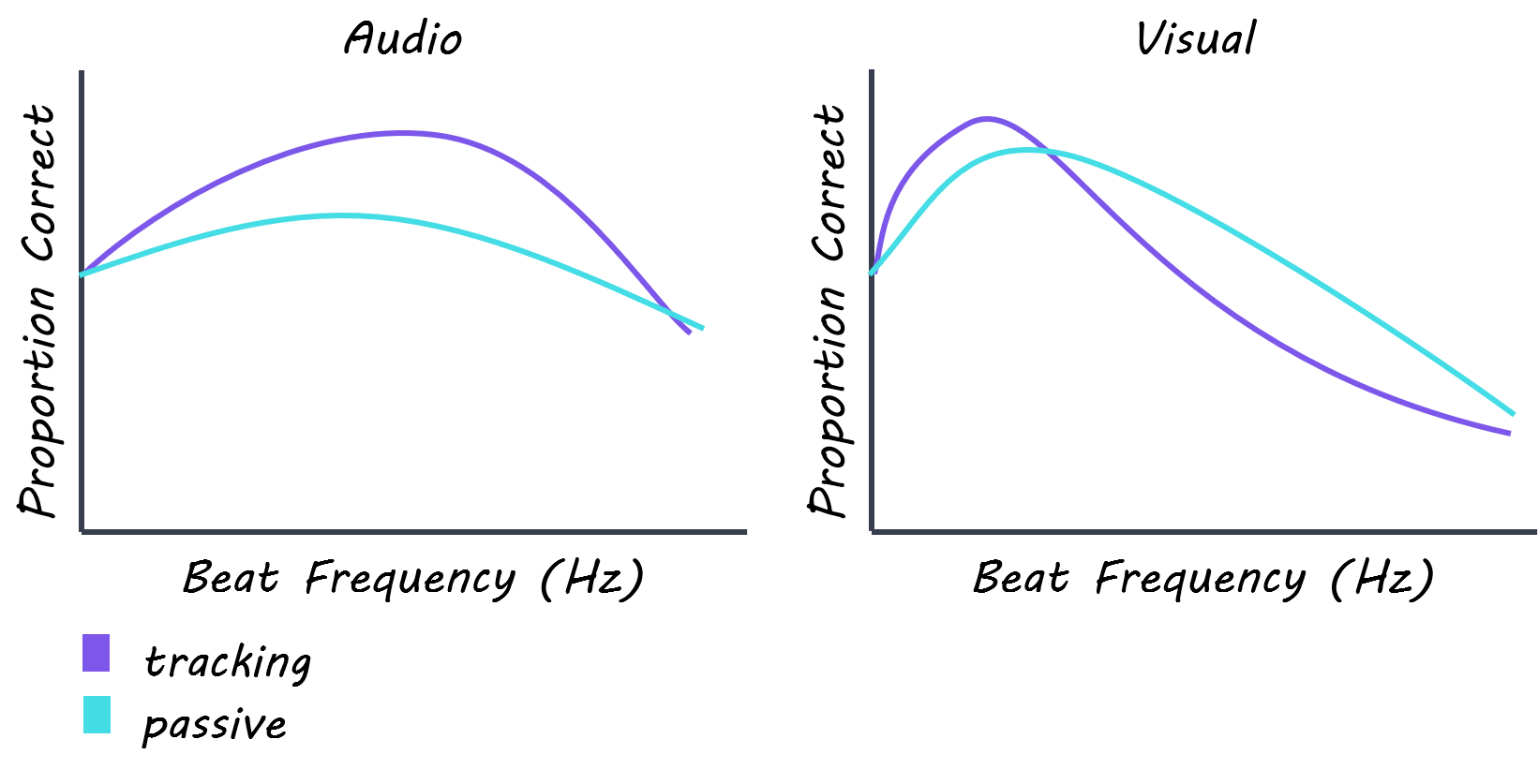
When the authors compared the passive and motor tracking sessions from the experiments investigating motor contributions, they found different effects in the auditory and visual conditions. In the auditory task, having participants tap their index finger could improve performance of up to 10%, but only within a specific frequency range, between 1.3 to 2.2 Hz. The authors calculated the optimal beat frequency to be around 1.5 Hz in both the passive and tracking sessions. During the fastest tempi, participants tended to tap too slowly. Similarly, during the slowest tempi, participants tended to tap too fast. In line with previous findings, the authors, therefore, suggest that overt motor activity optimizes auditory temporal attention. Specifically, the benefit of the motor activity is rate-restricted and has a maximum effect at 1.5 Hz. In the visual perception task, motor tapping significantly decreased performance at specific frequency ranges (between 1.7 and 2.2 Hz). The authors observed that in this visual task participants tapped faster and later than the actual beat. Trials that participants scored correctly on were associated with lower sensorimotor simultaneity than trials scored incorrectly. When participants closely tracked the beat with the motor task, they performed worse on the visual trials, especially at 1, 1.7 and 2.2 Hz. In short, motor tracking improved performance accuracy in the auditory perception task, but negatively impacted accuracy in visual perception task, due to the constraints in the temporal alignment between motor and attention fluctuations. When the authors asked subjects to free tap, they found that the subject tapped at a rate of 1.7 Hz, on average.
The authors’ model reproduced the results they found in both the visual and auditory sessions of the “passive” and “tracking” sessions (the model’s fit quality to the behavioral data was .92 for auditory and 0.95 for visual tasks). The model showed that the time delay between stimuli and the motor oscillator was critical for estimating the impact of motor tracking on performance across different sensory modalities. The authors found that a slight time delay (100 ms) had a positive impact on the quality of periodic temporal attention, while a longer delay had a disruptive effect, respectively compatible with auditory and visual periodic temporal attention.
What's the impact?
The authors quantify the optimal sampling frequencies of auditory and visual temporal attention and show that periodic temporal attention may be optimal at these frequencies. They build a model that captures their behavioral results and further shows that the impact of motor activity on temporal attention depends upon the temporal alignment between motor acts and attention fluctuations.
Zalta et al. Natural Rhythms of Periodic Temporal Attention. Nature Communications. (2020). Access the original scientific publication here.