
Frontal Cortex Neuron Types Categorically Encode Single Decision Variables
Post by Stephanie Williams
What's the science?
Individual neurons in cortical regions respond to specific features relevant to the function of the region. For example, individual neurons in primary visual cortex will fire robustly in response to viewing a line or a bar at a particular orientation. It is not currently known whether individual neurons across all cortical regions — especially in the frontal cortex which is involved in complex behavior — respond to specific sensory or task-related features, or whether information can only be read out from populations of neurons. This week in Nature, Hirokawa and colleagues show that the activity of individual neurons in rat orbitofrontal cortex covaries with individual decision variables.
How did they do it?
The authors examine the relationship between single neuron activity in rat orbitofrontal cortex and a set of individual choice variables by 1) recording behavioral and neural data from cohorts of rats performing a complex decision task and 2) developing a computational model of behavior for the decision task. They use the variables defined in their behavioral model to interpret the trends they observe in their neural data.
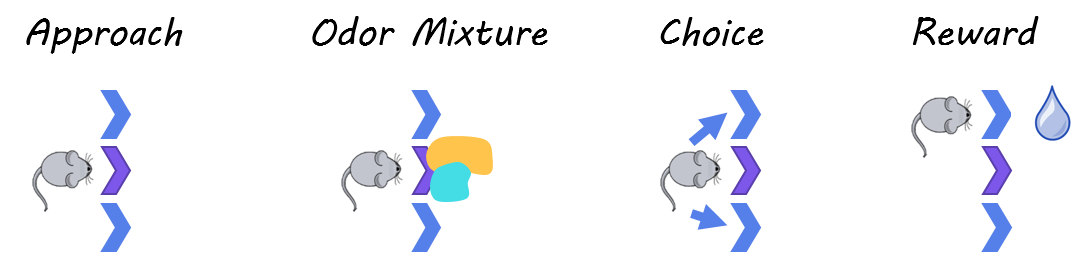
The decision task was a reward-biased olfactory decision task that required rats to make both perceptual and value-guided decisions. In the task, the rats sampled a mixture of two odors, and then had to choose between either the left or right port to receive a water reward. To make a correct choice, the rats needed to choose the port that corresponded to the dominant odor in the mixture. The structure of the task allowed it to be broken into several different epochs, which the authors analyzed separately. For example, the “reward anticipation epoch” consisted of the time period after the rat had entered a port to make the left or right choice, and before the rat received feedback on its choice. To vary perceptual uncertainty, the authors varied the concentration ratio of the odors in the mixture (5% to 95%) across trials. To vary reward expectations, the authors changed the amount of water given to the rats in the left or right ports across blocks. The authors recorded from hundreds of neurons in the orbitofrontal cortex of 9 rats while they performed the task.
The computational model the authors developed to represent decision choices incorporated variables that represented the reward context (eg. the size of the potential reward and the presence of a reward, previous rewards), variables that represented the sensory evidence that the rats used to represent the expected reward, and the amount of confidence in their decision. The authors first identified individual orbitofrontal neurons that covaried with particular variables in their decision model. Then, to ensure the neurons they identified were representative of the orbitofrontal neural population, the authors used a model-free approach to identify clusters of neurons that showed similar responses. The authors conducted their first set of analyses on a particular epoch of the task, the reward anticipation epoch, and then repeated their clustering procedure on two other epochs (the stimulus epoch and the feedback epoch). To understand whether the orbitofrontal neuron clusters represented individual task variables, decision variables, or mixtures of variables, the authors fit several regression models to the cluster-averaged response of neurons. Some of the models they used consisted of variables that were randomly mixed, which they compared to the models consisting of unmixed elementary decision variables.
To understand whether there was anatomical organization underlying the response profiles of the neural clusters, the authors examined neurons projecting to the striatum using a retrograde virus to target striatal-projecting neurons (this virus traces neurons back to where they originate from - the orbitofrontal cortex). They analyzed the activity of the tagged neurons in the context of the decision variables in their behavior model. The authors then repeated all of their analyses on an independent cohort of rats to confirm the reproducibility of their results.
What did they find?
When the authors analyzed the activity of neurons during the reward anticipation epoch of the task, they found individual neurons encoded specific variables in their behavioral choice model. For example, the authors identified individual neurons that were specifically active in proportion to the amount of evidence that supported their choice (eg. their confidence in their choice), and were not influenced by the amount of expected reward. They identified similar neurons for the decision variables in their model, including the anticipated reward size and the choice value, defined as probability of a reward multiplied by the reward size. When the authors used the model-free approach to cluster OFC neurons according to their response profiles, they found that there were nine primary clusters for the reward anticipation epoch. Each of the clusters they identified using their model-free approach resembled a variable in their computational model of behavior. These variables included decision confidence, integrated value, previous outcomes, and reward size. The authors confirmed that each cluster corresponded to a decision variable in several ways. Using regression analysis, they showed that the orbitofrontal neurons could be represented in a space made up of task-relevant variables, and that the average cluster neural response was best described by the individual variables in their decision model, rather than random mixtures of those variables. When the authors analyzed the activity of orbitofrontal neurons that projected to striatum, they found that a similar pattern across all of the striatum-projecting neurons, which matched one of the clusters they had previously identified, and encoded information about the trial outcome. This result suggests that the decision-variable-specific clusters of orbitofrontal neuron responses may be supported by cell-type specific circuit organization.
What's the impact?
The authors show that despite the complexity of frontal cortex computations, individual orbitofrontal neurons in rats do not encode random mixtures of multiple task variables, and instead encode information about individual decision variables. These findings provide new insights into the architectural logic of frontal cortex, with each neuron encoding distinct internal variables that have specific computational functions supporting behavior.
Hirokawa et al. Frontal cortex neuron types categorically encode single decision variables. Nature. (2019). Access the original scientific publication here.