
“Starter Cells” Mediate Stress-Induced Depression-Like Behaviors

Post by Amanda Engstrom 

The takeaway

In this study, researchers identified a small population of stress-responsive neurons, termed “starter cells”, in subregions of the hypothalamus-habenula circuit. These neurons are required for the development of depression-like behaviors in mice. 

What's the science?

Chronic stress has long been considered a major risk factor for depression. Identifying specific neurons that respond to stress could offer insights into anti-depressant interventions. Experience-responsive neuronal ensembles are small populations of neurons that are functionally involved in distinct experiences. The lateral habenula (LHb) and the lateral hypothalamus (LH), which projects into the LHb, have been implicated in encoding aversion and depression-like behaviors during chronic stress. However, the core stress-responsive neurons within this circuit have not been identified. This week in Neuron, Zheng and colleagues identified a small population of neurons within the LH-LHb circuit, investigating their role in mediating depression-like behaviors due to stress. 

How did they do it?

The authors combined c-fos immunostaining (a marker for neuronal activity) and a Robust Activity Marking (RAM) system to identify the functional neurons within the LH-LHb circuit that respond to stress. RAM is a viral strategy to capture and label experience-responsive neurons in mice. Using this approach, the mice were exposed to various types of stress, such as restraint stress, and the authors determined which cells were activated in response to stress. They then used a chemogenetic strategy where they expressed a compound to inhibit the identified neurons while the mice were exposed to stress. This enabled them to determine the effect on depression-like behaviors when these neurons were nonfunctional. In a complementary experiment, the authors used photostimulation, which uses light to activate these same cells to mimic the activity of the neurons in the absence of a stressor and determine if the mice would display depressive-like behaviors. To characterize the synaptic connections from the LH stress-responsive neurons to LHb subpopulations the authors used optogenetics - assisted electrophysiology, a technique that uses optical and genetic manipulation to control neuronal activity while simultaneously recording electrical activity. Finally, they visualized the process of neuronal recruitment by labeling stress-responsive LHb neurons via RAM at different stages of chronic stress. 

What did they find?

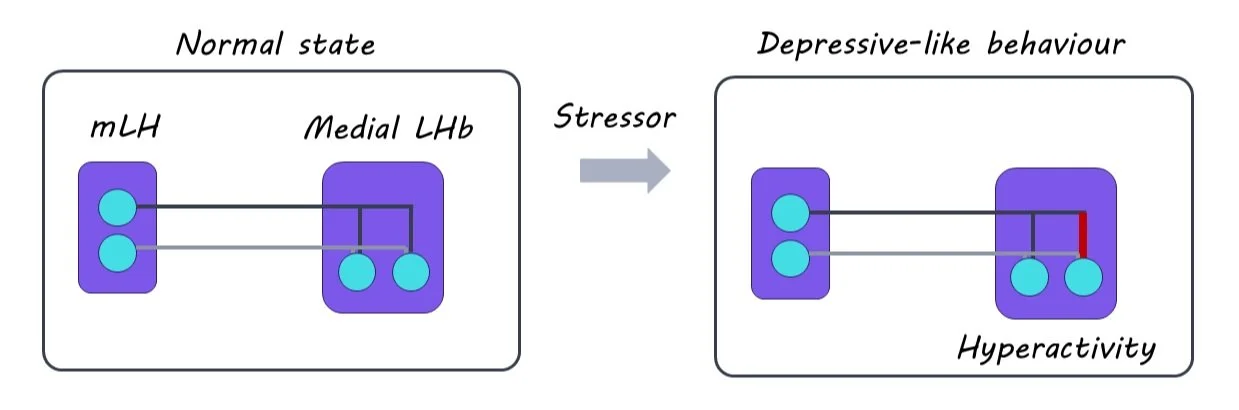
After exposing mice to stress the authors identified a small population of neurons in the LHb and the LH (10% and 5% respectively) that were activated and labeled via the RAM system as well as c-fos positive. In both the LH and the LHb the active cells localized to subregions, specifically the middle part of the lateral hypothalamus (mLH) and the medial part of the lateral habenula (LHbM). Chemogenetic inhibition of the stress-responsive mLH or the LHbM neurons during chronic stress stopped the development of depression-like behaviors in mice. Additionally, activating these neurons via photostimulation is sufficient to cause depression-like behaviors. These data suggest that both regions are required for the development of depression-like behaviors caused by chronic stress. Using optogenetics-assisted electrophysiology, the authors showed that the stress-responsive neurons in the mLH and LHbM formed dominant excitatory connections after one exposure to stress, and they are selectively potentiated during chronic stress. The authors termed these cells “starter cells”. LHbM starter cells propagate hyperactivity across the entire LHb via local excitatory connections. Finally, the authors visualized the progressive recruitment of LHb neurons over time due to chronic stress. Initially, very little fluorescence signified very few stress-induced neurons, but they gradually increased over time. This indicates that initially stress-irresponsive LHb neurons were gradually becoming responsive, and the intensity of this response increased over time. The LHb stress-responsive neurons were initially limited to the LHbM and gradually spread throughout the entire LHb. 
What's the impact?

This study identified a small population of stress-responsive neurons in subregions of the lateral hypothalamus (LH) and LH lateral habenula (LHb) that are critical for stress-induced depression-like behavior in mice. The authors identified and characterized a novel core functional unit within the larger LH-LHb circuit, further highlighting the importance of ensemble sparsity (a small number of functional cells within a larger ensemble) in various brain functions. Moreover, by identifying stress-responsive neurons, these data offer new insights into potential targets for antidepressant therapies.
Access the original scientific publication here. 

How Vesicles Shuttle Tau Filaments Throughout the Brain in Alzheimer's Disease

Post by Lila Metko

The takeaway

Many cell types, including neurons, release compartments called extracellular vesicles (EVs) for signaling and transportation. The cell’s transportation of tau, a protein that misfolds and propagates in Alzheimer’s disease, is carried out through these EVs. This research reveals that impairments in the function of lysosomes, organelles involved in breaking down cellular waste, may be involved in the association of tau with EVs and shows that tau filaments in EVs are short and tethered to their membranes. 

What's the science?

Tau is a protein that maintains the structural integrity of neurons in healthy individuals but becomes hyperphosphorylated, misfolded and aggregated in the brains of people with Alzheimer’s disease. Tau has a greater ability to seed new misfolded proteins when associated with EVs. It is unknown which types of tau associate with EVs, which EVs contain tau, and how tau associates with EVs. This November in Nature Neuroscience, Fowler and colleagues investigate how EVs shuttle tau throughout the brain. 

How did they do it?

The authors analyzed frontal and temporal lobe tissue that had been obtained from Alzheimer’s disease patients post-mortem. They separated the tissue using density gradient centrifugation, a type of analysis that separates molecules by density. This allows for the different subtypes of EVs to be separated into different fractions. The fractions were then analyzed by liquid chromatography-tandem mass spectrometry and immunoblotting to determine the protein content of the EV types. Additionally, they confirmed the ability of the EVs to seed further tau aggregation using cell culture and a transgenic mouse line, expressing human tau. Cryo-electron microscopy and Cryo-electron tomography were used to analyze the structure of the tau filaments found in the EVs. 

What did they find?

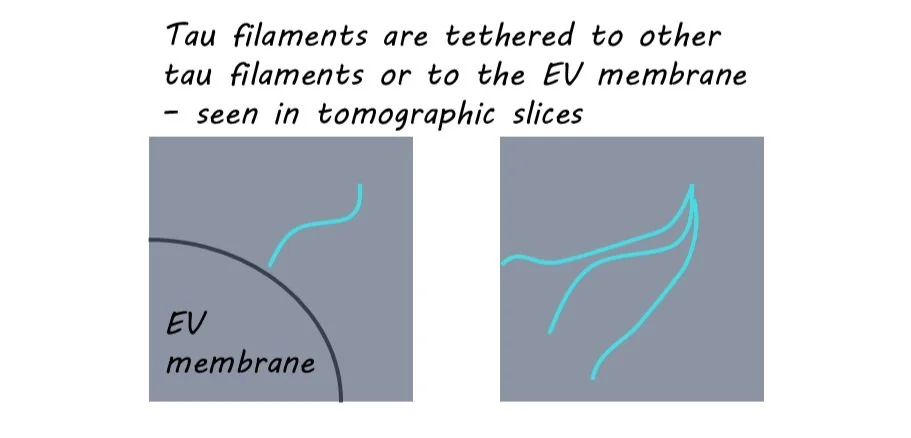
The authors found that only fractions 4-6, fractions with medium to high density, contained EVs with tau filaments and that these fractions also had the highest amount of lysosomal proteins. Further analysis showed that there were two types of tau filaments within the EVs, one with a symmetrical organization of its subcomponents and another with a non-symmetrical organization that was shorter than those found in neurofibrillary tangles (aggregated tau protein deposits seen in Alzheimer’s disease). Shorter tau filaments have a greater ability to seed tau assembly in animal models. The authors also found that tau filaments within EVs were either tethered to the EV membrane or tethered to a tau filament that was connected to the membrane. Additionally, these filaments were all tethered at their ends. This gives researchers insight into the tethering process of tau filaments to EVs and could potentially inform therapeutic interventions. 

What's the impact?

This research provides further insight into how tau filaments are transported out of the cell through EVs and propagate through the brain in Alzheimer’s disease. These findings can help us to develop therapeutics that target tau propagation. 

Access the original scientific publication here.

How Sleep Improves Behavioral Performance

Post by Laura Maile

The takeaway

Sleep is known to improve learning and memory, but the underlying neural mechanisms are not well understood. In the visual and prefrontal cortex of the brain, synchrony of neural network activity is decreased following sleep, which correlates with improved performance in visual tasks. 

What's the science?

Most previous research on how sleep improves learning and memory has been done in humans, where only non-invasive procedures like EEG are possible, or in rodents where studies have only investigated the influence of sleep on memory. 

This week in Science, Kharas and colleagues used multielectrode arrays inserted in the brain to record neuronal activity in macaques to see how sleep affects performance on behavioral tasks. The electrodes were inserted into specific brain areas to detect the changes in activity patterns across populations of neurons during behavioral tasks and sleep, offering the authors a more accurate view of non-rapid eye movement (NREM) sleep-related activity. Using macaque monkeys allowed them to observe performance in complex tasks than is possible with other non-human mammals.

How did they do it?

Five macaque monkeys were trained to complete visual discrimination tasks while experimenters recorded their brain activity. Monkeys then completed identical tasks before and after 30-minute rest periods, where their brain activity was continually monitored. NREM sleep was confirmed during rest periods using a polysomnogram (combination of electroencephalogram, eye movement, and muscle monitoring) and video analysis of their eyes and face. Multielectrode arrays, consisting of sets of multiple electrodes inserted into distinct areas of the visual cortex and prefrontal cortex, were used to measure neural activity during the tasks and the rest period. Local field potentials (LFP) were recorded, which allowed experimenters to detect neural activity across a population of neurons and analyze patterns of synchronized activity in specific frequency bands. Next, they replaced sleep with a 30-minute period of neural stimulation in the delta frequency, using the implanted electrodes in the V4 visual cortex. They repeated the neural activity analysis and the behavioral tasks before and after stimulation. Finally, they used network modeling of the visual cortex to model the observed changes in activity seen in the visual tasks following sleep. This allowed them to determine the likely cause of the observed changes in activity and synchrony that were associated with better performance. 

What did they find?

During the NREM phases of 30-minute sleep periods, LFP analysis of neuronal spiking activity showed decreased power in the gamma band and increased power in the low-frequency bands, especially the delta band, commonly associated with sleep. The increases in the delta band were associated with an increase in synchronization of neuronal firing in all tested brain areas. Performance in a visual discrimination task improved in monkeys after sleep and compared to control monkeys that sat in a dark room but were not allowed to sleep. Neural activity of the sampled population of neurons became desynchronized after sleep in all recorded areas and noise correlation decreased after sleep. Neural firing increased in all brain areas during the task after sleep but remained unchanged in monkeys that did not sleep. 

Importantly, the observed changes in synchronized activity and neural firing were correlated to improved performance in behavioral tasks. They found that by stimulating V4 visual cortex in the delta frequency while the animal was awake, they were able to achieve similar effects on neural firing, synchrony of activity, and behavioral performance that occurred due to sleep. This suggests that the increase in synchronized activity seen during sleep leads to reduced synchrony during tasks completed after sleep, allowing increased accuracy of system activity and improved task performance. Finally, the authors’ network models revealed that depression of inhibitory synapses likely accounts for the observed changes in neural population activity seen during the behavioral task after sleep. This suggests that the improvements in the discrimination task may be due to a net increase in excitatory synaptic activity between cortical neurons.

What's the impact?

This study found that activity across neural networks in the visual and prefrontal cortex becomes more synchronized during sleep, but less synchronized after sleep. This decrease in synchrony is associated with increased firing and improved performance in visual discrimination tasks. This study was also the first to demonstrate successful invasive electrode stimulation of distinct brain areas to improve performance in behavioral tasks, which could lead to future improvements in brain neuromodulation in humans. 

Access the original scientific publication here.