Sleep Loss Has Long-Lasting Consequences On Memory Processes in the Hippocampus

Post by Trisha Vaidyanathan

The takeaway

It is well-known that sleep loss hurts our memory, but it is not known how sleep loss affects memory processes in the brain. This study found that sleep loss prevents the hippocampus from “reactivating and replaying” memories, impairing the process of memory consolidation.

What's the science?

Many studies have demonstrated that the hippocampus is critical for promoting memory during sleep. When a rat runs through a maze, a specific subset of hippocampal neurons is activated and will then “reactivate” during sleep. Further, the order in which neurons activate in the maze will “replay” in the same order during sleep. This “reactivation” and “replay” process allows the brain to transfer the memory to other brain regions for long-term storage, a process called memory consolidation. Just as sleep promotes memory, it’s known that sleep loss can impair memory. However, it’s not known how sleep loss impacts hippocampal memory processes. This week in Nature, Giri and colleagues demonstrated that sleep loss diminishes the ability of the hippocampus to reactivate and replay memories and that these processes are not fully restored, even after recovery from sleep loss. 

How did they do it?

To study memory processes in the hippocampus, the authors used extracellular electrophysiology to record continuous activity from over 800 neurons in the hippocampus of rats. There were three phases of the experiment: First, the rats were able to sleep or rest naturally. Second, the rats explored a new maze for one hour. Third, the rats were either allowed to sleep naturally for 9 hours, or they were sleep deprived for 5 hours, followed by 4 hours of “recovery sleep”.

The authors first investigated how sleep loss impacted sharp-wave ripples, a type of neuronal oscillation known to drive reactivation and replay, and neuronal firing rates. Next, the authors used the neuronal activity recorded during the maze to study how sleep loss impacted hippocampal reactivations and replay. Reactivation was measured by assessing how links between neurons (using pairwise correlation) observed during the maze were similar to the links between neurons observed during subsequent sleep or sleep deprivation. Replay was measured by examining what proportion of the sharp-wave ripples observed after the maze contained neuronal firing patterns that could be used to accurately decode where the rat moved when it was in the maze.

What did they find?

First, the authors analyzed the neuronal recordings for sharp-wave ripples and found that while the rate of ripples decreased over natural sleep, the rate remained elevated during sleep deprivation. However, the sharp-wave ripples had a higher frequency and smaller amplitude than those in natural sleep. Neuronal firing rate also decreased during natural sleep and remained elevated during sleep deprivation. However, when the rats were allowed recovery sleep after sleep deprivation, the ripples and neuronal firing rate recovered to normal levels. 

Next, the authors examined reactivation events. After exploring the maze, rats that were allowed natural sleep exhibited hours of reactivation, while rats that were sleep-deprived had virtually no reactivation. Surprisingly, unlike the sharp-wave ripple rate, reactivations did not return to normal levels during the recovery sleep that followed sleep deprivation. 

Lastly, the authors tested the effect of sleep loss on replay events. As expected from the literature, a high proportion of sharp-wave ripples contained replay events in rats that were allowed to sleep naturally. Rats that were sleep-deprived, however, had significantly fewer replay events. Strikingly, the replay events continued to decrease even during the recovery sleep period. 

Together, the results from this study demonstrated that even though sharp-wave ripples appear to return to normal after recovery from sleep loss, the critical memory processes of reactivation and replay did not, suggesting long-term consequences of sleep loss on memory.

What's the impact?

Sleep loss is highly prevalent in our society and sleep disorders like insomnia are co-morbid with many other diseases. Many functions of sleep are known to return to normal levels following sufficient recovery sleep, but this study demonstrates why the effect of sleep loss on memory may be long-lasting.  
The Impact of Stress and Anxiety on Eating Disorders

Post by Baldomero B. Ramirez Cantu

The takeaway

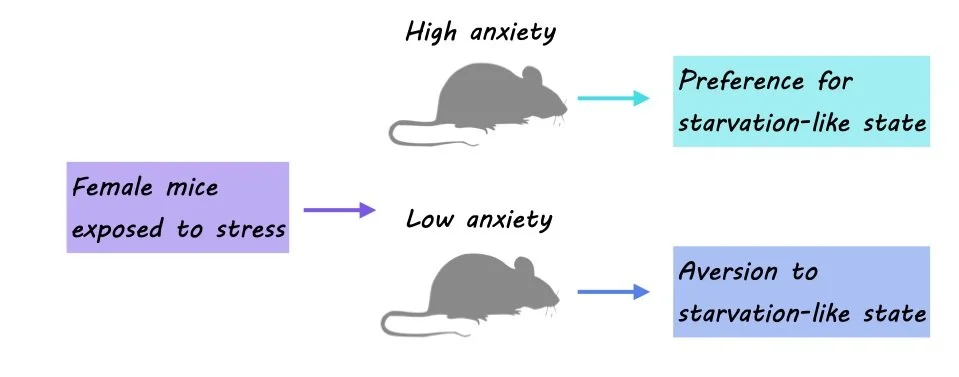
Stress causes anxiety-prone female mice to prefer a starvation-like state highlighting the potential neural mechanisms linking stress, anxiety and anorexia nervosa.

What's the science?

Eating disorders, such as anorexia nervosa, are severe psychiatric conditions marked by self-imposed starvation. Despite their complex etiology, characterized by a combination of genetic, environmental, and psychological factors, effective treatments remain limited. Experimental models in rodents have provided insights into underlying neural mechanisms but often fail to capture the crucial aspect of volitional starvation seen in patients. In a recent study published in Neuron, Kucukdereli et al., investigated how repeated stress influences the voluntary seeking of a starvation-like state in mice. Their findings offer an insight into the role of stress-induced anxiety in driving behaviors akin to anorexia nervosa.

How did they do it?

To investigate the role of stress in voluntary seeking of a starvation-like state, researchers developed a virtual reality (VR) real-time place preference protocol for head-fixed mice. Male and female mice were then exposed to two distinct virtual corridors paired with either optogenetic stimulation of agouti-related peptide (AgRP) hypothalamic neurons or a neutral outcome.

Optogenetic stimulation was achieved using a transgenic approach, involving the expression of light-activated channelrhodopsin (ChR2) in AgRP neurons, activated via an optic fiber placed above the arcuate nucleus

The experimental VR protocol included conditioning sessions where mice were alternately exposed to the stimulation or neutral corridor, followed by real-time place preference sessions where mice were allowed to choose between the two corridors. To test the hypothesis that stress influences AgRP neuron stimulation preference, researchers introduced repeated stressors by delivering unpredictable tail shocks during conditioning sessions.

Anxiety-like behavior was assessed using open-field tests (OFTs) before and after the stress exposure sessions to confirm effective stress induction. A preference index was calculated based on the duration mice dwelled in the stimulation corridor, excluding bouts of locomotion. Additionally, elevated plus maze (EPM) assays were conducted before the experiments to measure baseline anxiety levels, helping to identify any pre-existing stress-related traits in the mice. 

What did they find?

Before stress exposure, male mice generally exhibited a mild aversion to AgRP neuron stimulation, suggesting that the induced starvation-like state was aversive. Female mice showed no consistent preference or aversion to AgRP stimulation, with individual responses varying.

Following repeated stress exposure through unpredictable tail shocks during conditioning sessions, female mice displayed significant changes in behavior. A subset of females developed a strong preference for AgRP stimulation, actively seeking the starvation-like state, while others exhibited increased aversion. In contrast, male mice showed a reduction in aversion to AgRP stimulation but did not develop a preference for it.

Analysis of baseline anxiety levels, measured using the EPM assay, revealed that female mice with higher anxiety scores were more likely to prefer AgRP stimulation after stress exposure. This correlation was not observed in male mice, indicating that predisposition to anxiety significantly influenced the behavioral response to stress in females.

These results demonstrate a pronounced sex difference in how stress affects the seeking of a starvation-like state, with female mice showing more variability based on their anxiety levels. This suggests that individual susceptibility to stress-induced anxiety plays a crucial role in behaviors associated with conditions such as anorexia nervosa.

What's the impact?

This research provides valuable insights into the complex interplay between stress, anxiety, and behaviors resembling those seen in anorexia nervosa. These findings may inform future studies on the neurobiological mechanisms underlying eating disorders and potentially guide the development of targeted pharmacological and behavioral interventions that consider stress management and anxiety reduction strategies

Access the original scientific publication here. 

How Psychedelics Alter Visual Perception

Post by Annie Phan

The takeaway

Psychedelics, such as psilocybin, can alter visual perception, even when the eyes are closed. This phenomenon can be explained by inhibiting connectivity and reducing sensitivity in regions related to vision, leading to disruptions in visual connectivity and the serotonergic system.    

What's the science?

Psychedelics allow researchers to study visual alterations, similar to hallucinations that occur in clinical disorders like schizophrenia. Previous preclinical research has shown the relevance of the serotonergic system in changing synapses under psychedelics. This week in Molecular Psychiatry, Stoliker and colleagues used functional MRI to investigate how psilocybin, a psychedelic drug, produces changes in the connectivity of the human visual system, leading to hallucinations.

How did they do it?

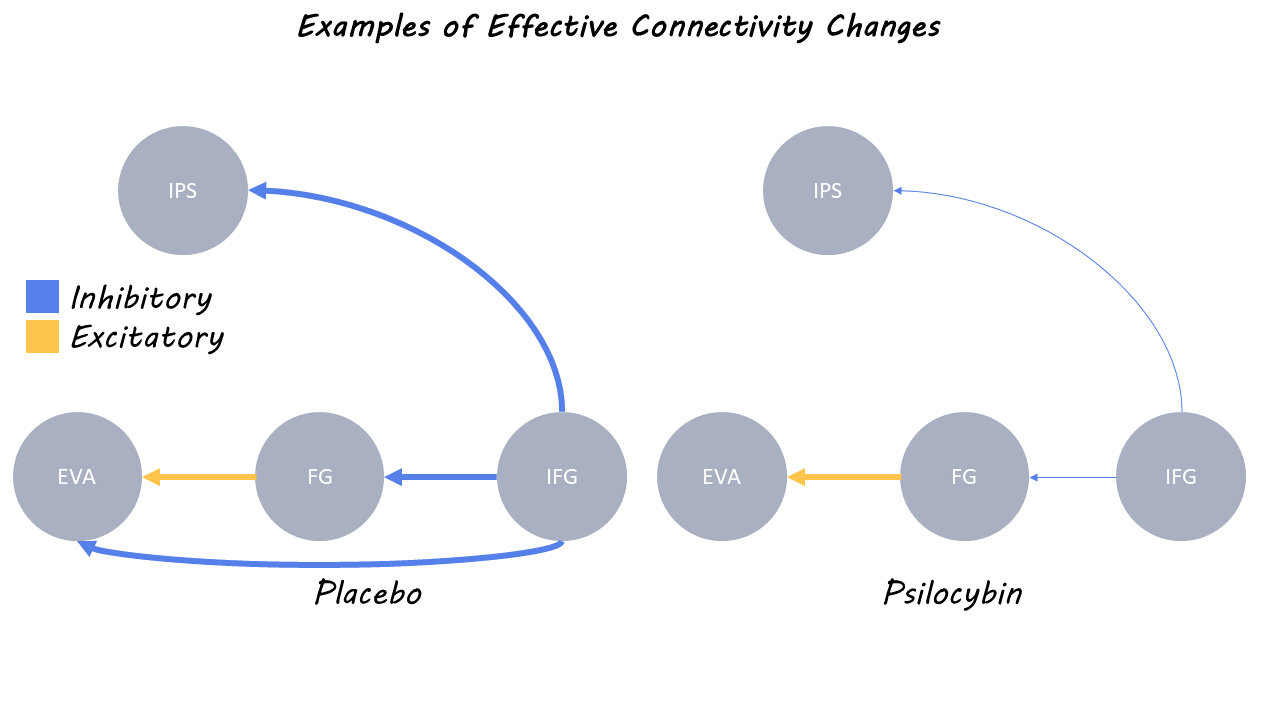
On 2 different occasions at least 2 weeks apart, participants were scanned with an MRI machine to acquire brain activity 20, 40, and 70 minutes after receiving psilocybin or placebo. During the scan, participants had their eyes closed while resting. Immediately after the scan, participants answered a questionnaire about their state of consciousness. The brain regions (Early visual area, Fusiform gyrus, Intraparietal sulcus, and Inferior frontal gyrus) that the authors studied were based on previous research findings. To study the circuits, the authors used Dynamic Causal Modelling to measure the inhibition or excitation of connections as described by effective connectivity (EC) and self-connectivity, allowing inferences of synaptic activity. 

What did they find?

The authors modeled the mean EC after administration of the placebo, the change in EC from placebo to psilocybin, and the mean EC after administration of psilocybin. They found a general trend of effective connectivity under psilocybin between the regions of interest showing reduced inhibition. These results further explain previous studies suggesting reduced reception of sensory signals. Under psilocybin, the effective connectivity of the human visual system reflects decreased sensitivity of the brain regions to sensory inputs. Therefore, psilocybin-induced visual alterations involve inhibition of the inputs from brain regions in the visual system and reduction of connectivity between those regions. 

What's the impact?

These findings further explain previous preclinical research on the serotonergic system and the inhibition of visual regions during clinical hallucinations and visual imagery. Overall, these findings contribute to a better understanding of visual imagery without external sensory input, which can be applicable in the context of psychiatric disorders, brain injury, sleep, and dreams.

Access the original scientific publication here.